Economics: record output, tiny farms, underfunded research
The paradox of 2025-2026 comes down to two figures. USDA estimated 2025/26 world production at a record 178.8 million bags (+2%), and consumption at 173.9 million (+1.3%).
The records then followed one another. In June 2026, USDA raised the 2026/27 Brazilian harvest to a record 71.9 million bags, of which 47.5 of arabica, after five years of climatic underperformance. Vietnam follows with a record of 32.5 million, obtained through rising acreage and through fertilizers that high prices made it possible to pay for.
And meanwhile, the reserves are draining. ICE certified stocks, that is, the stored and inspected coffee that the exchange accepts as deliverable, fell on August 31, 2026 to 223,976 bags. That is the lowest in twenty-seven years.
The market is therefore producing volume records with empty reserves. Nothing cushions an accident anymore. And an El Niño given an 82% probability for May-July 2026 is enough to make the September flowering, which is triggered by rain, tremble.
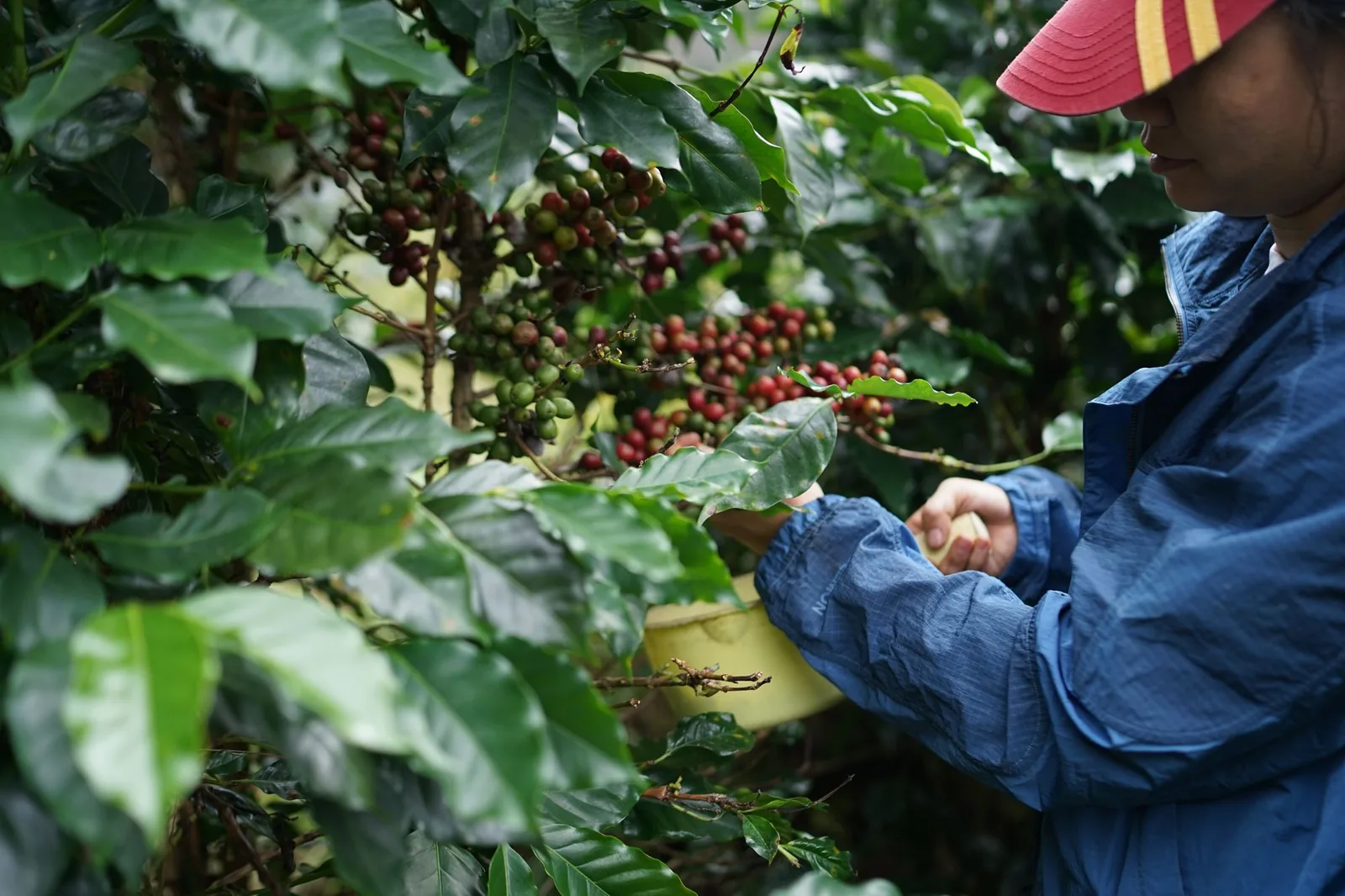
USDA FAS, Coffee: World Markets and Trade, June 2025 and June 2026, apps.fas.usda.gov/psdonline/circulars/coffee.pdf; Trading Economics, arabica, Sept. 4, 2026; StoneX, June 5, 2026Those who produce are the least equipped. Enveritas estimated in 2019, before the ICO statistics committee, the number of coffee farms at 12.5 million. ITC specifies that 95% of them are under five hectares, and ICO holds that 125 million people live from coffee.
| Indicator | Value | Source |
|---|---|---|
| Coffee farms | 12.5 million, 95% under 5 ha | Enveritas / ICO 2019; ITC |
| People living from coffee | 125 million | ICO |
| World production 2025/26 | 178.8M bags (record) | USDA, June 2025 |
| Brazil 2026/27 | 71.9M bags (record), 47.5 arabica | USDA, June 2026 |
| Vietnam 2026/27 | 32.5M bags (record) | USDA, June 2026 |
| Canephora share | ~40% (25% around 1990) | USITC |
| Arabica, peak | $4.41/lb, February 2025 | ICE / PDG |
| Arabica, Sept. 4, 2026 | 295.6 cents/lb | Trading Economics |
| ICE stocks, Aug. 31, 2026 | 223,976 bags, lowest in 27 years | Trading Economics |
| Coffee agronomic research | $115M/yr; need +$452M | WCR, June 2023 |
| Coffea species | 130 described, 2 cultivated, 75 threatened out of 124 evaluated | Davis 2019, 2021 |
| CATIE collection | ~2,000 accessions, 23 species, 5% duplicated | Crop Trust 2019 |
These farms are aging. The average age of a coffee grower exceeds fifty according to the ICO toolkit, and reaches 54 in Mexico according to the March 2025 value chain study.
They also have no access to the tools that protect against price. Hedging on the exchange requires an account and margin calls, that is, money to be paid in as long as the market moves against oneself. A family with two hectares does not have that cash.
Research, for its part, lags. WCR put worldwide investment in agronomic research on coffee in southern countries at 115 million dollars a year in June 2023, 90% of it public. That is 1.8% of the agricultural research of the 45 countries studied, whereas green coffee accounts for 4.8% of the value of production. The additional need is estimated at 452 million a year.
Yields tell the story. Outside Brazil, Vietnam and Colombia, productivity stagnates or declines.
The system capable of putting the genetics of 2025 in the hands of a two-hectare farm is weaker than in 1975.
Enveritas, presentation to the ICO Statistics Committee, 2019, ico.org; ITC, Coffee Exporter's Guide (LC ch. 18); ICO, Market Development Toolkit, “Youth in coffee”; ICO, Mexico Coffee Value Chain Study, March 2025; WCR, “Coffee's innovation crisis”, June 2023, worldcoffeeresearch.org; LC ch. 16 and 18Index-based climate insurance is the financial response offered to these farms. The principle removes the need for expert assessment. Rather than going to see the damage plot by plot, payment is made automatically as soon as a measured index crosses a threshold. The index can be cumulative rainfall from a station or a satellite, a temperature, a vegetation index.
The advantage is twofold. The cost of assessment disappears, and so does the risk of fraud, since the trigger is an outside measurement that neither the insured nor the insurer produces.
The flaw has a name: basis risk. The farm can lose its harvest without the index triggering. Or the reverse, collect without having lost anything.
Programs exist, on a small scale. Blue Marble reports more than 5,100 coffee growers compensated in Murang'a County, Kenya, after extreme events of the 2025-2026 season. Payouts to Colombian producers were reinvested in fertilizer, and a parametric product for small Indonesian producers was announced on August 6, 2026.
Other schemes are older. According to the CCAFS 2015 assessment, ACRE covered nearly 200,000 farmers in East Africa, all crops combined. The R4 program covered 20,000, in Ethiopia and Senegal.
What are those concerned prepared to pay? A survey interviewed 151 coffee growers in Lam Dong and Dak Lak (International Journal of Disaster Risk Reduction, 2023). It puts their willingness to pay at 92.30 dollars per policy on average. They ask first for drought cover in the three months after flowering (February-April).
The 2018 Kenyan study points to what blocks uptake. The contracts remain poorly suited to small farms. And transparency about the rainfall thresholds would increase subscription: a grower does not pay for a rule he cannot verify.
That leaves the order of magnitude. Set against the 12.5 million farms, coverage today is on the order of one thousandth.
Blue Marble, bluemarblemicro.com, press releases of August 6 and 12, 2026; CCAFS 2015, “Scaling up index insurance for smallholder farmers”; Int. J. Disaster Risk Reduction 2023, “Are Vietnamese coffee farmers willing to pay for weather index insurance?”; Agriculture & Food Security 2018 (Kenya)In this plateThe 17 sections
- 01The specifications of an understory plant
- 02What the climate is already doing: rust, frost, drought
- 03What the models forecast for 2050
- 04First answer: go up, shade, irrigate
- 05Mechanizing: what the machine compensates for, and where it cannot go
- 06Second answer: F1 hybrids and the industrialization of breeding
- 07Third answer: reading, then editing genomes
- 08What happens under the tree
- 09The reserve of forgotten species
- 10Canephora as the future, and its limits
- 11What remains to be saved: 60% of species threatened
- 12Gene banks: a plantation, not a vault
- 13Economics: record output, tiny farms, underfunded research
- 14Regulation: the European deforestation regulation
- 15Demand: Asia, specialty coffee, coffee without the bean
- 16What we still do not know
- 17Today (September 2026)
The table of contents, with the first sentence of each section