Mechanizing: what the machine compensates for, and where it cannot go
- 2008-2013Return of rust in Latin America; Colombia -33%, El Salvador -57%, 373,585 workers displaced
- 2015Bunn et al.: -50% suitable area in 2050
- 2017Moat and Davis: resilience of Ethiopian coffee; Crop Trust conservation report
- 2018December: a stenophylla plant found at Kasewe (Sierra Leone)
- 2019Davis et al.: 60% of 124 Coffea species threatened; Starmaya available as seed
- 2021Brazilian frost (June 30, July 20 and 30); stenophylla in a panel (81% “arabica”); six Malagasy species described
- 2023May 31: Regulation (EU) 2023/1115 adopted; WCR puts the research deficit at $452M a year
- 2024April: arabica genome (Nature Genetics); Brazilian and Vietnamese drought; August: two rust races on Catimor in Peru
- 2025February: arabica at $4.41/lb, a record; March: stenophylla chemistry (npj Sci. Food); USDA: record world production of 178.8M bags
- 2026February: I-CIP at 267.57 cents; March 30: Rabobank report; May 4: EUDR simplification report; December 30: entry into application
In hand-picked coffee, harvest is the heaviest item in the cost of production. It makes sense: one has to go back over the same tree several times, cherry by cherry, to take only the ripe ones.
And this seasonal labor is lacking in almost every producing country, as young people leave the countryside.
The problem is not new. Thurber was already writing in 1881, about Brazil, that the machine was “a new demonstration of the power of machinery to compensate for an insufficiency of labor”.
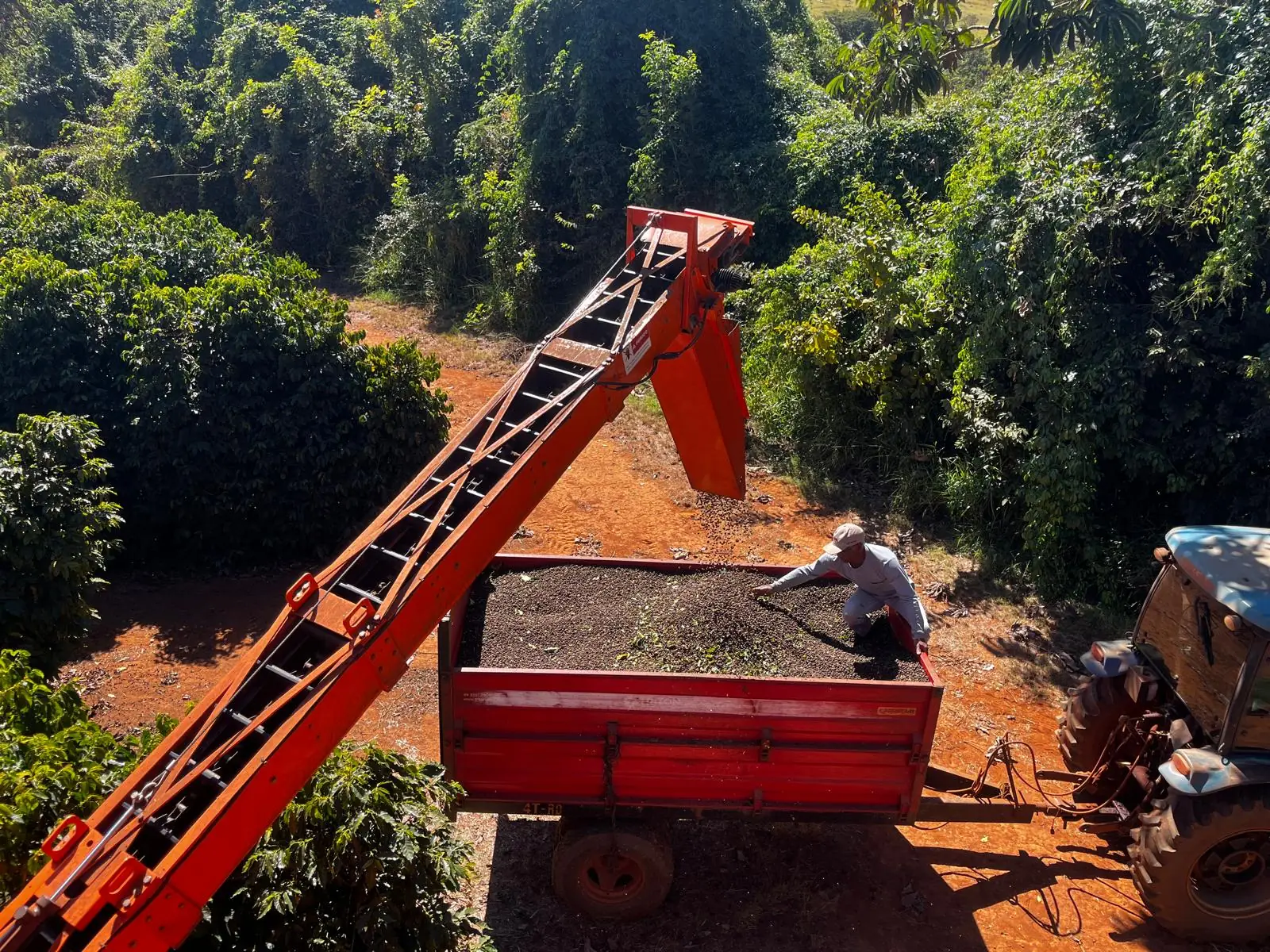
The Brazilian trajectory has not deviated an inch since. In the Cerrado Mineiro and southern Minas, orchards are no longer planted according to the terrain but according to the machine: in straight lines, or in circles around irrigation pivots, to let self-propelled harvesters pass, whose vibrators shake the cherries onto conveyor belts. The landscape has been redrawn around the tool.
Two studies measure what this yields. A Ciência Rural study (2012), conducted in Patos de Minas, evaluates the quality of mechanized harvesting in circular planting according to vibration frequency. And a survey published in the International Food and Agribusiness Management Review (2018) of 105 Brazilian producers describes three possible arrangements: owning the machine, subcontracting the harvest, or partial integration. The choice depends on transaction costs and farm size, not on the taste of the coffee.
Thurber 1881, Coffee: from Plantation to Cup (LC ch. 9 and 11); Ciência Rural 2012, “Quality of mechanized coffee harvesting in circular planting system”; Int. Food Agribus. Manag. Rev. 2018, “Make or buy: the case of harvesting mechanization in coffee crop in Brazil”The advantages are speed, lower unit cost and independence from a labor force that is no longer there. The three hold together: the machine replaces exactly the most expensive and hardest-to-fill item.
The drawbacks are of four kinds.
- Selectivitya vibrating harvester shakes down green cherries along with ripe ones, which requires sorting downstream and penalizes processes that demand uniform ripeness.
- Terrainit depends on flat topography and regular rows, which rules out sloping plantations from the start.
- Capitalthe machine ties up money that works only during the harvest.
- Soilrepeated passes compact the soil, and compacted soil lets water and roots in less well.
That is why mechanization draws the reverse of the specialty map. It is established on the Brazilian plateaus and partly in Vietnam. It remains marginal on the slopes of Colombia, Central America, Kenya or Ethiopia.
The reason there is also one of scale: 95% of farms under five hectares would have neither the area nor the cash for a machine anyway.
The real answer at this scale exists, but it is small: portable vibrating combs, foot-pedal pulpers, solar dryers. No global statistic measures their spread, which means we do not know how many farms have already equipped themselves.
Int. Food Agribus. Manag. Rev. 2018; ITC (95% of farms under 5 ha, LC ch. 18); LC ch. 11In this plateThe 17 sections
- 01The specifications of an understory plant
- 02What the climate is already doing: rust, frost, drought
- 03What the models forecast for 2050
- 04First answer: go up, shade, irrigate
- 05Mechanizing: what the machine compensates for, and where it cannot go
- 06Second answer: F1 hybrids and the industrialization of breeding
- 07Third answer: reading, then editing genomes
- 08What happens under the tree
- 09The reserve of forgotten species
- 10Canephora as the future, and its limits
- 11What remains to be saved: 60% of species threatened
- 12Gene banks: a plantation, not a vault
- 13Economics: record output, tiny farms, underfunded research
- 14Regulation: the European deforestation regulation
- 15Demand: Asia, specialty coffee, coffee without the bean
- 16What we still do not know
- 17Today (September 2026)
The table of contents, with the first sentence of each section