What happens under the tree
What happens under a coffee plant, and how far up does it go?
Start the scene or choose a stage. The animation simplifies the mechanism; what follows gives the details and the available references.
Half of the coffee plant is underground. Alone, the root goes looking for water and phosphorus only where it grows.
Read the stages without animation
- The root aloneHalf of the coffee plant is underground. Alone, the root goes looking for water and phosphorus only where it grows.
- The fungus-rootFungi colonize the roots and extend their reach well beyond: these are mycorrhizae, literally “fungus-root”. The fungus brings back water and phosphorus, and receives in exchange sugars made by the leaf. It is a trade four hundred million years old.
- Counting under real coffee plantsIn 2023, a thesis sampled soils, roots and fruits under three systems in the Maciço de Baturité, in Ceará: a wild coffee, a system being converted to syntropy, a conventional agroforestry one. Spores, colonization, soil DNA: 81 distinct sequences.
- More plants, more sporesThe greater the plant diversity, the more the roots are colonized, the more spores there are and the richer the fungal community. The syntropic system, the most diversified, carries the most species.
- Up to the cherryThe two most diversified systems also have the best sensory scores, a correlation and not a cause. A 2024 review supplies the missing link: the fruit's microbiota comes in part from the soil, and it is still there when fermentation begins.
To remember: What lives under the coffee plant does not stay under the coffee plant: it rises into the cherry.
Read the full article and its sources ↓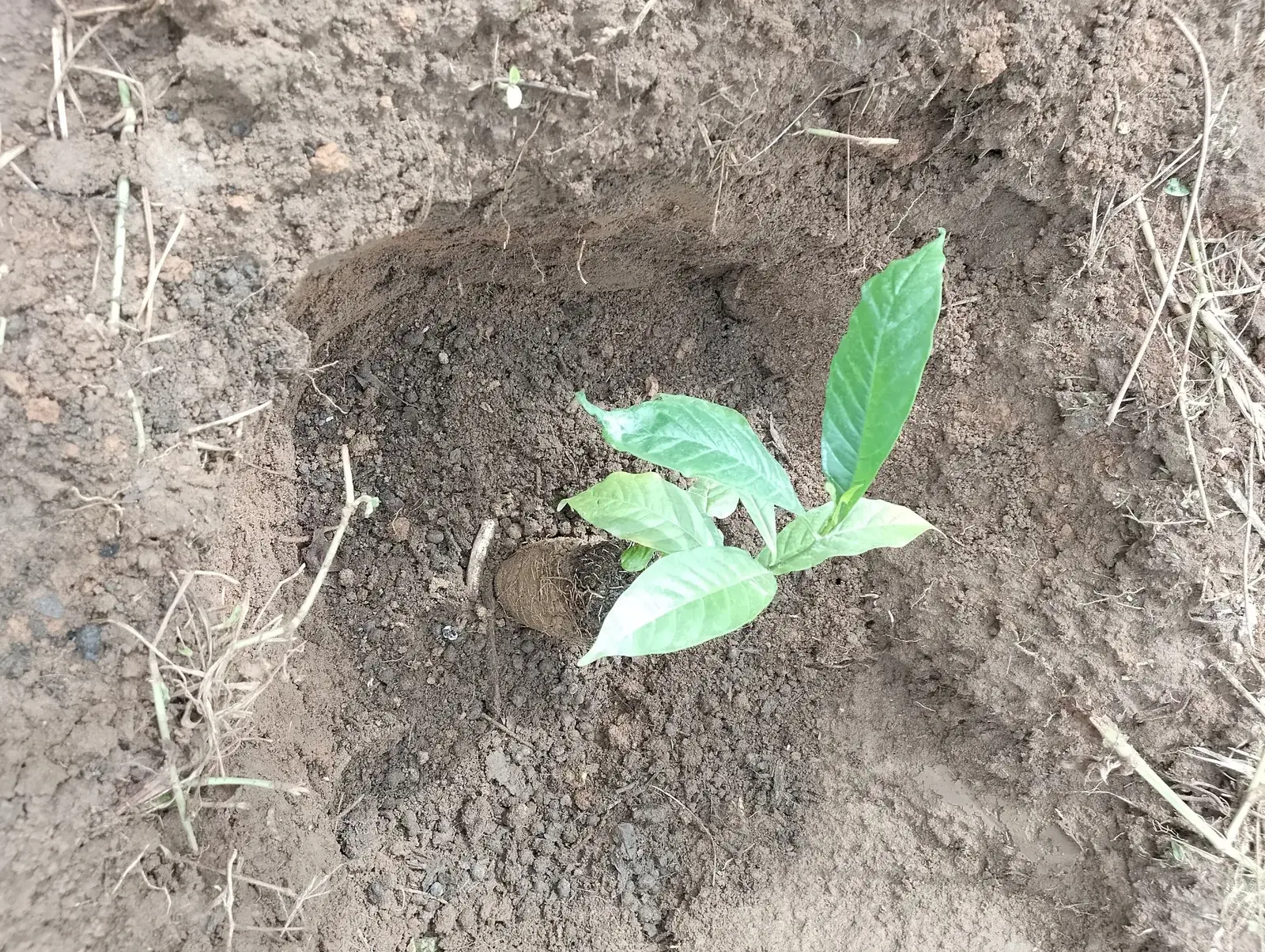
This plate talks about shade, altitude, irrigation, varieties. It talks about everything that is above ground. Yet half of the coffee plant is below, and nothing has been said about it.
A coffee plant's roots do not work alone. Fungi colonize them and extend their reach well beyond what they reach: these are mycorrhizae, literally “fungus-root”. The fungus goes looking for water and phosphorus where the root does not go, and receives in exchange sugars made by the leaf. It is a trade, and it is four hundred million years old.
A 2023 thesis went to count them under real coffee plants. Eloisio de Oliveira Martins, at the Federal Institute of Espírito Santo, sampled soils, roots and fruits in three agroforestry systems of the Maciço de Baturité, in Ceará: a coffee in wild plantation, a system being converted to syntropy, and a conventional agroforestry system. Spore counts, colonization rates, extraction and sequencing of the DNA of soil fungi. Eighty-one distinct sequences identified.
The central result fits in one sentence: the greater and more evenly distributed the plant diversity of the system, the more the coffee roots are colonized, the more spores there are, and the richer and more diverse the fungal community. The syntropic system, the most diversified, carries the largest number of total species and of species found only there.
The soil variables that drive this community are those of an ordinary agronomic analysis: cation exchange capacity, sum of bases, base saturation, potential acidity, magnesium, calcium, organic matter.
And one last result, which must be given with its caution. The two most diversified systems, the syntropic and the wild, are also the ones that obtained the best sensory scores. Three plots in a single region do not make a law, and a correlation is not a cause. But the hypothesis is on the table, and it can be tested.
It remains to see how what happens under the tree could reach the cup. A 2024 review, signed by Gisele Xavier Ribeiro Costa at the Federal University of Uberlândia, supplies the missing link: the fruit's microbiota comes in part from the soil. The two share microorganisms. What lives under the coffee plant does not stay under the coffee plant: it rises into the cherry, and it is still there when fermentation begins.
Martins, Cafés cultivados em sistemas agroflorestais e seus condicionantes de qualidade química, sensorial e dos fungos micorrízicos arbusculares na região do Maciço do Baturité, Ceará, master's thesis in agroecology, Instituto Federal do Espírito Santo, Alegre, 2023 (advisor Lucas Louzada Pereira); Costa, Processos de fermentação e suas influências na qualidade do café (Coffea arabica), master's thesis in food engineering, Universidade Federal de Uberlândia, 2024, DOI 10.14393/ufu.di.2024.57 (literature review)In this plateThe 17 sections
- 01The specifications of an understory plant
- 02What the climate is already doing: rust, frost, drought
- 03What the models forecast for 2050
- 04First answer: go up, shade, irrigate
- 05Mechanizing: what the machine compensates for, and where it cannot go
- 06Second answer: F1 hybrids and the industrialization of breeding
- 07Third answer: reading, then editing genomes
- 08What happens under the tree
- 09The reserve of forgotten species
- 10Canephora as the future, and its limits
- 11What remains to be saved: 60% of species threatened
- 12Gene banks: a plantation, not a vault
- 13Economics: record output, tiny farms, underfunded research
- 14Regulation: the European deforestation regulation
- 15Demand: Asia, specialty coffee, coffee without the bean
- 16What we still do not know
- 17Today (September 2026)
The table of contents, with the first sentence of each section