What remains to be saved: 60% of species threatened
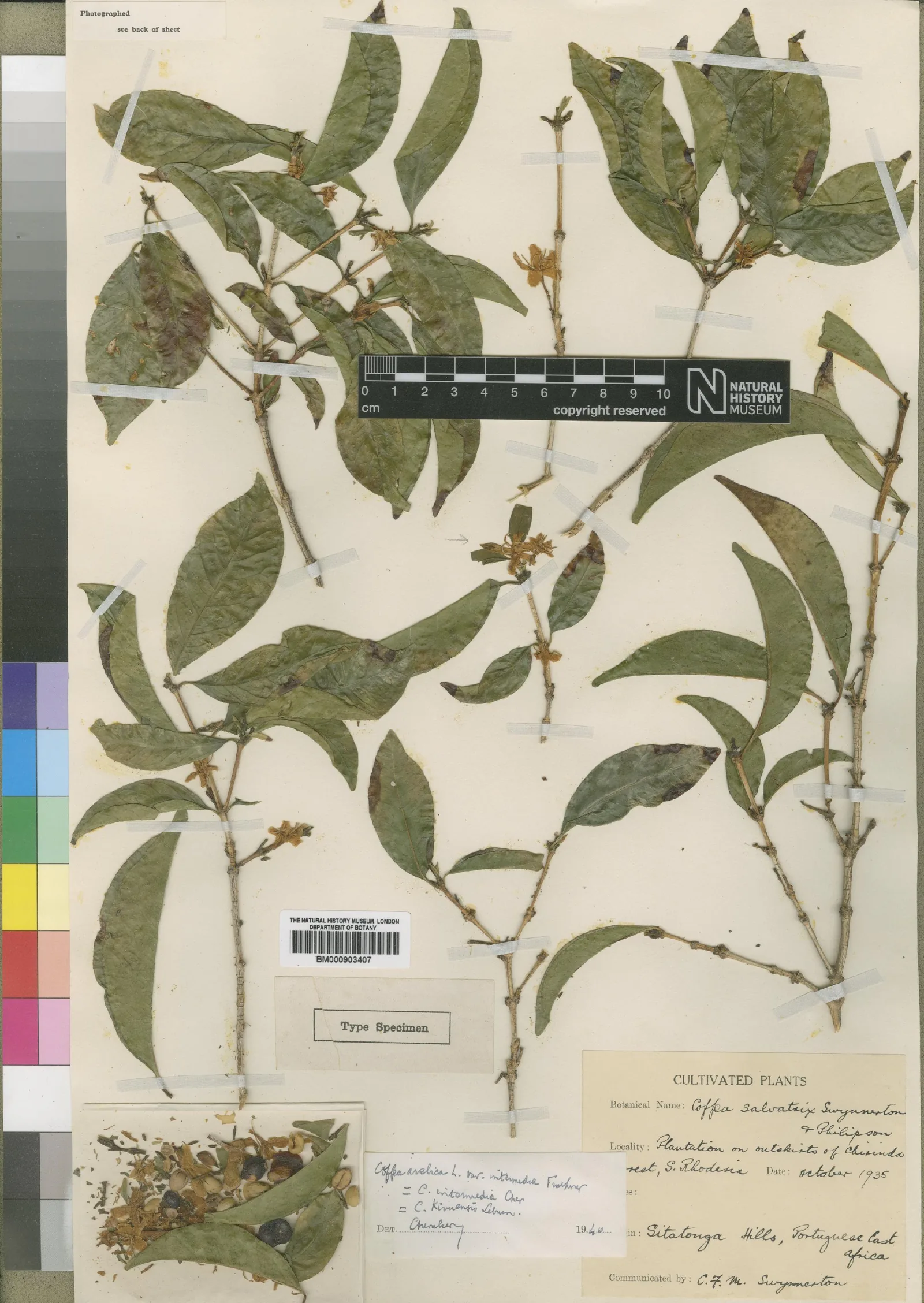
In January 2019, Aaron Davis's team (Kew) applied the IUCN Red List criteria for the first time to all of the 124 wild Coffea species then known (Science Advances). Result: 75 species, or 60%, are threatened with extinction, of which 13 are critically endangered, 40 endangered and 22 vulnerable; 35 are not threatened; 14 are classed “data deficient”. The world average for all plants is 22%; wild tea (Camellia) is at 45.4%, mango at 52.4%, only the Malagasy palms Dypsis do worse (73.8%). Madagascar holds 43 threatened species (72% of its own), Tanzania 12 (71%). Nine of the fourteen data-deficient species have not been reviewed since 1940; five Asian species (C. cochinchinensis, C. floresiana, C. fragrans, C. horsfieldiana, C. malabarica) are known only from three herbarium specimens or fewer, all earlier than 1900, and may be extinct; three Angolan species cannot be found for lack of access to the field. The six Malagasy species and the Cameroonian species described since have not been evaluated: 60% is a floor.
Davis et al. 2019, Science Advances 5(1), eaav3473, pp. 1-3 and fig. 1; LC ch. 4 and 21Wild arabica itself is classed “endangered”, and how it got there is the most troubling fact in the article: assessed on the usual criteria, it comes out as “least concern”; once climate projections are built in, it jumps three categories. It is not the state of the plant that has changed, it is the horizon of the calculation. Of the forest area that the species could occupy in Ethiopia and South Sudan, about 4% (1,681 km²) is in protected areas.
The authors describe the genus as “sensitive to extinction” for five traits: narrow climatic niches, low adaptive potential, dependence on forest, poor regeneration, and near-universal self-incompatibility, which means that a fragmented population stops having offspring before it dies. Arabica, more than 90% self-fertile according to Coste, is the exception that allowed a single plant to found entire coffee-growing regions, and that left it genetically poor.
Davis et al. 2019, pp. 3-5; Moat, Gole & Davis 2019, Global Change Biology 25, “Least concern to endangered”, doi 10.1111/gcb.14341; Coste 1955; LC ch. 21In this plateThe 17 sections
- 01The specifications of an understory plant
- 02What the climate is already doing: rust, frost, drought
- 03What the models forecast for 2050
- 04First answer: go up, shade, irrigate
- 05Mechanizing: what the machine compensates for, and where it cannot go
- 06Second answer: F1 hybrids and the industrialization of breeding
- 07Third answer: reading, then editing genomes
- 08What happens under the tree
- 09The reserve of forgotten species
- 10Canephora as the future, and its limits
- 11What remains to be saved: 60% of species threatened
- 12Gene banks: a plantation, not a vault
- 13Economics: record output, tiny farms, underfunded research
- 14Regulation: the European deforestation regulation
- 15Demand: Asia, specialty coffee, coffee without the bean
- 16What we still do not know
- 17Today (September 2026)
The table of contents, with the first sentence of each section