Canephora as the future, and its limits
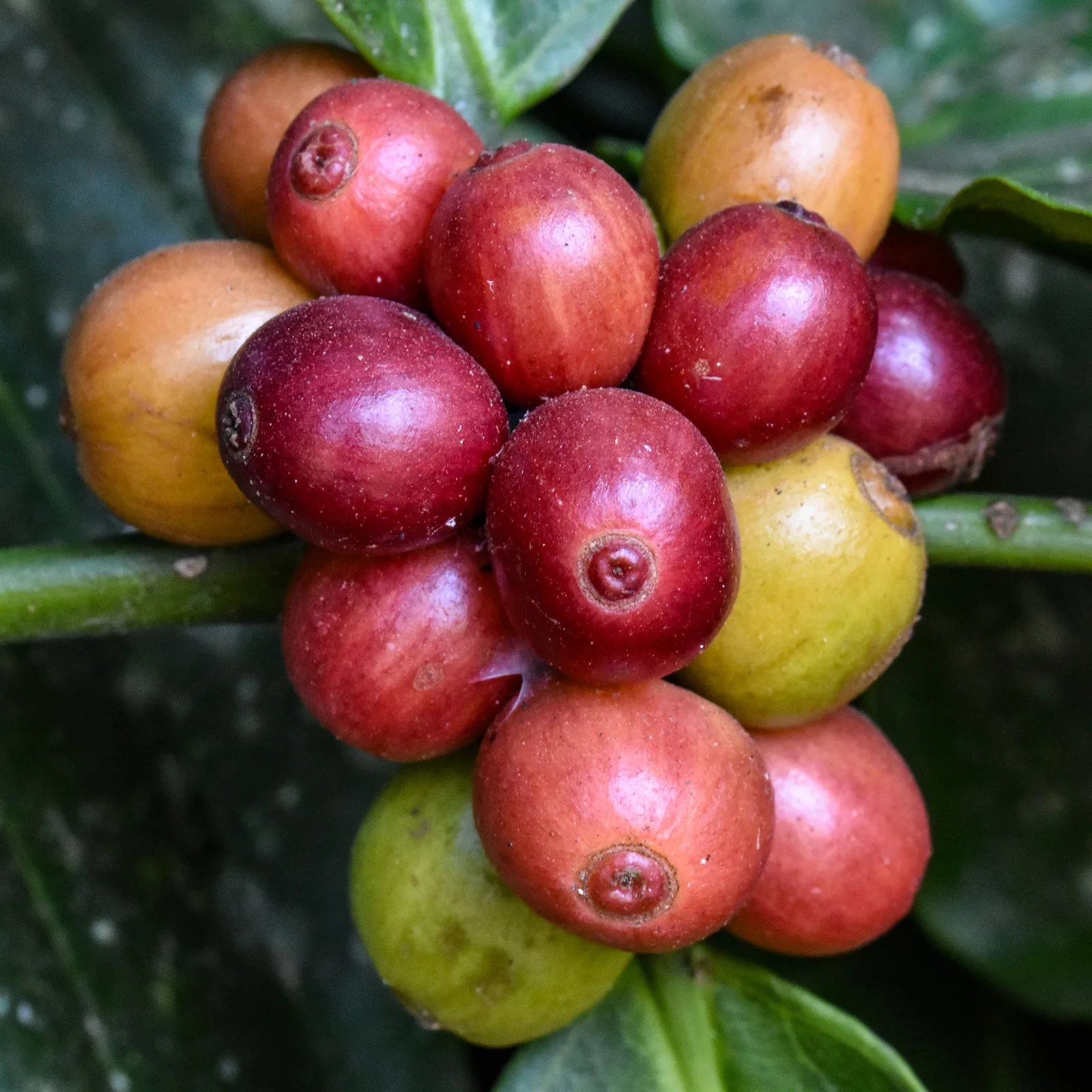
Canephora today accounts for about 40% of world production, against 25% in the early 1990s. Fifteen points gained, driven by Vietnam, Brazilian conilon, Uganda and Indonesia.
The movement shows in trade. Over the first four months of the 2025/26 marketing year, the share of arabicas in green coffee exports fell to 61.1%. It was 66.4% a year earlier.
Buyers arbitrage between the two species, and the price gap is wide. In February 2026, canephoras were selling for 179.73 cents a pound, against 308.62 for Brazilian naturals.
Breeding has followed. Embrapa's BRS 2314, a Guinea × Congo hybrid, reaches 87.2 points and the CQI “Fine Robusta” classification. WCR opened a canephora breeding program in 2024, and Uganda published its cultivation handbook in 2019.
But the species has its thresholds, measured by Kath in 2020 and given above. And its cultivated genetic base is narrower than people think.
The mistake comes from the reading of a document. WCR's genealogical poster is complex on the arabica side, and that complexity wrongly suggests that diversity is on that side. It is the reverse. Most Vietnamese clones descend from a small number of introductions. See canephora.
USITC, Executive Briefing “Is Robusta on the Rise?”, usitc.gov; ICO, Coffee Market Report, February 2026, pp. 1-2; WCR, Catalog 2025, p. 105; WCR 2024, poster user guide, p. 3; UCDA, Robusta Coffee Handbook, 2019In this plateThe 17 sections
- 01The specifications of an understory plant
- 02What the climate is already doing: rust, frost, drought
- 03What the models forecast for 2050
- 04First answer: go up, shade, irrigate
- 05Mechanizing: what the machine compensates for, and where it cannot go
- 06Second answer: F1 hybrids and the industrialization of breeding
- 07Third answer: reading, then editing genomes
- 08What happens under the tree
- 09The reserve of forgotten species
- 10Canephora as the future, and its limits
- 11What remains to be saved: 60% of species threatened
- 12Gene banks: a plantation, not a vault
- 13Economics: record output, tiny farms, underfunded research
- 14Regulation: the European deforestation regulation
- 15Demand: Asia, specialty coffee, coffee without the bean
- 16What we still do not know
- 17Today (September 2026)
The table of contents, with the first sentence of each section