Second answer: F1 hybrids and the industrialization of breeding
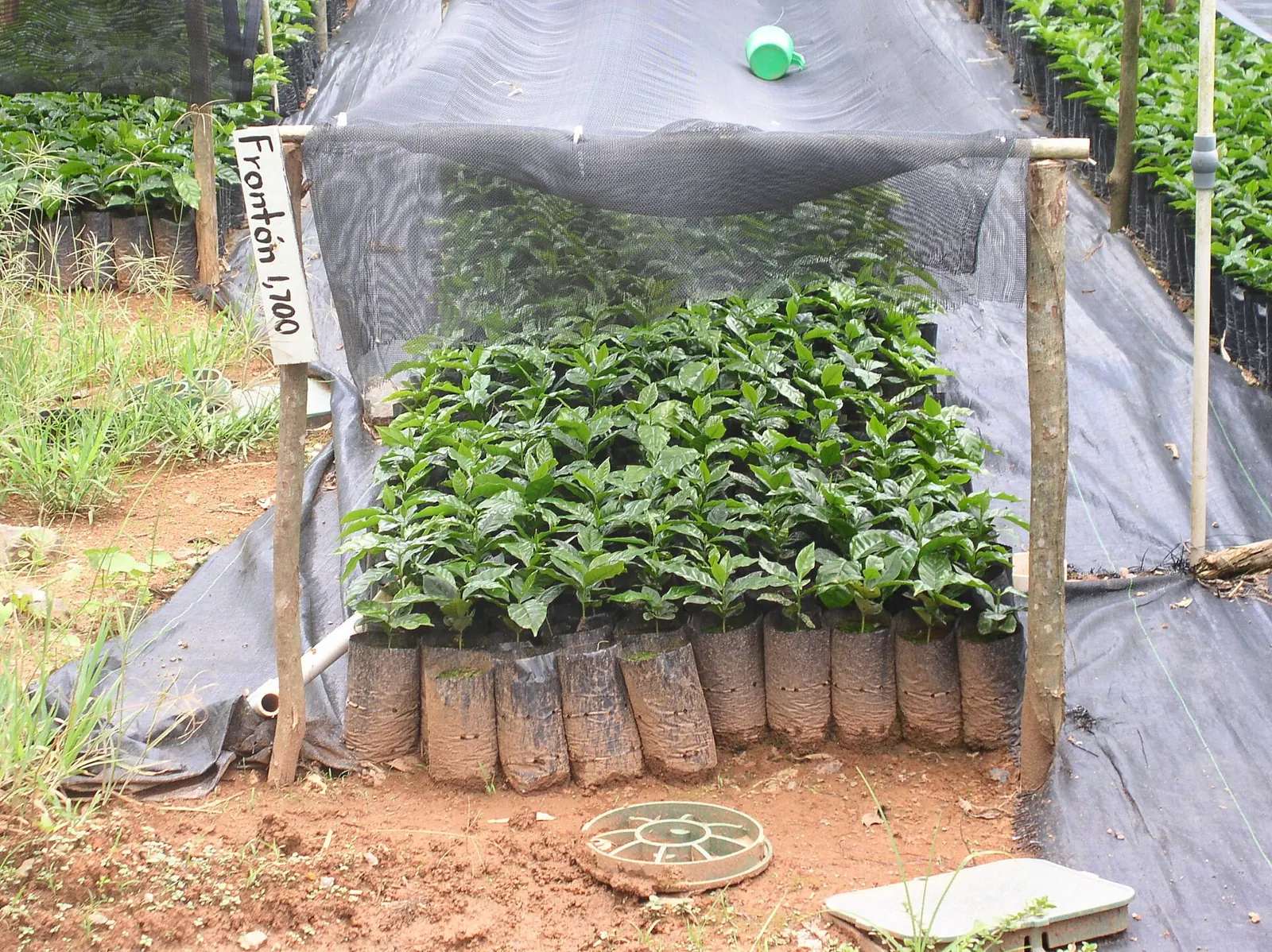
An F1 hybrid is the first-generation cross between two genetically distant parents, typically a resistant line derived from the Timor Hybrid and a wild Ethiopian or Sudanese accession; it combines vigor, yield and resistance in proportions that cannot otherwise be obtained. The Centroamericano (T5296 × Rume Sudan), selected by CIRAD, CATIE and PROMECAFÉ, is highly resistant to rust and outperforms Caturra in the cup.
| F1 (WCR 2025) | Parents | Breeder | Leaf rust | Altitude | Propagation |
|---|---|---|---|---|---|
| Centroamericano | T5296 × Rume Sudan | CIRAD-CATIE-PROMECAFÉ | High resistance | Low to high | Somatic embryogenesis |
| Milenio | T5296 × Rume Sudan | CIRAD-CATIE-PROMECAFÉ | High resistance | Medium, high | Somatic; not uniform |
| Mundo Maya | T5296 × ET01 (wild Ethiopian) | CIRAD-ECOM | High resistance | Medium, high | Somatic |
| Esperanza | T5296 × ET25 | CIRAD-CATIE-PROMECAFÉ | High resistance | Low to high | Somatic |
| Starmaya | CIR-SM01 (male-sterile) × Marsellesa | CIRAD-ECOM | High resistance | Medium | Seed-orchard seed (2019) |
| Nayarita | Naryelis (Catimor) × ET26 | CIRAD-ECOM | Low | High | Somatic |
| Evaluna | Naryelis × ET06 | CIRAD-ECOM | Intermediate | High | Somatic |
| Casiopea | Caturra × ET41 | CIRAD-CATIE-PROMECAFÉ | Susceptible | High | Somatic; exceptional quality |
| H3 | Caturra × E531 | CIRAD-CATIE-PROMECAFÉ | Susceptible | High | Somatic |
| Ruiru 11 | Catimor × multicross (K7, SL28, N39, Rume Sudan) | CRF / KALRO, Kenya | High resistance | Low to high | Seed from manual crossing |
Its limit is not a detail: the seeds of an F1 segregate, sowing an F1 does not give an F1 again, and propagation goes through somatic embryogenesis in the laboratory, which shifts an agronomic difficulty into a difficulty of capital, the producer having to buy again plants that he cannot re-sow.
WCR, Coffee Varieties Catalog 2025, p. 31; LC ch. 21Starmaya partially lifts this limit, and it owes this to an anomaly found in a collection.
In 2001, CIRAD researchers screened the Ethiopian accessions of the CATIE gene bank. They spotted a tall-habit mutant that produces no pollen, referenced CIR-SM01.
A plant without pollen cannot fertilize itself. Planted in a seed orchard next to Marsellesa, it can therefore be fertilized only by it. Every seed harvested from CIR-SM01 is an F1, obtained by sowing and not in the laboratory.
Georget and coauthors (Frontiers in Plant Science, 2019) report a yield 30% higher than that of Marsellesa. They note 8% of plants susceptible to rust in field observation.
The cup does not fall behind: 82.5 out of 100, against 83.13 for Marsellesa and 82.9 for the Caturra control. Field trials in Nicaragua, at ECOM, give 30 to 47% more than conventional varieties.
Cost is the decisive point. Somatic embryogenesis adds 0.50 to 0.60 dollars per tree, or 2,500 to 3,000 dollars per hectare at 5,000 plants. Seed-orchard seed costs about half that.
And a hectare of orchard can produce on the order of half a million seeds a year. That is where the change of scale plays out: one moves from plants regenerated one by one in the laboratory to seeds harvested in the field.
The lifting of the limit remains partial, and the WCR catalog says why: about 15% of plants segregate even in F1. Starmaya also targets mid altitudes, with marked acidity.
A generation has formed around it. Nayarita (Naryelis × wild Ethiopian accession ET26, CIRAD-ECOM) targets high altitude, but it is susceptible to rust.
Then come the F1s Casiopea, Milenio, Mundo Maya, Esperanza, H3 and Evaluna. All come from a Catimor or Sarchimor parent crossed with an Ethiopian or Sudanese accession from the CATIE collection: resistance on one side, wild diversity on the other.
These varieties make up the Central American generation. Kenya, for its part, has its own lineage, with Ruiru 11 (1985) and Batian.
Georget et al. 2019, Frontiers in Plant Science 10, 1344, “Starmaya: the first arabica F1 coffee hybrid produced using genetic male sterility”; CIRAD, press release of Dec. 20, 2019, cirad.fr; WCR, Coffee Varieties Catalog 2025, pp. 25, 31, 35, 36, 39, 55, 57, 59, 71, 79The change of scale comes from World Coffee Research, an organization funded by more than 200 companies from 30 countries. Its Innovea breeding network brings together eleven countries that together produce more than 40% of the world's coffee, has taken in canephora and welcomed Vietnam and Ghana in 2025; it runs pre-commercial F1 trials in Peru, Guatemala and Costa Rica (ten thousand seedlings on ten sites) and has developed, with Cenicafé and the USDA, low-cost genetic markers for rust, coffee berry disease, fruit rot and the berry borer, that is, tests that tell you on a young plant what one used to have to wait years to see in the field.
The international multilocation trial, which compares 31 arabica varieties in more than twelve countries, is ten years old. The stated objective is to cut the breeding cycle from thirty years to eight; this is an organizational goal, not a measured result, and it will take eight years to verify it. Breeding that counts in decades cannot keep up with a climate that moves in years; breeding that counts in years can, provided something remains to be selected.
WCR, Annual Report 2025, worldcoffeeresearch.org/resources/annual-report-2025; LC ch. 16 and 21In this plateThe 17 sections
- 01The specifications of an understory plant
- 02What the climate is already doing: rust, frost, drought
- 03What the models forecast for 2050
- 04First answer: go up, shade, irrigate
- 05Mechanizing: what the machine compensates for, and where it cannot go
- 06Second answer: F1 hybrids and the industrialization of breeding
- 07Third answer: reading, then editing genomes
- 08What happens under the tree
- 09The reserve of forgotten species
- 10Canephora as the future, and its limits
- 11What remains to be saved: 60% of species threatened
- 12Gene banks: a plantation, not a vault
- 13Economics: record output, tiny farms, underfunded research
- 14Regulation: the European deforestation regulation
- 15Demand: Asia, specialty coffee, coffee without the bean
- 16What we still do not know
- 17Today (September 2026)
The table of contents, with the first sentence of each section