The reserve of forgotten species
| Species | Optimum / range | Caffeine | Cup (protocol) | Status 2025-2026 |
|---|---|---|---|---|
| C. arabica | 20-24 °C mean; 1,000-2,000 m (400-800 m in Brazil) | 1,2-1,5 % | Reference; 98% “arabica” for an Ethiopian lot (2021) | 60% of production; wild classed “endangered” |
| C. canephora (robusta) | Yield optimum < 20.5 °C measured (Kath 2020); 30/26 °C day/night (Yang 2026); 0-900 m | 2-2,7 % | 7% “arabica”; BRS 2314 at 87.2 pts | ~40% of production; WCR program since 2024 |
| C. stenophylla | 24.9 °C mean, +6.2 to 6.8 °C vs arabica; 150-700 m; tolerates drought | Comparable to arabica (2025) | 81% “arabica”, 80.25 SCA, 47% “new” (2021) | > 5,000 plants, 200 grafted (Sierra Leone); agronomy unknown |
| C. liberica / excelsa | Hot and low; 500-1,500 m for excelsa; long dry seasons | Low to medium | Not evaluated in a published panel; thick skin, ferments quickly | Grown in Uganda, Malaysia, the Philippines, Vietnam; excelsa reinstated as a species (2025) |
| C. eugenioides | 23/19 °C day/night; maternal parent of arabica | Very low (~0.2-0.4%) | Sweetness, low bitterness; 2021 world barista champion | A few farms (Inmaculada, Colombia); 400-1,000 kg/ha at Nioka (Coste) |
| C. racemosa, C. zanguebariae | Dry and hot (Mozambique, Tanzania); deciduous | Low | Evaluated in panel, Frontiers Sust. Food Syst. 2021 | Wild; partial conservation |
| Mascarocoffea (18 sp., Madagascar) | Malagasy forests | None | Not evaluated | Majority threatened; no supply chain |
The genus Coffea has numbered 130 described species ever since Davis and Rakotonasolo added six from northern Madagascar in Kew Bulletin in 2021 (C. callmanderi, C. darainensis, C. kalobinonensis, C. microdubardii, C. pustulata, C. rupicola), four of them strictly endemic to a single massif. Only two are grown on a large scale. The others carry, according to Kew's 2019 assessment, tolerance to heat and drought, resistance to pests and diseases, zero or low caffeine contents and unexplored flavor profiles, and wild relatives have supplied “the major solutions” to the sector's sustainability for four hundred years, from the Timor Hybrid to the Catimors. See the living world and the origins.
Davis & Rakotonasolo 2021, Kew Bulletin 76; Daily Coffee News, Sept. 9, 2021; Davis et al. 2019, Science Advances 5, eaav3473, pp. 2 and 5The best-documented case is that of a species that had been lost, and that tells this whole chapter on its own.
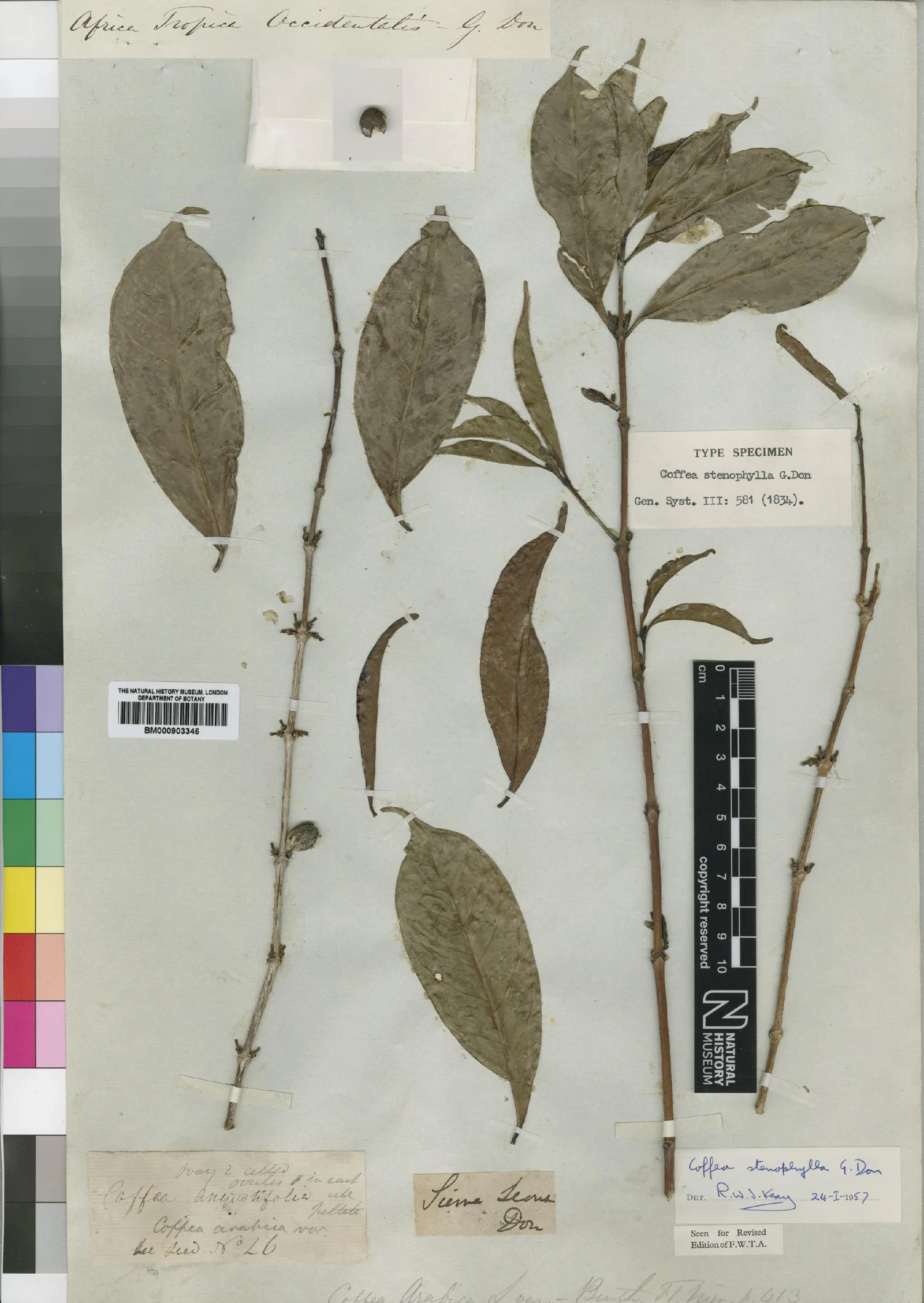
It is called Coffea stenophylla, the coffee of the Sierra Leone highlands. Don describes it in 1834, noting that its roasted seeds were reputed superior to ordinary coffee. In the 1890s, it is exported to France at a good price.
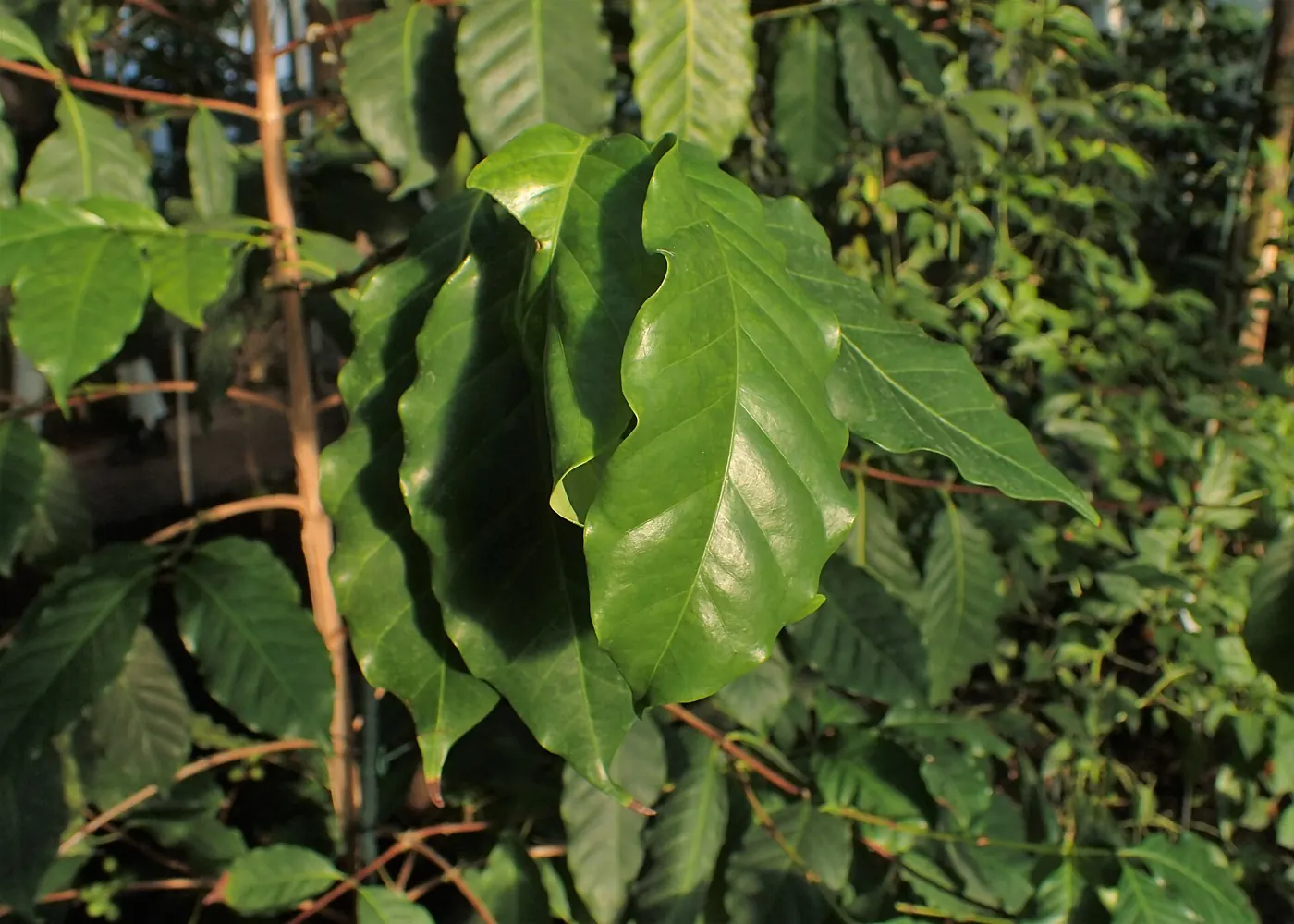
Then canephora arrives, and stenophylla is abandoned. Not because it was bad, but because it yielded little, its beans were small and it produced too many peaberries, those single round beans instead of the usual two flat ones. The market prefers the regular to the good.
After that, the species fades away. Last wild traces in Côte d'Ivoire in 1932, in Guinea in 1941, in Sierra Leone in 1954. After that, nothing for sixty years.
In December 2018, a team bringing together Davis (Kew), Haggar (Greenwich) and Sarmu finds it again. First a single immature plant in the Kasewe Hills. Then a small population in the Kambui Hills, at 400 meters of altitude, under an annual mean of about 26 °C.
And the team notes something else, which is not botanical: no vernacular knowledge of the species survived among the farming communities. They had lost not only the plant, but even the memory that it existed.
That leaves the question everyone is interested in: what does it taste like? On April 20, 2021, Nature Plants publishes the result of a blind tasting run by a CIRAD panel in Montpellier on four coffees. A high-quality Ethiopian arabica is identified as arabica by 98% of the judges. An average Brazilian arabica by 44%. An Indonesian canephora by 7%.
And stenophylla, by 81%. Scored 80.25 on the SCA scale, it was described by 47% of the judges as being neither arabica nor canephora. In other words: a coffee that professionals take for arabica, and that is not.
That is where the interest lies. It grows at a mean temperature of 24.9 °C, which is 6.2 to 6.8 °C above arabica. Six degrees is the gap that the climate is in the process of opening.
In March 2025, an analysis by liquid chromatography and mass spectrometry, published in npj Science of Food, completes the picture with chemistry. The two techniques split the work: the first separates the molecules of an extract, the second identifies them by their mass.
The levels of caffeine, trigonelline, sucrose and citric acid are comparable to those of arabica. What the panel thought it recognized in the cup is therefore found in the composition.
Two results depart from the known. Mozambioside, a bitter molecule, is absent from the bean. And it is the first time theacrine has been detected in a coffee bean.
Davis et al. 2020, Frontiers in Plant Science 11, 616, pp. 3-16; Davis, Mieulet et al. 2021, Nature Plants 7, pp. 413-418, doi 10.1038/s41477-021-00891-4; Davis, Jan-Smith & Howes 2025, npj Science of Food, March 19, 2025; LC ch. 4What remains to be established is the agronomy, that is, what had killed the species the first time. Kew's program in Sierra Leone had more than five thousand plants in production in 2025; to speed things up, two hundred plants were grafted in June 2024 onto an excelsa rootstock, all of them took, planted in October 2024, with a first harvest expected in 2025 of which no account has been published as of the date of this plate.
Yield, management, disease resistance, preparation chain, outlet: nothing is established. This is not an isolated case: since 2021, at least five wild species have been evaluated in panel according to a published protocol, C. stenophylla, C. brevipes and C. congensis (Bertrand, Davis and coauthors, Journal of the Science of Food and Agriculture, December 2022), C. racemosa and C. zanguebariae (Davis and coauthors, Frontiers in Sustainable Food Systems, October 2021), and none disappointed to the point of justifying the 20th-century culling.
Bertrand et al. 2022, J. Sci. Food Agric., doi 10.1002/jsfa.12309; Davis et al. 2021, Frontiers in Sustainable Food Systems 5, 740137; LC ch. 4 and 21Coffea liberica and excelsa follow a parallel trajectory. Davis and coauthors (Nature Plants, December 2022) argue that liberica could become a major crop again in a warmer world. Its failure around 1900 would be due in part to poor selection of the material distributed, that is, to a human choice rather than a limit of the species.
Excelsa, for its part, had been misclassified. Ranked for decades as variety dewevrei of liberica, it has been reinstated as a full species by a genomic study published in Nature Plants in 2025. Kew proposes the name Coffea x libex for the hybrid of the two.
In Uganda, excelsa tested at several sites withstands variable years better. Its fruits stay on the tree after ripening, which makes picking easier.
Two defects go with it. The thick skin complicates pulping, and the fruit ferments quickly if it is not harvested in time.
The trade press puts forward at least two hundred Ugandan farms exporting excelsa. The figure has not been cross-checked.
Coffea eugenioides, maternal parent of arabica, long remained a trial curiosity. Tried at Nioka in the Belgian Congo, it gave 400 to 1,000 kg/ha there according to Coste.
It became a competition product in 2021. Diego Campos won the world barista championship with a lot from Inmaculada (Colombia), and second and third place used the same species.
The eighteen Mascarocoffea of Madagascar are naturally caffeine-free. None has ever founded a supply chain.
Davis et al. 2022, Nature Plants 8, pp. 1322-1328; Nature Plants 2025, genomic delimitation of liberica, doi 10.1038/s41477-025-02073-y; Coste 1955, vol. I, p. 27; Sprudge, interview with Diego Campos, 2021; LC ch. 4In this plateThe 17 sections
- 01The specifications of an understory plant
- 02What the climate is already doing: rust, frost, drought
- 03What the models forecast for 2050
- 04First answer: go up, shade, irrigate
- 05Mechanizing: what the machine compensates for, and where it cannot go
- 06Second answer: F1 hybrids and the industrialization of breeding
- 07Third answer: reading, then editing genomes
- 08What happens under the tree
- 09The reserve of forgotten species
- 10Canephora as the future, and its limits
- 11What remains to be saved: 60% of species threatened
- 12Gene banks: a plantation, not a vault
- 13Economics: record output, tiny farms, underfunded research
- 14Regulation: the European deforestation regulation
- 15Demand: Asia, specialty coffee, coffee without the bean
- 16What we still do not know
- 17Today (September 2026)
The table of contents, with the first sentence of each section