What the climate is already doing: rust, frost, drought
What is the climate already doing to coffee plants?
Start the scene or choose a stage. The animation simplifies the mechanism; what follows gives the details and the available references.
Between 2008 and 2013, orange rust returned to Latin America, on varieties selected to resist it. Rust defoliates the tree, the tree stops fruiting: Colombia lost 33% of its production between 2007 and 2011, Central America 16% over 2012-2013.
Read the stages without animation
- Rust returnsBetween 2008 and 2013, orange rust returned to Latin America, on varieties selected to resist it. Rust defoliates the tree, the tree stops fruiting: Colombia lost 33% of its production between 2007 and 2011, Central America 16% over 2012-2013.
- Frost killsThe nights of June 30, July 20 and July 30, 2021 hit 150,000 to 200,000 hectares in Brazil, about 11% of the cultivated area, with damage ranging from defoliation to the death of trees. A frost does not reduce a harvest: it kills the trees and imposes four years of waiting before the first cherry. The 2021/22 harvest fell by 23%.
- Drought prevents floweringIn 2024, the Minas Gerais probes showed a water deficit of 300 mm at the end of the dry season, against 110 mm in 2023. Some areas went more than 120 days without significant rain during the September-October flowering window: no rain, no flowering, and no cherries the following season.
- Stumping back to save the treeHence a high rate of stumping back: cutting the tree close to the ground so that it regrows from the stump. The tree survives, but it does not bear right away. Five consecutive arabica harvests have been hit by heat, drought or frost.
To remember: Climate does not just reduce a harvest: it removes trees, or years of trees, from production.
In history: PROMECAFÉ counted 373,585 workers displaced by rust: a harvest with nothing left to pick employs no one.
Read the full article and its sources ↓The first signal was not a temperature but a fungus. Between 2008 and 2013, orange rust (Hemileia vastatrix) returned to Latin America. It returned on varieties selected to resist it, that is, on material thought to be safe.
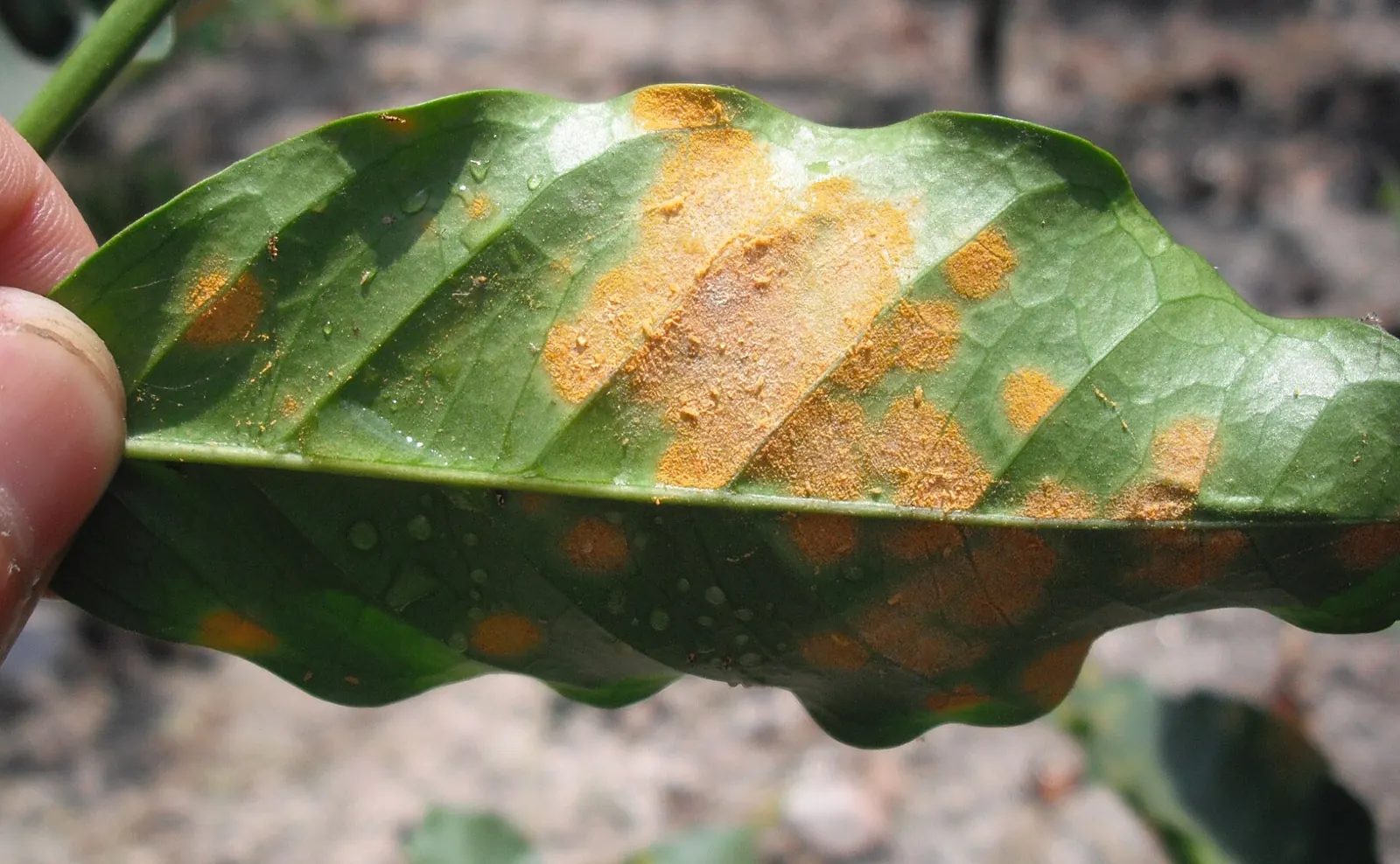
The toll can be read country by country. Colombia lost 33% of its production between 2007 and 2011. Central America lost 16% over 2012-2013, with extremes of 57% in El Salvador, 46% in Mexico and 39% in Peru.
PROMECAFÉ counted 373,585 displaced workers. This figure follows from the previous ones: rust defoliates the tree, the tree stops fruiting, and a harvest with nothing left to pick employs no one.
Why on these varieties? The studies do not settle on one cause but on a pile-up: warmer nights, shifted rains, low prices that had led growers to give up treatments, aging varieties.
The lesson was confirmed in August 2024 by a survey published in Agronomy. Of eighteen rust samples collected in Peru, two new races infect Catimor lines, that is, the material distributed massively after 2013, right after the epidemic.
The timeline is the real lesson. It had taken forty years to overcome the resistance of the Timor Hybrid; it took ten to overcome the second generation. In other words, the lifespan of a resistance has collapsed. See diseases.
Avelino et al. 2015, Food Security 7; PROMECAFÉ, 2013 assessment; Agronomy, August 2024, rust races in Peru; LC ch. 16The second signal is a frost. The nights of June 30, July 20 and July 30, 2021 hit Paraná, São Paulo and Minas Gerais; Conab estimated the affected areas at between 150,000 and 200,000 hectares, or about 11% of the Brazilian cultivated area, with damage ranging from defoliation to the death of trees, and meteorologists ranked the episode as the worst since 1994.
IBGE then put the 2021/22 harvest at 48.1 million 60 kg bags (32.5 of arabica, 15.6 of canephora), down 23% from 2020/21. A frost does not reduce a harvest: it kills the trees and imposes four years of waiting before the first cherry, which explains why its effects on supply spread out until 2025.
USDA FAS, GAIN Coffee Semi-annual Brazil, Nov. 15, 2021 (Conab, IBGE), apps.fas.usda.gov; Daily Coffee News, July 12, 2021; LC ch. 2The third is a drought. In 2024, Brazil went through its worst drought in more than seventy years.
The measurement comes from the probes of the Fundação Procafé, in Minas Gerais. In October 2024 they showed a water deficit of 300 mm at the end of the dry season, against 110 mm in 2023. The shortfall had therefore almost tripled in one year.
Some areas went more than 120 days without significant rain during the September-October flowering window. This is the moment that decides everything: no rain, no flowering, and no cherries to pick the following season.
StoneX notes that this resulted in a high rate of stumping back in the Cerrado and in São Paulo. To stump back is to cut the tree close to the ground so that it regrows from the stump. The tree survives, but it does not bear right away.
The same document recalls that five consecutive arabica harvests have been affected by heat waves, droughts or frosts. It is no longer an accident, it is a series.
Vietnam, the leading producer of canephora, suffered at the same time an abnormally prolonged dry season lasting until May 2024. It depleted aquifers that were already drawn down, that is, reserves of underground water from which irrigation had been drawing for years.
Geography says why this matters: Dak Lak supplies about 40% of national production. And the 2023/24 harvest had already fallen by 20%, to a four-year low.
StoneX, Brazil Coffee Crop Survey, Nov. 10, 2025, stonex.com; Global Coffee Report, “Reality hit”, 2025 (Fundação Procafé); USDA FAS, Coffee: World Markets and Trade, June 2025, cited by CropGPT July 15, 2025; StoneX, Vietnam weather risks, June 5, 2026These shocks showed up in the price. The New York C contract crossed 4.41 dollars a pound in February 2025, an all-time record, more than double the previous year.
Four causes added up: the failed flowering in Brazil, Vietnam's drought, the shift of buyers from canephora to arabica, and certified stocks at their lowest.
The last point weighs more than it seems. A market without stock has no cushion: the slightest harvest accident goes straight into the price, with no reserve to absorb the shock.
Then the movement reversed. The return of the rains and Conab's announcement, on February 5, 2026, of a record Brazilian harvest of 66.2 million bags (+17.1%) were enough.
The ICO composite indicator fell back to 267.57 cents a pound in February 2026, down 9.9% in a month. Rabobank projects a surplus of 8.64 million bags for 2026/27, after three years of deficit. See economics.
Perfect Daily Grind, Feb. 2, 2026, perfectdailygrind.com; ICO, Coffee Market Report, February 2026, pp. 1-2, ico.orgIn this plateThe 17 sections
- 01The specifications of an understory plant
- 02What the climate is already doing: rust, frost, drought
- 03What the models forecast for 2050
- 04First answer: go up, shade, irrigate
- 05Mechanizing: what the machine compensates for, and where it cannot go
- 06Second answer: F1 hybrids and the industrialization of breeding
- 07Third answer: reading, then editing genomes
- 08What happens under the tree
- 09The reserve of forgotten species
- 10Canephora as the future, and its limits
- 11What remains to be saved: 60% of species threatened
- 12Gene banks: a plantation, not a vault
- 13Economics: record output, tiny farms, underfunded research
- 14Regulation: the European deforestation regulation
- 15Demand: Asia, specialty coffee, coffee without the bean
- 16What we still do not know
- 17Today (September 2026)
The table of contents, with the first sentence of each section