Contemporary shapes: what we buy is a well-drawn hypothesis
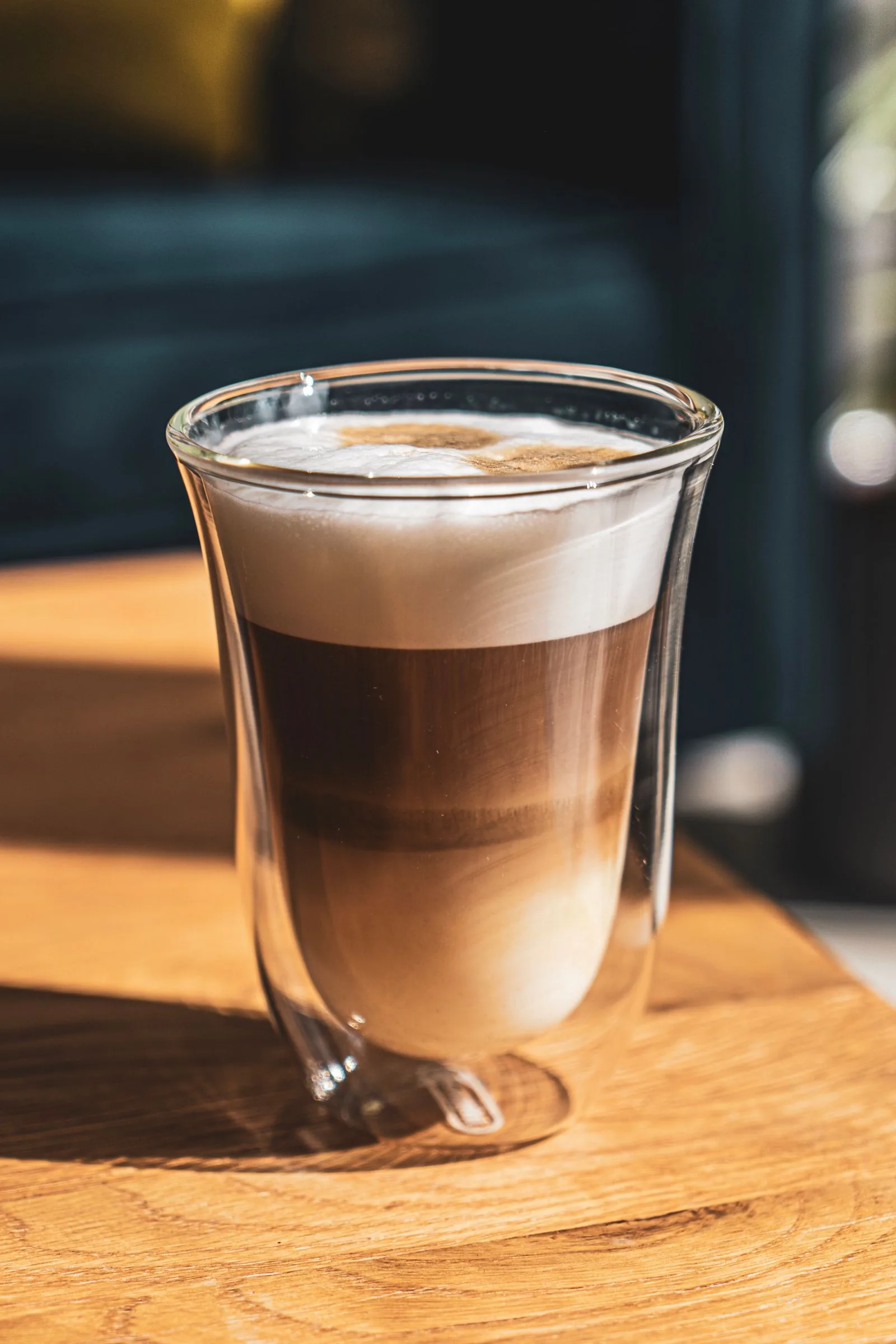
For about fifteen years, makers have been selling the shape of the vessel as a tasting adjustment and not as a table choice. It is the most recent segment of this plate, and also the one where the gap between claim and measurement is widest.
The technical argument comes from wine and has a name: the D ratio, that is, the maximum diameter of the vessel divided by the diameter of its opening. The higher it is, the more evaporation surface the vessel offers while narrowing the exit, and the more the volatile compounds, those light molecules that carry odor, accumulate in the headspace of the glass. In the wine literature, perceived aromatic intensity is positively correlated with this ratio.
The idea is much older than its formalization, and it is a nice archive surprise. Hattox cites the description of an ibriq, the Levantine coffee pot, by the Frenchman Dufour in the seventeenth century: the wide base receives more flame, so the water boils faster, and the opening is very narrow to better retain the volatile essence of the brew. The reasoning is therefore at least three and a half centuries old. It then concerned the pot, not the cup.
Spence and Carvalho point out that this physics does not transfer mechanically. Wine is served cold and its volatiles must be released; coffee is served hot and they must on the contrary be retained, the increased volatility of a hot drink making this retention difficult whatever the shape. There is moreover an upper limit: if the opening is too narrow, the nose no longer enters the glass, and orthonasal olfaction, the kind that passes through the nostrils before the sip, becomes impossible while drinking.
What each house claims, and what it rests on
- Kruve, CanadaThe EQ range, awarded twice by the SCA in 2019, is sold in pairs of opposite glasses in mouth-blown borosilicate, double-walled, 150 mL each, 155 mm high by 98 wide. The EXCITE is bulbous, with a large liquid surface: the maker claims this surface increases the speed of oxidation and reduces acidity. The INSPIRE has a narrowed inner wall and a liquid surface half as large: it would limit exposure to air, concentrate the aroma and strengthen acidity. The site invokes principles of sensation and perception based on science, without naming a study, a laboratory or a panel. The oxidation argument is the most interesting because it is verifiable: it would suffice to measure dissolved oxygen or oxidation markers in the two glasses. Nobody has published it.
- Loveramics, Hong KongThree tasting cups of 150 mL. Contrary to what is often read, they have neither the same dimensions nor the same weight, and the maker publishes them: FLORAL 8 × 6 × 8 cm for 148 g, SWEET 7 × 6 × 7 cm for 154 g, NUTTY 7 × 6 × 7 cm for 141 g. The weight gap between the lightest and the heaviest reaches 13 g, whereas Carvalho and Spence had taken care to equalize theirs to within 4 g. No study is cited.
- Origami, JapanThe Flavor Cup series offers three shapes inspired by wine glasses. The announced mechanism is unusual, because Origami invokes not the headspace of the glass but the posture of drinking: the Aroma shape would raise the chin and make the coffee flow toward the back of the tongue, making acidity more pronounced. The maker says it consulted a sommelier, but cites neither a study nor a panel.
- notNeutral and ACMEThe LINO range, designed in Los Angeles with baristas, features a curved inner wall, a thick base for heat and a refined rim for mouthfeel. ACME's logic is purely volumetric: one volume per drink, 70 mL for espresso, 150 for flat white, 190 for cappuccino. Neither claims to change perceived acidity or sweetness, and that is to their credit.
- Nespresso and RiedelThe Reveal collection, developed by glassmakers, is described by its maker as a promise of ritual rather than a testable hypothesis: see, then smell, then taste. No protocol or panel is mentioned.
One case stands apart, and it is the only place where the researcher and the designer meet. Fabiana Carvalho, coauthor of the 2018 study, accompanied the Italian barista Daniele Ricci, world runner-up in 2023 in Athens. The 150 mL cups of his routine took three years of joint work. Their shape is open, with a beveled rim, tall at the back and low at the front, so that the judges can reach the aromas. The object is consistent with the literature, without having been the subject of a published trial.
The state of the evidence must be stated plainly and without contempt. One published experiment shows that shape shifts the perceived aroma, sweetness and acidity of specialty coffee. It involves 276 people and three cups that none of the makers cited here sells. Its own authors do not attribute the effect to physics alone. A second, on a trained panel, finds almost nothing.
And one gap remains that, by itself, sums up the problem. No maker in this segment publishes the opening diameter or the maximum inner diameter of its vessels. The D ratio of these objects therefore cannot be calculated, and the physical argument they invoke cannot be verified on their own products. No measurement of the volatiles above the liquid exists for a commercial coffee vessel, though it is the simplest measurement to make. Rim thickness and wall angle are documented by none of the houses cited.
In 2019, reviewing the field, Spence and Carvalho named three of these makers and concluded that no empirical data supported their promises. Nothing since has filled this void. The hypothesis remains plausible, and the wine literature supports it. But what one buys is a well-drawn hypothesis, not a result.
F. M. Carvalho and C. Spence, Food Quality and Preference, vol. 68, 2018, pp. 315-321; C. Spence and F. M. Carvalho, same journal, vol. 75, 2019, pp. 239-248; Hattox, 1985, p. 86 and note 15, for Dufour's description of the ibriq; product sheets of the makers cited, accessed in September 2026; Daily Coffee News, September 7, 2021 and October 28, 2019; Bargiornale, criteria of the IEI Approved Product labelIn this plateThe 15 sections
- 01Three things we must stop confusing
- 02The handleless cup, and the holder that takes on the status
- 03The Ethiopian sini, and a ceramic route older than coffee
- 04Europe does the opposite: it adds a handle and removes the holder
- 05The tazzina, and what the texts really say
- 06Material: the question asked at the counter is the wrong one
- 07Preheating, porosity, and two beliefs to sort out
- 08Shape: the only solid measurement in the file, and its counterexample
- 09Color, weight, rim thickness: three very unequal beliefs
- 10The cupping bowl, the only coffee vessel to be standardized
- 11Contemporary shapes: what we buy is a well-drawn hypothesis
- 12Asia, and vessels made for the nose
- 13The disposable cup, which is a plastic object
- 14The largest survey ever made, and why it does not settle the matter
- 15What can be said in the end, and what cannot
The table of contents, with the first sentence of each section