The handleless cup, and the holder that takes on the status
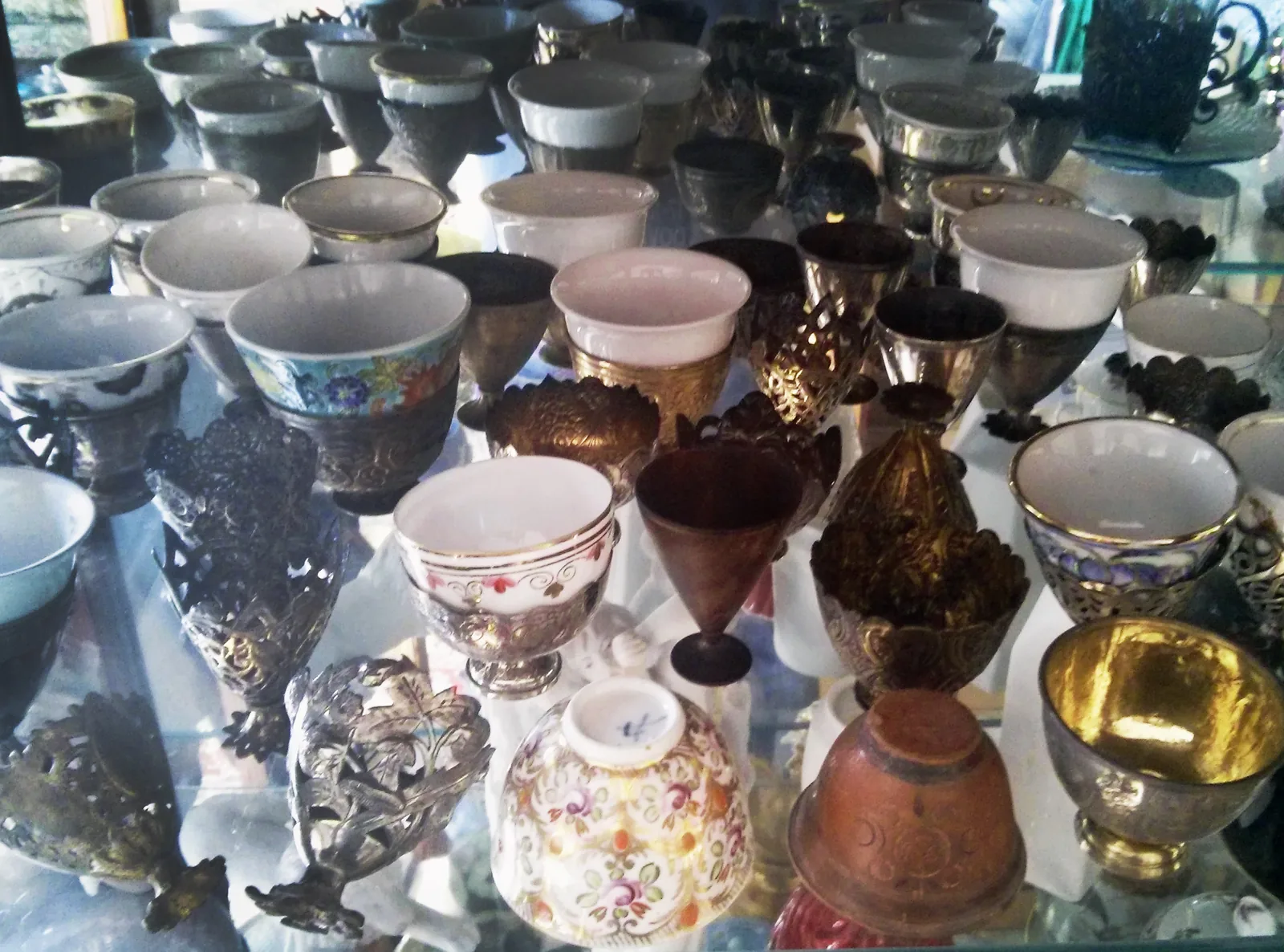
The first coffee vessels described in the sources are not cups in the European sense. Ralph Hattox, who combed the sixteenth-century Arabic sources, writes that the serving cups there are invariably of clay or porcelain, depending on the wealth of the establishment and its clientele. The German physician and botanist Leonhard Rauwolff, who died in 1596, describes coffee drunk from small deep dishes of earthenware or porcelain.
The chronicler Jaziri insists on the distinction: for him the coffee vessel is a clay bowl, or porcelain at Jeddah, whereas the wine cup is often of glass.
None of these vessels has a handle, and that is exactly the reason for the zarf, the cup holder that envelops it. The Turkish word means envelope. The consequence is more interesting than the object: since the cup is a small thing of earth that cannot be richly decorated without making it unusable, it is the holder that receives the silver, the silversmith's art and the status. It is not the cup that carries the prestige, it is its packaging.
The traveler Carsten Niebuhr says it bluntly in the eighteenth century. In the country relay stations, the drink is served in cups of coarse earthenware. People of quality carry their own porcelain cups in their luggage.
On capacity, one must be clear, because the figures read everywhere have no source. Hattox himself writes that the accounts diverge on the size of the old cups. The inscription of Turkish coffee culture on UNESCO's intangible heritage list, in 2013, says only that the coffee is served there in small cups accompanied by a glass of water. The volumes of 60 to 90 milliliters come from the trade. No normative text fixes the capacity of a fincan.
The surviving pieces, with their dimensions
Museums make it possible to measure what the texts do not say. A cup holder at the Metropolitan Museum, in silver, measures 3.5 cm high by 5.7 cm in diameter and weighs 25.5 g. The cup that goes with it is cataloged separately: porcelain, 3.5 cm high, 5.4 cm in diameter, 22.7 g. This is the direct measure of a fincan and its holder.
The other pieces confirm the order of magnitude. A pair of cup holders from the same museum measures 3.8 cm high by 5.7 and 6.2 cm in diameter. A Persian zarf at the Victoria and Albert Museum is 5.5 cm high by 5 cm in diameter. An eighteenth-century zarf in stonepaste reaches 4.4 cm high and 6.4 cm in diameter. An eighteenth-century cup and saucer set, in stonepaste painted under the glaze, gives a cup 5.1 cm high and 7 cm in diameter.
One catalog detail deserves to be noted, because it is a lesson in method: the entry for the silver cup holder dates it to the nineteenth century without attributing any culture to it. Nothing there says “Ottoman.” What the trade and popular articles present as a clearly localized tradition is, in museum catalogs, an object of circulation whose origin is not always known.
In this plateThe 15 sections
- 01Three things we must stop confusing
- 02The handleless cup, and the holder that takes on the status
- 03The Ethiopian sini, and a ceramic route older than coffee
- 04Europe does the opposite: it adds a handle and removes the holder
- 05The tazzina, and what the texts really say
- 06Material: the question asked at the counter is the wrong one
- 07Preheating, porosity, and two beliefs to sort out
- 08Shape: the only solid measurement in the file, and its counterexample
- 09Color, weight, rim thickness: three very unequal beliefs
- 10The cupping bowl, the only coffee vessel to be standardized
- 11Contemporary shapes: what we buy is a well-drawn hypothesis
- 12Asia, and vessels made for the nose
- 13The disposable cup, which is a plastic object
- 14The largest survey ever made, and why it does not settle the matter
- 15What can be said in the end, and what cannot
The table of contents, with the first sentence of each section