Asia, and vessels made for the nose
Everything above looks toward the West, and that is a blind spot. Asia has hot-drink vessels far older than the European cup, and one of them has strictly one function: to carry the smell. It was designed for tea, and coffee seized on it, but not at all as one would expect.
The wénxiāng bēi, literally the cup for smelling the fragrance, is a tall, narrow cup from which one never drinks. It belongs to the gongfu cha service, this method of preparing tea with short, repeated infusions, and it is always sold as a pair with a low, wide drinking cup.
The gesture is codified in five steps. The cup is warmed with hot water, the tea is poured into it, the drinking cup is placed upside down on top, the whole is flipped, the smelling cup is withdrawn in a vertical movement, and the empty cup is smelled while it cools. This last point is the real object of the rite: what one breathes is not the liquid, but the residual film drying on the wall. Taiwanese sellers distinguish three moments, the hot fragrance, the warm fragrance, the cold fragrance.
Its origin is recent and Taiwanese, which contradicts the Western commercial discourse. The Pinglin tea museum, in New Taipei, exhibited in 2013 one hundred forty-four pieces of utensils and credited the paternity of the object to Shen Fu-han, then eighty-three years old, who had seen customers sniffing the empty cups of his tea house and had drawn from it the first Taiwanese series of smelling cups. The press article reporting this places the invention some thirty years earlier, so in the early 1980s. English-speaking merchants repeat this decade without ever citing the source.
The mechanism put forward is a chimney effect: a narrow opening and a deep body would form a conduit where the aroma concentrates, then is released as the wall cools. The same discourse recommends white porcelain or celadon fired above 1,200 degrees, whose dense surface absorbs nothing, and advises against stoneware and porous earth, which would carry the smells of one tea over to the next.
This reasoning is consistent with what the chapter on materials establishes about porosity. It has never been tested. No measurement of volatiles above a smelling cup was found, nor any blind trial comparing it with an ordinary cup. An object can be in use for forty years without ever having been published.
And here is the clearest result of this research. Taiwanese and Hong Kong specialty coffee took over the word, but not the cup. What is sold under this name for coffee are tall glasses inspired by the wine glass. A Taiwanese roaster sells a double-walled smelling glass whose 120 milliliter model has an opening of 5.8 centimeters for 8.7 in height; a Hong Kong shop offers one of 255 milliliters, 10 centimeters tall; and the Kruve glasses of the previous chapter are commonly called fragrance-smelling cups by Taiwanese resellers.
None of these makers claims the geometry of the original object, and none practices the flipping. The vocabulary of tea is used to sell an object that came from wine.
China, southern India, Japan and Vietnam
China. Yunnan produces most of Chinese coffee, 98 percent of national production according to official figures, for a harvest exceeding 140,000 tonnes in 2024. What Chinese professionals call the Chinese expression of coffee goes through local ingredients and a change of vessel: the gaiwan, this lidded bowl attributed to the Ming dynasty at the time when loose-leaf tea replaces compressed brick tea, blue-and-white porcelain, or the purple stoneware of Jianshui. This is a usage, not a protocol: no published Chinese tasting procedure replaces the standardized cupping bowl with a gaiwan.
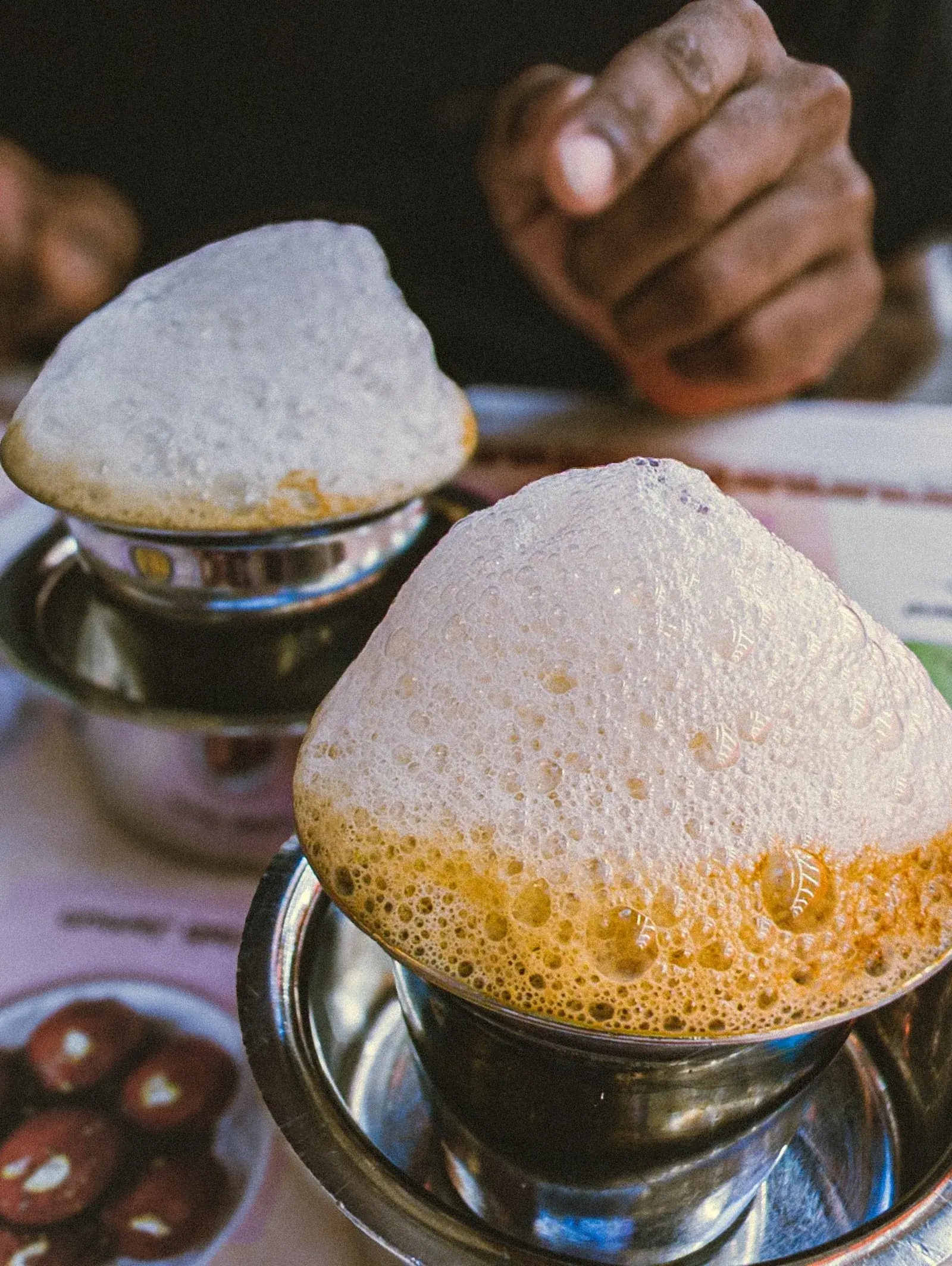
Southern India offers the most interesting case of the whole plate, because the vessel there is a process. Filter kaapi is served in a two-piece stainless steel set: a cylindrical tumbler, and the davara, a wide, flared dish that serves as its base, around 120 milliliters. The gesture is a transfer: the coffee is poured from a height, from the tumbler to the davara, then in the opposite direction, three to five times, from a height of thirty to forty centimeters.
The popular name “meter coffee” comes from the fact that some servers stretch the stream to nearly a meter. The announced function is twofold, cooling to a drinkable temperature and aerating to produce the foam. The thermal part is credible, since a thin stream offers a large surface to the air and stainless steel conducts quickly. But no source consulted measures anything: neither temperature drop, nor foam volume, nor perceived aroma.
Japan holds two coffee-cup cultures at once, and they are opposed. That of the kissaten, the old-style coffee house, uses a thick cup, and Noritake writes that some of its coffee cups are thickened over their whole height to keep the heat, which is a maker's argument and not a measurement. That of the third wave goes on the contrary toward the thin rim, supplied by four ceramic centers: Arita, in Saga Prefecture, cradle of Japanese porcelain, where tradition dates the discovery of kaolin at Mount Izumiyama to 1616; Hasami, in Nagasaki; Mino, in Gifu, which supplies most of everyday Japanese tableware; and Seto, in Aichi. The published dimensions always concern the overall size, never the rim.
Vietnam, finally, also integrates the vessel into the brewing device. The phin is an individual percolator, in aluminum, stainless steel or brass, set directly on the serving glass. The glass receives the sweetened condensed milk before extraction, and if it is straight and tall, it is to hold the ice, not the aroma.
Two absences deserve to be pointed out rather than hidden. Korea stays out of this chapter for lack of published material: collaborations with ceramists exist there, but without dimensions or protocol. And nothing solid was found for Hong Kong, Singapore, Thailand and Indonesia beyond retail.
In this plateThe 15 sections
- 01Three things we must stop confusing
- 02The handleless cup, and the holder that takes on the status
- 03The Ethiopian sini, and a ceramic route older than coffee
- 04Europe does the opposite: it adds a handle and removes the holder
- 05The tazzina, and what the texts really say
- 06Material: the question asked at the counter is the wrong one
- 07Preheating, porosity, and two beliefs to sort out
- 08Shape: the only solid measurement in the file, and its counterexample
- 09Color, weight, rim thickness: three very unequal beliefs
- 10The cupping bowl, the only coffee vessel to be standardized
- 11Contemporary shapes: what we buy is a well-drawn hypothesis
- 12Asia, and vessels made for the nose
- 13The disposable cup, which is a plastic object
- 14The largest survey ever made, and why it does not settle the matter
- 15What can be said in the end, and what cannot
The table of contents, with the first sentence of each section