Shape: the only solid measurement in the file, and its counterexample
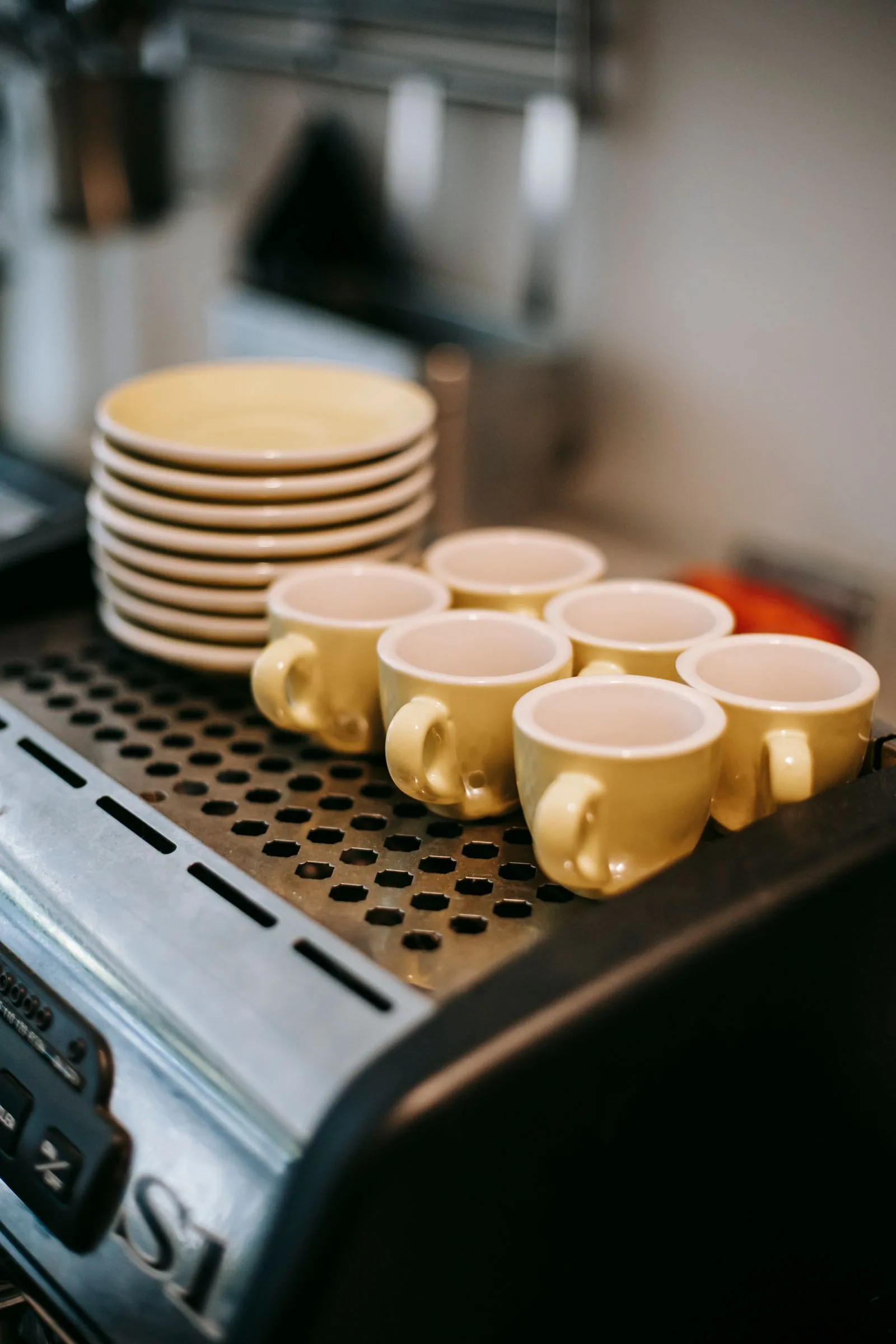
Here is the experiment around which this whole field turns. Fabiana Carvalho and Charles Spence had the same coffee tasted by 287 people during the fifth International Coffee Week in Brazil, of whom 276 were retained after quality control: 151 professionals, producers, Q Graders, traders, roasters and baristas, and 125 amateurs.
The protocol locks down everything except the shape. Three cups of the same series, same ceramic, same smooth texture, same white, same height of 6.5 centimeters, and weights of 173.0, 176.5 and 175.2 grams, this equalization to within 4 grams being no detail since the weight of a container shifts judgments by itself. A tulip, an open cup, and a split cup, that is, one bulging beneath a constriction of the wall.
The coffee is also controlled: a Brazilian Yellow Bourbon with a honey process, scored 86 points, light to medium roast, V60 brew at 77 grams per liter, water at 92 degrees, served at 58.2 degrees, 60 milliliters per person.
The result is clear. The aroma was judged significantly stronger in the tulip, by amateurs and experts alike. Sweetness and acidity were judged more intense in the split cup. And the split cup received the lowest liking scores, with a gap that separates the two audiences: amateurs give it 4.44, professionals 6.46.
The size of these effects must be seen immediately, because that is where the common reading goes astray. On a scale of 0 to 10, sweetness is 6.10 in the tulip and 5.83 in the open cup, and that gap does not even reach the threshold of significance. We are measuring tenths of a point.
The authors themselves refuse to draw a physical conclusion from it, and that is to their credit. They point out that round shapes increase perceived sweetness through simple mental association, with no mechanism in the liquid. And they note that the split cup had the same opening diameter as the open cup without producing the same scores, which weakens the geometric explanation.
The 2021 counterexample, and what it obliges us to say
A second trial exists, and it must be set beside the first rather than forgotten. Labbe, Rytz, Strube and Leloup published in 2021 a descriptive profile, that is, a rating by a trained panel on a fixed vocabulary. Eleven judges profiled 32 beverages with a glossary of 59 descriptors, covering appearance, orthonasal aroma, retronasal aroma, taste, mouthfeel and aftertaste. The design crosses two mug shapes, low and wide against tall and narrow, and four volumes from 100 to 250 milliliters, on four coffees.
The result is almost null. The only thing that varies systematically is the intensity of the dark color of the liquid. For three coffees out of four, sensory quality is stable from one condition to the other. Only a lightly dosed arabica sees its orthonasal aroma shift, and the authors attribute it to the visual effect of the tint, not to geometry.
The coffee was instant and the panel small, which limits the scope of the result. This does not refute Carvalho and Spence. But it forces a more cautious sentence than the one read everywhere: shape shifts judgments among tasters in a single session, naive and expert alike, and it shifts almost nothing for a trained panel that compares.
An older counterexample points the same way. Machiels tested round cups against angular ones: no effect on flavored fermented milk, and on maté soda, only bitterness moved.
In this plateThe 15 sections
- 01Three things we must stop confusing
- 02The handleless cup, and the holder that takes on the status
- 03The Ethiopian sini, and a ceramic route older than coffee
- 04Europe does the opposite: it adds a handle and removes the holder
- 05The tazzina, and what the texts really say
- 06Material: the question asked at the counter is the wrong one
- 07Preheating, porosity, and two beliefs to sort out
- 08Shape: the only solid measurement in the file, and its counterexample
- 09Color, weight, rim thickness: three very unequal beliefs
- 10The cupping bowl, the only coffee vessel to be standardized
- 11Contemporary shapes: what we buy is a well-drawn hypothesis
- 12Asia, and vessels made for the nose
- 13The disposable cup, which is a plastic object
- 14The largest survey ever made, and why it does not settle the matter
- 15What can be said in the end, and what cannot
The table of contents, with the first sentence of each section