The disposable cup, which is a plastic object
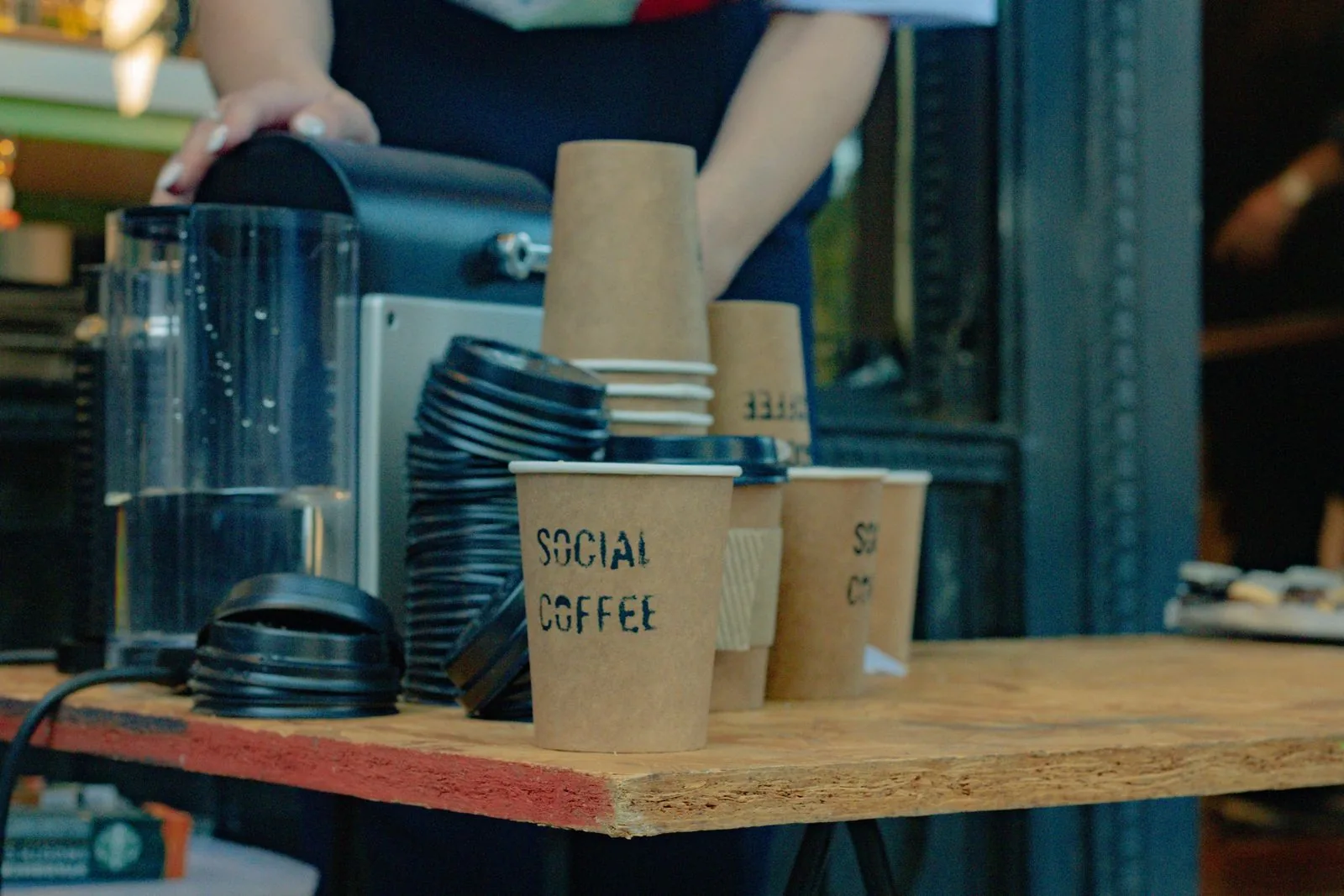
The disposable cup is the most widespread coffee vessel and the least described. It deserves the same rigor as porcelain, and it begins with a correction of vocabulary.
Cardboard alone does not hold a hot liquid. What holds the cup is a film applied to the inner face by extrusion, that is, by depositing a molten polymer onto the moving cardboard, and this film is almost always polyethylene. A manufacturing patent places this deposit between 10 and 25 grams per square meter. When we speak of the taste of a cup, we are therefore never speaking of the cardboard: we are speaking of a film a few tens of micrometers thick, brought to serving temperature.
This temperature, moreover, has been calculated. Brown and Diller sought the optimum between pleasure and risk of burns and placed it at 57.8 degrees, recommending a serving range of 54 to 71 degrees.
Two mechanisms have been measured, and the verdict is more nuanced than is said. The first is aroma trapping: the polymer absorbs odorant molecules from the liquid and removes them from the drinker's nose, nonpolar polymers such as polyethylene absorbing mainly nonpolar molecules. The most instructive measurement is that of van Willige and coauthors, who put low-density polyethylene in contact with orange juice: the absorption was massive, with valencene almost entirely disappearing from the model.
Then they put a panel through a triangle test, in which the taster must identify the odd one among three glasses. The panel did not distinguish the samples up to twenty-nine days of storage. The chemical loss was large, the perceived loss was nil. A cup holds the coffee for fifteen minutes, not twenty-nine days, and the aroma of coffee is dominated by polar compounds that polyethylene absorbs poorly. The trapping exists; its scope on a takeaway coffee has never been measured.
The second mechanism is the reverse: the film gives off its own odors. Polyethylene is extruded between 280 and 340 degrees, and Andersson, Nielsen and Wesslén followed this degradation. Their measurement is clear: surface oxidation stays negligible up to 280 degrees and becomes more and more significant between 300 and 325. The perceived note called “plastic” correlates with C5 to C8 aldehydes and C7 to C9 ketones. In other words, the smell of a new cup comes from the manufacture of the film, not from the coffee.
The lid, PLA, and what really migrates
The lid and the hole. The lid closes the headspace of the cup, keeps the heat, and imposes a drinking hole of a few millimeters. It is this hole that matters most, because it sets the flow, hence the volume of the sip. Now Genovese and coauthors measured that this volume modifies retronasal release, that of the aromas that rise from the mouth to the nose on exhalation: with a 25 milliliter sip they observe a rise in certain aldehydes, and with smaller sips the aldehydes fall while beta-damascenone and 4-vinylguaiacol rise.
The profile does not diminish, it shifts. One reservation concerns the method: it is not a panel but a retronasal aroma simulator, where the beverage is put in contact with human saliva and the headspace analyzed by chromatography. Nobody tasted. And no experiment comparing a covered and an open cup on coffee was found. Lids sold as aroma releasers therefore put forward a plausible promise that is not measured.
PLA. Polylactic acid replaces polyethylene in so-called compostable cups. Its glass transition, that is, the temperature at which an amorphous polymer goes from rigid to rubbery, lies between 55 and 65 degrees. A coffee served at 60 degrees therefore reaches this threshold. Shi and coauthors compared the two linings in hot water: the total mass of particles released by PLA is 11.6 micrograms per liter against 0.9 for polyethylene, about twelve times more, with PLA nanoparticles confirmed in two size fractions and no polyethylene nanoparticle detected. The plant-based cup therefore releases more than the petroleum-based cup.
What migrates. Ranjan and coauthors pour 100 milliliters of water at 85 to 90 degrees into a paper cup and count about 25,000 micrometer-sized particles after fifteen minutes. Mohery and coauthors test twenty paper cups and five polypropylene cups: median lead of 1.38 micrograms per liter for paper, 37.2 for polypropylene, a factor above 26, the paper cup coming out here as the one that releases less of the two.
A Turkish study on forty cups finds DEHP as the dominant phthalate, up to 0.95 milligram per kilogram, and identifies five photoinitiators from the printing inks. This last point is worth noting: the decoration printed on the outside contributes to what is found inside.
These figures do not say “danger.” They say that a hot cup is an active chemical system, which is not the same thing, and that regulation has moved accordingly: the migration limit for DEHP was lowered from 1.5 to 0.6 milligrams per kilogram in 2023, and bisphenol A is banned in food contact by a regulation that entered into force on January 20, 2025, with deadlines: articles complying with the earlier rules could be placed on the market until July 20, 2026, until January 20, 2028 for certain packaging and professional equipment, and reusable articles may remain on sale until January 20, 2029.
Reusables have their own faults. Melamine, alone or loaded with bamboo fiber, gives off formaldehyde when hot: the Dutch food safety authority sampled forty-six commercial cups, of which 88 percent complied with the limit of 15 milligrams per kilogram, some exceeding 200 milligrams. A decisive detail, bamboo is not authorized in the European Union as an additive of plastic materials in contact with food, and the Netherlands, Belgium and Luxembourg have withdrawn these products from the market.
As for the metallic taste attributed everywhere to stainless steel, no blind sensory measurement on coffee in a stainless steel cup was found. What is measured is the reverse: Carvalho and Spence showed, on 51 experts and 132 consumers, that a simple metallized outer coating changes the scores, a Brazilian coffee being rated better in the bronze cup and a Kenyan in the gold one. The eye therefore weighs on the verdict, and the metal tested was only a surface color.
In this plateThe 15 sections
- 01Three things we must stop confusing
- 02The handleless cup, and the holder that takes on the status
- 03The Ethiopian sini, and a ceramic route older than coffee
- 04Europe does the opposite: it adds a handle and removes the holder
- 05The tazzina, and what the texts really say
- 06Material: the question asked at the counter is the wrong one
- 07Preheating, porosity, and two beliefs to sort out
- 08Shape: the only solid measurement in the file, and its counterexample
- 09Color, weight, rim thickness: three very unequal beliefs
- 10The cupping bowl, the only coffee vessel to be standardized
- 11Contemporary shapes: what we buy is a well-drawn hypothesis
- 12Asia, and vessels made for the nose
- 13The disposable cup, which is a plastic object
- 14The largest survey ever made, and why it does not settle the matter
- 15What can be said in the end, and what cannot
The table of contents, with the first sentence of each section