The tazzina, and what the texts really say
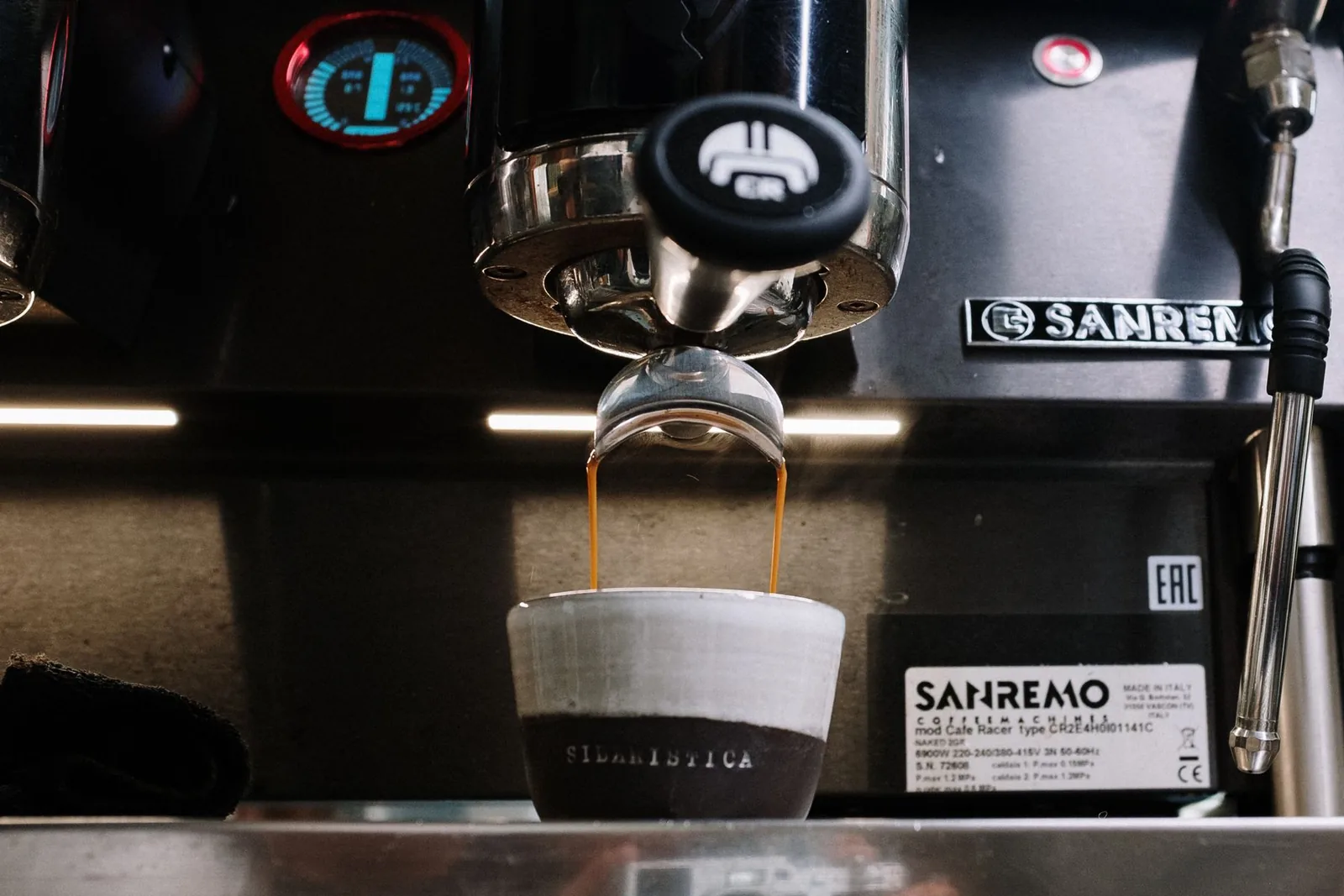
The espresso cup is the coffee vessel most often presented as standardized. It is worth looking closely at the texts, because they do not say what they are made to say.
The Istituto Nazionale Espresso Italiano defines certified espresso by six values: 7 grams of ground coffee to within half a gram, water at 88 degrees to within two degrees, a pressure of 9 bars to within one bar, a percolation of 25 seconds to within five seconds, a volume in the cup of 25 milliliters crema included, and a drink served at 67 degrees. The same institute then describes the ideal cup: white ceramic, with no interior decoration, of elliptical section truncated on the inside and flared on the outside, with a capacity of about 50 milliliters. This is a description, not an enforceable clause, and some secondary sources moreover widen this capacity to a range of 50 to 100 milliliters.
Next comes the specification of the Caffè Espresso Italiano Tradizionale, often cited for its cup requirements. The official 2018 document contains no vessel specification. Its eight parameters all concern extraction: pressure greater than or equal to 8 bars, mean flow of 0.48 to 1.3 grams per second, temperature of 90 to 96 degrees, dose of 7 to 9 grams, dry residue greater than or equal to 5 percent, quantity in the cup of 13 to 26 grams, covering crema persisting at least 120 seconds, extraction time of 20 to 27 seconds.
The clause on the cup does exist, but elsewhere: in the 2015 text, signed on June 16 of that year and still published. It asks for hard feldspathic porcelain, a base narrower than the opening, a thickness adequate to maintain the temperature, and a maximum content of 25 to 30 milliliters at 65 degrees. This clause is a normative assertion and not a measurement result: the text publishes neither a protocol nor a cooling curve. And the 2018 document, which is now the reference, does not repeat it.
In other words, the most regulated espresso cup in the world is not regulated today by any text in force.
Istituto Nazionale Espresso Italiano, specification of the Espresso Italiano Certificato; Consorzio di Tutela, “Disciplinare Caffè Espresso Italiano Tradizionale,” 2018 document, and 2015 text signed June 16, 2015In this plateThe 15 sections
- 01Three things we must stop confusing
- 02The handleless cup, and the holder that takes on the status
- 03The Ethiopian sini, and a ceramic route older than coffee
- 04Europe does the opposite: it adds a handle and removes the holder
- 05The tazzina, and what the texts really say
- 06Material: the question asked at the counter is the wrong one
- 07Preheating, porosity, and two beliefs to sort out
- 08Shape: the only solid measurement in the file, and its counterexample
- 09Color, weight, rim thickness: three very unequal beliefs
- 10The cupping bowl, the only coffee vessel to be standardized
- 11Contemporary shapes: what we buy is a well-drawn hypothesis
- 12Asia, and vessels made for the nose
- 13The disposable cup, which is a plastic object
- 14The largest survey ever made, and why it does not settle the matter
- 15What can be said in the end, and what cannot
The table of contents, with the first sentence of each section