The cupping bowl, the only coffee vessel to be standardized
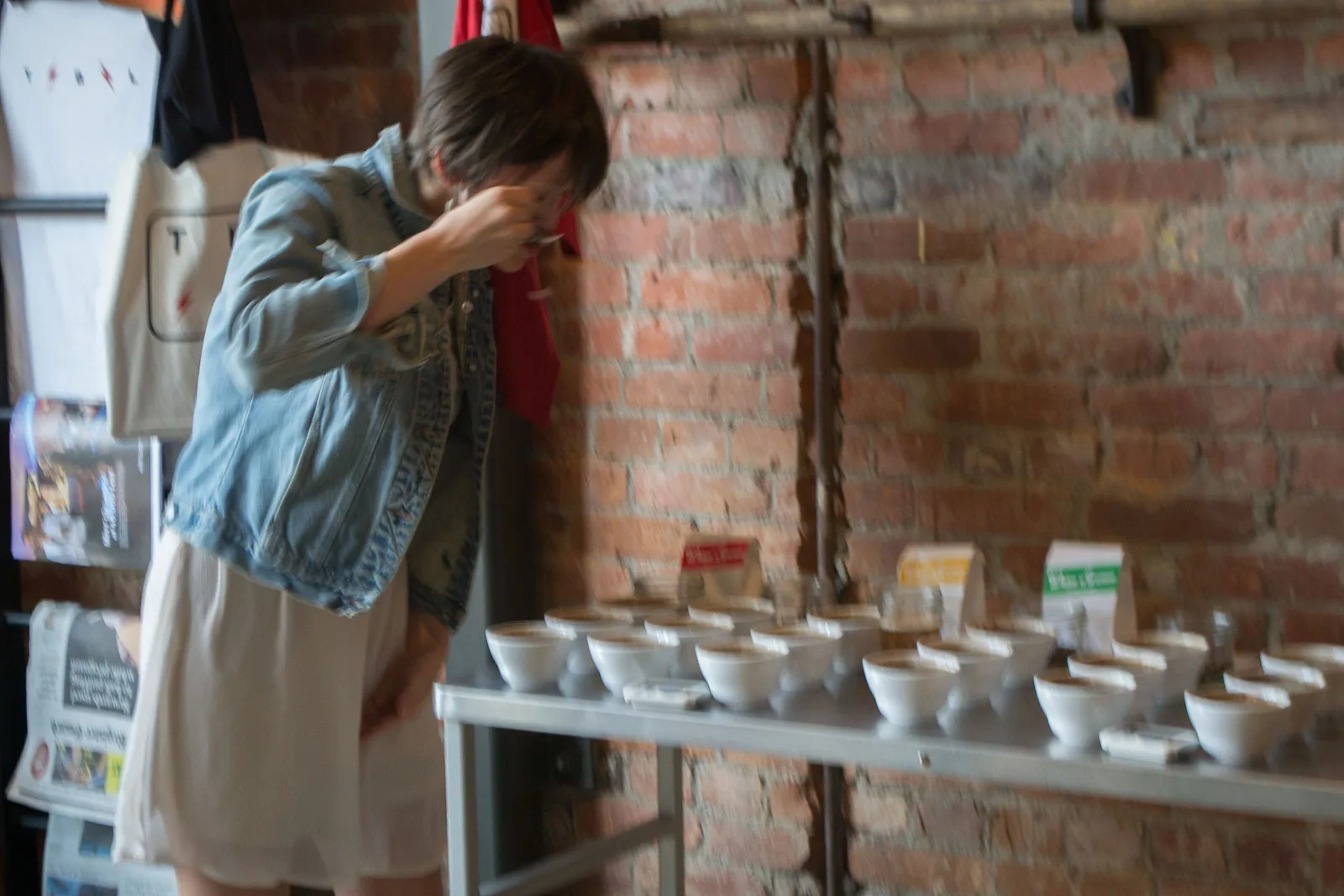
Coffee is drunk from just about anything. A single container escapes this freedom, and that is the cupping bowl, the vessel into which hot water is poured and from which the liquid is then slurped with a spoon. Its dimensions are written into a standard. Into two, in fact, which do not say the same thing.
The protocol of the Specialty Coffee Association, in its December 2015 version, imposes only four things on the vessel: tempered glass or ceramic, capacity of 207 to 266 milliliters, diameter at the top of 76 to 89 millimeters, and complete identity of all the cups of a session, fitted with lids. Standard 102-2024 widened the range to 200 to 350 milliliters for a diameter of 75 to 90 millimeters.
The international standard ISO 6668, for its part, describes a quite different object: a porcelain or glass cup of 150 to 350 milliliters, clean, odorless and free of cracks, with no diameter at all.
The only shape figure ever standardized in coffee is therefore the diameter of the SCA bowl, and it is recent: the 2005 version of the same protocol asked only for a whisky glass of five or six ounces, with no dimensions at all.
Why these values? Only one carries its reason in the text. The ratio of 8.25 grams for 150 milliliters makes 55 grams per liter, and the protocol specifies that it corresponds to the middle of the Golden Cup recipes. For the rest, the standard orders without explaining, and what follows is a reading of the mechanism rather than a quotation.
The capacity can be a wide range because it commands almost nothing, as long as the ratio is held. The diameter, for its part, commands not the extraction but the geometry: at fixed volume, imposing it amounts to imposing the height, therefore the thickness of the bed of grounds at the bottom and the free surface at the top. Now this surface does three things at once. It carries the crust, it receives the nose, and it sheds heat, since evaporation dominates the cooling of a hot liquid in open air.
A wider bowl therefore cools faster, and passes through the tasting window sooner. The lid, for its part, has its function written into the procedure: it is lifted to smell the dry grounds, and it holds the fragrance until the chosen moment.
This bowl is not made for drinking, and three facts say so
Extraction first. Liang, Chan and Ristenpart measured on their cupping trials an equilibrium yield of 23.9 percent, within 0.6, on caffeinated coffees, and 22.2 percent on decaf. That is above the 18 to 22 percent window aimed at for a beverage. How they measured must be stated: the coffee was brewed in a twelve-ounce glass, about 180 grams of water at 99 degrees on 9 to 14 grams of grounds, crust broken at the fourth minute, then ten more minutes before filtration.
The figure therefore describes the beverage at the end of a session, not at the moment of the first spoonful. The authors themselves point out a possible bias, these coffees having been brewed on the very day of their roasting, without degassing.
The same work incidentally gives a result that justifies the width of the normative ranges: at equilibrium, in full immersion, the yield is insensitive to the brew ratio, the grind size, the roast degree and the temperature between 80 and 99 degrees. A bowl of 210 milliliters and a bowl of 340, dosed at the same ratio, therefore give about the same beverage. What counts is the identity among the cups of a session, not the absolute value.
Temperature next. The SCA protocol has the tasting run from 71 to 21 degrees. The ISO standard, on the same product, skims the surface grounds and has the tasting between 50 and 55 degrees. The two standards do not put the same liquid in the mouth.
Finally, the direct comparison. Di Donfrancesco, Gutierrez Guzman and Chambers had thirteen coffees from Huila evaluated by two routes: four cuppers following the SCA protocol, and six trained judges tasting the filtered beverage served between 60 and 65 degrees. The two data sets overlap little. Only one pair of attributes stands out positively, and two correlations are negative. The cuppers moreover used 59 different terms, of which only four were used by more than two evaluators to describe the same coffee. The authors conclude that the two methods cannot substitute for each other.
This last result should not be over-interpreted, as it changes the vessel, the brewing, the temperature and the panel all at once: the share of the container cannot be isolated in it. It establishes only this, which is enough: the cupping score and the profile of a cup drunk are not the same object.
And there remains a hole, the most astonishing of the plate. No published experiment varies the geometry of the cupping bowl alone. The trade's phrases about the wide bowl that cools fast or the tall bowl that holds the aromas are consistent with physics, but they have not been measured on this object.
In this plateThe 15 sections
- 01Three things we must stop confusing
- 02The handleless cup, and the holder that takes on the status
- 03The Ethiopian sini, and a ceramic route older than coffee
- 04Europe does the opposite: it adds a handle and removes the holder
- 05The tazzina, and what the texts really say
- 06Material: the question asked at the counter is the wrong one
- 07Preheating, porosity, and two beliefs to sort out
- 08Shape: the only solid measurement in the file, and its counterexample
- 09Color, weight, rim thickness: three very unequal beliefs
- 10The cupping bowl, the only coffee vessel to be standardized
- 11Contemporary shapes: what we buy is a well-drawn hypothesis
- 12Asia, and vessels made for the nose
- 13The disposable cup, which is a plastic object
- 14The largest survey ever made, and why it does not settle the matter
- 15What can be said in the end, and what cannot
The table of contents, with the first sentence of each section