The Ethiopian sini, and a ceramic route older than coffee
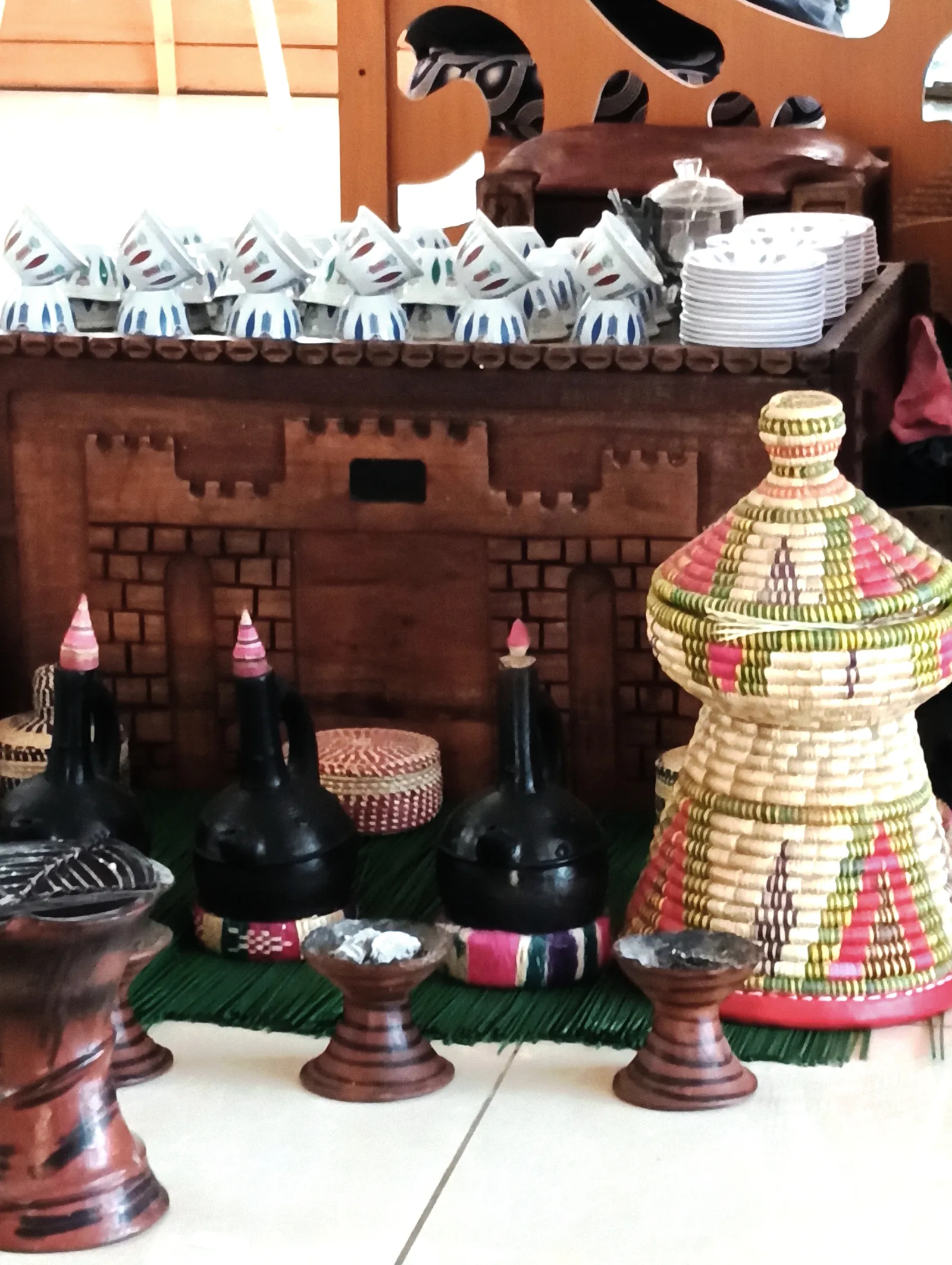
The Ethiopian ceremony serves coffee in small handleless cups, called sini, set on a tray. The coffee is poured from a height from the jebena, this narrow-necked clay pot, and the three successive servings have distinct names: abol, tona, baraka.
There is a chronological fact here that shifts the perspective. Porcelain reached Ethiopia across the Indian Ocean, and well before coffee. The excavations at Harlaa, in the east of the country, yielded 160 sherds of Chinese and Southeast Asian ceramics. Fifty-seven come from storage jars known as Martaban. Of the other 103, 93 are green-glazed, and most of it is celadon from the Longquan kilns, in Zhejiang, between the eleventh and the end of the fourteenth century. Coffee as a drink is attested only later.
In other words, the ceramic route precedes the coffee cup, and the ceremony inherited an object that was already there. It is an observation that can be generalized to almost this whole plate: coffee has very rarely had its vessels made for it, it has almost always taken over those of another drink.
The capacity commonly advertised for a sini, 60 to 80 milliliters, comes from sellers and popular sites, not from a published measurement. The ceremony is not inscribed on UNESCO's list: a national workshop to prepare the file was held on February 19 and 20, 2025 in Addis Ababa, with more than a hundred and twenty participants, and the nomination was still in progress on that date.
Timothy Insoll et al., “Material cosmopolitanism: the entrepot of Harlaa as an Islamic gateway to eastern Ethiopia,” Antiquity, vol. 95, 2021, pp. 487-507, section on imported ceramics; UNESCO, “Brewing Heritage: Ethiopia Advances File Preparation for Traditional Coffee Ceremony,” workshop of February 19 and 20, 2025In this plateThe 15 sections
- 01Three things we must stop confusing
- 02The handleless cup, and the holder that takes on the status
- 03The Ethiopian sini, and a ceramic route older than coffee
- 04Europe does the opposite: it adds a handle and removes the holder
- 05The tazzina, and what the texts really say
- 06Material: the question asked at the counter is the wrong one
- 07Preheating, porosity, and two beliefs to sort out
- 08Shape: the only solid measurement in the file, and its counterexample
- 09Color, weight, rim thickness: three very unequal beliefs
- 10The cupping bowl, the only coffee vessel to be standardized
- 11Contemporary shapes: what we buy is a well-drawn hypothesis
- 12Asia, and vessels made for the nose
- 13The disposable cup, which is a plastic object
- 14The largest survey ever made, and why it does not settle the matter
- 15What can be said in the end, and what cannot
The table of contents, with the first sentence of each section