Europe does the opposite: it adds a handle and removes the holder
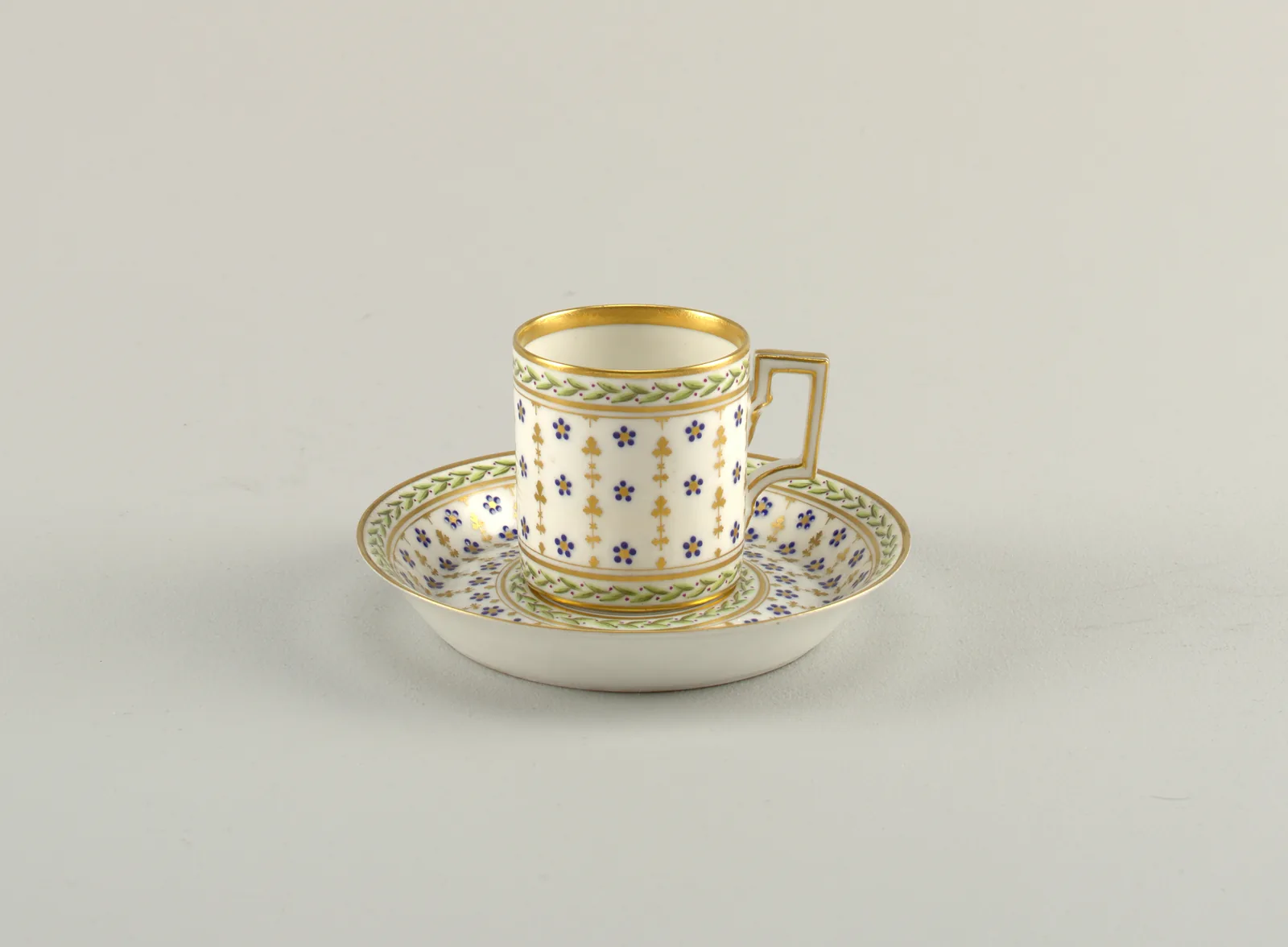
The European gesture is exactly symmetrical to the Ottoman one. Rather than wrapping a scalding cup in a holder, a grip is grafted onto it. The handle kills the zarf, and with it a whole silverwork craft.
The word follows the same path as the object. “Tasse” comes from the Arabic tass, by way of Middle French. Littré defines the demi-tasse as a cup smaller than ordinary cups, in which coffee with water is ordinarily served. The word enters English in 1842. The surviving examples are small: a soft-paste porcelain coffee cup from a service of the years 1780 to 1790 measures 4.6 centimeters high.
What makes the handle possible is not an idea, it is a material. Earthenware is a porous earth covered with a glaze, and it requires thick walls so as not to break. Hard-paste porcelain, made of kaolin and feldspar, vitrifies in firing and becomes dense. It therefore allows much thinner walls at equal strength, and a handle fine enough not to weigh the piece down.
The first successful firing of European hard-paste porcelain took place at Meissen in 1708, around Ehrenfried Walther von Tschirnhaus, who died in October of that year, and Johann Friedrich Böttger. The royal manufactory of Saxony was founded in January 1710. One often reads 1708 for the founding, which confuses the first firing with the creation of the establishment.
The kaolin of Saint-Yrieix, and why the sources do not agree
In France, everything changes with the discovery of the kaolin of Saint-Yrieix-la-Perche, in Limousin. The sources agree neither on the year nor on the author, and it must be said so rather than choosing.
The Louvre-Lens attributes the discovery to the chemist Pierre-Joseph Macquer, in 1766, and gives 1768 for the first hard-paste porcelain of Sèvres. The Limousin sources, among them the sheet of the École normale supérieure de Lyon, date it to 1768, at the place called Clos de Barre, and attribute it to Jean-Baptiste Darnet, a retired military doctor, the white earth having been identified by the Bordeaux apothecary Marc-Hilaire Villaris. Louis XV buys the seam for Sèvres. The first Limoges manufactory opens in 1771.
This disagreement is not trivial. It shows how closely the fabrication of a national story of porcelain followed the fabrication of porcelain itself, and it invites distrust of round dates.
In this plateThe 15 sections
- 01Three things we must stop confusing
- 02The handleless cup, and the holder that takes on the status
- 03The Ethiopian sini, and a ceramic route older than coffee
- 04Europe does the opposite: it adds a handle and removes the holder
- 05The tazzina, and what the texts really say
- 06Material: the question asked at the counter is the wrong one
- 07Preheating, porosity, and two beliefs to sort out
- 08Shape: the only solid measurement in the file, and its counterexample
- 09Color, weight, rim thickness: three very unequal beliefs
- 10The cupping bowl, the only coffee vessel to be standardized
- 11Contemporary shapes: what we buy is a well-drawn hypothesis
- 12Asia, and vessels made for the nose
- 13The disposable cup, which is a plastic object
- 14The largest survey ever made, and why it does not settle the matter
- 15What can be said in the end, and what cannot
The table of contents, with the first sentence of each section