Five forms, five philosophies
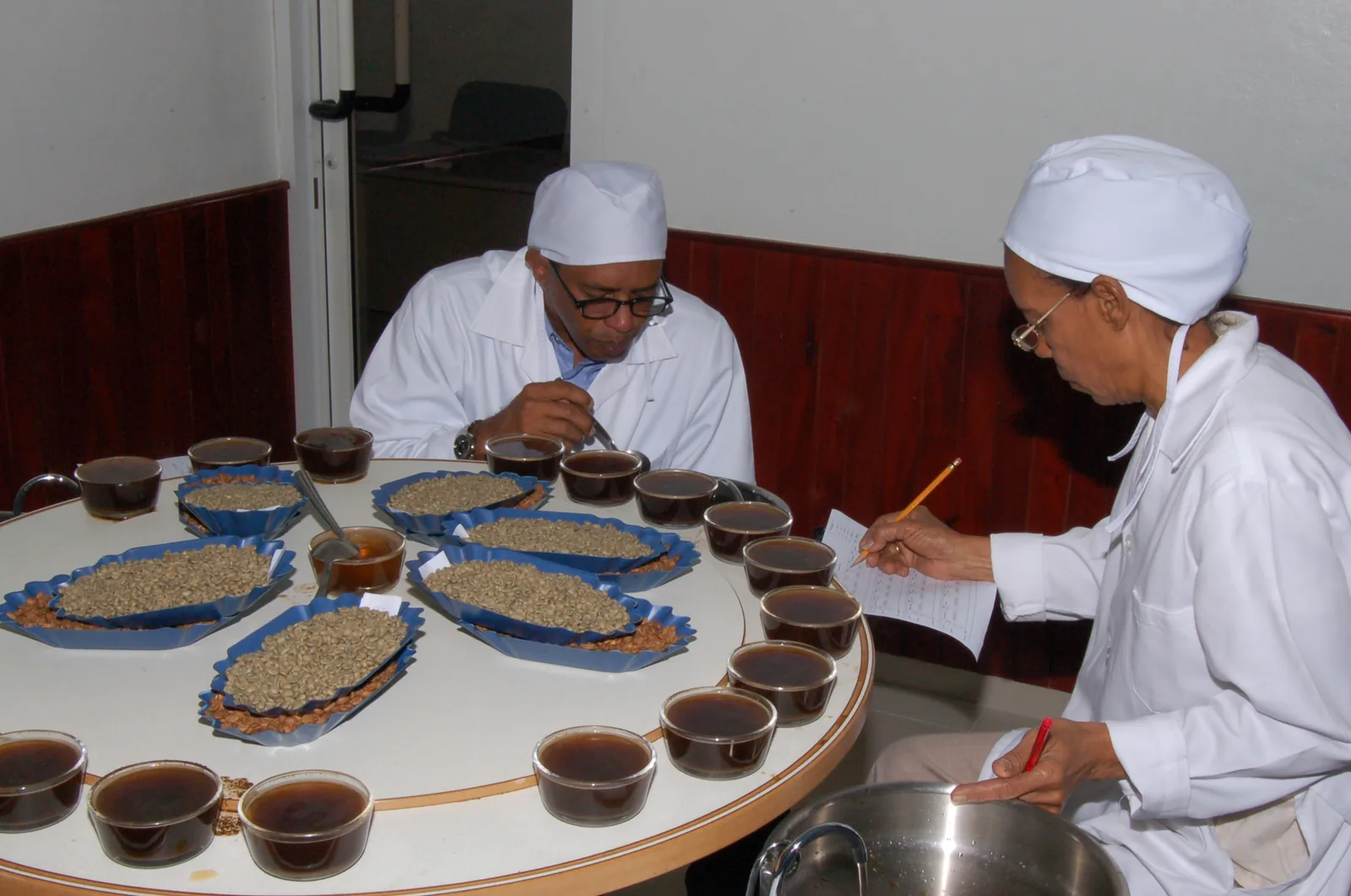
There is not one scoresheet but several, and the only way to find one's bearings is to ask, for each, which question it answers.
The Brazilian classification, the COB, answers: what price? It counts physical defects in 300 grams, with a scale: one full black bean is worth one defect, a shell one third, an insect-damaged bean a tenth, a large stick two. It then classifies the cup on two axes, soft / rio and fine / bad. It describes nothing. This is its strength as much as its limit: fast, reproducible from one warehouse to another, and blind to everything that makes specialty what it is.
| Form | Since | What it scores | Strength | Limite |
|---|---|---|---|---|
| COB (Brazil) | 1917 | defects in 300 g; soft/rio, fine/bad cup | fast, reproducible | describes nothing |
| SCAA 2004 | 2004 | 10 attributes, 6-10, −2/−4 per bowl | worldwide scale, threshold 80 | mixes description and preference, compressed scores |
| Cup of Excellence | 1999 | 8 attributes 0-8 + 36; threshold 86 | calibrated juries, 4 rounds | designed to rank, not to buy |
| Professional training (France) | 2010s | 9 criteria, nose × 1.5, geographic perimeter | fine within an origin | incomparable across origins |
| CVA (SCA) | 2023-2024 | physical, descriptive (1-15, CATA), affective (1-9 × 8), extrinsic | separates “it is” from “I like” | four sheets, training to be redone |
The 2004 SCAA scoresheet answers: what is this coffee worth on a universal scale? Ten attributes, a single number at the end, deductions by bowl. It made worldwide comparison possible, along with the famous 80-point threshold. Its flaws are known: it mixes description and preference, it starts at 6 as if every coffee were at least good, and it compresses scores between 80 and 90 to the point that buyers fight over quarter points.
The Cup of Excellence form answers: what is the best lot of this country this year? Eight attributes scored from 0 to 8 (clean cup, sweetness, acidity, mouthfeel, flavor, aftertaste, balance, overall impression), plus 36 base points, and a threshold of 86 to pass each round.
The funnel deserves to be detailed, because it explains the price of these lots. It starts with 300 samples or more, each tasted four times. At most 150 pass the preselection. 90 pass the national jury, made up of about twenty cuppers from the country. 40 go to the international jury. 30 receive the label. And the top 10 are retasted to establish the ranking. A calibration day precedes each stage, so that all the judges score on the same ruler.
The professional training scoresheet cited above answers: how does this coffee place within its origin? Nine criteria, a coefficient of 1.5 on the nose, a geographic perimeter. It is fine for an importer comparing Brazils with one another, and unusable for comparing a Brazil with a Kenya.
The 2023-2024 CVA answers four separate questions, and that is both its strength and its weakness. Its strength: “I like it” and “it is acidic” are no longer confused. Its weakness, according to its critics: four sheets instead of one, training to be redone, and a market that keeps asking for a single number.
professional training document, classifications and purchase descriptions of green coffee, p. 8-10; SCAA, Cupping Form (2004); Scott Rao, A Deep Dive into Cup of Excellence (blog, trade press); professional training document, tasting guide, p. 3; Perfect Daily Grind, May 2025In this plateThe 18 sections
- 01What green coffee contains
- 02What heat makes of it
- 03Five tastes, and touch
- 04The nose, twice
- 05Naming: from trade vocabulary to the wheel
- 06Acidity, six acids and a confusion
- 07How much citric acid is in a coffee? Six answers
- 08Cupping, where the gesture comes from
- 09The protocol
- 10The 2004 scoresheet and what 80 points are worth
- 11Five forms, five philosophies
- 12When chemistry discriminates, and what it really discriminates
- 13The Q Grader
- 14Cup defects and their cause
- 15What each link changes
- 16Extraction: Lockhart, 18 to 22%, and what was made of it
- 17Instruments: what each one measures, and what it misses
- 18Today
The table of contents, with the first sentence of each section