The protocol
What does the cupping protocol fix?
Start the scene or choose a stage. The animation simplifies the mechanism; what follows gives the details and the available references.
The ratio is 8.25 g of coffee for 150 mL of water, to within 0.25 g, that is 5.5 g per 100 mL, and five bowls per sample. The grind, a little coarser than for a filter, lets 70 to 75% of the particles through a US sieve of mesh 20; it is done bowl by bowl, at most 15 minutes before the water, purging the grinder between two coffees.
Read the stages without animation
- Weigh and grind, bowl by bowlThe ratio is 8.25 g of coffee for 150 mL of water, to within 0.25 g, that is 5.5 g per 100 mL, and five bowls per sample. The grind, a little coarser than for a filter, lets 70 to 75% of the particles through a US sieve of mesh 20; it is done bowl by bowl, at most 15 minutes before the water, purging the grinder between two coffees.
- Pour at 93 °CThe water is clean, odorless, between 125 and 175 ppm of dissolved solids, neither distilled nor softened, poured at 93 °C directly onto the grounds. The grounds rise and form a crust. The professional training protocol justifies it: above 95 °C “you burn,” below 90 “you under-extract.”
- Break the crust at four minutesAfter four minutes, five at most, the crust is broken by pushing the grounds back three times with the back of the spoon, nose right at the rim of the bowl: the volatiles trapped under the crust escape all at once.
- Skim, then slurpThe foam is removed, then the coffee is slurped from the spoon, drawing in air. Flavor and aftertaste are judged at about 71 °C; the professional training places the maximum of the aromas there, around 8 to 10 minutes, and first checks the concentration with the refractometer so that the bowls all have the same strength.
- Judge as it coolsThe reading follows the thermometer: acidity, body and balance between 70 and 60 °C, sweetness, uniformity and clean cup as the liquor approaches 37 °C. Evaluation stops below 21 °C.
To remember: The protocol fixes the dose, the water, the time and the gesture, then reads each attribute at the temperature where it is best perceived.
In history: The SCAA published it in 2004; it was revised in 2015.
Read the full article and its sources ↓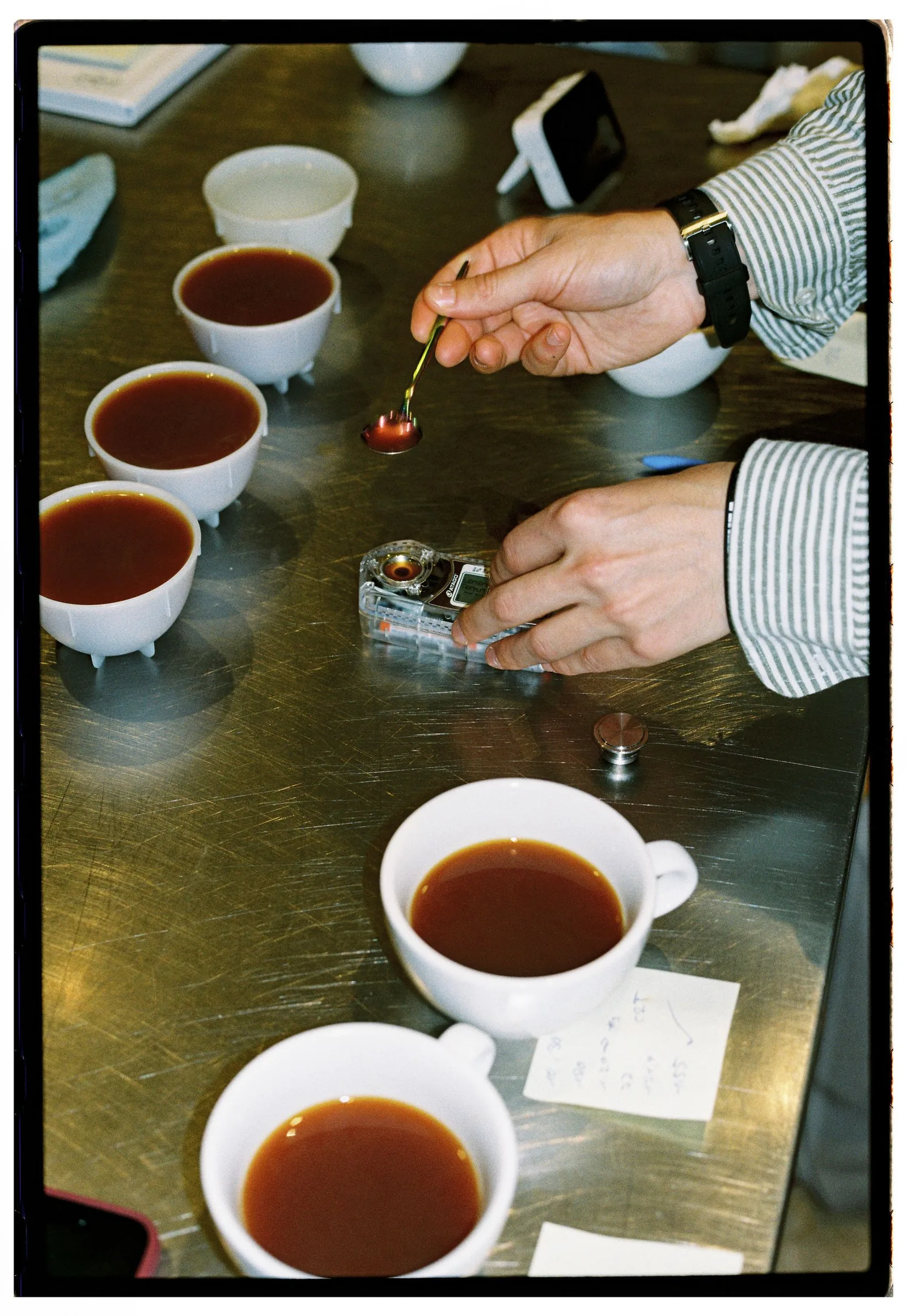
The protocol the SCAA published in 2004 sets figures that the whole world adopted. Samples are roasted in 8 to 12 minutes, to a light to medium-light color (Agtron 58 whole bean, 63 ground on the Gourmet scale), and rest between 8 and 24 hours. The grind is a little coarser than for a filter, 70 to 75% of the particles passing a US sieve of mesh 20, and it is done bowl by bowl, at most 15 minutes before the water, purging the grinder between two coffees.
The ratio is 8.25 g of coffee for 150 mL of water, to within 0.25 g, which gives 5.5 g per 100 mL; five bowls per sample. The water is clean, odorless, between 125 and 175 ppm of dissolved solids, neither distilled nor softened, poured at 93 °C directly onto the grounds. After four minutes (five at most), the crust is broken by pushing the grounds back three times with the back of the spoon, nose right at the rim of the bowl, the surface is skimmed, and then the coffee is slurped from the spoon, drawing in air.
| Protocol | SCAA 2004 | Professional training (France) |
|---|---|---|
| Dose | 8.25 g / 150 mL (± 0.25) | 8.25 g / 150 mL (± 0.25) |
| Bowls | 5 | 3 |
| Water | 125-175 ppm, 93 °C | 50-150 ppm, 93 °C (90-95) |
| Roasting | 8-12 min, Agtron 58/63, rest 8-24 h | 8-12 min, Neuhaus 85-95 / 100-120, rest 8 h min. |
| Steeping | 4 min, crust broken in 3 movements, skimming | 4 min, crust broken in 3 movements |
| Flavor, aromas | 71 °C | 71 °C (8-10 min) |
| Acidity, body | 70-60 °C | 71-60 °C, 2-3 passes |
| Sweetness, uniformity, clean cup | around 37 °C | per bowl, out of 3 |
| Scoring | 10 attributes, 6-10, defects −2/−4 per bowl | 9 criteria out of 10, odors and aromas × 1.5 |
Flavor and aftertaste are judged at about 71 °C, acidity, body and balance between 70 and 60 °C, and sweetness, uniformity and clean cup as the liquor approaches 37 °C; evaluation stops below 21 °C.
SCAA, Cupping Protocols (2004, revised 2015); Lingle, The Coffee Cupper's Handbook, 4th ed. (2011)House variants are numerous, and each says what its author is looking for. A French professional training protocol gives a good example: it takes up the SCAA framework and adds several requirements.
The setting first. Tasting takes place between 8 and 11 in the morning, in a room with no fragrance and no telephone: nothing that smells, nothing that distracts. At least two cuppers are needed and three bowls per coffee, because the scoresheet precisely scores the consistency from one bowl to another.
Then the roast. The density of the lot is measured, then 100 g are roasted in a sample roaster, in 8 to 12 minutes, dropped before second crack. The target color runs from 85 to 95 for whole bean and from 100 to 120 for ground, measured with the Neuhaus Colortest II.
The steeping keeps the SCAA ratio, 8.25 g per 150 mL. The water measures 50 to 150 ppm and is poured at 93 °C. The range is narrow, and the protocol says why: above 95 °C “you burn,” below 90 “you under-extract.” Four minutes, then three movements to break the crust.
Then comes a gesture the SCAA does not require: the concentration is checked with the VST refractometer before scoring. The aim is to make sure that the bowls being compared all have the same strength, failing which one would be scoring a dilution rather than a coffee.
Finally, the reading follows the clock and the thermometer. Odors are judged 3 to 4 minutes after steeping. Aromas are judged at 71 °C, around 8 to 10 minutes, because that is where they are at their maximum. Matter, brightness and sweetness are judged between 71 and 60 °C, going back over the bowls two or three times.
professional training document, tasting guide, p. 2-6In this plateThe 18 sections
- 01What green coffee contains
- 02What heat makes of it
- 03Five tastes, and touch
- 04The nose, twice
- 05Naming: from trade vocabulary to the wheel
- 06Acidity, six acids and a confusion
- 07How much citric acid is in a coffee? Six answers
- 08Cupping, where the gesture comes from
- 09The protocol
- 10The 2004 scoresheet and what 80 points are worth
- 11Five forms, five philosophies
- 12When chemistry discriminates, and what it really discriminates
- 13The Q Grader
- 14Cup defects and their cause
- 15What each link changes
- 16Extraction: Lockhart, 18 to 22%, and what was made of it
- 17Instruments: what each one measures, and what it misses
- 18Today
The table of contents, with the first sentence of each section