Naming: from trade vocabulary to the wheel
How was the flavor wheel built?
Start the scene or choose a stage. The animation simplifies the mechanism; what follows gives the details and the available references.
In 1986, Ted Lingle did not just draw up a list of defects: he sorted them by the place where they can be corrected. Harvest and drying give the earthy, the moldy, the fermented; storage, grass, straw, wood; roasting, green, tipped, baked, burnt. His first flavor wheel appeared in 1995 and stayed in use for twenty years.
Read the stages without animation
- Sorting defects by originIn 1986, Ted Lingle did not just draw up a list of defects: he sorted them by the place where they can be corrected. Harvest and drying give the earthy, the moldy, the fermented; storage, grass, straw, wood; roasting, green, tipped, baked, burnt. His first flavor wheel appeared in 1995 and stayed in use for twenty years.
- A lexicon of 110 attributesIn 2016, the SCAA and World Coffee Research replaced it. The new wheel rests on a lexicon of 110 attributes built at Kansas State University with Texas A&M. Each attribute is defined there by a commercial reference product and by an intensity on a 15-point scale: the word stops being an opinion.
- Having 72 people sort 99 wordsIt remained to arrange the words on the circle. Spencer and coauthors, at UC Davis, had 72 people sort 99 words freely, 29 trained panelists and 43 professionals. A hierarchical classification, that is, a method that groups step by step the words sorted together, drew nine classes from it.
- Placing neighbors side by sideA multidimensional analysis then placed each class on the circle, so that neighbors on the wheel are those that tasters spontaneously bring together: fruity, sour/fermented, green/vegetative, other, roasted, spicy, nutty/cocoa, sweet, floral.
- Saying “cherry”A cupper says “cherry.” One starts from the center, the fruity class, goes down to the attribute, and the attribute points to a product one can buy and taste: a branded tart cherry juice, with its intensity. Version 2.0 of October 2017 adds references for 24 attributes, including acetic, fermented, musty and jasmine.
To remember: The 2016 wheel is not a list but an arrangement: words defined by a reference product, placed where tasters bring them together.
In history: Ukers, in 1922, was already listing the “trade designations” of the New York cup tester.
Read the full article and its sources ↓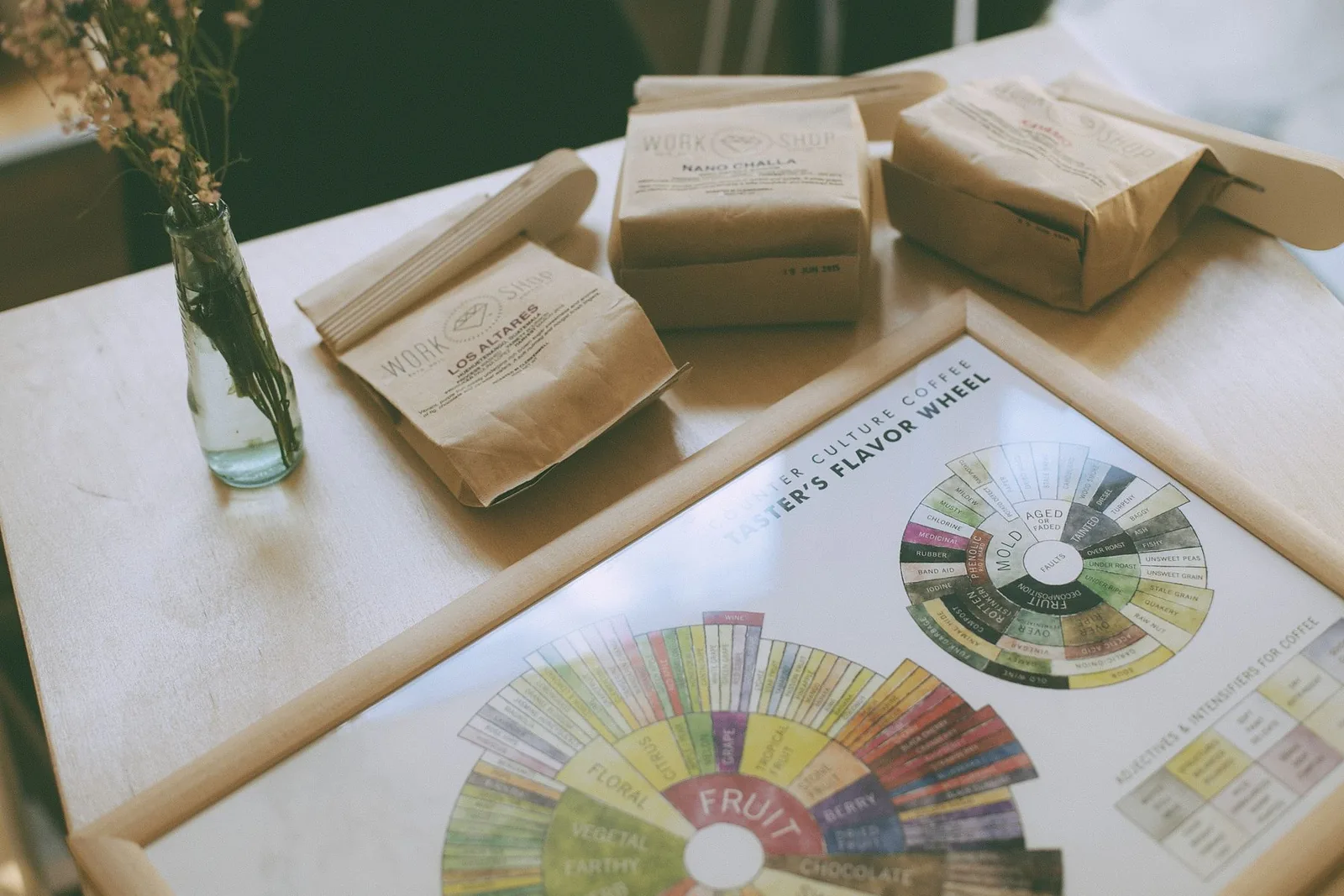
The first vocabulary is that of the merchants. Ukers, in 1922, lists the “trade designations” that the palate of the New York cup tester applies to a liquor: it has body, it is smooth, rich, acidy or mellow; winy, neutral, harsh or Rioy; musty, groundy, woody or grassy; rank, hidey (sour), muddy or bitter. Each word has an effect on price. Brazil, for its part, formalizes a two-axis cup scale that purchase descriptions still carry: softness, from strictly soft to soft, softish, hard, hardish and rio; fineness, from fine cup to good, fair, poor and bad cup.
Ukers 1922, ch. XXIV, p. 551; professional training document, classifications and purchase descriptions of green coffee, p. 8The modern vocabulary was born with Ted Lingle, executive director of the Specialty Coffee Association of America. His Coffee Cupper's Handbook appeared in 1986. Its novelty is not the list of defects but how they are sorted: Lingle classes them by origin, and therefore by the place where they can be corrected.
- Harvest and dryingearthy, moldy, fermented.
- Storagegrass, straw, wood.
- Roastinggreen, tipped, baked, burnt.
- Agingflat, stale, rancid.
Lingle then published, in 1995, the first flavor wheel. It stayed in use for twenty years.
In 2016, the SCAA and World Coffee Research replaced it. The new wheel rests on the Sensory Lexicon of the Sensory Analysis Center at Kansas State University, built with Texas A&M. It has 110 attributes of flavor, aroma and texture.
Its principle settles an old problem: two cuppers who say “cherry” are not necessarily thinking of the same cherry. Each attribute is therefore defined by a commercial reference product and by an intensity on a 15-point scale. The reference for “cherry” is a branded tart cherry juice, which one can buy and taste. The word stops being an opinion.
Version 2.0, of October 2017, adds references for 24 attributes, including acetic, butyric, isovaleric, fermented, musty and jasmine.
It remained to decide how to arrange the words on the circle, and the authors did not decide alone. Spencer and his coauthors (UC Davis) had 72 people sort 99 words freely: 29 trained panelists and 43 professionals recruited by the SCAA. A hierarchical classification then brought out nine main classes. A multidimensional analysis placed each group on the circle, so that neighbors on the wheel are those that tasters spontaneously bring together.
The nine classes are fruity, sour/fermented, green/vegetative, other (chemical, papery), roasted, spicy, nutty/cocoa, sweet and floral.
Lingle, The Coffee Cupper's Handbook, SCAA (1986); World Coffee Research, Sensory Lexicon (2016) and 2.0 (October 2017); Spencer, Sage, Velez, Guinard, Journal of Food Science 81 (2016), 10.1111/1750-3841.13555; SCAA News, January 19, 2016A French tool took another path. A Bordeaux importer had a set of 48 vials built with the aroma house Cinquième Sens. The method is short: about fifty coffees roasted to three profiles, tasted blind by six people, three coffee experts and three aroma experts.
The selection rule is the interesting point. A note was kept only if at least four of the six had perceived it. The set therefore does not list everything one can smell in a coffee, but what six trained noses agree on.
The 48 notes are sorted into eight families.
- Citruslemon, lime, grapefruit.
- Fruitypineapple, cherry, raspberry, apple, apricot, passion fruit, cassie.
- Floraljasmine, iris, rose, violet.
- Gourmandcocoa, caramel, praline, honey, hazelnut, vanilla, toast, butter, cereals, licorice, tonka bean, milk.
- Spicycinnamon, ginger, pepper, clove, coriander, cardamom.
- Woodycedar, sandalwood, vetiver, patchouli, guaiac, forest floor.
- Vegetalbay leaf, blackcurrant bud, bell pepper, rhubarb.
- Leatherbirch, tobacco leaf, animal.
The difference from the World Coffee Research lexicon lies in the size of the panel. Here, six people; the 2016 wheel, by contrast, was drawn from the sorting of 72. This is a pedagogical consensus, not a nomenclature, and it is used as a learning tool.
professional training document, coffee odors and aromas, p. 6 and 8In this plateThe 18 sections
- 01What green coffee contains
- 02What heat makes of it
- 03Five tastes, and touch
- 04The nose, twice
- 05Naming: from trade vocabulary to the wheel
- 06Acidity, six acids and a confusion
- 07How much citric acid is in a coffee? Six answers
- 08Cupping, where the gesture comes from
- 09The protocol
- 10The 2004 scoresheet and what 80 points are worth
- 11Five forms, five philosophies
- 12When chemistry discriminates, and what it really discriminates
- 13The Q Grader
- 14Cup defects and their cause
- 15What each link changes
- 16Extraction: Lockhart, 18 to 22%, and what was made of it
- 17Instruments: what each one measures, and what it misses
- 18Today
The table of contents, with the first sentence of each section