What heat makes of it
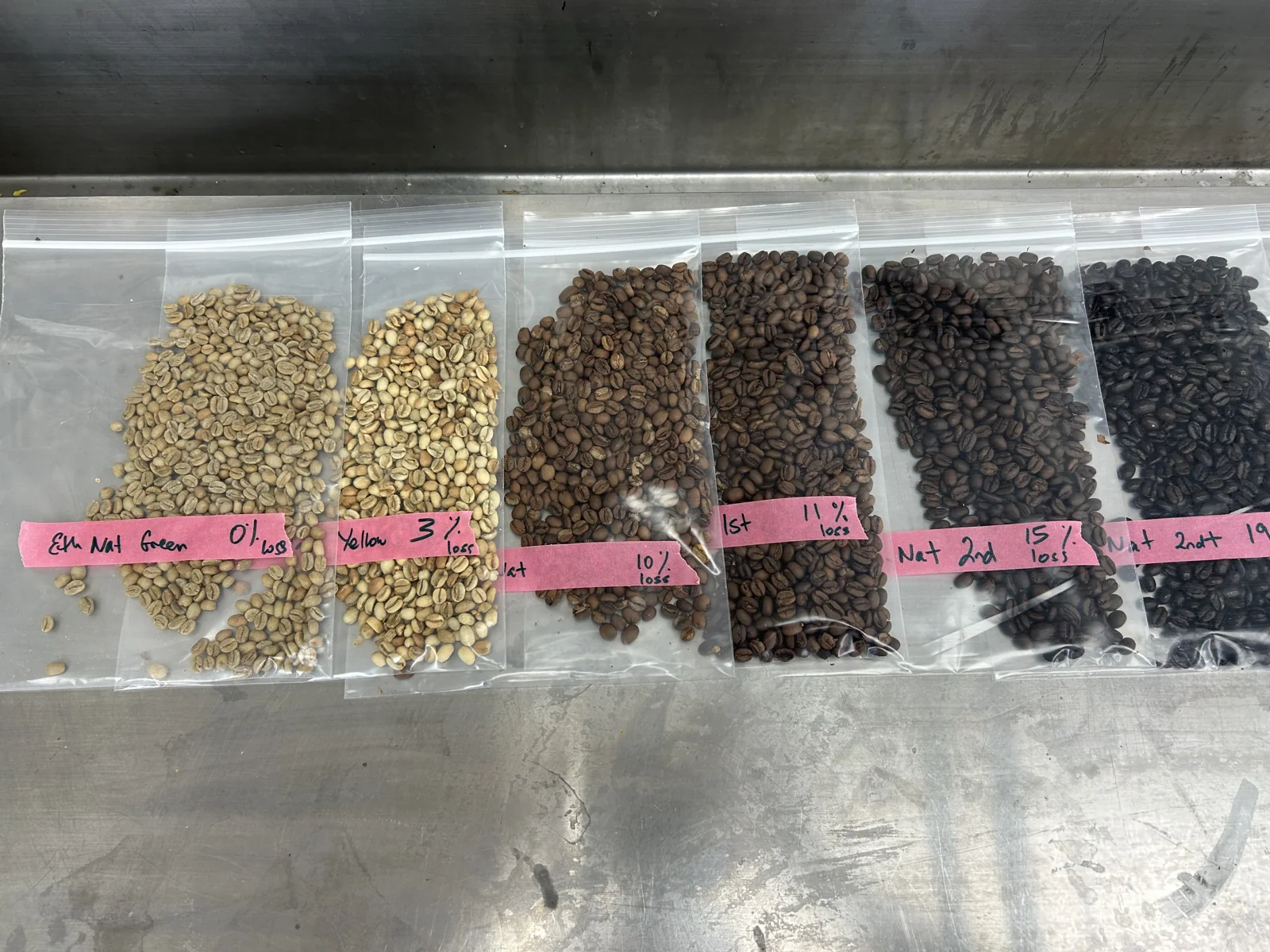
Two families of reactions govern roasting, and they are those of bread crust and caramel. The Maillard reaction, described by Louis-Camille Maillard in the early 20th century, makes sugars and nitrogen compounds react and produces both the brown color and hundreds of aromatic molecules; caramelization breaks down sugars alone. Both make melanoidins, heterogeneous brown polymers built on sucrose, arabinogalactans, galactomannans, proteins and chlorogenic acids, which make up as much as 25% of the dry matter of a cup and carry the color, part of the body and of the astringency.
Trigonelline is degraded by 50 or 80% depending on the roast degree, into nicotinic acid (vitamin B3, 1 to 2% of what is degraded), pyridine and methylpyridines. Sucrose almost entirely disappears. The detail of the roast is on the roasting plate.
Moreira, Nunes, Domingues, Coimbra, Food & Function 3 (2012), p. 903-915; RSC 2019, ch. Trigonelline; Yang et al. 2026, p. 12; LC ch. 16bBitterness is mostly made by the roast, not inherited from the bean. In 2007, Thomas Hofmann and Oliver Frank (University of Münster, then TU Munich) isolated the bitter compounds of roasted coffee by fractionation: the chlorogenic acid lactones, formed when CGAs lose a molecule of water, give the frank and pleasant bitterness of light to medium roasts; if roasting continues, these lactones break into 4-vinylcatechol, which oligomerizes into hydroxylated phenylindanes, responsible for the harsh and lingering bitterness of overroasted coffees.
Caffeine, which the public takes to be the source of bitterness, accounts for only part of it. In the same movement, the breakdown of CGAs releases quinic acid, whose content rises with dark roasting, with aging and with the cooling of the cup.
Frank, Blumberg, Kunert, Zehentbauer, Hofmann, J. Agric. Food Chem. 55 (2007), summarized by the American Chemical Society, August 21, 2007; professional training document, acidity in coffee, p. 3Volatiles are the other product of roasting. More than a thousand volatile compounds have been identified in roasted coffee, but only a minority really weighs on the aroma. The reason is the perception threshold: a molecule counts only if its concentration exceeds the dose at which the nose detects it. Being present is not enough.
Sorting through these thousand compounds therefore required a method. In 1992, Blank, Sen and Grosch (Deutsche Forschungsanstalt für Lebensmittelchemie, Garching) tried one on the ground coffee and the brew of an arabica. Their tool is aroma extract dilution analysis, that is, the extract is diluted in steps until the odor is no longer perceived. The longer a molecule resists dilution, the more it weighs.
They thus retained 13 key odorants, including 2-furfurylthiol (roasty, “coffee”), methional (boiled potato), several methoxypyrazines (vegetal, bell pepper) and furanones. Grosch's later work raised the list to 25 or 30 high-impact compounds.
These compounds are grouped by chemical family, and each family brings its own register.
- Furansincluding furaneol (4-hydroxy-2,5-dimethyl-3(2H)-furanone), which smells of caramel.
- Pyrazinesfrom Strecker degradation. 2-ethyl-3,5-dimethylpyrazine leans toward earthy and toasted, 2,5-dimethylpyrazine carries the very smell of “roasted coffee.”
- Sulfur thiols2-furfurylthiol and 3-mercapto-3-methylbutyl formate, whose so-called “cat” note recalls blackcurrant.
- Aldehydesacetaldehyde and methional, already met above.
- Diketonessuch as 2,3-butanedione, which smells of butter.
- Volatile phenolsderived from ferulic acids: guaiacol and 4-vinylguaiacol, smoky and clove-like.
- β-damascenonecited separately, for cooked fruit and honey.
The roast degree shifts the balance between these families. A 2024 study compared five roast degrees and counted 74 volatiles, of which 25 were active: 8 furans, 7 pyrazines, 2 ketones. Medium roasting concentrates the sweet, hazelnut and caramel notes; dark roasting tips toward burnt and sulfurous. One lot, two roasts, two aromas.
Blank, Sen, Grosch, Z. Lebensm. Unters. Forsch. 195 (1992), p. 239-245; Grosch, Chemistry III: Volatile Compounds, in Coffee: Recent Developments, Wiley (2001); Sunarharum, Williams, Smyth, Food Research International 62 (2014); Effect of Roasting Level on the Development of Key Aroma-Active Compounds in Coffee (2024, PMC11477549)In this plateThe 18 sections
- 01What green coffee contains
- 02What heat makes of it
- 03Five tastes, and touch
- 04The nose, twice
- 05Naming: from trade vocabulary to the wheel
- 06Acidity, six acids and a confusion
- 07How much citric acid is in a coffee? Six answers
- 08Cupping, where the gesture comes from
- 09The protocol
- 10The 2004 scoresheet and what 80 points are worth
- 11Five forms, five philosophies
- 12When chemistry discriminates, and what it really discriminates
- 13The Q Grader
- 14Cup defects and their cause
- 15What each link changes
- 16Extraction: Lockhart, 18 to 22%, and what was made of it
- 17Instruments: what each one measures, and what it misses
- 18Today
The table of contents, with the first sentence of each section