What green coffee contains
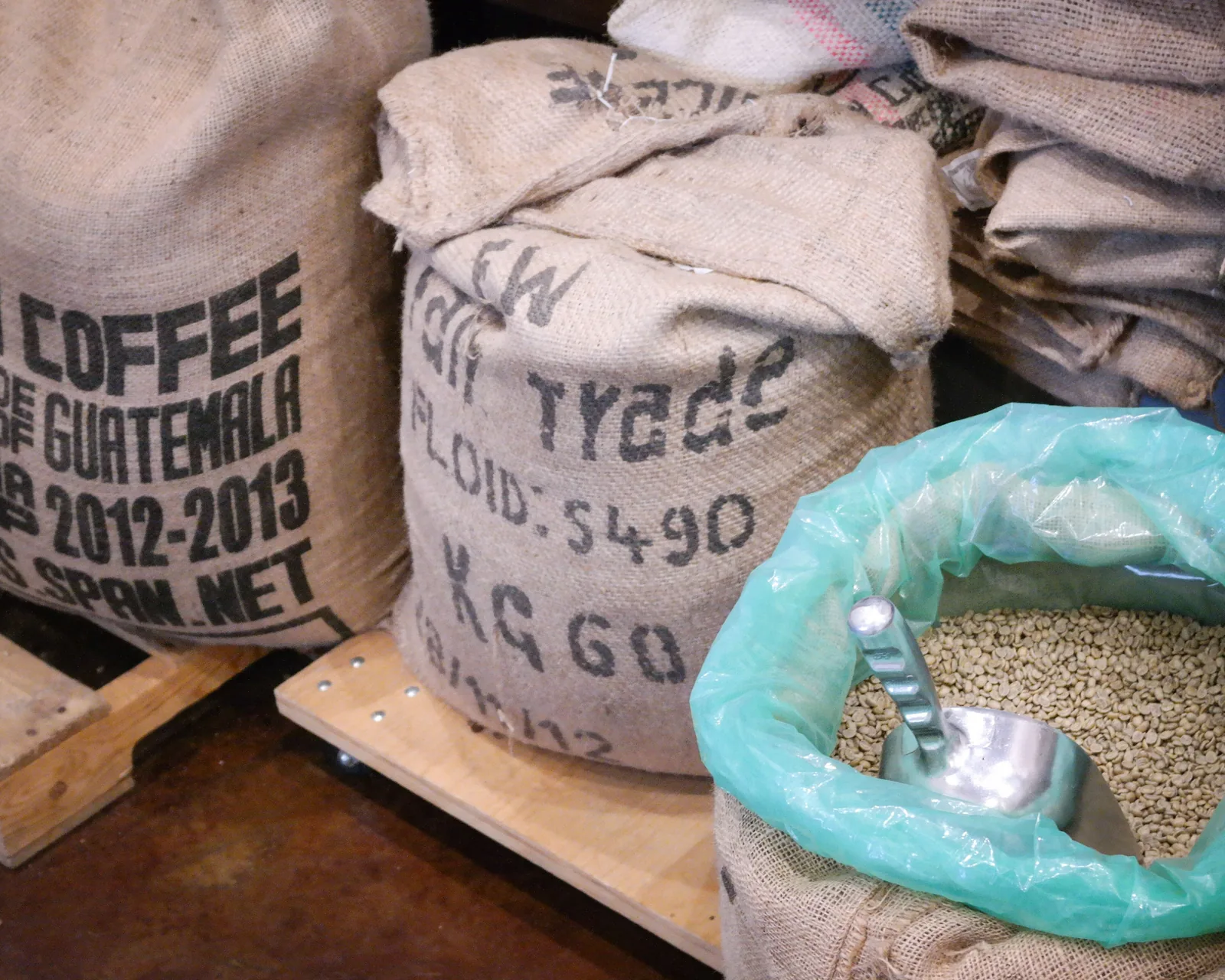
A green bean smells of almost nothing and contains none of the aromas of roasted coffee. It contains their precursors, a stock of raw materials that heat will transform. Sucrose first, 7.3 to 11.4% of dry weight in arabica; it is not found in the cup, it is the fuel of the roasting reactions. Chlorogenic acids (CGAs) next, polyphenols of which 5-caffeoylquinic dominates: 13.6 mg per fruit in arabica, 16.9 mg in canephora, which offsets the gap by accumulating less sugar.
| In green coffee (arabica) | Content | What roasting does to it |
|---|---|---|
| Sucrose | 7.3-11.4% dry | consumed: caramelization, Maillard, melanoidins |
| Chlorogenic acids | 13.6 mg/fruit (canephora 16.9) | bitter lactones, then phenylindanes; quinic acid |
| Lipids | 7-17% dry, 1/5 diterpenes | body, carrier of volatiles; oxidize in storage |
| Caffeine | 0.9-1.5% dry | stable; part of the bitterness |
| Trigonelline | ~1% dry | degraded by 50-80%: niacin, pyridines |
| Amino acids, proteins | Maillard nitrogen; pyrazines, Strecker | |
| Polysaccharides | framework of the melanoidins (up to 25% of the dry matter of the cup) | |
| Citric, malic, phosphoric acids | citric falls, quinic and acetic rise |
Lipids, 7 to 17% of dry weight, of which about a fifth is diterpenes (cafestol, kahweol); the difference in content between the two species exceeds 30%. Caffeine, finally, 0.9 to 1.5% in arabica according to the wide range in the literature (0.85 to 1.15% in the sample set of the 2026 review), about double in canephora, made by three methyltransferases (XMT, MXMT, DXMT) of which canephora has three highly expressed copies and arabica six less expressed ones.
Yang et al., Agriculture (2026), p. 3-5; LC ch. 16b and 17Green coffee does not stop there. Added to it are trigonelline, an alkaloid that weighs about as much as caffeine, around 1% of dry weight. Then proteins and free amino acids. Then polysaccharides, arabinogalactans and galactomannans. Then organic acids already present in the fruit: citric, malic, phosphoric.
Each has a use later on, and that is how they are recognized. Amino acids supply the nitrogen without which the Maillard reaction cannot get started, since this reaction is by definition the meeting of a sugar and a nitrogen compound. Polysaccharides will make the framework of the melanoidins, those large brown molecules that color the cup. Trigonelline is mostly destined to be destroyed by heat.
This list reads as a ceiling, not an inventory. Everything that will come out in the cup is already present here, as raw material. The farm, the climate, the variety and the fermentation make up this stock; roasting only consumes it. A roaster therefore cannot add what the bean does not have.
The 2026 review draws the same boundary. It explicitly treats roasting as the step that consumes the precursors accumulated upstream, and stops there.
Yang et al. 2026, p. 12; Moreira et al., Food & Function 3 (2012), on melanoidins; Royal Society of Chemistry, Coffee: Production, Quality and Chemistry (2019), ch. Trigonelline and Derivatives; LC ch. 16bIn this plateThe 18 sections
- 01What green coffee contains
- 02What heat makes of it
- 03Five tastes, and touch
- 04The nose, twice
- 05Naming: from trade vocabulary to the wheel
- 06Acidity, six acids and a confusion
- 07How much citric acid is in a coffee? Six answers
- 08Cupping, where the gesture comes from
- 09The protocol
- 10The 2004 scoresheet and what 80 points are worth
- 11Five forms, five philosophies
- 12When chemistry discriminates, and what it really discriminates
- 13The Q Grader
- 14Cup defects and their cause
- 15What each link changes
- 16Extraction: Lockhart, 18 to 22%, and what was made of it
- 17Instruments: what each one measures, and what it misses
- 18Today
The table of contents, with the first sentence of each section