Cupping, where the gesture comes from
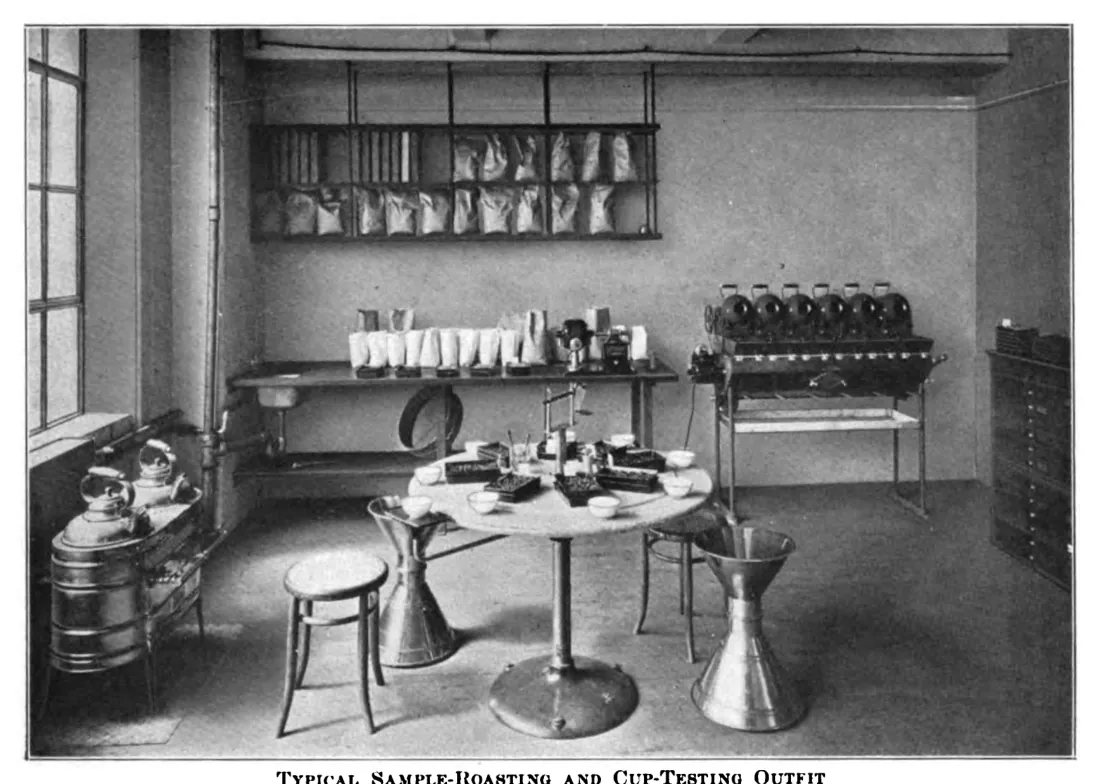
Until the end of the 19th century, almost all the coffees bought and sold in the United States were judged on the appearance of the green or roasted bean. Ukers, in 1922, describes the cup test that had become general: comparison of the green with a standard sample, comparison of the roasted, examination of the odor of the ground coffee, then “the most difficult of all,” the liquor. The tester roasts his samples in a six-ounce gas cylinder, distinguishes light, medium, dark, Italian and French roasts, notes the quakers, and smells the bean hot and then cooled.
Two methods coexist: the blind test, preferred by buyers and sellers, and the open test. In both, the ground coffee is weighed so that the strength is identical in every cup, and the water is poured at a constant temperature; a crust forms, and it is smelled before being broken (the “wet smell” or “crust test,” “held to be of great importance”), equal sips are slurped, and the coffee is spat into an hourglass-shaped brass spittoon, waist high.
“The expert never swallows the liquor.” The typical setup includes a turntable, a precision scale, brass kettles, porcelain cups and silver spoons.
Ukers 1922, ch. XXIV, p. 549-551Secondary sources attribute the systematization of the “cup test” to a San Francisco trader, Clarence E. Bickford, in the 1890s; the level of evidence is low (commercial pages and blogs, with no contemporary document cited). What is better established is the role of Brazil: the Brazilian official classification (COB) was built orally among warehouses, green coffee traders and cuppers, a cup evaluation system is in use in warehouses around 1910, and the Santos official coffee exchange classifies by the cup from 1917.
This is where the soft/rio scale comes from, along with the expression “Brazilian method” that French trainers still use for steeping directly in the bowl.
Daily Coffee News, February 21, 2019, COB: The Complex History of the Brazilian Official Classification System (trade press); professional training document, tasting guide, p. 4; on Bickford: commercial pages, not verifiedIn this plateThe 18 sections
- 01What green coffee contains
- 02What heat makes of it
- 03Five tastes, and touch
- 04The nose, twice
- 05Naming: from trade vocabulary to the wheel
- 06Acidity, six acids and a confusion
- 07How much citric acid is in a coffee? Six answers
- 08Cupping, where the gesture comes from
- 09The protocol
- 10The 2004 scoresheet and what 80 points are worth
- 11Five forms, five philosophies
- 12When chemistry discriminates, and what it really discriminates
- 13The Q Grader
- 14Cup defects and their cause
- 15What each link changes
- 16Extraction: Lockhart, 18 to 22%, and what was made of it
- 17Instruments: what each one measures, and what it misses
- 18Today
The table of contents, with the first sentence of each section