The inventory of substitutes
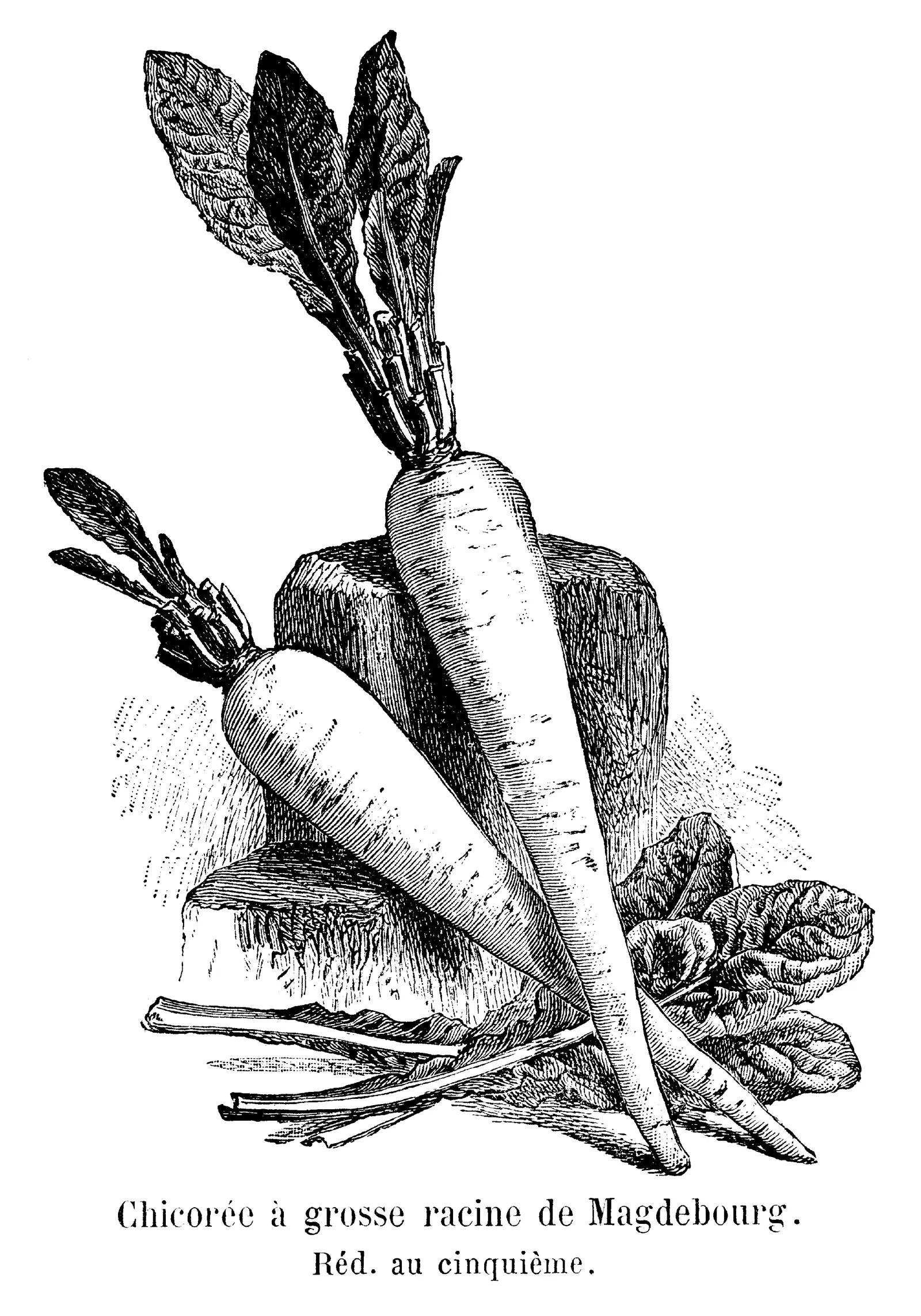
Walsh's list for ground coffee reads like a market gardener's order. Roots: chicory, dandelion, carrot, parsnip, beet. Seeds: peas, beans, rye, rice, wheat, barley. Then what one does not ordinarily eat: broom seeds, fenugreek, iris, acorns. Ukers, in 1922, lengthens the world inventory: malt, starch, acorns, soy, beet, figs, prunes, date stones, ivory nuts, sweet potato, carrots, peas, bananas, dried pears, grape seeds, dandelion root, citrus peels, lupin, whey, peanuts, juniper berries, rice, the fruit of the wax palm, kola nut, chickpeas, cassia seeds, and the seeds of any tree growing in the country that makes the substitute.
Attested substitutes
| Substitute | Period and place | What it adds to the cup |
|---|---|---|
| Roasted barley | Attested in the Levant as early as the 18th century (Scheuzer); Prussia 1781; world wars | Color, bitterness, starchy body |
| Chicory (root) | Holland around 1750-1770; Brunswick 1770; France after 1806; Louisiana 1861; India | Fast, strong color, bitterness, dense texture |
| Acorns, chestnuts, beechnuts | Germany, 1806-1812 blockade and world wars | Tannins, bitterness |
| Rye, wheat, oats, buckwheat, bran | Prussia 1781; United States, 19th century; Postum 1895 | Starch, roasted note |
| Dried figs | Prussia 1781; Austria | Caramelized sugars |
| Beet, carrot, parsnip, dandelion | England and the United States, 19th century | Sugars, color |
| Peas, beans, chickpeas, lupin | United States 1881; Germany; GDR 1977 (pea flour) | Weight, proteins that swell and clog filters |
| Dates and date stones | Ukers list 1922; Atomo 2023-2025 | Sugars, body |
| Betony, saloop (sassafras and sugar) | London, after 1666 and 1719 | Cheap hot drink |
| Spent coffee grounds, re-flavored | United States, before 1881 | The look of coffee, nothing else |
| Fake beans (plaster, then molded flour paste) | England and the United States, before 1894 | Blackish, muddy liquid, greasy sediment |
Cereals are prepared in two ways, by simply roasting the grains with or without sugar, molasses, tannin or citric acid, or by kneading the flour into a baked paste, ground and then roasted; sometimes the grains are sprouted or soaked before treatment.
Walsh 1894, p. 206; Ukers 1922, ch. XVII, p. 170In London, substitutes appeared right after the Great Fire of 1666, and for two opposite reasons. The first is taste: a liquor of betony, a medicinal plant, was sold to those who could not get used to the bitterness.
The second is price. In 1719, coffee cost 7 shillings a pound, and the street sold bocket or saloop, a decoction of sassafras and sugar served from stalls.
The United Kingdom then shifted to tea in the 19th century, but it kept a coffee and chicory essence, Camp Coffee, sold since 1885. It would get through the rationing of 1939-1945, that is, the moment when real coffee was again scarce.
In Louisiana, it is again a deprivation that fixed the custom. The blockade of New Orleans by the Union navy, during the Civil War, established chicory in coffee. The habit survived the conflict, even though the reason for the blend had disappeared with it. In India, chicory enters filter coffee and stays there.
The substitute thus ceased to be a stopgap and became a requirement. Ukers notes in 1922 that many French, Italian, Dutch and German consumers demand their chicory, as do many Southerners in America.
Ukers 1922, p. 73-74 and p. 404; en.wikipedia.org/wiki/Chicory, accessed September 7, 2026Why does chicory dominate all the others? Because the roasted root does almost everything one asks of coffee, except taste like it. It colors the water very quickly and very strongly, it gives a dense liquid that clings to the mouth, it is frankly bitter. Ukers gives its composition: the fresh root contains 77% water; pure roasted chicory is 74.2% soluble, with 26.1% glucose, 9.6% dextrin and inulin and 16.4% coloring matter, roasting converting inulin into reducing sugars, dextrin and caramel.
And chicory itself is adulterated: Walsh finds it cut with beet and fodder beet, some lots containing 95%, to the point that it would be more accurate, he says, to call them adulterated chicory.
Ukers 1922, p. 170; Walsh 1894, p. 215; LC ch. 10In this plateThe 17 sections
- 01What makes fraud possible
- 02Chicory, from Brunswick to the Continental Blockade
- 03The inventory of substitutes
- 04Dyeing, polishing, sweating: fraud on green coffee
- 05Molded fake beans
- 06Ground coffee: the thousand-pound formula
- 07Glazing and its patents
- 08The chemists: Accum, Hassall, the microscope and the oven
- 09The laws, country by country
- 10The substitute becomes an industry: Postum and the “cereal-fakers”
- 11Taste manufactured by habit
- 12Wartime ersatz: 1914, 1939, 1977
- 13Instant coffee and today's blends
- 14Modern fraud: the species, the origin, the vat
- 15Animal coffees, or rent-seeking on the story
- 16Today's detection tools
- 17Today
The table of contents, with the first sentence of each section