What happens, hour by hour
What happens in a washed tank, hour by hour?
Start the scene or choose a stage. The animation simplifies the mechanism; what follows gives the details and the available references.
The tank is loaded with pulped beans, covered in mucilage. The bath starts slightly acidic. An ordinary washed fermentation will last, according to this plate, from twelve to thirty-six hours.
Read the stages without animation
- Hour zeroThe tank is loaded with pulped beans, covered in mucilage. The bath starts slightly acidic. An ordinary washed fermentation will last, according to this plate, from twelve to thirty-six hours.
- Three curves in the same directionSugar, the raw material, is consumed: it is followed with a refractometer in degrees Brix, and the value falls steadily. Acidity, the main waste, rises: it is what makes the mucilage let go and kills the early microorganisms. The temperature rises a little, because eating gives off heat; a full tank therefore does not behave like a half-empty one.
- How many hours?Four sources give four ranges: 12 to 36 hours (this plate), 8 to 48 (Kornman), 24 to 72 (Hackler and Särchen), 14 to 42 (Cenicafé). They overlap only between 24 and 36 hours. Cenicafé requires fifteen and a half hours to exceed 97% of mucilage degraded: a lot stopped at eight hours is an unfinished fermentation.
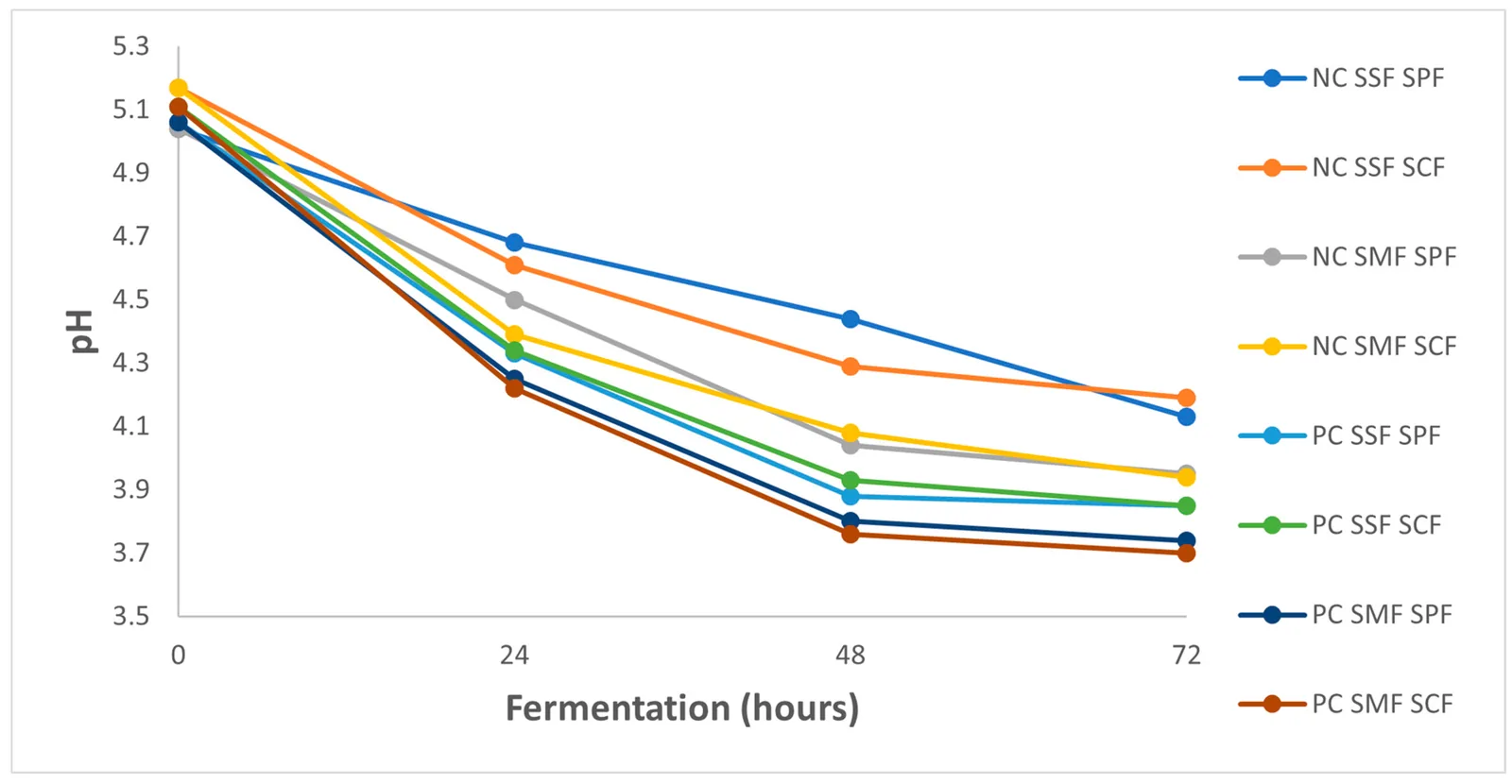
- Stopping by washingNone of this stops on its own at the right moment: it is the producer who stops it, by washing. The pH most often decides when to stop, with thresholds specific to each station. Extended, the fermentation exhausts the sugar, and the population then consumes the acids already produced.
To remember: A fermentation duration is a datum only if it travels with the temperature of the bath, the system used and the stopping criterion.
Read the full article and its sources ↓An ordinary washed fermentation lasts between twelve and thirty-six hours. What changes during that time comes down to three curves, and they all go the same way.
Sugar goes down. It is the raw material, it is consumed. It is measured with a refractometer, the instrument also used for wine, and the value falls steadily.
Acidity rises. It is the main waste. The bath starts slightly acidic and becomes markedly so. This acidity is what makes the mucilage let go, and it is also what kills the early microorganisms.
The temperature rises a little. Eating gives off heat. A well-loaded tank gains a few degrees on its surroundings, which speeds up the process further. This is why the same recipe does not give the same result in a full tank and in a half-empty one.
None of this stops on its own at the right moment. The producer is the one who stops it, by washing.
The quantities followed, and what each one governs
- Degrees BrixThe content of soluble matter, in practice sugar. It says how much fuel remains. Its fall is the most direct signal that the fermentation is working.
- pHThe quantity most used to decide when to stop, because it integrates everything that has been produced. The thresholds used are specific to each station and do not transfer.
- Bath temperatureIt governs the speed and the balance between yeasts and lactic acid bacteria. It is steered by shading, volume and the addition of water.
- MetabolitesEthanol, lactic acid, acetic acid, glycerol, mannitol. They are the true signature of a fermentation, but they require a laboratory.
An extended fermentation does not extend these curves indefinitely: the sugar runs out, and the population switches to pathways that consume something else, including the acids already produced. Past this point, nothing is built any more, things are transformed, and the margin between the remarkable and the defective narrows sharply.
Four duration ranges, and none that covers the others
The section opens on a duration, twelve to thirty-six hours for an ordinary washed fermentation. This is a defensible value, but it is not the only one in circulation, and the gap between sources is such that it deserves to be laid out rather than hidden by a choice.
Four ranges were recorded, given by four authorities of different kinds.
- Twelve to thirty-six hoursThe value of this plate, drawn from the professional outreach literature and from station records.
- Eight to forty-eight hoursChris Kornman, who presents it as probably the most common range, making it depend on regional traditions and temperatures.
- Twenty-four to seventy-two hoursHackler and Särchen, who write that the remaining pulp ferments in a water tank for one to three days.
- Fourteen to forty-two hoursCenicafé, as a recommendation, depending on the system and the temperature, with a Colombian field record that goes down to ten hours and up to forty-two.
None of these four ranges covers the other three. Their intersection shrinks to the band from twenty-four to thirty-six hours, which is much narrower than each one taken alone, and this narrowing is a lesson in itself: what everyone accepts is a short range, what each adds on his own side is what makes the difference.
Two limits deserve a comment, which is not an arbitration. The upper limit of seventy-two hours is the one that rests on the fewest conditions: it is given without distinguishing temperature or system, submerged or dry, whereas the records in the sheet on the washed process show that temperature governs duration more strongly than any other parameter.
The same three-day instruction does not mean the same thing at fifteen and at twenty-eight degrees. The lower limit of eight hours poses the symmetrical problem: it is below what Cenicafé judges sufficient, since exceeding ninety-seven percent degradation of the mucilage takes fifteen and a half hours there. A lot stopped at eight hours is not a short fermentation, it is an unfinished fermentation, except under particular conditions that the source does not specify.
What would settle the matter is not a fifth range, it is a change of form. A fermentation duration is not a datum unless it travels with three companions: the average temperature of the bath, the system used, submerged or dry, and the stopping criterion adopted, touch, settling cone or pH with its threshold. Two ranges accompanied by these three elements can be compared, and the disagreement will probably resolve itself; two bare ranges cannot be, which is why this one lasts. In the meantime, the plate can state that it gives its own for a reference case, and not for a constant of the process.
Kornman, p. 11. Hackler and Särchen, chapter 5, p. 70. Cenicafé and Colombian record: sheet 02, DEROULE and REPERES fields.In this plateThe 10 sections
- 01What we call fermenting
- 02What ferments, and what does not
- 03Who does the work
- 04What happens, hour by hour
- 05Who really detaches the sweet flesh
- 06“Anaerobic,” the most misused word in the trade
- 07Knowing when it is done
- 08What goes wrong
- 09What fermentation really changes in the cup
- 10What we do not know
The table of contents, with the first sentence of each section