Who does the work
Who does the work?
Start the scene or choose a stage. The animation simplifies the mechanism; what follows gives the details and the available references.
Nobody puts them there: the microorganisms are on the skin of the fruit, on the hands, on the tanks, in the water. The starting flora is dominated by enterobacteria, Klebsiella, Enterobacter, Erwinia, quickly supplanted: they do not tolerate the acidification they help trigger.
Read the stages without animation
- They arrive with the cherryNobody puts them there: the microorganisms are on the skin of the fruit, on the hands, on the tanks, in the water. The starting flora is dominated by enterobacteria, Klebsiella, Enterobacter, Erwinia, quickly supplanted: they do not tolerate the acidification they help trigger.
- Yeasts firstYeasts arrive first and turn sugar into alcohol: Hanseniaspora uvarum, Pichia kudriavzevii, Saccharomyces cerevisiae, Torulaspora delbrueckii. They produce the greatest share of the fruity and floral molecules.
- The lactics take overLactic acid bacteria, Leuconostoc mesenteroides, Lactiplantibacillus plantarum, Lactococcus lactis, produce lactic acid, the acid of yogurt. Above about 25 °C, the balance tips in their favor; mucilage ferments from about 12 to 34 °C, which explains why no duration transfers from one origin to another.
- The acetics, where there is airAcetic acid bacteria, Gluconobacter and Acetobacter, arrive last, and only if there is air: on the surface of the tank and on the drying grounds. They turn alcohol into vinegar; a little is ripe fruit, a lot is a defect. Duration is not a taste setting, it is the choice of the moment at which a race is stopped.
To remember: A spontaneous fermentation is a competition: temperature, starting pH and oxygen decide who gets the upper hand, not a clock.
Read the full article and its sources ↓Nobody puts them there. The microorganisms arrive with the cherry: they are on the skin of the fruit, on the hands, on the tanks, in the water. A spontaneous fermentation is simply this little world suddenly finding a mountain of sugar and starting to eat it.
Three families matter, and they do not work at the same time.
- YeastsThey arrive first and turn sugar into alcohol. They produce the greatest share of the fruity and floral molecules.
- Lactic acid bacteriaThey take over and produce lactic acid, the acid of yogurt. This is the pathway that gives creamy, tart profiles.
- Acetic acid bacteriaThey arrive last, and only if there is air. They turn alcohol into vinegar. A little is ripe fruit. A lot is a defect.
This succession explains the simplest rule of the trade: duration is not a taste setting, it is the choice of the moment at which a race is stopped.
Genera, populations and the ecological switchover
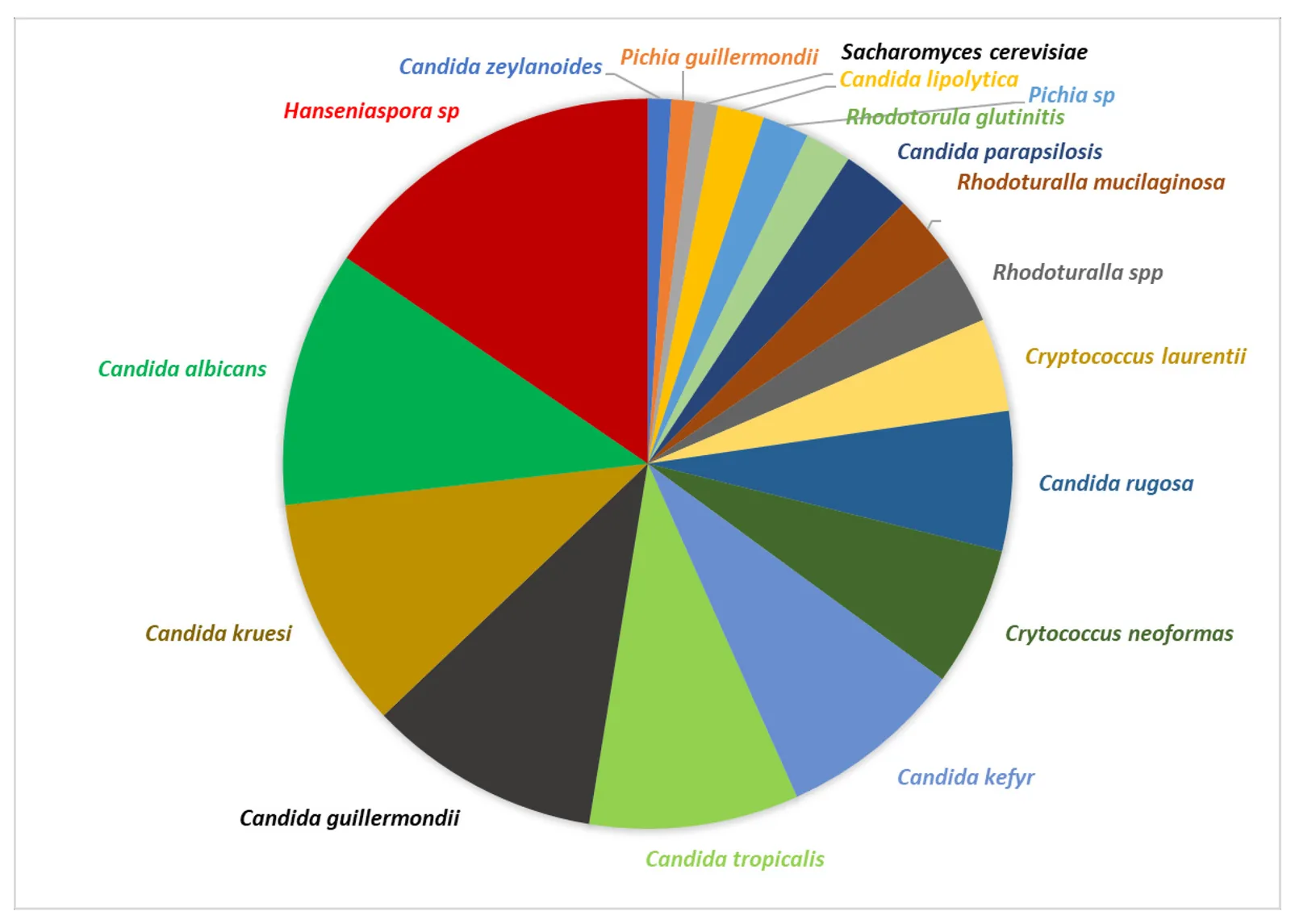
The starting flora is dominated by enterobacteria, Klebsiella, Enterobacter, Erwinia, present from the pulping onward and quickly supplanted: they do not tolerate the acidification they help trigger. Yeasts follow, Hanseniaspora uvarum, Pichia kudriavzevii, Saccharomyces cerevisiae, Torulaspora delbrueckii, then lactic acid bacteria, Leuconostoc mesenteroides, Lactiplantibacillus plantarum, Lactococcus lactis. Acetic acid bacteria, Gluconobacter and Acetobacter, settle only where oxygen remains available, that is, on the surface of the tank and on the drying grounds.
The switchover is not a clock, it is a competition. Three variables command it: temperature, which speeds everything up and shifts the balance toward the lactics above about 25 °C; the starting pH, which depends on the ripeness of the cherries; and oxygen availability, which alone decides the fate of the acetics. Mucilage ferments over a range of about 12 to 34 °C, which covers nearly all field conditions and explains why no duration transfers from one origin to another.
Inoculation with selected strains consists in short-circuiting this competition by imposing a dominant population from the start. The demonstrated gain is consistency from one lot to the next, not absolute quality.
Vinegar without air: what a five-carbon sugar changes
The rule the section has just stated is the simplest of the trade and the most useful: acetic acid bacteria arrive only if there is air, so vinegar is a defect of the open tank and the drying ground. It remains true for these bacteria. It ceases to be true for the molecule, and this is a nuance the plate has nowhere.
A word of vocabulary is needed first, which section 02 uses without glossing. A lactic acid bacterium is called homofermentative when it yields only one useful end product, lactic acid, and heterofermentative when it yields several at once, typically lactic acid, ethanol, acetic acid and carbon dioxide. This is not only a fixed characteristic of the species: it is also a consequence of what it is given to eat.
Hackler and Särchen set out the constraint. When the starting substrate consists of pentoses, that is, sugars built on five carbon atoms such as xylose or arabinose, the homofermentative pathway cannot be used: only the heterofermentative pathway remains open, and it yields acetic acid. The reason is bookkeeping, in the strict sense of the term. The homofermentative pathway is balanced for a six-carbon sugar split into two equal halves; a five-carbon sugar cannot be split that way, it goes through an enzyme, phosphoketolase, which detaches a two-carbon fragment from it.
This fragment cannot become lactate, it comes out as acetate. Acetic acid here is therefore not the product of an oxidation of ethanol by an aerobic organism; it is an obligatory by-product of the way the molecule is cut up.
Yet the same authors write, two chapters earlier, that mucilage contains precisely arabinose and xylose. The conclusion is direct and needs no intermediate hypothesis: a hermetically closed tank, without a single acetic acid bacterium and without a molecule of oxygen, can produce acetic acid, simply because part of the available sugar is pentoses.
Three practical consequences follow, and they correct lines of reasoning that circulate.
- Measuring acetate does not prove that air got inThis is the most common inference and the most fragile. A producer who finds acetic acid in a closed tank concludes that his seal leaks. He may be right, or he may simply be dealing with the sugar composition of his mucilage.
- The lactate degradation hypothesis now has a rivalThe sheet on the closed tank presents as a hypothesis of its authors the idea that the acetic acid measured would come from lactobacilli degrading the lactate already produced. This mechanism remains possible, but it is no longer the only candidate, and the pentose one is better established since it belongs to general biochemistry and not to a field inference.
- A so-called lactic tank is never purely lacticThe share of acetic acid found there depends in part on the sugar composition of the mucilage, and not only on the tightness of the seal. It is a variable that nobody measures and nobody declares.
What is missing to go further is precise and modest: the split between six-carbon and five-carbon sugars in coffee mucilage is published nowhere with its dispersion, nor its variation with variety and maturity. As long as we do not have it, we know that the pathway exists, we do not know what share of a closed tank's acetate is due to it.
Hackler and Särchen, chapter 3, p. 28 for the substrate constraint; chapter 2, p. 9 for the pentoses of the mucilage. Competing hypothesis: sheet 09, PRINCIPLE field.In this plateThe 10 sections
- 01What we call fermenting
- 02What ferments, and what does not
- 03Who does the work
- 04What happens, hour by hour
- 05Who really detaches the sweet flesh
- 06“Anaerobic,” the most misused word in the trade
- 07Knowing when it is done
- 08What goes wrong
- 09What fermentation really changes in the cup
- 10What we do not know
The table of contents, with the first sentence of each section