What fermentation really changes in the cup
Here one must be careful, because this is the ground where the most is claimed and the least is measured.
What is established: two lots of the same coffee, processed differently, give different cups. Blind tastings show it without difficulty, and chemical analyses find distinct profiles of acids and volatile compounds.
What is not: the idea that a given process would produce a given taste, reproducibly from one farm to another. The same protocol applied in two places does not give the same coffee, because the flora, the temperature, the ripeness and the water are not the same. A fermentation is not a recipe, it is a way of running things.
And one uncomfortable thing must be said: part of what is attributed to fermentation comes from elsewhere. A producer who launches into an experimental process sorts his cherries better, watches his drying and selects his plots. The gain is real, the attribution is doubtful.
What controlled trials show, and what they cannot show
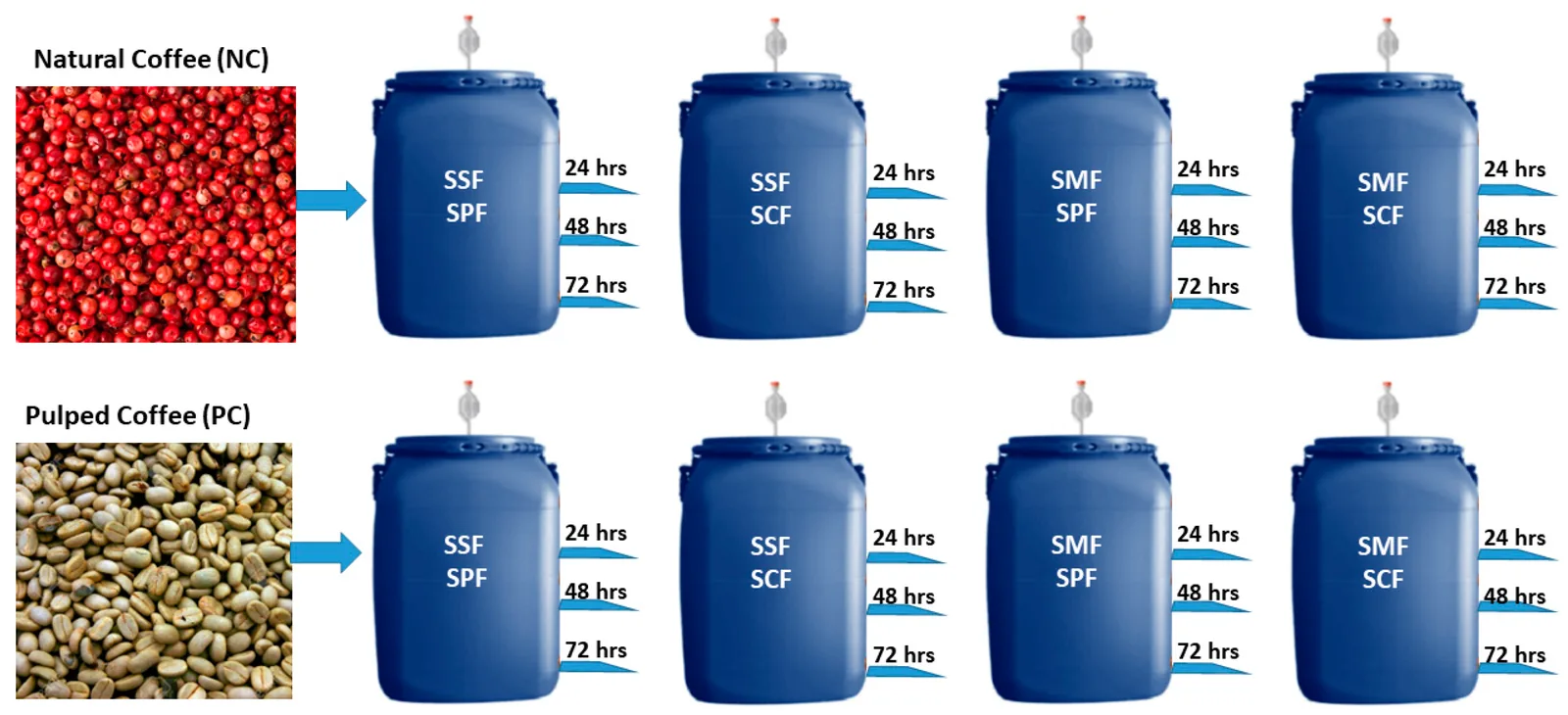
Inoculation work with selected strains is the most conclusive, because it is the only kind that compares a modality to its control on the same lot, in the same place, on the same day. It shows differences in aroma profile attributable to the strain, and above all a reduction in variability between batches.
Three limits weigh on almost all the sensory literature of the field:
- The control is missingComparing an “anaerobic” lot from one farm with a washed lot from another says nothing. Without a control from the same lot of cherries, there is no experiment.
- The blinding is missingThe panel often knows what it is tasting. The expectation effect is massive on descriptors as suggestible as “fermented” or “fruity.”
- Roasting is not neutralizedA roast profile adapted to each lot introduces a second variable. Roasting identically introduces the opposite bias, since the same profile does not suit two coffees of different density.
This is not a reason to reject the field, it is a reason to read the claims looking for the control.
Does inoculating improve the taste? Two works, two opposite answers
The plate writes that the demonstrated gain of inoculation is consistency from one lot to the next, not absolute quality. This is an intermediate position, and it must be said that it is taken between two flatly opposed claims, published in the same year, a year apart.
Hackler and Särchen write without reservation that for all methods, natural, honey and washed, the use of starter cultures of specific yeasts, compared with spontaneous microflora, has been shown to improve the taste quality of the coffee and to allow it to be influenced precisely. A starter culture is a known mixture of microorganisms with defined properties, introduced at the start to impose a population rather than let one build up at random; the term is that of the food industry, and it is more exact than “selected strains.” This claim rests on four references, including Evangelista 2014 and de Melo Pereira 2015, that is, on published trials with a control.
Kornman writes the opposite. Inoculation provides a stable and predictable population, which reduces the risk of mold and of ferment defect, but claims of an increase in score remain verifiable only case by case, and inoculation should not be taken as a guarantee of better taste than the native flora.
The reader needs two elements to weigh this alone. The first is that Hackler and Särchen's position rests on the protocol the site demands everywhere, comparison to a control, whereas Kornman's rests on nothing citable: his booklet carries neither a bibliography nor a note. The second runs the other way, and it is one of method: these trials compare a chosen strain with a spontaneous flora on the same lot, which demonstrates an effect of that strain on that lot, and not a general superiority of the practice.
A trial that finds that a yeast does better than chance says nothing about what the hundred other yeasts on sale do, nor about what an experienced producer carefully running his native flora would have achieved.
Two remarks of context complete the picture without closing it. Kornman is a buyer at an importer that sells inoculated coffees: he had no commercial interest in writing the reservation he writes, which gives it weight. Conversely, Hackler and Särchen mention elsewhere a health argument that is perhaps the strongest of all and that the dispute over taste covers over: yeasts can suppress the growth of mycotoxin-producing molds. If inoculation is justified, it may be first of all on this ground.
What would settle the matter is an experiment that nobody seems to have done, and that is not out of reach of a national institute. One would have to compare the same strain with the native flora on several lots, several origins and several years, with a blind panel, and above all publish the complete distribution of scores and not its mean. A practice that improves consistency and a practice that improves quality are not distinguished by the mean: they are distinguished by the dispersion.
As long as trials publish means, the two works can read the same corpus and draw opposite conclusions from it, which is exactly what happens here. The plate does not settle it.
Hackler and Särchen, chapter 4, p. 49, after Evangelista 2014 and de Melo Pereira 2015; health argument, chapter 4, p. 45. Kornman, p. 18.In this plateThe 10 sections
- 01What we call fermenting
- 02What ferments, and what does not
- 03Who does the work
- 04What happens, hour by hour
- 05Who really detaches the sweet flesh
- 06“Anaerobic,” the most misused word in the trade
- 07Knowing when it is done
- 08What goes wrong
- 09What fermentation really changes in the cup
- 10What we do not know
The table of contents, with the first sentence of each section