Getting pure water
How is pure water obtained, and at what price?
Start the scene or choose a stage. The animation simplifies the mechanism; what follows gives the details and the available references.
A home still boils the water and condenses its steam, about an hour per liter, with a noisy fan. It has to be maintained regularly with a weak acid, otherwise the water takes on a metallic taste; Gagné's overheated and gave up the ghost after a month. Bottled distilled water suits the short term and travel, and large returnable jugs are perhaps the most efficient option.
Read the stages without animation
- Distilling, an hour per literA home still boils the water and condenses its steam, about an hour per liter, with a noisy fan. It has to be maintained regularly with a weak acid, otherwise the water takes on a metallic taste; Gagné's overheated and gave up the ghost after a month. Bottled distilled water suits the short term and travel, and large returnable jugs are perhaps the most efficient option.
- The pitcher microfilters, then gives backMicrofiltration pitchers remove the vast majority of dissolved solids, where ordinary pitchers are far less aggressive. The Peak Water, designed by Colonna-Dashwood for coffee, microfilters and then remineralizes with ion-exchange resins, small beads that give ions to the water; the BWT gives back magnesium. All require a new filter every month or two, even unused, because microbes proliferate in them.
- Reverse osmosis, two streamsMounted on the tap, reverse osmosis splits the water into two streams: on one side a water at about 10 ppm, rather than a distilled water, on the other a loaded water that goes down the drain. These 10 ppm are adjusted in the concentrate, and even make it possible to keep the magnesium-to-calcium ratio and the hardness-to-alkalinity ratio of the local water. It is the best option for a coffee shop or a heavy consumer.
- The price: 4 to 9 liters thrown awayThe price is a yield of 10 to 20%: each liter of soft water sends 4 to 9 liters down the drain. One false good idea to finish: adding an acid to tap water to lower its alkalinity does not work. Weak acids, vinegar for example, react with part of the bicarbonate but leave another buffer behind them, and strong acids are dangerous.
To remember: Every route to pure water has a price, in time, in equipment or in discarded water; reverse osmosis is the best for a coffee shop, at the cost of 4 to 9 liters down the drain per liter of soft water.
Read the full article and its sources ↓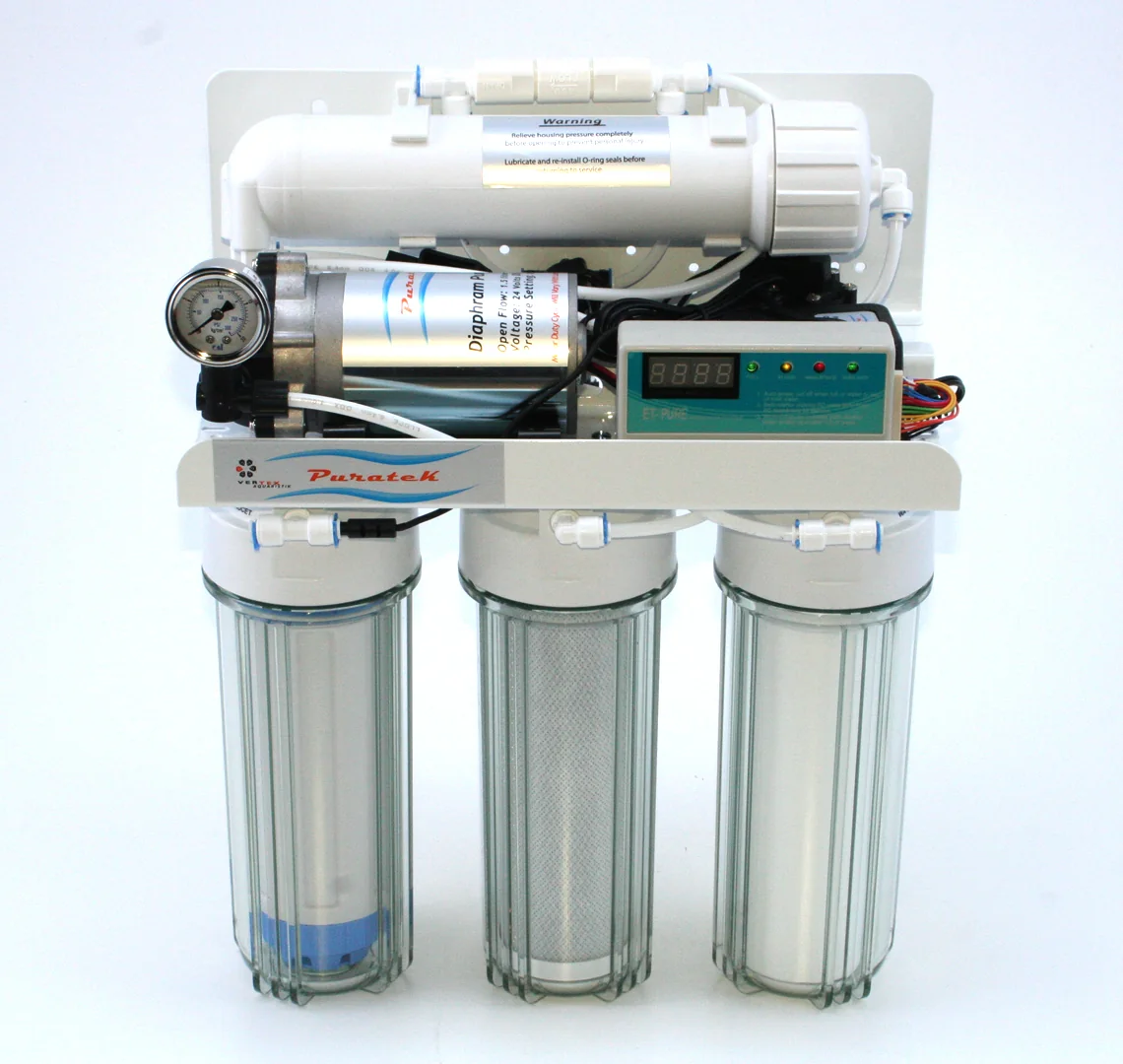
This is often the hardest part, and the least ecological. Four routes lead to pure water, and each has a price: in time, in equipment, or in discarded water.
- Home distillationAbout an hour per liter, with a noisy fan. The appliance has to be maintained regularly with a weak acid, otherwise the water takes on a metallic taste. Gagné's overheated and gave up the ghost after a month.
- Microfiltration pitchersThey remove the vast majority of dissolved solids, where ordinary pitchers are far less aggressive. Peak Water, designed by Colonna-Dashwood for coffee, microfilters then remineralizes with ion-exchange resins; the BWT pitcher gives back magnesium. All require a new filter every month or two, even unused, because microbes proliferate in them.
- Bottled distilled waterIt suits the short term and travel. Large returnable jugs are perhaps the most efficient option.
- Reverse osmosisMounted on the tap, reverse osmosis gives a water at about 10 ppm rather than a distilled one. These 10 ppm are adjusted in the concentrate, and even make it possible to keep the magnesium-to-calcium ratio and the hardness-to-alkalinity ratio of the local water. It is the best option for a coffee shop or a heavy consumer. The price is a yield of 10 to 20%: each liter of soft water sends 4 to 9 liters down the drain.
One false good idea to finish. Adding an acid to tap water to lower its alkalinity does not work. Weak acids, vinegar for example, react with part of the bicarbonate but leave another buffer behind them. As for strong acids, they are dangerous.
Gagné 2021, pp. 28-30In this plateThe 13 sections
- 01What water does, and why
- 02Alkalinity and hardness, and the words that mislead
- 03Units
- 04The standard, and the zones that do not coincide
- 05Salts, and the hydrate trap
- 06Getting pure water
- 07Making a concentrate
- 08Published recipes
- 09The profile calculator
- 10Measuring your water
- 11Water in machines
- 12Before chemistry: water in the old treatises
- 13Today
The table of contents, with the first sentence of each section