Measuring your water
How to measure your water, and how precisely?
Start the scene or choose a stage. The animation simplifies the mechanism; what follows gives the details and the available references.
The TDS meter measures the electrical conductivity of the water, that is, how easily its ions carry a current, and translates it into total dissolved solids with a ratio of 0.5 or 0.7 depending on the device. This translation assumes a typical tap water. Expect 30% error, plus 20% if the temperature is not corrected, and nothing at all on alkalinity. It serves to see that a water has changed, or that it is properly distilled, always measured at 25 °C.
Read the stages without animation
- The TDS meter estimatesThe TDS meter measures the electrical conductivity of the water, that is, how easily its ions carry a current, and translates it into total dissolved solids with a ratio of 0.5 or 0.7 depending on the device. This translation assumes a typical tap water. Expect 30% error, plus 20% if the temperature is not corrected, and nothing at all on alkalinity. It serves to see that a water has changed, or that it is properly distilled, always measured at 25 °C.
- Alkalinity first, drop by dropAquarium kits are much better, because they titrate instead of estimating: one drop of reagent at a time is counted into 5 mL of water, until the color changes, blue to green then yellow for alkalinity with API. Start with it, because a bad alkalinity harms taste far more than a bad hardness.
- Hardness, one drop at 17.85 ppmThe hardness reagent is an EDTA salt, a molecule that captures calcium and magnesium, buffered at a very high pH so that the color change, orange to green, is sharp. Its resolution is coarse: each drop equals one German degree, or 17.85 ppm, a lot when the recipes aim at 40. A Red Sea kit goes down to 2.5 ppm per drop for alkalinity, but only to 82 for magnesium.
- Stretch, reverse, weighThree strategies refine the titration. Stretched, with twice as much water, each drop is worth half as much, but one never counts better than 5 ppm or 5% of the reading. Reverse, for waters beyond 400 ppm, starts from a fixed volume of reagent and adds the water drop by drop. By scale, the reagent and the water are weighed instead of counting drops, between 18 and 25 °C.
- The colorimeter, precise and costlyElectronic colorimeters, such as the Hanna HI775 for alkalinity, are more convenient and more precise, but costly and hungry for reagent. This one reads in mg/L of bicarbonate: divide by 1.22 to get back to ppm CaCO₃. On a Rao/Perger water expected at 40.5 ppm, all the methods landed right within the error bars; the most precise were the scale and the colorimeter.
To remember: A TDS meter says that a water has changed, not what it contains: for alkalinity, which matters most, it has to be titrated, drop by drop or by scale.
Read the full article and its sources ↓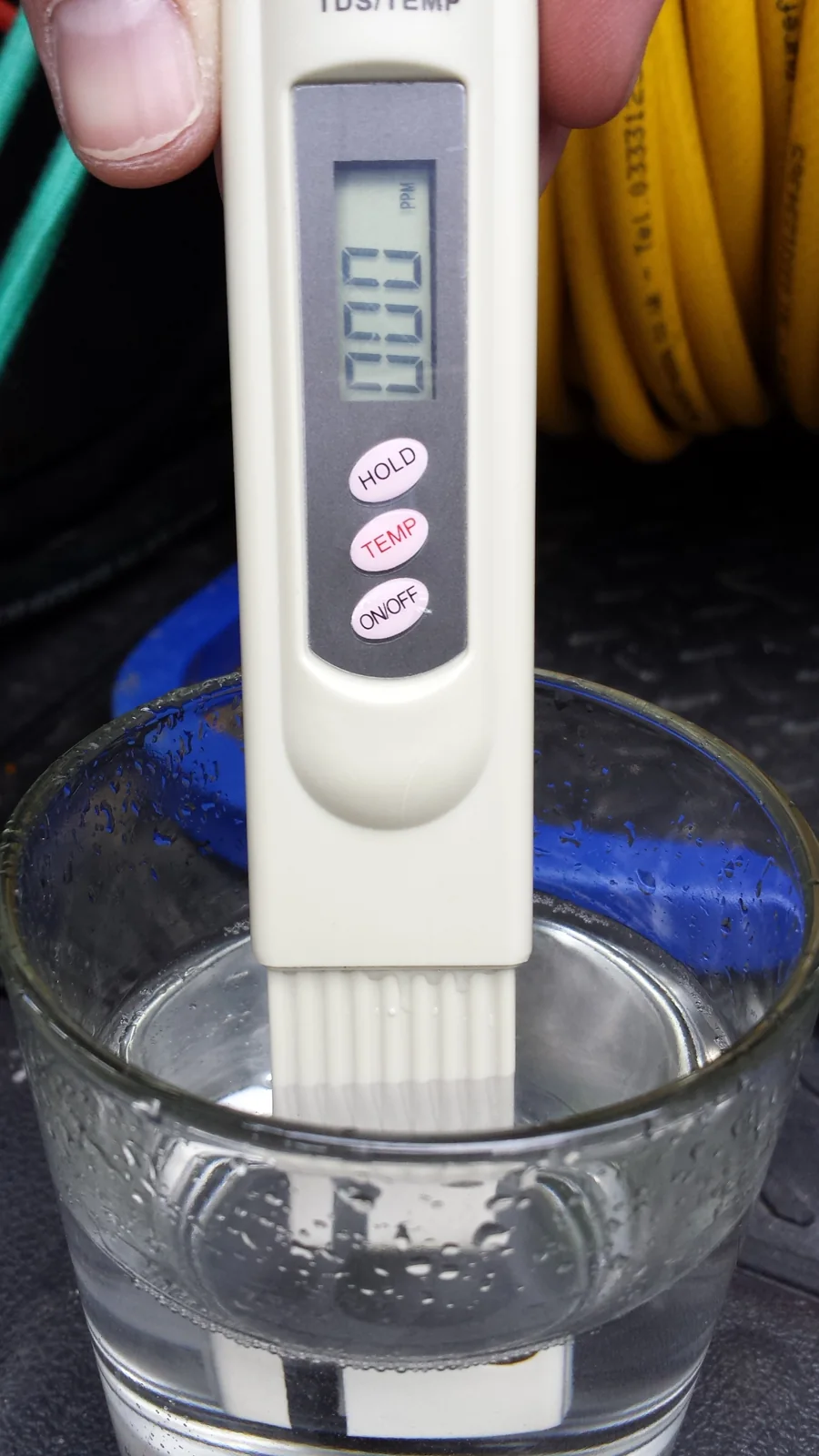
Conductivity meters, called TDS meters, measure the electrical conductivity of water and translate it into total dissolved solids. They are small, cheap and fast. They are also problematic, for two reasons.
The first: the reading depends strongly on temperature, and the built-in correction is imperfect. The second: the translation into total dissolved solids assumes a typical tap water chemical profile, and applies a ratio of 0.5 or 0.7 depending on the device. If your water does not resemble that profile, the displayed figure no longer means much.
The result is a rough approximation of hardness, and nothing at all on alkalinity, which matters more. Expect a typical 30% error, plus 20% if the temperature is not corrected.
The device keeps two uses: detecting that a water has changed, and verifying that a water is properly distilled. Provided it always measures at the same temperature, 25 °C by convention.
Aquarium kits are much better, because they titrate instead of estimating: one drop of reagent at a time is counted into 5 mL of water, until the color changes. Orange to green for hardness, blue to green then yellow for alkalinity with API.
The hardness reagent is a tetrasodium salt of EDTA, a molecule that captures calcium and magnesium. It is buffered at a very high pH by triethanolamine, which makes the color change easier to read.
Its resolution, on the other hand, is coarse: each drop equals one German degree, or 17.85 ppm. That is a lot when the recipes aim at 40. A Red Sea kit goes down to 2.5 ppm per drop for alkalinity, but only to 82 for magnesium.
In what order to measure? Alkalinity first. A bad alkalinity harms taste far more than a bad hardness.
Gagné 2021, pp. 34-38; Wellinger, Smrke and Yeretzian 2017Three strategies improve the precision of these titrations.
- Stretched titrationMore water goes in the tube: twice as much, and each drop is worth half as much, about 9 ppm instead of the 17.85 of the 5 mL kit; four times as much, 20 mL as in the calculator's table, and it falls to about 4.5 ppm. The price is a reagent consumption that grows in the same proportion. And the gain plateaus: past a certain point, other errors dominate, such as the assumption the kit makes about the magnesium-to-calcium ratio. Never count better than 5 ppm or 5% of the reading.
- Reverse titrationFor hard waters, beyond 400 ppm, where an ordinary titration would take too many drops. Start from a fixed volume of reagent, then add drops of water until the reverse color change, with a pipette calibrated on a milligram scale, 25 drops weighed.
- Scale-assisted reverse titrationSame principle, except that the reagent and the water are weighed instead of counting drops. To be carried out between 18 and 25 °C, so that the densities on which the calculation rests remain valid.
That leaves electronic colorimeters, such as the Hanna HI775 for alkalinity. More convenient and more precise, but costly and hungry for reagent. This one reads in mg/L of bicarbonate: divide by 1.22 to get back to ppm CaCO₃.
Watch the model numbers. The HI719 and HI720 are unsuitable, because they are made for minute concentrations. And the only hardness photometer Gagné found adequate, the HI96735, is expensive and complicated.
He compared all these methods on his Rao/Perger water, expected at 40.5 ppm. All landed right, within the error bars. The most precise were scale titration and the colorimeter. And reverse titration with five drops of reagent saves a lot of reagent for the same error.
Gagné 2021, pp. 38-45, with his online spreadsheets| Measurement | Precision | Cost |
|---|---|---|
| TDS meter | ≈ 30%, nothing on alkalinity | low |
| API kit, 5 mL | 17.85 ppm per drop | low |
| Stretched titration, 20 mL | ≈ 5 ppm or 5% | 4 times more reagent |
| Reverse titration, 5 drops | ≈ 5 ppm or 5% | little reagent |
| HI775 colorimeter | best, independent of the water | high, fixed reagent |
In this plateThe 13 sections
- 01What water does, and why
- 02Alkalinity and hardness, and the words that mislead
- 03Units
- 04The standard, and the zones that do not coincide
- 05Salts, and the hydrate trap
- 06Getting pure water
- 07Making a concentrate
- 08Published recipes
- 09The profile calculator
- 10Measuring your water
- 11Water in machines
- 12Before chemistry: water in the old treatises
- 13Today
The table of contents, with the first sentence of each section