The exchange and its panics: New York 1882, Le Havre, Hamburg, London
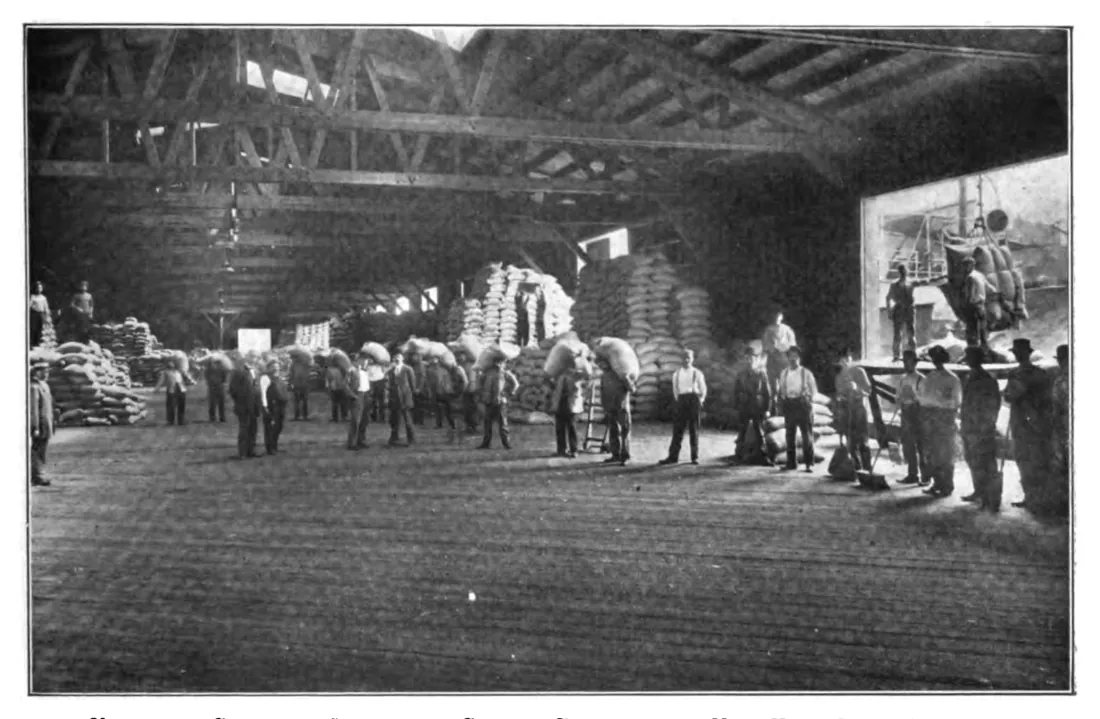
The response to the collapse is not the abandonment of speculation but its regulation. The New York Coffee Exchange is organized in December 1881, incorporated the same year with the statutory purpose of adopting classification standards, establishing uniform rules and settling disputes between members; it opens its sessions in March 1882, with Arnold as its first president. The entry fee is 250 dollars; a seat sells for 110 dollars at the worst of times, 3,000 in January 1916, 8,600 at the 1919 record, about 6,000 in 1922. The institution then has 323 members, brokers, importers, green coffee traders and roasters, and reports average annual sales of over 16 million bags of 130 pounds over five years; it licenses its own graders, warehousemen, weighers and samplers.
Ukers 1922, ch. XXXIV, pp. 509-516 (print), and ch. XXXV, p. 799Europe follows, place by place.
- 1882Coffee exchange at Le Havre. Before 1914, this is where most of the world's visible stock is concentrated, in bonded warehouses, that is, stores where the goods wait without yet having paid the import duty.
- 1887Amsterdam and Hamburg.
- 1890Antwerp, London and Rotterdam.
- 1905Trieste.
London is the exception: it does not quote prices. It sells green coffee at auction in Mincing Lane, four times a week, by catalog. Samples are displayed before the sale and buyers can taste them. One therefore buys a lot one has seen, and not a contract on a quality defined in advance.
The duty there is 4 and a half pence a pound, paid only on leaving the bonded warehouse. This detail matters, because the domestic market takes only a tenth of it: the rest is re-exported without ever entering the country, hence without ever paying the duty.
A doubt about the date remains. Ukers specifies that the Le Havre exchange was the only one in existence when New York organized, which places its founding in 1881 at the latest. His own date of 1882 for Le Havre is therefore to be taken with a year of uncertainty.
Ukers 1922, ch. XXXIII, pp. 461 and 469 (print), ch. XXXIV, pp. 508-509, ch. XXXV, p. 799| Mechanism | Principle | Since | Who gains | Who loses |
|---|---|---|---|---|
| Corner | buy and withdraw the supply | 1869 (Arnold) | the operator while he buys | himself and the market when he sells |
| Futures market | standard contract, margin, rare delivery | 1881-1882 (NY, Le Havre) | whoever has cash and information | whoever can neither hedge nor wait |
| Valorization | the state stocks or destroys | 1906-1944 (Brazil) | planters and bankers behind the scheme | consumers; the state that finances |
| ICA quotas | negotiated export shares | 1962-1989 | established producers | new entrants, consumers |
| Differential | gap negotiated against the price | from 1882 (points) | origins in demand | unfashionable origins |
| PTBF | differential fixed, price fixed later | common practice | whoever chooses the moment | whoever fixes badly |
| Fixed price | figure set in advance | 2000s | seller in a bear market | seller if costs rise |
| Minimum price | enforceable floor | 1988 (Fairtrade) | cooperatives in a low market | no effect in a high market |
| Auction | price formed in public | 1999 (COE) | a few producers a year | the rest of their crop |
| EUDR | geolocation, due diligence | Dec. 30, 2026 | chains already documented | producers without coordinates |
The exchange rests on an enforceable quality convention. New York quotes on the basis of type No. 7; each type is defined by a number of imperfections counted on a pound of sample, reduced to “full black” equivalents on a fixed scale: three pods, five immature beans or five broken beans equal one full black, a large stone equals two or three.
Six full blacks make a No. 2, thirteen a No. 3, twenty-nine a No. 4, sixty a No. 5, one hundred and ten a No. 6; beyond that, No. 7 or No. 8 by comparison with reference types, and nothing below No. 8 is admitted for import. Other origins are quoted by gaps in points, hundredths of a cent, above or below the base: when Rio No. 7 is worth 17.10, Santos No. 3 is worth 19.10 and Bogota No. 5 is worth 18.10. The modern differential is already there, down to its unit.
Ukers 1922, ch. XXXIV, pp. 510-512 (print); LC ch. 18 and 19Two markets coexist from the start, and they do not trade the same thing.
The first is the “spot” market, in lower Wall Street, between Front Street and Water Street. Actual coffee is sold there, in warehouse, available immediately.
The second is the futures market. Contracts are bought and sold there for coffee that may still be on the tree. Accounts are settled by margin difference, that is, by paying the gap between the agreed price and the market price, without the coffee changing hands. Physical delivery is only rarely exercised.
The rules provide that in the event of a corner, the officers of the exchange themselves set a liquidation price. The aim is to avoid chain failures: without this safeguard, the cornered operator drags down his broker, who drags down his banker. There is not yet a general clearing house, so no one stands guarantor for the whole of the commitments.
The Hughes committee of the State of New York, in 1909, acknowledges that the exchange has created “stability and certainty” where scarcity and glut used to alternate. Then it points to a “noncommercial” factor that has just distorted the game: Brazilian valorization.
Ukers 1922, ch. XXXIV, pp. 510, 514-515 (print)The exchange does not abolish corners. It gives them a calendar.
In 1883-1884, a rise from 7 to 11 ½ cents unwinds for a reason that has nothing commercial about it. The telegraph cable that runs through Portugal breaks on a Saturday. The agents of the Brazilian syndicate can no longer cover their margins, so their accounts are liquidated automatically. The funds arrive on Monday, too late.
The “great boom” of 1886-1887 starts, for its part, from catastrophic Brazilian crop estimates: 3,033,000 bags announced for 1887-1888. A bullish clique from New York, Chicago, New Orleans, Brazil and Europe sets itself a target of 25 cents.
It carries the December contracts from 7.65 to 22 ¼ cents on June 1st, 1887, a record that will stand for thirty-two years. Then the market breaks by 6 ¼ cents in less than two weeks, on a session of 412,000 bags.
It is in this campaign, waged against the Arbuckles, that Hermann Sielcken earns his spurs. He becomes the most feared man on the floor.
Ukers 1922, ch. XXXV, pp. 800-801 (print); ch. XXXI, p. 781What follows is a decade of maneuvers, and it is worth taking them one by one rather than making a list of them.
September 1891. George Kaltenbach, a Parisian speculator, allies himself with three operators from Le Havre, Hamburg and Antwerp to break a New York corner. Then he changes sides and becomes a buyer. He pushes the price to 17.7 cents and pockets, rumor has it, more than a million dollars. In May 1893 he collapses, and drags down with him thirty houses in Hamburg, Le Havre and Rotterdam.
April 1895. Guzmán Blanco, a former president of Venezuela living in Paris, tries the stunt in his turn and buys 200,000 bags at Le Havre.
1898. A bear campaign brings Rio 7 down to 4 ½ cents in November.
1899-1900. This is what was called the “bubonic plague boom.” Brazilian steamers are quarantined, the coffee stops arriving, and the price goes from 4 ¼ to 8 ¼ cents. An epidemic has just doubled the price of coffee.
June 1903. Brazil harvested 15 million bags in 1901-1902, then 20 million in 1902-1903. Too many. The price falls to 3.55 cents a pound for July delivery: the lowest in the entire history of coffee.
February 1904. The “Southern boom,” led by the cotton king D. J. Sully, lifts the price back to 11.85 cents on February 2 on 462,000 bags. Three days later, on the 5th, more than a million bags are liquidated in a single session.
Look at what these fifteen years have in common. Not one of these shocks comes from a coffee tree.
Ukers 1922, ch. XXXV, pp. 801-803 (print)In this plateThe 11 sections
- 01Before the exchange: Mocha, the brokers and the right not to come
- 02The century of kings: Arnold, the syndicate and the crash of 1880-1881
- 03The exchange and its panics: New York 1882, Le Havre, Hamburg, London
- 04Brazilian valorization and wartime controls, 1906-1944
- 05The International Coffee Agreement, 1962-1989, and its breakdown
- 06The 2001 crisis
- 07Green coffee traders, cooperatives and the institutions of origin
- 08Incoterms
- 09The industrial roasters
- 10Climate, the EUDR and the cost of compliance
- 11Archive plates
The table of contents, with the first sentence of each section