Decaf: from Bremen to Sanka
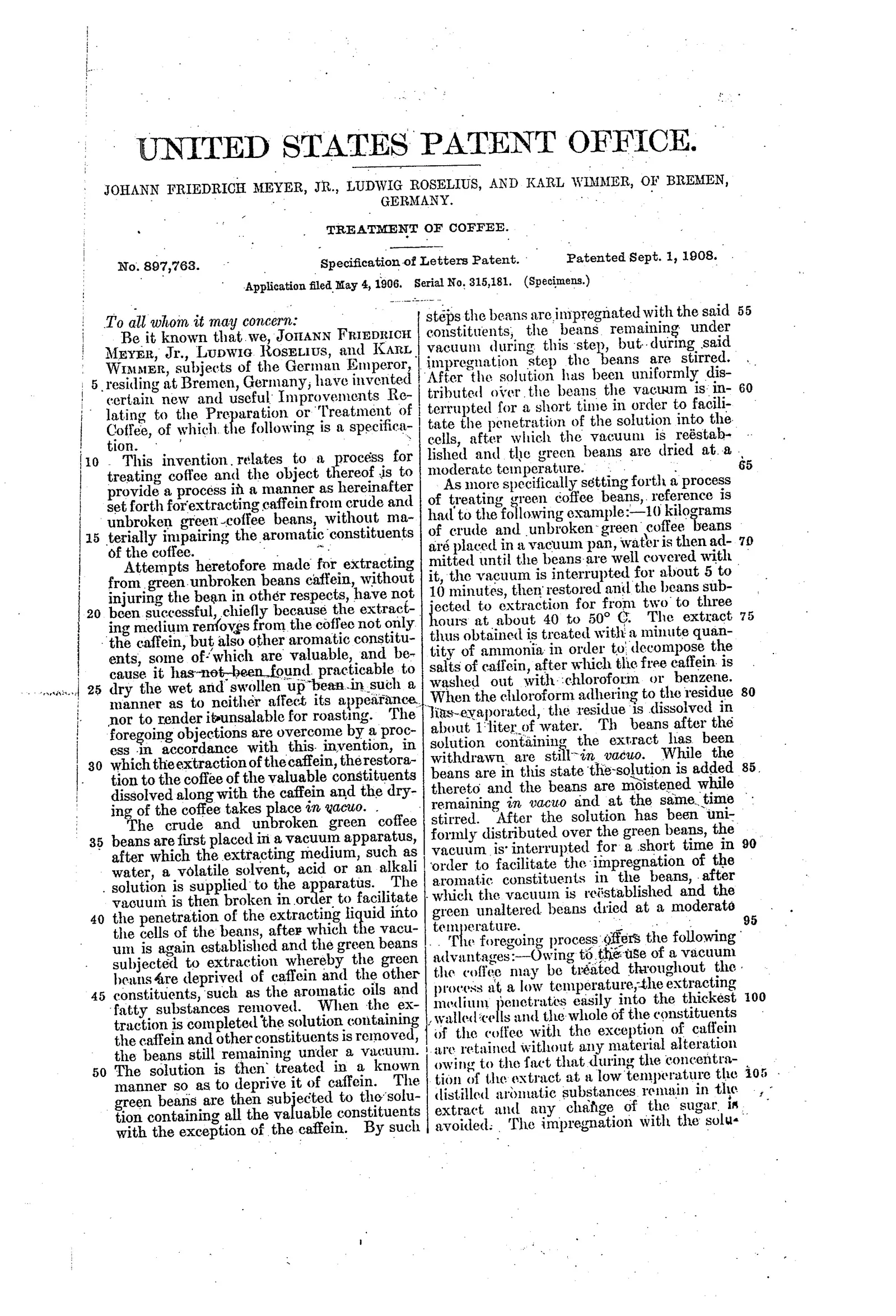
The first attempts, reported by Ukers, extracted the caffeine from roasted coffee. The choice is understandable: the molecule is far less tightly bound there, and the cooked bean, riddled with pores, lets liquids through. But the volatile aromas leave with the caffeine, and they cannot be put back.
So the ground green bean was tried. Grinding opens everything to the solvent, but a green powder no longer roasts uniformly. That left the whole green bean, the most thankless route of the three. Its tight structure slows the solvent, and its caffeine, bound as a chlorogenic acid salt, refuses to be carried off.
The solution was to swell the bean before treating it: with water, with steam, sometimes with acids “softening the cellulose.” A swollen bean opens up, and the salt that held the caffeine breaks. According to Ukers, the pressurized steam treatment in the Meyer, Roselius and Wimmer patent was “probably the safest.”
The inventor's motive, for its part, had nothing industrial about it. Ludwig Roselius, a Bremen merchant, blamed his father's death on excessive coffee drinking. His team perfected the process in 1903. The Kaffee-Handels-Aktiengesellschaft of Bremen obtained a German patent in 1905, and the American patent was granted to Meyer, Roselius and Wimmer in 1908.
The solvent used is benzene, a carcinogen as we now know, poured over a bean first steamed with salt water. The product went on sale in Europe from 1905-1906 under the brand Kaffee HAG. In France, it took the name Sanka, a contraction of “sans caféine” (“without caffeine” in French).
Ukers 1922, ch. XVIII (p. 174-188) and chronology p. 725-737 (entries 1905, 1908); Wikipedia, Sanka and Decaffeination, accessed on 09/07/2026Roselius brought his coffee to the United States in 1909. Merck & Co. sold it from 1910 under the name Dekafa, then Dekofa. The Kaffee Hag Corporation, founded in New York in 1914, then sold it under its own name.
The war confiscates everything. The Alien Property Custodian, the American agency that seized enemy property, takes over the company and resells it to an American firm. Roselius loses his brand in the most promising market.
He returns there under another name, the French one: Sanka. The launch took place in 1923, in two “Sanka Coffee Houses” in New York. Two coffee houses first, the grocery store next. He made an agreement with General Foods in 1927, then ceded the brand to it in 1932. Sanka became the American decaf, with its orange lid, and today belongs to Kraft Heinz.
Did the product keep its promise? Not always. In 1922, Ukers noted that some “caffeine-free coffees” on the market contained almost as much as the natural bean. Those from serious houses, however, came down to between 0.3 and 0.07%, against 1.5% for untreated coffee. He also reported the demand that kept them alive: neurasthenics, and “the questionable advertising of the substitute dealers,” which persuaded normal people that they were fragile.
The lineage of solvents then follows the health alerts, each abandonment coming after a toxicological verdict. Benzene goes first. Trichloroethylene replaces it, until the National Cancer Institute declared it a probable carcinogen in 1975. The industry then moves to methylene chloride, in other words dichloromethane. General Foods finally obtains authorization for ethyl acetate for Sanka in the early 1980s.
Ukers 1922, ch. XVIII and ch. XXII (p. 273-302); Wikipedia, Sanka, accessed on 09/07/2026; UPI, Cancer question about decaffeinated coffee, 06/17/1982; Coffee Review, Decaffeinated coffee: solvent methodIn this plateThe 14 sections
- 01The problem comes down to one sentence of chemistry
- 02Decaf: from Bremen to Sanka
- 03What caffeine-free coffee built in Bremen
- 04Why decaf coffeepots are orange
- 05The processes, one by one
- 06The processes specialty coffee is inventing
- 07The methylene chloride quarrel
- 08What the bean really loses, and what is attributed to it
- 09Roasting it: three landmarks that jump all at once
- 10Who decaffeinates, and where: a handful of plants worldwide
- 11What it costs, and why decaf is more expensive
- 12The extracted caffeine: which of the two is the by-product?
- 13The other route: coffee plants that make none
- 14The questions people ask most often
The table of contents, with the first sentence of each section