ATLASTimor-Leste
about 10,000 tonnes (FAOSTAT 2024, imputed value)In-depth dossier, atlas 2026In-depth dossier: the FAOSTAT series set against other figures, the history, today's industry and its gray areas, with numbered sources. Region: Asia.
Timor-Leste had only a statistical reference point. This dossier completes it: the history of the sector, what it is today, and what remains uncertain, each paragraph referring to its sources, numbered at the bottom of the page.
The FAOSTAT series remains displayed as is. The dossier says what it is worth, year by year when possible, and compares it with the other figures available.
- Geographic status
- country
- Name in FAOSTAT
- Timor-Leste
- Latest value
- about 10,000 tonnes in 2024
- Nature of the value
- value imputed by the receiving organization
- Start of the positive series
- 1961
- Series maximum
- 14,500 tonnes in 2004, figure from an external organization
Confirmed coverage: the FAOSTAT series, and a dossier of 19 sources that cross-checks the history, today’s sector and what remains uncertain.
History
Timor coffee first appears in the sources as a matter of the Dutch half of the island. Ukers, in 1922, lists Timor among the islands of the Dutch East Indies where the Dutch extended coffee cultivation, with Sumatra, Celebes and Bali, and notes that the plantations there are mostly held by local growers, with methods below those of the European estates of Java and Sumatra. He places “Timor” just after the Korinchi of Sumatra among the coffees from private plantations, less handsome to the eye, in roasting and in the cup, and his table of origins describes it as a medium bean of good quality, under a single line “Timor (Dutch and Portuguese)” and a single port, Kupang, which lies in the Dutch part. The eastern, Portuguese half has no chapter of its own in the book. The researchers of the University of Évora place the introduction of the coffee tree in the Portuguese colony in the middle of the 18th century, the first plantations in the early 19th, and its real boom in the last quarter of the 19th century, when coffee becomes the colony's medium of exchange with the outside world [2][5][6].
On the Portuguese side, coffee takes the place of sandalwood, whose trade declines in the second half of the 19th century, and the administration imposes its cultivation. Under Governor José Celestino da Silva, from 1894 to 1908, compulsory labor becomes a reality, and the governor himself founds the Sociedade Agrícola Pátria e Trabalho, the SAPT. In the 1920s, according to the reports of the colonial bank, the Banco Nacional Ultramarino, it is the only large enterprise that lasts: it has the best plantations, tries cinchona, vanilla or tea, and sells directly to Rotterdam, Amsterdam and Singapore. Coffee makes up 4.4% of exports in 1858, 60.7% in 1920 and 81.5% of the value shipped in 1930, on an area estimated that year at 17,000 hectares. The rest of the trade goes through Chinese traders, who send the coffee to be prepared at Makassar, in the Dutch Celebes, before the European markets, and the bank's managers note an irregular crop, stronger one year in three [4][5].
Coffee leaf rust, the fungus Hemileia vastatrix, reaches the colony around 1886 according to McCook's map, who nonetheless writes further on that it arrived there in the early 20th century; it confines arabica above 1,000 meters. The Portuguese try liberica at the end of the 19th century then canephora at the beginning of the 20th, but in 1930 the latter remains little planted, for lack of interest from growers and of prices. It is in this neighborhood of the two species that the Timor Hybrid is born, a spontaneous cross of arabica and canephora that kept the 44 chromosomes of arabica and its fertility. The original plant is found in a Typica plantation called Mata Nova, at the feitoria, that is, the estate, of Fatu Bessi, planted in 1917-1918 at 800 meters in the present municipality of Ermera, where the old SAPT installations also survive. Its genetics and its descendants, Catimors and Sarchimors, are told in the Timor Hybrid sheet of the variety map. What matters here is that it remains a local curiosity until the 1950s, that the colony's coffee export office, the Junta de Exportação do Café, sends seeds of it to the rusts research center of Oeiras, in Portugal, in 1957, 1960 and 1966, and that it spreads through the Timorese plantations from 1956 under the local name “Moka” [3][4][5][6].
The Second World War puts the colony in the hands of Japan, and Portugal recovers it only at the end of the conflict. The FAO series begins in 1961 with official figures up to 1973, from 1,023 to 6,602 tonnes depending on the year, with jumps from one year to the next, from 6,602 tonnes in 1967 to 1,023 in 1968, which the sources read do not explain. Indonesia invades the territory in 1975. Coffee remains the first source of income and trade, but domestic trade and export fall under the monopoly of Indonesian companies that pay producers little. The main one, Denok, controlled by the army and linked to the former armed forces chief Benny Murdani according to the Far Eastern Economic Review, was built up by seizing large plantations of the Portuguese period. The profits, write the Évora researchers, often financed the war of occupation, and the main legacy of the period is the Timorese loss of interest in cultivation: the peasants merely harvest the old plantations of which they have become the caretakers [1][3][5][7].
The monopoly comes undone after the Dili massacre of 1991, which draws international attention; Washington presses Jakarta and, around 1995, the army withdraws from the trade. In 1994, the American development agency, USAID, funds the organization of 450 coffee growers into a cooperative by the National Cooperative Business Association, a federation of American cooperatives: this is the birth of the Cooperativa Café Timor, the CCT, of which Starbucks becomes the main buyer. In 1999, the Far Eastern Economic Review announces a crop of about 13,000 tonnes, almost double that of 1998, on 55,000 hectares in production, and estimates that a fifth of the 830,000 inhabitants live from coffee. After the restoration of independence, in 2002, other buyers enter the market, and in 2005 four exporters share most of the sales: Timorcorp 27.1%, Timor Global 24.4%, the CCT 21.4% and ELSAA Café 11.4%. The country ratifies the International Coffee Agreement of 2007 on February 5, 2009 and becomes an exporting member of the International Coffee Organization [5][6][7][8][9].
The FAOSTAT series is almost never a measurement. After the official figures of 1961 to 1973, it lines up eleven years of identical estimates, 8,000 tonnes each year from 1979 to 1989, in the midst of the occupation, then unofficial figures and other estimates; between 1974 and 2011, only 1996 and the years 2008 to 2011 carry the status of official figure. The maximum of the series, 14,500 tonnes in 2004 and 2005, is an unofficial figure. From 2012 to 2019, the values carry status X, figure from an outside organization: these are the estimates of the International Coffee Organization converted into tonnes, to the tonne from 2014 to 2018 (111,000 bags of 60 kilograms for 2014, or 6,660 tonnes), and only 2019 departs from it, 6,180 tonnes against 6,900. The last official year is 2021, with 13,314 tonnes; 2020, 2022, 2023 and 2024 are imputed, that is, calculated by FAO for lack of a report from the country. The current value, 9,522.52 tonnes in 2024, is one of those, and its two decimals say nothing about its precision [1][11].
Today
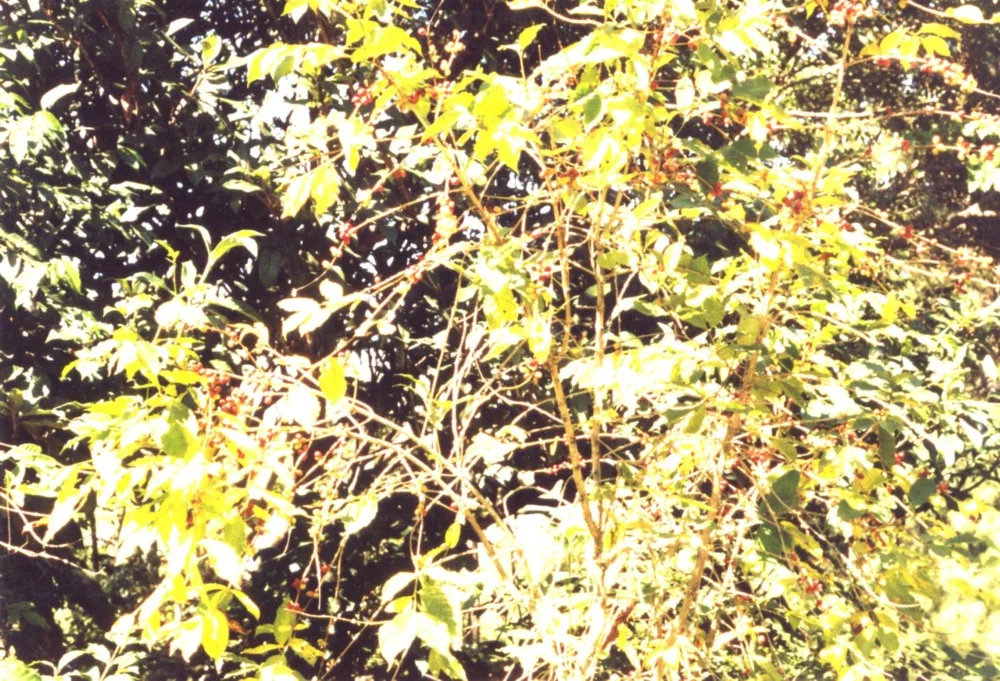
Coffee is grown in the thirteen former districts, but four concentrate nearly all of it: Ermera, Manufahi, Liquiçá and Ainaro together held in 2006 92.9% of the 51,989 hectares and 93.8% of production according to the Ministry of Agriculture, Ermera alone 56% of the area and 53% of the harvest, with 85% of its families producing coffee. Maubisse, in the highlands of the center, is the other name found on the bags: the CCT has one of its two factories there, the other being in Ermera. Arabica largely dominates, 53,816 hectares against 2,574 for canephora according to the ministry, and about eight tenths of production. Canephora grows between 600 and 1,000 meters, arabica between 1,000 and 2,000 meters. In the plantations, old Typica stands alongside the Timor Hybrid; a calculation of 2010 gave the latter a rate of return of the order of 30% on replanting against a little over 15% for Typica, because it does not show the alternation of a good year and a bad year [5][6].
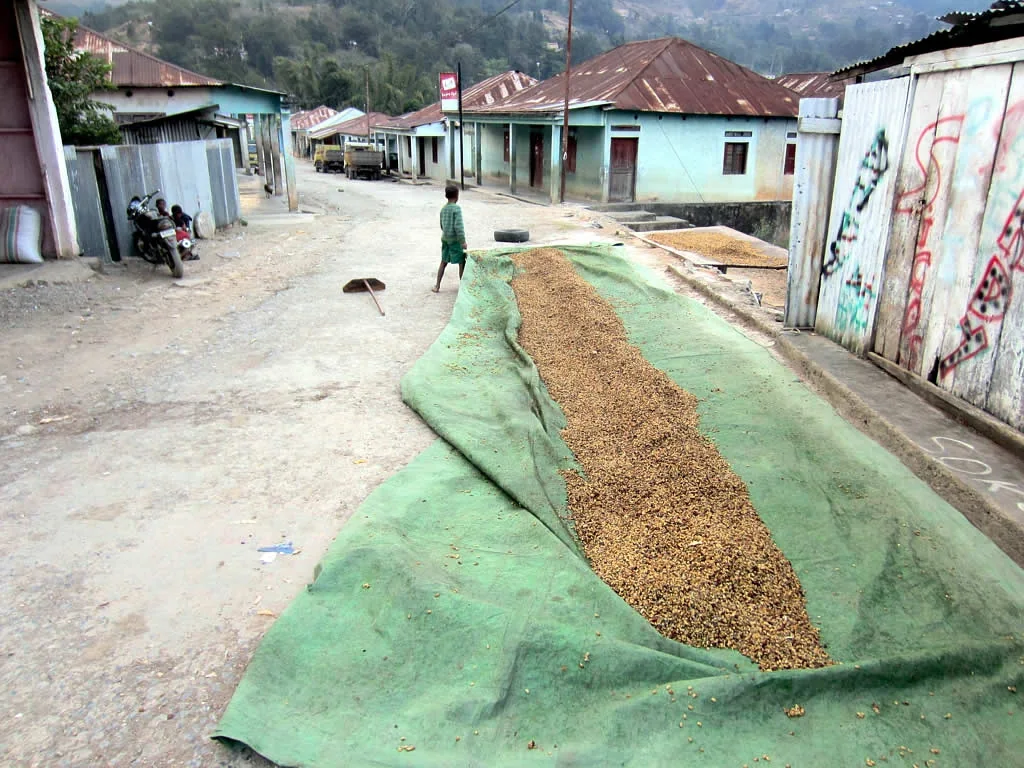
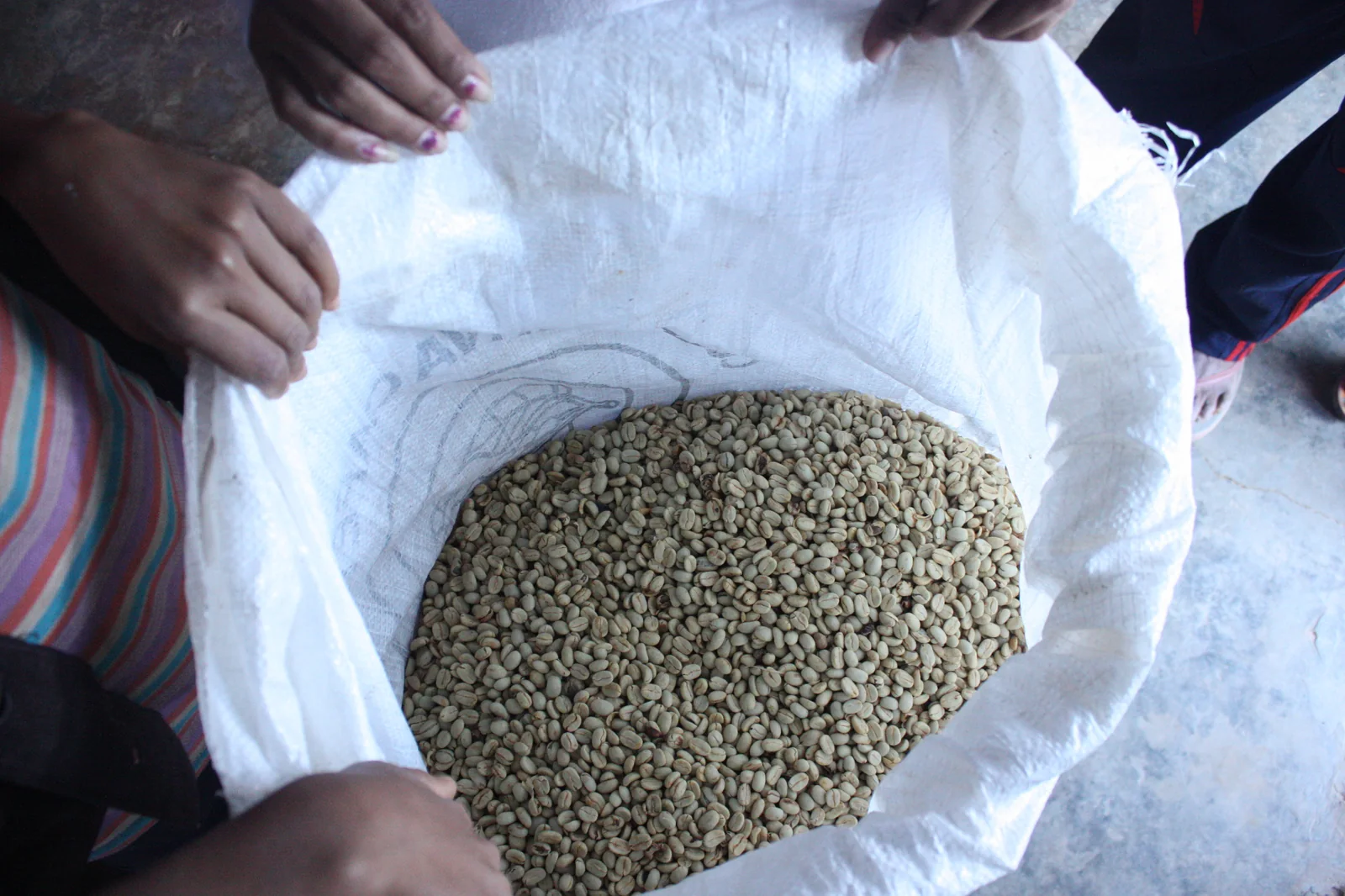
Companies buy cherries from March to August; what is picked later, or what nobody buys, is processed on the farm. Growers have three ways of doing it: the dry process, where the cherry dries with its pulp; an “attenuated” wet process, where the pulped coffee ferments in traditional baskets; or, where a station exists, the full wet process. Around 2002, three quarters of the coffee went through the dry process and the rest through the wet process, almost entirely at the CCT; ten years later the ratio had reversed, with the arrival of new companies and the refurbishing of washing stations. The CCT buys arabica cherries, turns them into parchment in its factories of Maubisse and Ermera and dries them in its warehouses at Tibar, near Dili, before hulling, that is, the removal of the envelope around the bean; on the farm, this hulling is still done with a pestle. The plantations receive little care, no pruning, no weeding, no disease control, no replacement of old trees, and 56% of the areas were judged in 2006 to be old and almost unproductive. The national yield is estimated at less than 200 kilograms of green coffee per hectare [5][6][15].
The CCT remains the reference producer organization. It had 24,000 members in 2019 according to the American federation that founded it, a number that changes with the years and the documents, and runs a rural health network, ten fixed and twenty-seven mobile clinics in 2010. It was the first to obtain organic and fair trade certifications, which earned it around 2010 about 0.10 dollar more per kilogram of green coffee exported. In 2009, four exporters made 90% of sales: Timorcorp, about 4,700 tonnes mostly to Germany, the CCT and Timor Global, about 1,500 tonnes each, ELSAA Café, 450 tonnes mostly to Portugal. A survey published in 2012 of 86 members of a primary cooperative of the CCT at Letefoho, in Ermera, shows the limits of the model: 76% say their quality of life has not improved and 81% do not take part in decisions. The State has given itself, with the Asian Development Bank, a national coffee plan to 2030, which aims to double production and to increase the value of exports by 270%, and a 3 million dollar project trains 2,000 households in six municipalities, Aileu, Ainaro, Bobonaro, Ermera, Liquiçá and Manufahi [5][6][8][15][17].
Coffee is the country's first export outside oil. According to the National Institute of Statistics, Timor-Leste sold 4,191 tonnes of it in 2024 for 17.7 million dollars, or 88% of the 20.2 million dollars of exported non-oil products, and between 5,895 and 7,521 tonnes a year from 2021 to 2023. For the International Coffee Organization, it was in 2016 the only country in Asia and Oceania to depend heavily on coffee, which made up 77% of its merchandise export earnings. The destinations have changed. In 2005, the United States took 43.6% of the coffee, Germany 29.4% and Indonesia 12.6%; the ICO gave in 2018 the European Union, 41.4%, the United States, 27.4%, and Canada, 13.7%. In 2023, according to the Timorese reports passed on to the United Nations, Indonesia receives 2,706 of the 4,682 tonnes of green coffee exported, or 58%, far ahead of Portugal and the United States [6][10][12][13].
A small share of the coffee stays in the country. The parchment that nobody buys is hulled with a pestle or mortar and becomes green coffee that the family drinks or sells in local markets during the rainy season, when money is short to buy food. In the countryside, roasting is done by hand; in Dili, in industrial workshops, including that of the CCT. The ministry estimated domestic consumption at 1,500 tonnes in 2008, for 14,000 tonnes produced and 12,500 exported, and another chapter puts it at around 1,000 tonnes a year. For families, coffee is first of all the cash income: 90% of household cash according to a 2003 Oxfam study, or 264 dollars a year per family according to a calculation made on 2006, below the national poverty line [5][6].
- Dominant species
- Coffea arabica, 53,816 ha against 2,574 ha of canephora according to the ministry (around 2009) [6]
- Main areas
- Ermera, Manufahi, Liquiçá, Ainaro: 92.9% of the area in 2006, of which Ermera 56% [6]
- Growing altitude
- Canephora from 600 to 1,000 m, arabica from 1,000 to 2,000 m [6]
- Cherry purchasing
- From March to August [5]
- FAOSTAT production 2024
- 9,522.52 t, status I (imputed value); last official value 13,314 t in 2021 [1]
- Exports 2024
- 4,191 t for 17.7 million dollars, 88% of non-oil exports [12]
- Coffee area, 2019 census
- 31,856 ha [14]
- International Coffee Organization
- Exporting member, ratification of the 2007 agreement on February 5, 2009 [9]
Gray areas
Nobody knows exactly how much coffee Timor-Leste produces. For 2004, the year of the FAOSTAT maximum, FAO gives 14,500 tonnes, an unofficial figure, and the Ministry of Agriculture 10,050; from 2002 to 2007, the international series exceeds the national series by 2,100 to 4,450 tonnes each year. The official FAOSTAT figure for 2009, 10,122 tonnes, is exactly the one the ministry publishes for 2006, on 51,989 hectares: either one of the two documents has the wrong year, or the same number was carried forward. In 2021, the only recent official year, FAO records 13,314 tonnes on 22,627 hectares, or 588 kilograms per hectare, three times the yield of 195 kilograms cited by the ministry and sector studies, whereas trade statistics count only 7,521 tonnes exported that year and domestic consumption is around 1,000 to 1,500 tonnes. The ICO, in the table reproduced by the International Trade Centre, classes the country as a producer of arabica alone, whereas the ministry counts 2,574 hectares of canephora. The U.S. Department of Agriculture, finally, does not track the country at all in its balances [1][5][6][11][12][18].
Areas and families are just as unsettled. The ministry counted 51,989 hectares in 2006, the press 55,000 hectares in production in 1999, FAOSTAT official areas of 52,182 to 54,341 hectares from 2008 to 2011 then imputed areas of 14,732 to 32,196 hectares; the agricultural census of 2019 measures 31,856 hectares, 6.3% of the area cultivated by households. The number of families ranges from 66,679 in 2006, 34% of households, to 38,000 households living directly from coffee according to a World Trade Organization figure repeated in 2026, without the definitions being comparable. The share of arabica is 86% of production in one chapter and 79%, plus 8% of a mix of the two species, in the other, both after the same source of 2009. Finally, the coffee reported to Indonesia, often first in tonnes since 2016 according to the importing countries, leaves in 2023 at about 1.8 dollars a kilogram, against 4.5 dollars to the United States: no source read says whether it is canephora, downgraded coffee or a coffee later resold under another origin [1][5][6][7][13][14][15].
The beginnings remain poorly dated. The Timor Hybrid is “identified in 1927” for the geneticists of 2024 and for the Timorese ministry, which celebrated this discovery at Fatubessi in 2017, but McCook gives only “the 1920s”, a 2026 publication writes 1930, and no period document consulted fixes the year; its departure from the island varies too, 1956 for the Évora researchers, 1957 for the first shipment to Oeiras according to McCook. McCook has rust arrive around 1886 on his map and in the early 20th century in his text. For the Indonesian period, the role of Denok rests on the press and activist accounts; no academic source read dates the monopoly or quantifies the prices paid. The FAOSTAT figures for the 1990s are estimates that do not agree with the press: 11,000 tonnes for 1998, whereas the Far Eastern Economic Review announced for 1999 about 13,000 tonnes, “almost double” the previous year. A series of colonial exports from 1947 to 1974, published in 1975 by Gonçalves and Mexia, exists but was not consulted [1][3][5][6][7][15][16][19].
Not covered: Production of the Portuguese period in tonnes before 1961 (the export series 1947-1974 of Gonçalves and Mexia, 1975, and the memoir of Lains e Silva, 1956, were not consulted); the effect of the Japanese occupation and of the destruction of 1999 on the plantations, which no source read measures; the exact date and content of ICO figures after 2019, its historical file no longer being in open access; the current share of each variety (Typica, Timor Hybrid, Catimor) in the plantations, which only importers' sheets cite, without proportion; prices paid to producers; the number of CCT members, given as 19,600 to 26,700 according to pages that I did not open; the detailed content of the national coffee plan, whose text was not found; the origin of the official FAOSTAT figure of 2021.
- FAOSTAT, Production: Crops and livestock products, Coffee, green (656), FAO, 2025, https://www.fao.org/faostat/en/#data/QCL solid level
Series 1961 to 2024 read in pays_producteurs_complement.json (version of December 23, 2025) and, for the status of each year, in the local copy of the bulk file (Production_Crops_Livestock_E_All_Data_(Normalized).csv, extracted on October 20, 2026, identical values). Production: A from 1961 to 1973 (1,023 to 6,602 t), 8,000 t in E from 1979 to 1989, A in 1996 and from 2008 to 2011 (2009 = 10,122 t), X from 2012 to 2019, I in 2020, A in 2021 (13,313.98 t on 22,627 ha), I from 2022 to 2024 (9,522.52 t in 2024). Maximum 14,500 t in 2004 and 2005, status X (“unofficial figure”). Official areas 52,182 to 54,341 ha from 2008 to 2011, imputed from 14,732 to 32,196 ha thereafter. - All About Coffee, William H. Ukers, The Tea and Coffee Trade Journal Company, 1922, https://www.gutenberg.org/ebooks/28500 solid level
Library copy. The Dutch extend coffee to Sumatra, Celebes, Timor, Bali; Timor among the “Other East Indies” with plantations mostly held by local growers; “Timor coffee” ranked after the Korinchi; table of origins: “Timor (Dutch & Portuguese)”, port of Kupang, “Medium bean of good quality”; index: Timor c., pp. 355 and 376. No separate mention of Portuguese Timor. - Coffee Is Not Forever: A Global History of the Coffee Leaf Rust, Stuart McCook, Ohio University Press, 2019 solid level
Library copy. P. 69: rust in the Portuguese colony of Timor around 1886. P. 104: canephora introduced into Portuguese Timor. Pp. 134-135: hybrids discovered in the 1920s in an arabica plantation; local curiosity until the return of Portugal after the Japanese occupation; Junta de Exportação do Café in the 1950s; rust arrived “at the beginning of the 20th century”, arabica limited to above 1,000 m; seeds sent to the CIFC in 1957, 1960 and 1966; tetraploid, self-fertile hybrid. - Timor Português, Produção e Mercados na década de 1920, Célia Reis, Revista Portuguesa de História, vol. XLVII, 2016, https://impactum-journals.uc.pt/rph/article/download/0870-4147_47_20/5 solid level
After the reports of the Banco Nacional Ultramarino: coffee substituted for sandalwood, compulsory cultivation, compulsory labor under José Celestino da Silva (1894-1908), founder of the SAPT; the SAPT the only large lasting enterprise, sales in Rotterdam, Amsterdam, Singapore; coffee 4.4% of exports in 1858, 60.7% in 1920, 81.5% of the value shipped in 1930; 17,000 ha in 1930; strong crop one year in three; canephora introduced by the first republican governor, little cultivated; Chinese traders who prepare the coffee at Makassar. - O impacto do desempenho da Cooperativa Café Timor na satisfação e qualidade de vida dos seus membros, Carlos da Conceição de Deus, Pedro Henriques, Fátima Jorge, Vanda Narciso, in M. Leach, N. Canas Mendes et al. (eds.), New Research on Timor-Leste, Swinburne Press, 2012, https://dspace.uevora.pt/rdpc/bitstream/10174/7071/1/chp_16.pdf medium level
Introduction in the middle of the 18th century, boom in the last quarter of the 19th; liberica then canephora after the rust; original plant of the hybrid at “Mata Nova”, feitoria of Fatu Bessi, 1917-1918, 800 m, Ermera (Ferreira et al. 1972); spread from 1956, local name “Moka”; Indonesian monopoly, profits financing the war; arabica 86% and canephora 14% (Wahjudi 2009); cherry purchases from March to August; three peasant methods; 75% by the dry process in 2002 (Oxfam 2003), ratio reversed afterwards; 2006 table (51,989 ha, 10,122 t, 195 kg/ha); 56% of old coffee trees; 1,500 t of domestic consumption in 2008; income of 264 USD per family; survey of 86 members at Letefoho. University chapter drawn from a master's thesis, hence the medium level. - Coffe Value Chain in Timor-Leste, in Las redes de cadenas de valor alimentarias en el siglo XXI, Pedro Damião Henriques, Maria Raquel Ventura-Lucas, Maria Leonor da Silva Carvalho, Carlos de Deus, Editorial Agrícola Española, 2012, https://dspace.uevora.pt/rdpc/bitstream/10174/16098/1/Libro%20redes%20 medium level
Thirteen districts; canephora from 600 to 1,000 m, arabica from 1,000 to 2,000 m; arabica 53,816 ha and canephora 2,574 ha (ministry); production 79% arabica, 13% canephora, 8% mix (Wahjudi 2009); 92.9% of the area and 93.8% of production in four districts; 66,679 families, 34%; ministry table 3 (DNPIA 2009): production 9,787 t (2002) to 14,000 t (2008), exports 12,500 t in 2008; consumption of about 1,000 t; exporters' shares in 2005 and destinations 2005; exports 2009 by company; CCT factories at Maubisse and Ermera, drying at Tibar; certifications and premium of $0.10/kg (World Bank 2011); old SAPT installations at Fato Bessi; series 1947-1974 by Gonçalves and Mexia (1975) cited. - Ending military monopoly has revitalized E. Timor's coffee industry, Dan Murphy, Far Eastern Economic Review, reproduced by the East Timor Action Network, 1999, https://www.etan.org/et/1999/february/15-21/20ending.htm medium level
Denok, army-controlled company linked to Benny Murdani, formed by seizing Portuguese plantations; monopoly undone after the Dili massacre of 1991, army withdrawal before 1995; cooperative with the NCBA, Starbucks main buyer; 1999 crop of about 13,000 t, almost double that of 1998; 55,000 ha in production; a fifth of the 830,000 inhabitants employed by coffee. - Percolating profits: USAID helps brew Timor-Leste coffee into #1 agricultural export, U.S. Co-ops (NCBA CLUSA), 2019, https://us.coop/blog/percolating-profits-usaid-helps-brew-timor-leste- medium level
In 1994, USAID funds the organization of 450 coffee growers into the Cooperativa Café Timor; 24,000 members in 2019; clinics. Founding body of the CCT, hence an interested party. - Membership of the International Coffee Agreement 2007, as at 2 February 2022, International Coffee Organization, 2022, https://www.icocoffee.org/wp-content/uploads/2022/11/membershipica2007 solid level
Timor-Leste among the countries that have completed their procedures: ratification deposited on February 5, 2009. Document ED 2409/22 Rev. 3 (2025) lists it among the exporters admitted to sign the 2022 agreement. - Identifying coffee sector challenges in selected countries in Asia and Oceania (PJ 125/18), International Coffee Organization, Projects Committee, 2018, https://www.ico.org/documents/cy2017-18/pj-125e-challenges-asia-oceani solid level
Only country in the region to depend heavily on coffee: 77% of merchandise export earnings in 2016; green coffee exported mainly to the European Union (41.4%), the United States (27.4%) and Canada (13.7%); ICO data for the country only since the early 2000s. - The Coffee Guide, 4th edition, International Trade Centre (ITC), with data from the International Coffee Organization, 2021 solid level
Library copy, read by word coordinates (PyMuPDF). Table 5, PDF page 114 (source ITC and ICO): Timor-Leste ranked (A), April-March crop year, 111, 59, 82, 65, 139 and 115 thousand bags for 2014 to 2019. P. 29: coffee makes up about 10% of national export earnings (ICO 2019). - External Trade Statistics Timor-Leste 2024, National Institute of Statistics of Timor-Leste (INETL), Ministry of Finance, 2025, https://www.laohamutuk.org/DVD/DGS/Trade-publication_2024.pdf solid level
Coffee exports, value in thousands of dollars and quantity: 19,009 and 7,034 (2019), 12,658 and 3,739 (2020), 28,072 and 7,521 (2021), 26,596 and 6,084 (2022), 15,402 and 5,895 (2023), 17,704 and 4,191 (2024). Non-oil exports: 20,164 thousand dollars in 2024. Copy hosted by the NGO La'o Hamutuk; quantities assumed to be in tonnes (unit not written, consistent with Comtrade). - UN Comtrade, HS 090111 (coffee, not roasted, not decaffeinated), United Nations Statistics Division, 2026, https://comtradeapi.un.org/public/v1/preview/C/A/HS?reporterCode=626&a solid level
Queried on October 21, 2026. Exports reported by Timor-Leste in 2023: 4,682 t for 12.6 million dollars, of which Indonesia 2,706 t (4.9 million dollars), Portugal 713 t, United States 340 t (1.5 million dollars). Reports of the importing countries: Indonesia first in tonnes from 2016 to 2019 and in 2023-2024; Germany first from 2010 to 2014. The country does not report every year. - Timor-Leste Agriculture Census 2019, National Report on Final Census Results, General Directorate of Statistics and Ministry of Agriculture and Fisheries, 2020, https://inetl-ip.gov.tl/wp-content/uploads/2023/03/FINAL-MAIN-REPORT-T solid level
Table A.14: 31,855.8 ha of coffee cultivated during the twelve months preceding the census; coffee makes up 6.3% of the 509,226 ha of gross area cultivated by households. - Hope in a Cup: Timor-Leste's Path to a Sustainable Coffee Future, Nuno Ridenio, Heinrich Böll Foundation, Southeast Asia, 2026, https://th.boell.org/en/node/2683 medium level
38,000 households living directly from coffee (WTO 2024); yields of 195 to 204 kg of green coffee per hectare; national plan 2019-2030 (rehabilitation of 18,000 ha); Timor Hybrid “discovered in 1930” (after a source of 2023). - The genome and population genomics of allopolyploid Coffea arabica reveal the diversification history of modern coffee cultivars, Jarkko Salojärvi et al., Nature Genetics 56, 2024, https://doi.org/10.1038/s41588-024-01695-w solid level
Library copy, p. 722: spontaneous hybrid canephora × arabica “identified on the island of Timor in 1927”, after Clarindo et al. 2013. - Timor-Leste: Coffee and Agroforestry Livelihood Improvement, project 51396-001, Asian Development Bank, 2020, https://ewsdata.rightsindevelopment.org/files/documents/01/ADB-51396-0 solid level
Project sheet: grant of 3 million dollars, 2,000 households trained in Aileu, Ainaro, Bobonaro, Ermera, Liquiçá and Manufahi, in support of the national coffee plan; objectives: production doubled and export value increased by 270% by 2030. Copy archived by a monitoring site, the Bank's page having refused access. - Production, Supply and Distribution Online, coffee file (psd_coffee.csv), USDA Foreign Agricultural Service, 2026, https://apps.fas.usda.gov/psdonline/downloads/psd_coffee_csv.zip solid level
File downloaded on October 21, 2026 for another dossier and reread here: no row for Timor-Leste. - 2017-10-25 Fatubessi.jpg, description of the photograph of the Festival Café Timor-Leste, Office of the Minister of Agriculture and Fisheries (GAB MEMAP), on Wikimedia Commons, 2017, https://commons.wikimedia.org/wiki/File:2017-10-25_Fatubessi.jpg low level
On October 21, 2017 at Fatubessi, municipality of Ermera, the ministry launches a coffee festival that commemorates the discovery of the Timor Hybrid at Fatubessi “in 1927”. Official statement, but a mere photograph caption.
