ATLASThailand
16,623 tonnes (FAOSTAT 2024)In-depth dossier, atlas 2026In-depth dossier: the FAOSTAT series set against other figures, the history, today's industry and its gray areas, with numbered sources. Region: Asia.
Thailand had only a statistical reference point. This dossier completes it: the history of the sector, what it is today, and what remains uncertain, each paragraph referring to its sources, numbered at the bottom of the page.
The FAOSTAT series remains displayed as is. The dossier says what it is worth, year by year when possible, and compares it with the other figures available.
- Geographic status
- country
- Name in FAOSTAT
- Thailand
- Latest value
- 16,623 tonnes in 2024
- Nature of the value
- official figure
- Start of the positive series
- 1961
- Series maximum
- 86,450 tonnes in 1995
Confirmed coverage: FAOSTAT series, and a dossier of 22 sources that crosses the history, today's sector and what remains uncertain.
History
Siam is almost absent from the library's old sources. Ukers, in 1922, describes the coffee of French Indochina and of the Federated Malay States and even mentions a few plantations in Burma, but never names Siam; Coste, in 1955, says no more about it. The only trace found is older and concerns another species. In 1894, the American Joseph Walsh writes that the “systematic” cultivation of Coffea liberica, the Liberian coffee tree, began some ten years earlier in Siam, in Malacca and on several small Malay islands, that it first succeeded there so well that the seeds were in great demand, then disappointed on trial. No source read says what became of these plantations [2][3][4].
The account that serves as the birth certificate of southern coffee is later still. In 1986, two researchers of the Department of Agriculture, the State's agronomic research service, Arporn Tummakate and Wichit Thanomthin, report that “it is said” that a Thai Muslim named Nai Ti Mun planted the first Coffea canephora at Saba Yoi, in Songkhla province, in 1904. They suppose that the seeds came from Indonesia, where the Dutch had introduced the species in 1900 and 1901, or a little later from Malaysia, and add that no evidence allows saying who else brought it in. Their source for this account is a brochure of the rubber division of the Ministry of Agriculture, dated 1972, sixty-eight years after the events. In 1986, again according to them, canephora grows in almost all the southern provinces and is among the country's exports, but planters resow their own seeds without selection, so that small-leaved and large-leaved trees mingle in almost every garden [5].
Northern coffee is born of another story, that of opium. According to the Thai Ministry of Foreign Affairs, the arrival of migrants during the Chinese civil war makes poppy cultivation grow in the northern mountains to some 145 tonnes of opium a year in the 1960s, and the ban of 1958 fails for lack of means. In 1969, King Bhumibol launches what will become the Royal Project, a private foundation tasked with finding replacement crops for the hill peoples; in 1971, the project joins the United Nations Fund for Drug Abuse Control in a crop substitution and community development project. The agronomist Pongsak Angkasith, of Chiang Mai University, dates this pilot project from 1972 to 1979 and sums up its conclusion: arabica can replace poppy in the long term, because the land and climate suit it, because coffee is easy to transport and store, and because demand exists. A study published in 2025, based on interviews with Akha and Lisu producers in Chiang Rai province, recalls the other side of this account: these programs also aimed to put an end to swidden farming, shifting slash-and-burn cultivation, among highland minorities, and the marketing of coffee today presents them as loyal and picturesque subjects while keeping silent about the Cold War, inequalities and ecological damage [6][7][8].
The first cultivar spread by the United Nations project, Caturra, succumbs to coffee leaf rust, the fungus Hemileia vastatrix. In 1974 Catimor progenies arrive, crosses with the Timor Hybrid that carry its resistance to rust, then sorted for tree size, yield, bean and cup. The Department of Agriculture has kept the record of a line of this type, a cross of Mundo Novo and Catimor: obtained in 1960 at the Coffee Rusts Research Center of Oeiras, in Portugal, it is tested in Thailand as early as 1975 at Mae Lod, in Chiang Mai province, then selected for forty-five years from station to station until it becomes, in 2021, the recommended variety DOA Chiang Rai 2. The sector remains small. A grading of green arabica beans is set in 1985, and about 500 tonnes of quality arabica reach the market in 1990-1991 with the support of highland development projects; the fall in prices from 1990 to 1992, which coincides with the end of this support, leads planters to uproot their coffee trees, and cultivation withdraws toward shade and agroforestry, that is, coffee planted under fruit or forest trees. The Doi Tung development project, a royal initiative of 1988 intended to reforest the mountain and to fight narcotics, also chooses arabica among the substitution crops [6][9][14].
The FAOSTAT series mainly follows southern canephora. It starts at 60 tonnes in 1961, exceeds 1,000 tonnes in 1971 and reaches 9,120 tonnes in 1980, then 71,483 tonnes in 1990 and a maximum of 86,450 tonnes in 1995, still 86,009 in 2001. In 1995, the Office of Agricultural Economics, the statistics service of the Ministry of Agriculture, counts 85,371 tonnes of canephora harvested on 69,914 hectares in the south and 863 tonnes of arabica on 1,509 hectares in the north: arabica then weighs 1% of Thai coffee, and around 2000 Angkasith estimates that 63% of green coffee is exported, to the United States, South Korea, Germany, Japan and Poland. The series then falls almost without pause, 48,955 tonnes in 2010, 26,089 in 2015, 16,623 in 2024, or 81% less than at the maximum. What it does not show is that the decline is that of a single species: from 1995 to 2023, canephora was divided by ten and arabica multiplied by more than nine, to the point that the two weigh almost as much today [1][6][11].
Today
The two Thai coffees almost never meet. Canephora grows in the south, in the provinces of Chumphon, Surat Thani, Nakhon Si Thammarat, Krabi, Phang Nga and Ranong, which together had 423,947 rai of it in 1997-1998, or 67,832 hectares, a hectare being worth 6.25 rai. The Department of Agriculture recommends it below 700 meters of altitude and describes a mostly intercropped culture, planted in durian and longkong orchards or under shade trees set out six to twelve months before the coffee trees, such as sator, Parkia speciosa. Arabica occupies the northern mountains, between 800 and 1,700 meters according to the product specifications of Doi Tung and Doi Chaang, two mountains of Chiang Rai province, and a market study of 2021 also cites the provinces of Chiang Mai, Nan and Tak. In 2023, the Office of Agricultural Economics places 54.49% of the bearing areas in the north, 39.56% in the south, 4.11% in the center and 1.84% in the northeast [6][9][10][11][12][22].
In 2023, the Office counts 104,682 rai of bearing arabica, about 16,750 hectares, for 7,991 tonnes, and 99,529 rai of canephora, about 15,925 hectares, for 8,583 tonnes, out of a total of 16,574 tonnes; the south now supplies only 6,896 of them. The canephora yield, 1,221 kilograms per hectare in the south in 1995, is now only about 540 kilograms. The Department of Agriculture speaks of a production “in recession”: in Chumphon and Ranong, planters cut down the old coffee trees intercropped in the orchards to make the durians easier to maintain, while coffee trees planted in 2020 under the rubber trees and the Assam tea bushes of the north come into production. The drought and heat of February and March 2023, which dried the fruit on the tree, and the coffee berry borer, a small beetle that lays its eggs in the cherry and can cause the loss of more than half a crop according to the department, brought yields down further. In 2023-2024, the Office recorded 25.04 baht per kilogram of arabica cherries, 197.66 baht per kilogram of arabica parchment, parchment being the envelope that surrounds the bean, and 70.33 baht per kilogram of canephora green coffee [6][11][12][16].
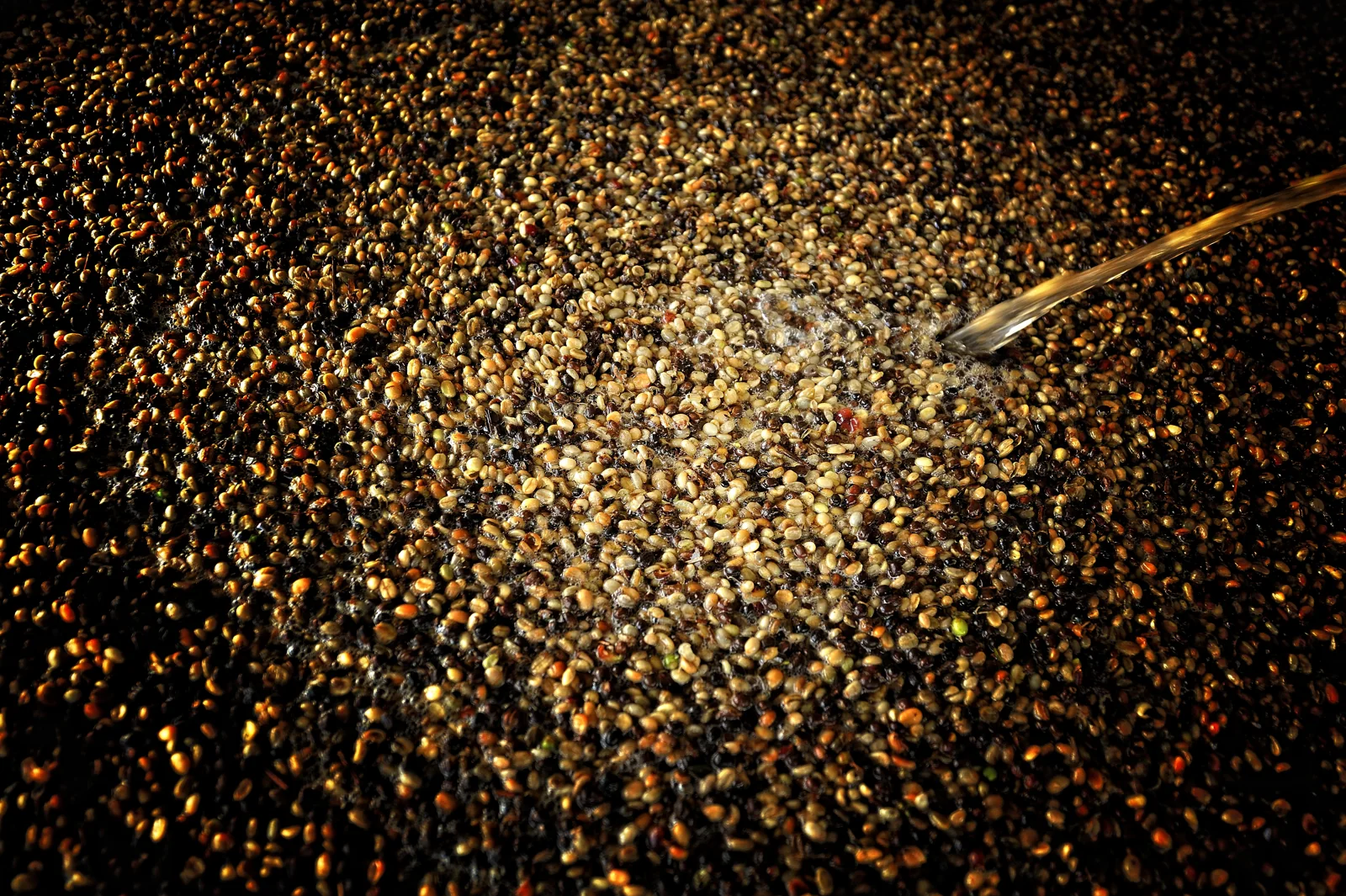
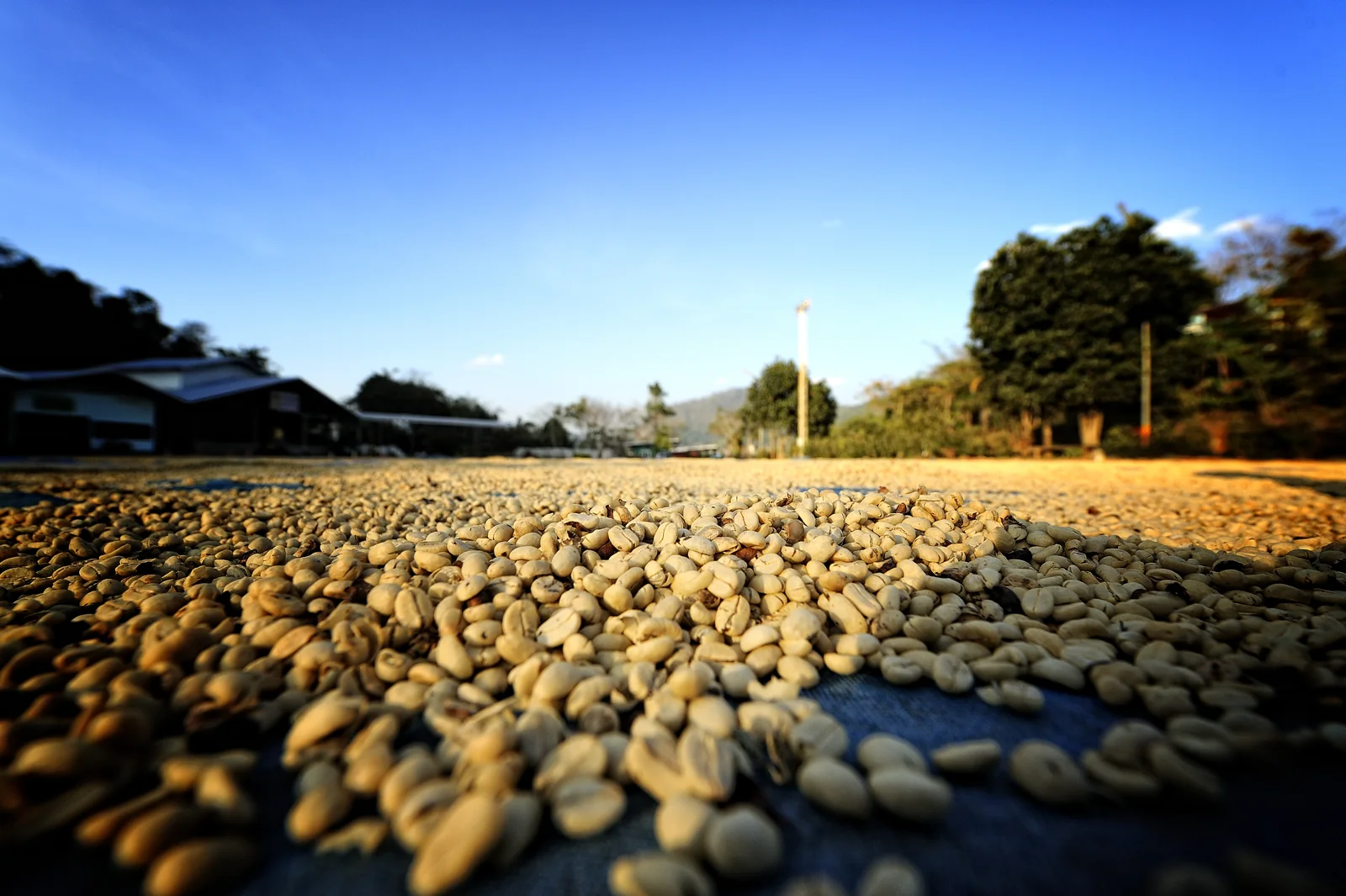
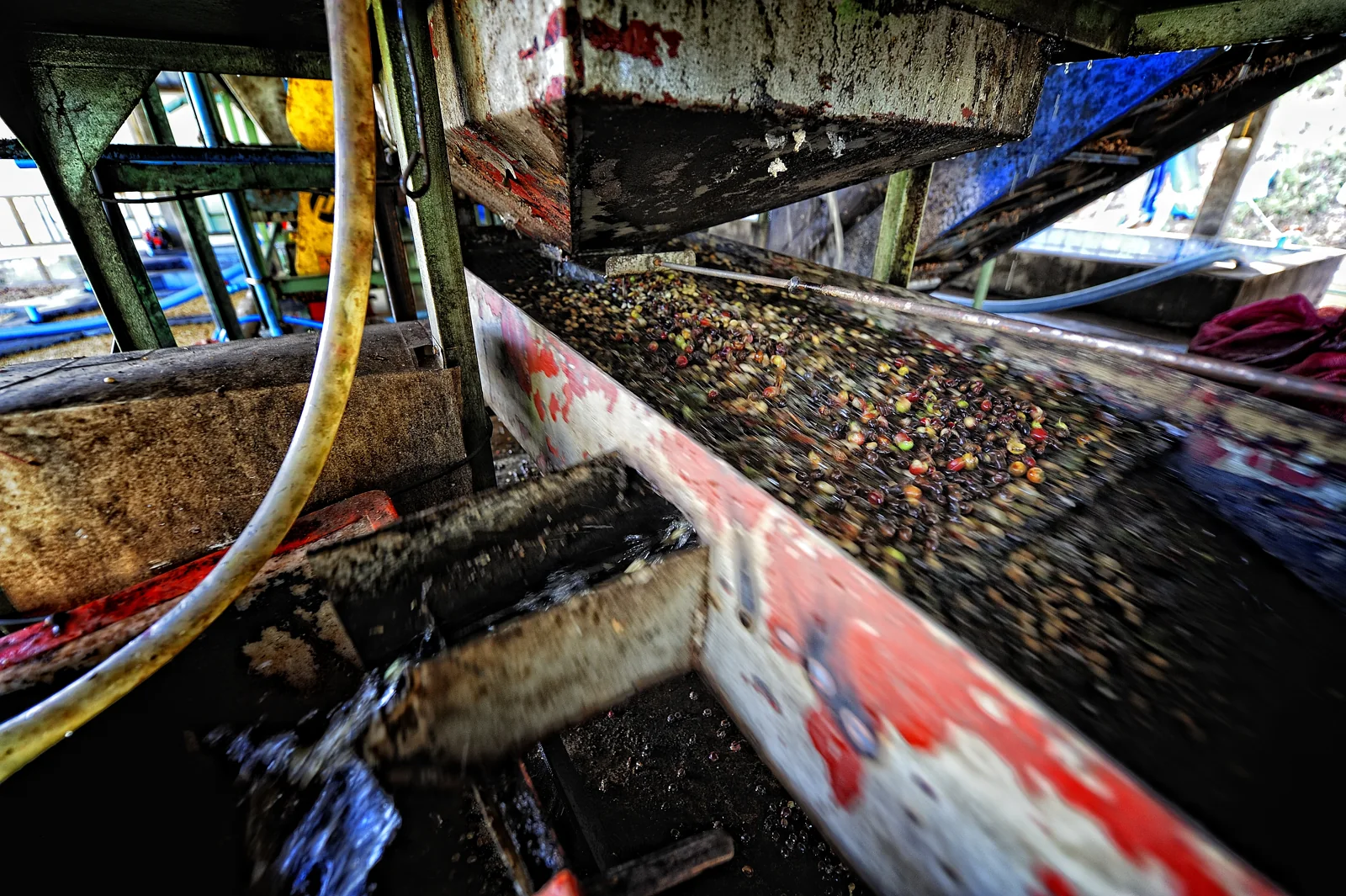
The recommended varieties come mostly from public research. For the south, the Department of Agriculture recommends five canephora selected at its horticultural research center in Chumphon; the first, DOA Chumphon 1, drawn from 1989 from planters' trees in Sawi district, was recommended in 2006 after seventeen years of trials, with 3.94 kilograms of dry bean per tree per year on average over nine years. The World Coffee Research catalog cites two Nestlé Research clones distributed in Thailand, Roubi 4 and Roubi 5, large-beaned and highly resistant to rust, and ranks the country among the top ten canephora producers. In the north, the certified variety Chiang Mai 80 crosses a Catimor lineage, derived from the Timor Hybrid and Caturra, with SL28; the department asks that it be planted in shade, especially below 1,000 meters. The product specifications of Doi Tung and Doi Chaang name Catimor, Caturra and Catuai and describe the wet process: sorting the cherries by flotation, pulping, fermentation in water, 36 hours at Doi Tung after a pass through a mucilage remover, a machine that removes the mucilage, the sugary layer stuck to the parchment, then washing and sun drying down to 10 to 12% moisture. Harvest runs from October to February at Doi Tung and from November to March at Doi Chaang, where the coffee trees flower in February [9][10][12][13][15][21].
These two Chiang Rai mountains obtained on the same day, July 9, 2015, a protected geographical indication of the European Union, that is, a name reserved for coffees that follow a product specification tied to a place: Kafae Doi Tung and Kafae Doi Chaang, kafae meaning coffee in Thai. Doi Tung had received as early as 2006 the geographical indication of the Thai Department of Intellectual Property; its zone, 149.62 km² between the districts of Mae Fah Luang and Mae Sai, is controlled by the Mae Fah Luang Foundation, which processes the coffee in its own factory and may display the seal of the United Nations Office on Drugs and Crime on its packs. Doi Chaang covers two villages of Mae Suai district, between 1,100 and 1,700 meters, where coffee grows under plum, peach, pear and macadamia trees. Thailand is an exporting member of the International Coffee Organization, a party to the 2007 agreement, and the Organization's table reproduced by the International Trade Centre ranks it among the producers of both species, with an October to September crop year [9][10][17][20].
The country drinks far more coffee than it produces. An exporter of 71,295 tonnes of green coffee in 1997, it reports only 15,980 tonnes in 2005 and 720 in 2024. Its imports of green coffee reach 61,284 tonnes in 2024, of which 36,704 from Vietnam, 15,049 from Laos and 8,797 from Indonesia. This coffee enters at a 5% duty from the countries of ASEAN, the Association of Southeast Asian Nations, against 30% within the tariff quota negotiated at the World Trade Organization, that is, a volume admitted at a reduced duty, here 5.25 tonnes, and 90% beyond. The Department of Agriculture estimates the needs of industry at 80,000 tonnes a year. A large share becomes instant coffee: the U.S. Department of Agriculture estimates Thai consumption in 2024 at the equivalent of 700,000 60-kilogram bags in instant against 230,000 in roasted and ground coffee, and the 2021 market study, made for the Brazilian embassy, credits Nescafé with 81% of the instant market. The country resells these processed products to its neighbors, 26,244 tonnes of coffee products in 2020 according to the same study, mostly “3 in 1” mixes of instant coffee, sugar and non-dairy creamer sold in Myanmar, Laos and Cambodia. Consumption is also changing form: instant imports were multiplied by more than five from 1997 to 2000, and the 2021 study describes the rise of coffee chains and of coffee prepared at home [6][12][18][19][22].
- Species
- Coffea arabica in the north, Coffea canephora in the south, in almost equal shares in 2023 (7,991 t and 8,583 t) [11]
- Official production 2024
- 16,623 t, status A (official figure) [1]
- FAOSTAT series maximum
- 86,450 t in 1995 [1]
- Growing zones
- Canephora in Chumphon, Surat Thani, Nakhon Si Thammarat, Krabi, Phang Nga and Ranong; arabica in the northern mountains [6]
- Canephora altitude
- 700 m at most, according to the recommendation of the Department of Agriculture [12]
- Protected geographical indication (EU)
- Kafae Doi Tung, arabica from 800 to 1,200 m, registered on July 9, 2015 [9]
- Green coffee imports 2024
- 61,284 t, of which 60% from Vietnam [19]
- Introduction of canephora
- 1904 in Songkhla, according to an account reported in 1986 from a text of 1972 [5]
Gray areas
The volume of Thai coffee depends on who counts it. The Office of Agricultural Economics, which FAOSTAT repeats to within a few tonnes, gives 16,575 tonnes for 2023; the International Coffee Organization, through the International Trade Centre, 450,000 bags for the 2019 crop year, or 27,000 tonnes, close to the Office's 26,414 tonnes; the U.S. Department of Agriculture, 750,000 bags in 2023 and 900,000 in 2024, or 45,000 and 54,000 tonnes, 2.7 to 3.2 times the official figure. The disagreement also concerns the species: the American database has not counted a single bag of Thai arabica since 1999, whereas the Office counts 7,991 tonnes of it in 2023, almost half the crop. As the pages of the U.S. department refused access, no annual report on Thai coffee could be read, and the origin of these figures remains unknown. The official statistic is not of one piece either: for 2019, two publications that cite the Office give 26,414 and 26,424 tonnes; for 2018, FAOSTAT records 23,619 tonnes whereas the Office publishes 24,687; and the FAOSTAT series carries decimals, 16,623.48 tonnes in 2024, unexpected for a national figure, while only the status of 2024 is known [1][11][17][18][22].
Consumption is even less well known. For 2019, the U.S. department estimates it at 800,000 bags, 48,000 tonnes, and the International Trade Centre at 2,169,000 bags of green equivalent, about 130,000 tonnes, which would make Thailand the twentieth-largest consumer in the world; the Department of Agriculture speaks of industrial needs of 80,000 tonnes a year and counts 91,389.90 tonnes of green coffee and instant coffee imported in 2023, without saying how it converts the instant. Processed products do not cross-check any better: the American database credits the country with 650,000 bags of instant coffee exported in 2024, about 39,000 tonnes of green equivalent, whereas customs report 2,322 tonnes of coffee extracts exported. The “3 in 1” mixes, filed under another customs code, perhaps explain part of the gap, but no source read says so. Finally, the two official documents that comment on the harvests of 2023 and 2024 contradict each other on a simple point: the Department of Agriculture writes that the coffee trees planted under the rubber trees and tea bushes of the north are arabicas, the trade policy bureau of the Ministry of Commerce that they are canephora [11][12][16][17][18][19].
The dates of origin rest on little. The 1904 planter, Nai Ti Mun, is attested in what has been read only by a brochure of 1972, not to be found online, and the researchers who cite it in 1986 introduce it with an “it is said”; the Indonesian origin of the seeds is a supposition on their part. The liberica reported in Siam by Walsh around 1884 leaves no other trace in the sources read. Angkasith writes that extension work on coffee began as early as 1957, without saying where or by whom, twelve years before the Royal Project, and dates the project with the United Nations to 1972 whereas the Ministry of Foreign Affairs has it begin in 1971. The account of opium replaced by coffee is carried mostly by official sources, which write it as a success: the ministry announces a 97% drop in poppy between 1985 and 2015 without saying what share is due to coffee, and the 2025 study disputes how it is presented. Finally, no source read quantifies what Doi Tung and Doi Chaang weigh today within the 7,991 tonnes of arabica of the north [3][5][6][7][8].
Not covered: The 1972 text that carries the 1904 account, not to be found online; the annual reports of the U.S. Department of Agriculture on Thai coffee, its pages having returned 403, so that the origin of its figures remains unknown; the FAOSTAT status of each year, only that of 2024 being known; the breakdown of production by province, the Office publishing in open access only totals and the regional shares read here; the harvest calendar of southern canephora, which no source read gives in months; the number of planters; the share of Doi Tung and Doi Chaang in northern arabica and the history of the companies that market them; competitions, recent processes (honey, controlled fermentations) and the specialty coffee market; Black Ivory elephant coffee, already covered by the site's plate on animal coffees; the effect of climate change, beyond the drought of 2023; the export licensing regime introduced by the Ministry of Commerce in 2023, seen only in a search result.
- FAOSTAT, Production: Crops and livestock products, Coffee, green (656), FAO, 2025, https://www.fao.org/faostat/en/#data/QCL solid level
Series 1961 to 2024 read in pays_producteurs_complement.json (version of December 23, 2025): 60 t in 1961, 1,140 t in 1971, 9,120 t in 1980, 71,483 t in 1990, maximum of 86,450 t in 1995, 86,009 t in 2001, 48,955 t in 2010, 26,089 t in 2015, 23,619 t in 2018, 26,424.38 t in 2019, 16,690 t in 2023, 16,623.48 t in 2024 with status A. The status is known only for the current year. - All About Coffee, William H. Ukers, The Tea and Coffee Trade Journal Company, 1922, https://www.gutenberg.org/ebooks/28500 solid level
Library copy, full-text search: no occurrence of Siam, Thailand or Bangkok. The book describes French Indochina (p. 237), the Federated Malay States and mentions coffee “on a restricted scale” in Burma. - Coffee: Its History, Classification and Description, Joseph M. Walsh, Henry T. Coates & Co., 1894, https://www.biodiversitylibrary.org/bibliography/33348 solid level
Library copy (Pepites_historiques_et_scientifiques), p. 149, chapter on the coffees of Polynesia: systematic cultivation of liberica begun some ten years earlier in Siam, Malacca and small Malay islands, at first prosperous, then disappointing. - Les caféiers et les cafés dans le monde, tome I, Les caféiers, René Coste, Larose, 1955, https://horizon.documentation.ird.fr/exl-doc/pleins_textes/divers20-12 solid level
Library copy, extracted text: no mention of Thailand or Siam as a coffee-growing country (only occurrence: the shade tree Cassia siamea). - Robusta Coffee (Coffea canephora): A Perspective (ความเป็นมาของกาแฟโรบัสต้า), Arporn Tummakate and Wichit Thanomthin, Thai Agricultural Research Journal, vol. 4, no. 2, pp. 174-177, 1986, https://li01.tci-thaijo.org/index.php/thaiagriculturalresearch/article solid level
Scanned PDF without a text layer, read from the image (pages 1 and 3). Introduction of canephora in Indonesia in 1900-1901; “it is said” that Nai Ti Mun planted it at Saba Yoi, Songkhla, in 1904, after Thongphun Sriwanarat, department brochure, 1972; Indonesian or Malaysian origin supposed; 82 years later, grown in almost all the southern provinces and an export product; no varietal selection, small-leaved and large-leaved types mixed. - Coffee Production Status and Potential of Organic Arabica Coffee in Thailand, Pongsak Angkasith, Chiang Mai University, AU Journal of Technology (paper presented at the First Asian Regional Round-table on Sustainable, Organic and Speciality Coffee, Chiang Mai, February 2001), 2002, https://web.archive.org/web/2015/http://www.journal.au.edu/au_techno/2 solid level
Read as a PDF through the archive (the original address returns 404). Table 3 after the Office of Agricultural Economics: 1995, north 863 t on 1,509.4 ha, south 85,371 t on 69,914 ha, south yield 1,221.1 kg/ha, total 86,233 t; 1998, total 78,214 t. Canephora in six southern provinces, 423,947 rai in 1997-1998. Green coffee exports 71,295 t in 1997, 59,311 t in 2000; customers United States, Korea, Germany, Japan, Poland; instant coffee imports from 412 t (1997) to 2,270 t (2000). Thai/UN crop substitution project 1972-1979; extension “since 1957”; Caturra then Catimor in 1974; grading of 1985; 500 t of arabica in 1990-1991; price fall 1990-1992; arabica from 800 to 1,200 m. - From Poppy to Coffee: How Thailand Became a Model for Alternative Development, Chutintorn Gongsakdi, Thai Ministry of Foreign Affairs, 2021, https://image.mfa.go.th/mfa/0/Ty8J7f4hKr/ข่าว/Article_From_Poppy_to_Co medium level
Migrations of the 1940s, about 145 t of opium a year in the 1960s, ban of 1958, the king's idea in 1969, first training in 1970, substitution project with UNFDAC in 1971, arabica among more than 150 introduced crops, eradication from 1985, 97% drop in poppy from 1985 to 2015. Government promotional text, hence the medium level. - From Cold War to Cold Brew: Crop Replacement Strategies, Bean Logistics, and Ethnicized Coffee Commerce in Northern Thailand, Jane M. Ferguson and Amporn Ayuttacorn, Critical Asian Studies, vol. 57, no. 1, pp. 96-118, DOI 10.1080/14672715.2025.2450476, 2025, https://hdl.handle.net/1885/733751052 solid level
Abstract only, read on the record in the Australian National University repository (article behind a paywall): crop replacement programs of the 1970s against swidden farming and opium, interviews with Akha and Lisu producers in Chiang Rai, marketing that presents the highlanders as loyal and picturesque and keeps silent about the Cold War, inequalities and ecological damage. - Single document “Kafae Doi Tung”, OJ C 48 of 20.2.2014, p. 14, and Implementing Regulation (EU) 2015/1134 of July 9, 2015, European Commission, Official Journal of the European Union, 2014 and 2015, https://publications.europa.eu/resource/oj/JOC_2014_048_R_0014_01 solid level
Protected geographical indication (and not designation of origin), application TH-PGI-0005-0814 of 27.05.2010; arabica Catimor, Caturra, Catuai; 800 to 1,200 m; zone of 93,515 rai or 149.62 km² in the districts of Mae Fah Luang and Mae Sai; Thai geographical indication of 2006; harvest from October to February; mechanical demucilaging then 36 h of fermentation; sun drying down to 10-12%; control by the Mae Fah Luang Foundation; UNODC seal; Doi Tung development project launched in 1988. Regulation read through the EU publications portal (CELEX 32015R1134). - Single document “Kafae Doi Chaang”, OJ C 49 of 21.2.2014, p. 8, and Implementing Regulation (EU) 2015/1135 of July 9, 2015, European Commission, Official Journal of the European Union, 2014 and 2015, https://publications.europa.eu/resource/oj/JOC_2014_049_R_0008_01 solid level
Protected geographical indication, application TH-PGI-0005-0815 of 27.05.2010; Caturra, Catimor, Catuai; 1,100 to 1,700 m; villages of Doi Chaang and Ban Mai Pattana, Wawi sub-district, Mae Suai district; flowering in February, harvest from November to March; wet process, soaking for 20 to 24 h, drying for seven to eight days down to 11%; shade of plum, peach, pear and macadamia trees. - คู่มือ การป้องกันกำจัดมอดเจาะผลกาแฟแบบผสมผสาน (manual of integrated pest management against the coffee berry borer), Sumet Pakpian, Lampang Agricultural Research Center, Department of Agriculture, after the Office of Agricultural Economics (2024), 2026, https://www.doa.go.th/ac/lampang/wp-content/uploads/2026/01/คู่มือ-การ solid level
2023: 204,211 rai bearing (arabica 104,682, canephora 99,529), 16,574 t (arabica 7,991, canephora 8,583); north 54.49%, south 39.56%, center 4.11%, northeast 1.84% of the areas; table 2018-2023 (24,687, 26,414, 22,481, 21,775, 18,689, 16,575 t); felling of old canephora in the durian orchards at Chumphon and Ranong; coffee trees planted in 2020 under rubber trees and Assam tea bushes said to be arabica; drought; borer, more than 50% losses; prices for 2023-2024 of 25.04, 197.66 and 70.33 baht per kilo. - คู่มือเทคโนโลยีการผลิตกาแฟโรบัสตา (manual of canephora production technology), Horticultural Research Institute and Chumphon Horticultural Research Center, Department of Agriculture, 2024, https://www.doa.go.th/hort/wp-content/uploads/2025/01/คู่มือเทคโนโลยีก solid level
Production “in recession”; 2023: 99,529 rai and 8,584 t, of which the south 80,633 rai and 6,896 t; industry needs of 80,000 t a year; imports of green coffee and instant coffee of 91,389.90 t in 2023; five recommended varieties (Chumphon 1, 2, 3, 84-4, 84-5); altitude of 700 m at most; intercropping in durians and longkongs, shade of sator, Sesbania or Leucaena; harvest at least 309 days after flowering. - กาแฟโรบัสตาพันธุ์ กวก.ชุมพร 1 (data sheet of the variety DOA Chumphon 1), Chumphon Horticultural Research Center, Department of Agriculture, 2025, https://www.doa.go.th/hort/wp-content/uploads/2025/01/กาแฟโรบัสตาพันธุ solid level
Collection from 1989, including line 1/11 from Sawi district; 17 years of research (1989-2005); 3.94 kg of dry bean per tree per year over nine years; variety recommended on October 9, 2006. - กาแฟอะราบิกาพันธุ์ กวก. เชียงราย 2 (data sheet of the variety DOA Chiang Rai 2), Chiang Mai Royal Agricultural Research Center, Department of Agriculture, 2025, https://www.doa.go.th/hort/wp-content/uploads/2025/01/กาแฟอะราบิกา-กวก solid level
Cross of Mundo Novo 1535/33 by H.W. 26/14 (Caturra by Timor Hybrid CIFC 832/1) obtained at the CIFC in Oeiras in 1960; second generation tested in Thailand from 1975 to 1981 at Mae Lod (Mae Taeng, Chiang Mai), selection until 2020; variety recommended on July 19, 2021; to be planted in shade above 1,200 m. - การปลูกและดูแลรักษากาแฟอะราบิกา (cultivation and maintenance of arabica), Chiang Mai Agricultural Research and Development Center, Department of Agriculture, 2025, https://www.doa.go.th/hc/cmrarc/wp-content/uploads/2025/08/การปลูกและด solid level
Chiang Mai 80, certified variety, cross of H.W. 26/5 (Timor Hybrid 832/1 by Caturra 19/1) and SL28; 500 to 900 g of dry bean per tree at seven years; not to be planted in full sun, especially below 1,000 m. - มาตรการและสถานการณ์การค้าสินค้ากาแฟของต่างประเทศ (measures and situation of the coffee trade abroad), Trade Policy and Strategy Office, Ministry of Commerce, after the Office of Agricultural Economics, 2023, https://uploads.tpso.go.th/มาตรการและสถานการณ์การค้าสินค้ากาแฟของต่างป solid level
2023 forecast: bearing areas +0.69% (arabica +4.81%, canephora -3.31%), felling of old canephora in the durian orchards at Chumphon and Ranong, coffee trees planted under rubber trees and Assam tea bushes of the north said to be canephora; production -11.31%; drought from late February to early March 2023 in the south. - The Coffee Guide, 4th edition, International Trade Centre (ITC), with data from the International Coffee Organization, 2021, https://www.intracen.org/resources/publications/the-coffee-guide-fourt solid level
Library copy, tables read by word coordinates (pdftotext assigns the Thai row of table 5 to another one). Table 2, p. 80: tenth canephora producer in 2018-2019, 352,000 bags. Table 5, p. 88: Thailand (R/A), October-September crop year, 845, 762, 538, 638, 482 and 450 thousand bags for 2014 to 2019. Table 9, p. 96: consumption of 871 (2005), 1,302 (2010), 1,755 (2015) and 2,169 thousand bags (2019), twentieth rank in 2019. Table 10, p. 98: 35,000 bags of instant coffee exported to the EU in 2019. - Production, Supply and Distribution Online, coffee file (psd_coffee_csv), USDA Foreign Agricultural Service, 2026, https://apps.fas.usda.gov/psdonline/downloads/psd_coffee_csv.zip solid level
File downloaded on October 21, 2026 (sandbox copy). Thailand: production of 700,000 bags in 2019, 750,000 in 2023, 900,000 in 2024; arabica zero since 1999, everything under the “Robusta Production” heading; consumption of 800,000 bags in 2019 and 930,000 in 2024, of which 700,000 in instant and 230,000 in roasted; instant coffee exports of 650,000 bags in 2024; bean imports of 650,000 bags in 2024. - UN Comtrade, HS 090111 (coffee, not roasted, not decaffeinated) and HS 210111 (coffee extracts, essences and concentrates), United Nations Statistics Division, 2026, https://comtradeapi.un.org/public/v1/preview/C/A/HS?reporterCode=764&a solid level
Queried on October 21, 2026. Thai reports: green coffee exports of 15,980 t (2005, of which 11,800 t to the United States), 236 t (2010), 720 t (2024); green coffee imports of 14,263 t (2010), 62,162 t (2023, of which 43,720 from Vietnam, 10,010 from Indonesia, 8,063 from Laos), 61,284 t (2024, of which 36,704 from Vietnam, 15,049 from Laos, 8,797 from Indonesia); coffee extract exports of 2,322 t in 2024. Laos reports 6,986 t exported to Thailand in 2023 (query by the agent in charge of the Laos dossier, reread in its file). - Procedures for membership of the International Coffee Agreement 2022, ED 2409/22 Rev. 3, International Coffee Organization, 2025, https://www.ico.org/documents/cy2024-25/ed-2409-r3e-membership-ica-202 solid level
Annex III, document of July 16, 2025: Thailand is among the exporting members party to the 2007 agreement. The Organization's “About us” page, accessed October 21, 2026, also lists it among its members. - Coffee Varieties Catalog, World Coffee Research, 2025, https://varieties.worldcoffeeresearch.org/ solid level
Library copy. P. 90: Thailand follows the top six canephora producers, with Laos, Tanzania and Madagascar, among the world's top ten (after Abacusbio 2023). Pp. 132 and 133: clones Roubi 4 and Roubi 5, Nestlé Research, distributed in Thailand, large beans, highly resistant to rust. - Market Research in Thailand: Coffee, premium and standard, green and roasted beans, Final Report, Canvassco (Thailand), for the commercial section of the Brazilian embassy in Bangkok, published on gov.br (Invest Export Brasil), 2021, https://www.gov.br/empresas-e-negocios/pt-br/invest-export-brasil/expo medium level
After the Office of Agricultural Economics: 223,690 rai in 42 provinces in 2020; arabica 10,497, 8,895 and 11,169 t, canephora 14,192, 17,529 and 11,336 t for 2018 to 2020; total of 26,424 t in 2019; factory needs of 78,954 t. Plantations cited in Chiang Mai, Nan and Tak. Imports of 78,583 t of coffee products in 2020, 70% from Vietnam; duties on green coffee of 30% within a quota of 5.25 t and 90% outside the quota (WTO), 5% in AFTA (after the Department of Foreign Trade); exports of 26,244 t of coffee products in 2020, 84.7% mixes, to Myanmar, Laos and Cambodia; Nescafé 81% of instant coffee. Consultant study, hence the medium level.