ATLASTogo
about 22,000 tonnes (FAOSTAT 2024, imputed value)In-depth dossier, atlas 2026In-depth dossier: the FAOSTAT series compared with the other figures, the history, today's sector and its gray areas, numbered sources. Region: Africa.
Togo had only a statistical reference point. This dossier completes it: the history of the sector, what it is today, and what remains uncertain, each paragraph referring to its sources, numbered at the bottom of the page.
The FAOSTAT series remains displayed as is. The dossier says what it is worth, year by year when possible, and compares it with the other figures available.
- Geographic status
- country
- Name in FAOSTAT
- Togo
- Latest value
- about 22,000 tonnes in 2024
- Nature of the value
- value imputed by the receiving organization
- Start of the positive series
- 1961
- Series maximum
- 25,132 tonnes in 2022
Confirmed coverage: the FAOSTAT series, and a dossier of 28 sources that cross-checks the history, today’s sector and what remains uncertain.
History
The first coffee trees documented in Togo grow on the coast, under the German protectorate proclaimed in July 1884, and these are not yet the ones that will make the sector. The plantations inventoried, around Anecho, the former Klein-Popo, grow Coffea liberica, the Liberian coffee tree, a third species beside arabica and canephora. The Kolonial-Handbuch of 1901 gives the inventory for 1899: 98,000 trees and 31,000 cuttings spread among seven holdings, including 32,500 trees at the d'Almeida brothers', 30,000 at the trader J. K. Vietor's and 20,000 at chief Ayite Ajavon's. Seidel, in 1905, confirms that almost only liberica is planted there, and reports the verdict of the agronomist Wohltmann: mediocre plantations without a future, on the coast as in the mountains, at least for large-scale cultivation. Exports prove him right, 1,135 kilograms in 1901 for 871 marks, then 80 marks of coffee the following year. Seidel nonetheless points out what foreshadows what follows: the inhabitants of Kuma Topli, a mountain village, planted coffee trees years earlier, at the government's urging, and get crops from them. In 1907, the railway from Lomé to Palime, the present Kpalimé, opens up the hinterland; it is nicknamed the coffee and cocoa line [9][10][11].
Mountain coffee is born in the southwest, in the districts of Kloto and Akposso. According to Chauveau and Gu-Konu, it was introduced there at the beginning of the century by German missionaries from Bremen, and the German administration organized its spread before 1907. After the German capitulation of August 1914, the territory is divided between the British and the French; the French part, which will become Togo, is placed in 1920 under the authority of the League of Nations. The French administration then makes the coffee tree practically compulsory for every able-bodied man, and the same authors report the villagers' response: after the agriculture agent had passed, they would go and gently lift the young plants, which died a few days later, and the conclusion was that the land did not suit coffee. The boom comes only after the Second World War, driven by high purchase prices. It rests on dibi ma dibi, literally “I eat, you eat”, a sharecropping arrangement by which the one who clears and plants receives half of the plot in full ownership when it comes into production; it draws Ewe from the maritime region and Kabyè from the north to the Plateaux. Antheaume specifies that this contract, of Ghanaian origin, has served mostly for cocoa, whereas coffee plantations are passed on by inheritance or by gift from the father or the maternal uncle. In 1979, the southwest supplies nearly 90% of Togolese coffee [4][11][5].
The coffee tree of this boom is neither the liberica of the coast nor arabica, which Coste still reports in Togo in 1955 in connection with a trunk-boring insect, Apate, which allegedly attacked only arabicas of four or five years there. It is a canephora, Niaouli, named after the agricultural station of neighboring Dahomey, present-day Benin, from which these varieties come: Pontié and Ruf speak of niaouli canephora coffee, and Deuss estimates at about 60,000 hectares the niaouli plantations of the Plateaux region, planted for the most part between 1940 and 1960. The atlas's Niaouli sheet recalls that the Niaouli experimental garden, founded in 1904, fixed this form in 1923, and that the genotypes of Togo and Benin have remained of this type. Coste gives its quality and its flaw: a hardy coffee tree, resistant to drought, but whose fruiting is drawn out so long that it complicates the harvest and favors the coffee berry borer, a small beetle that bores into the cherry; a selection is launched at Niaouli to obtain a form with grouped fruiting [12][6][7][26].
After independence, coffee passes under the Togo Agricultural Products Office (OPAT), created in 1964, which holds the monopoly of collection and export and sets a compulsory price. This price stays frozen: 72 CFA francs a kilo from 1963 to 1971 according to Deuss, 90 francs in 1973-1974, the same as in 1959-1960 according to Pontié and Ruf; in 1977-1978, the Togolese planter receives 145 francs when Cameroon pays 230 and Côte d'Ivoire 250. The plantations age, and Deuss puts at 43% the fall in production from 1979 to 1983. The French Coffee and Cocoa Institute (IFCC, later IRCC) settles in Kpalimé in 1967; in 1971, the State creates with the French Aid and Cooperation Fund the Company for the Renovation of Togolese Coffee and Cocoa Plantations (SRCC), which the World Bank finances from 1975. A decree of 1974 requires replanting niaouli plantations more than twenty years old. Renovation replaces sowing seed with clonal mixtures, that is, assortments of canephora clones selected by the IFCC, delivered as rooted cuttings, at the rate of half a hectare per planter and on credit. From 1975 to 1982, 9,248 hectares are replanted; yields are good on the plateaus of Dayes, Akébou and Akposso, poor on the plain. Prices finally follow: in 1984, coffee is paid more than cocoa, and in 1986-1987 as much as in Côte d'Ivoire, 400 francs a kilo [8][7][6].
Technical success then runs up against the market. In 1992, Antheaume judges the renovation a success for coffee, unlike cocoa, but the price paid to the producer has fallen to 185 francs a kilo for the 1991-1992 crop year, against 400 in 1987-1988, to the point of barely covering operating costs. Under pressure from the World Bank and the IMF, OPAT is dissolved in 1996 and marketing passes to private companies and producer associations. A ministerial order of June 14, 1996 creates the Coordination Committee for the Coffee and Cocoa Sectors (CCFCC), on which sit two representatives of the State, two of the technical services, three elected by the producers and three from trading and processing companies. The committee no longer sets a compulsory price: it publishes a reference price, equal to 70% of the FOB price, that is, the price of coffee loaded at the port, recalculated every two weeks on New York prices. Samati, in 2002, shows its limits: this price barely reaches the villages, the actual price stays below it until February, when the planter has already sold most of his harvest, and exceeds it only from April. The indicative price of coffee, 780 francs in April 1998, falls to 238 francs in May 2001 [5][8].
The FAOSTAT series covers these six decades. It begins in 1961 at 10,300 tonnes, a value taken from an outside organization (X) until 1967, then becomes official (A) from 1968 to 2022. It oscillates for thirty years without a trend, with a low of 2,689 tonnes in 1984 and jumps that are hard to believe, 24,900 tonnes in 1991, 6,300 in 1992, 22,400 in 1996, 10,600 in 1997. It falls back to 5,500 tonnes in 2003, then rises every year without exception from 2012 to 2022, from 10,843 to 25,132 tonnes, the maximum of the series, while the official yield goes from 448 to 566 kilograms per hectare between 2017 and 2022. The last two values, 22,619 tonnes in 2023 and 21,769 in 2024, are imputed (I), that is, calculated by FAO for lack of a report from the country; the current value represents 87% of the maximum. The areas are almost always estimated or imputed, and that of 2020, 42,691 hectares, reproduces that of 2019 to the hectare. What these figures are worth against the other counts is discussed under gray areas [1].
Today
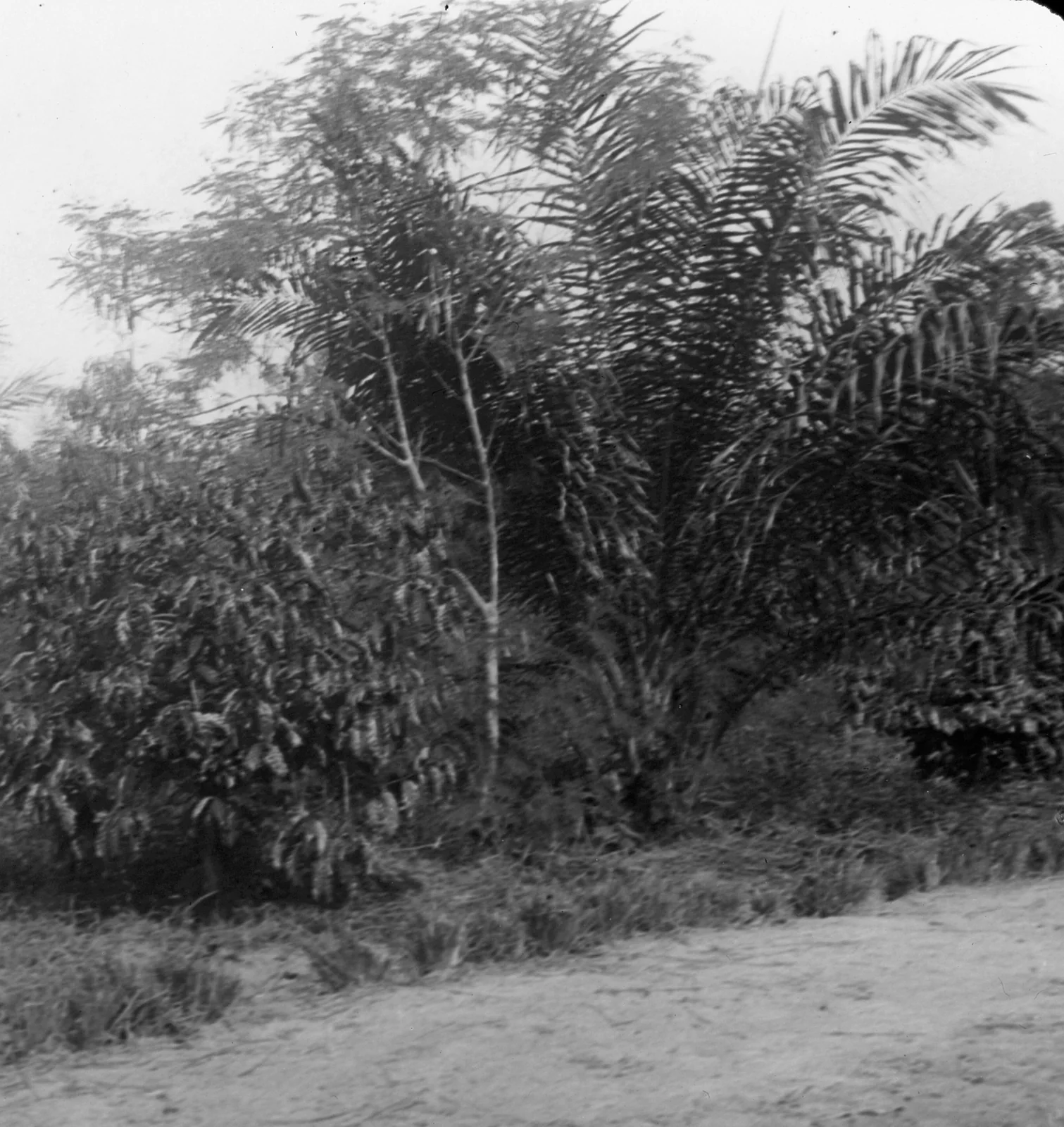
Coffee is grown in the west of the Plateaux region and the southwest of the Central region, along the Ghanaian border, in eight prefectures according to the CCFCC. Antheaume describes this zone as a series of compartmented plateaus of the Atakora range, Akébou, Akposso and Dayes, with their piedmonts, the Litimé and the Akposso plain. Kpalimé, 120 kilometers northwest of Lomé, is its crossroads, and it is there that each crop year is officially opened. In September 2025, the CCFCC counts 45,117 hectares of coffee trees and 27,645 of cocoa trees, and nearly 400,000 producers for the two crops together, without distinguishing those of coffee [20][18][5][25].
Togolese coffee is canephora: the table of the International Coffee Organization (ICO) reproduced by the ITC ranks Togo among the producers of this species alone, with a crop year from October to September. The orchards mix old niaouli and the clones spread since 1975 by the SRCC, in a proportion that no document read measures. The government aims for at least 50,000 tonnes of canephora a year in 2030, and announced in April 2026 184 million CFA francs to produce a million cuttings of coffee trees, mostly for the Plateaux and the Central region. The country is also home to a wild coffee tree that bears its name, Coffea togoensis, which Coste in 1955 lists among the species described by Chevalier and whose range the Crop Trust places in southern Ghana and southern Togo. Davis and his colleagues describe it in 2020 as a small tree with black fruits, grouped with Coffea stenophylla of Sierra Leone in a single genetic group of Upper Guinea [2][6][22][27][12][13][14].
Harvest begins in October, and the marketing season opens on October 1 across the territory. Unlike Côte d'Ivoire and Cameroon, where intermediaries hull the bean, the Togolese planter sells marketable coffee, that is, already freed of its husk, according to a 1995 study cited by Samati. Producers group into village groups and unions, federated by the Federation of Coffee and Cocoa Producers' Unions of Togo (FUPROCAT); in December 2025, it bought with the support of the CCFCC 500 tonnes of coffee-specific fertilizer, sold at cost, 18,000 CFA francs a 50-kilogram bag, in the unions' stores. For the 2024-2025 season, 24 economic operators had received CCFCC approval. The plan announced in 2026 aims above all at what follows picking, for coffee as for cocoa: fermentation, drying, sorting, quality control at export, traceability and the fight against smuggling [8][25][23][19][27].
The CCFCC provides regulation, coordination and monitoring of the two sectors, alongside an interprofessional body, the Interprofessional Council of the Coffee and Cocoa Sectors of Togo (CICC-TOGO), and a buyers' union, SIACCTO. Its secretary general, Enselme Gouthon, chaired the International Coffee Council of the ICO for 2023-2024 and also chaired in 2024 the ACRAM (Agency for Robusta Coffees of Africa and Madagascar). Development plans for the coffee and cocoa sectors, adopted in 2024, set the horizon at 2030, and Togo deposited in April 2025 its instrument of acceptance of the agreement of the Inter-African Coffee Organization. The CCFCC counts 11,609 tonnes of coffee exported in 2010-2011; then 2,000 tonnes in 2020-2021, 3,200 in 2021-2022 as of August 30, 2,618 in 2023-2024 and 4,400 in 2024-2025. Coffee remains in 2024 the country's second agricultural export product, and coffee and cocoa together make up 1.4% of gross domestic product [20][19][16][22][18][17][21].
The country drinks little of the coffee it produces. “We produce what we do not consume,” sums up Enselme Gouthon in January 2026: some forty tonnes of products processed locally, coffee and cocoa together, circulate on the domestic market, and customs report 35 tonnes of green coffee imported in 2023. The same month, after a collapse in purchase prices from about 6,000 to 2,000 CFA francs a kilo, which the article does not break down by product, more than 1,500 tonnes of stock remained unsold with producers, buyers and exporters [24][3].
- Dominant species
- Coffea canephora, the only species retained for Togo by the ICO [2]
- Historical type
- Niaouli canephora, see the Niaouli sheet in the atlas [26]
- 2024 production (FAOSTAT)
- 21,769 tonnes, imputed value (I) [1]
- FAOSTAT series maximum
- 25,132 tonnes in 2022, official figure (A) [1]
- Production 2019 according to the ICO
- 70,000 bags of 60 kg, or 4,200 tonnes [2]
- Exports, 2024-2025 crop year
- 4,400 tonnes according to the CCFCC [21]
- Coffee tree area (2025)
- 45,117 hectares [20]
- Regulatory body
- CCFCC, created by order of June 14, 1996 [8]
Gray areas
Four counts, four orders of magnitude. For the years 2014 to 2019, FAOSTAT records official figures that rise smoothly, from 15,500 to 21,316 tonnes. The ITC table, drawn from ICO data, gives for the corresponding crop years 143,000, 81,000, 23,000, 115,000, 54,000 and 70,000 bags of 60 kilograms, or from 1,380 to 8,580 tonnes: in 2016, the ratio reaches 13. Togolese customs, as restituted by the United Nations Comtrade database, report 10,849 tonnes of green coffee exported in 2015, more than double the ICO production for that year, and 1,621 tonnes in 2017 at 0.35 dollar a kilo, a price that casts doubt on the line. For 2023, FAOSTAT imputes 22,619 tonnes; customs report 6,510 tonnes exported, a figure that the French economic service roughly repeats (6,600), and the CCFCC counts 2,618 tonnes exported during the 2023-2024 season. Yields say the same thing: 2 bags per hectare, about 120 kilos, for the ITC in 2019-2020, against 499 to 515 kilos for FAOSTAT, and the 4,400 tonnes exported in 2024-2025 on 45,117 hectares make less than 100 kilos. If the FAOSTAT production is right, more than 15,000 tonnes a year disappear between the harvest and the port, whereas the domestic market absorbs only a few tens of tonnes. Two explanations come to mind, a report in cherry weight rather than green bean or a coffee that leaves by smuggling, and no document read confirms either. The government, in aiming for 50,000 tonnes, says it will almost double current production: it is therefore the FAOSTAT figure, not that of exports, that public policy takes as its base [1][2][3][16][20][21][22][24].
The early history rests on accounts that do not agree. Antheaume writes in 1992 that the colonizer introduced the coffee tree in the early 1920s; Chauveau and Gu-Konu, in 1979, attribute it to the Bremen missionaries and the German administration before 1907; Samati dates it to the German period but sees its development only from 1940; the German inventories of 1899 and 1905 mention only coastal liberica and a mountain village. These versions can be reconciled if one distinguishes the species, but no source read says which coffee tree the mountain villages planted under the Germans, nor when niaouli crossed the border from Dahomey. Ukers, the site's usual source for early history, never names Togo in 1922, although his export table cites the Gold Coast and Côte d'Ivoire. The old figures fit together no better: Pontié and Ruf give 2,727 tonnes exported on average in 1959-1961, while Deuss speaks of an average production of 13,000 tonnes until 1963 and FAOSTAT of 10,300 tonnes in 1961; for 1978-1980, the same authors count 9,060 tonnes exported on average, whereas FAOSTAT records only 7,107 tonnes of production. Pontié and Ruf explain a similar surplus for cocoa by Ghanaian beans smuggled in; for coffee, none of the authors read explains it. Finally, the CCFCC places the 1991 record at 25,903 tonnes, FAOSTAT at 24,900 [5][4][8][9][10][28][6][7][1][18].
The orchard itself is poorly known. The site classes the Togolese genotypes in the Niaouli type, on the basis of work from the 1930s; but from 1975 the SRCC replaced part of the old coffee plantations with the IFCC's clonal mixtures, and no genetic inventory of the current plantations has been found: neither the list of clones, nor the area still in niaouli. The number of producers varies without explanation: 18,500 planters to be supervised by the SRCC from 1974 to 1985 according to Deuss, about 40,000 coffee and cocoa planters around 2002 according to Samati, 400,000 for the two crops in 2025 according to the CCFCC. The health calendar has its gaps: McCook dates the arrival of orange rust in Dahomey to 1952 and in British Togo, now Ghanaian, to 1953-1954, saying nothing about the French part, present-day Togo. Arabica, lastly, appears in Coste in 1955 only through an insect, with no area or place, and a press summary come across during this research credits Togo with a mainly arabica sector, which nothing that was read confirms [26][6][7][8][20][15][12].
Not covered: The series of the International Coffee Organization consulted directly: the addresses of the historical ICO statistics return a 404 page and the Internet Archive copy refused access (429); only the ITC table for 2014-2019 was used, so no ICO data after 2019 was compared. No USDA GAIN report exists for Togolese coffee to my knowledge, and I did not look for one. The figure of 3,500 t exported in 2022-2023 attributed to the CCFCC by the APA agency, seen only in a search summary, the APA page returning 404. The book by Ralph Erbar on German Togo (1991) and the one by L. Péchoux on the French mandate (1939), not accessible. The species planted by the mountain villages under the Germans, the date niaouli arrived in Togo, the current share of SRCC clones in the orchard, the conservation status of Coffea togoensis, the date of rust in French Togo: no source read establishes them. Current farmgate prices for coffee, the cup profile of Togolese canephora and the volumes of higher-quality coffee: nothing sourced found.
- FAOSTAT, Production: Crops and livestock products, Coffee, green (code 656), Togo: production, harvested area, yield and status of each value, Food and Agriculture Organization of the United Nations (FAO), 2025, https://bulks-faostat.fao.org/production/Production_Crops_Livestock_E_ solid level
Series 1961-2024 read in the bulk archive already extracted on disk, with the status of each year. Production: X from 1961 to 1967 (10,300 t in 1961), A from 1968 to 2022, I in 2023 (22,619.45 t) and 2024 (21,769.41 t); minimum 2,689 t in 1984; 24,900 t in 1991, 6,300 t in 1992, 22,400 t in 1996, 10,600 t in 1997, 5,500 t in 2003; continuous rise from 10,843 t (2012) to 25,132 t (2022). Area E or I almost everywhere, A in 1968-1970, 1988-1990, 1995 and 2017-2022; 42,691 ha in 2019 and in 2020; 42,200 ha (I) in 2024. Yield A from 448 kg/ha (2017) to 566.1 kg/ha (2022), 499.3 kg/ha in 2019 and 515.5 kg/ha in 2020. Computed 1978-1980 average: 7,107 t. - The Coffee Guide, fourth edition: table 4 (p. 85), figure 5 (p. 86) and table 5 (p. 88), International Trade Centre (ITC), from the International Coffee Organization, 2021, https://www.intracen.org/resources/publications/the-coffee-guide-fourt solid level
PDF copy from the local library, pages rendered as images and read. Table 5: Togo classed (R), crop year October-September, production of 143, 81, 23, 115, 54 and 70 thousand 60 kg bags for 2014 to 2019. Table 4: Togo yield of 2 bags per hectare in 2019-2020, canephora column. Figure 5: Togolese yields between about 1 and 8 bags per hectare from 2001-2002 to 2018-2019. - UN Comtrade, exports and imports of Togo, HS code 090111 (green coffee, not decaffeinated), years 2010 to 2024, United Nations Statistics Division, from Togo's customs declarations, 2026, https://comtradeapi.un.org/public/v1/preview/C/A/HS?reporterCode=768&a solid level
Query of the public interface, one year per call. Net weight exported: 7,629 t (2010), 8,749 t (2012), 5,461 t (2013), 7,859 t (2014), 10,849 t (2015), 4,089 t (2016), 1,621 t for 562,535 dollars (2017), 5,497 t (2019), 3,519 t (2020), 2,878 t (2021), 5,145 t (2022), 6,510 t (2023), 4,689 t (2024); nothing for 2011 and 2018 under this code. Imports 2023: 35 t. - Deux notes sur l'économie de plantation dans le Sud-Ouest du Togo, Jean-Pierre Chauveau and E. Y. Gu-Konu, ORSTOM and Université du Bénin (Lomé), 1979, https://horizon.documentation.ird.fr/exl-doc/pleins_textes/divers11-10 solid level
Districts of Kloto and Akposso; the southwest supplies nearly 90% of the coffee; coffee and cocoa introduced by German missionaries from Bremen, spread by the German administration from before 1907, practically imposed by the French administration between the wars, boom after 1945 thanks to high prices; obligation for every able-bodied man and young plants lifted by the villagers; sharecropping in the 1950s and early 1960s, half of the plot going to the person who cleared it; Ewe migrants from the coastal region and Kabyè; OPAT, a prosperous state body in 1972. - Café et cacao au Togo : divergences et ressemblances. Deux terroirs revisités, seminar “Action concertée politiques agricoles”, CERDI, Clermont-Ferrand, November 17-18, 1992, Benoît Antheaume, ORSTOM Lomé, 1992, https://horizon.documentation.ird.fr/exl-doc/pleins_textes/divers17-06 solid level
Coffee tree introduced by the colonizer in the early 1920s, expansion between the wars; coffee plantations passed on by inheritance or gift, dibi ma dibi contract of Ghanaian origin tied to cocoa; Akébou, Akposso and Dayes plateaus, foothills of the Litimé and the Akposso plain; IRCC and SRCC supervision; farmgate price of 185 F CFA/kg in 1991-1992 against 400 in 1987-1988; successful renovation for coffee, relative failure for cocoa; Béna coffee terroir down from 270 to 207 plots between 1973 and 1990. - L'opération de rénovation de la caféière et de la cacaoyère togolaises, in Paysans, experts et chercheurs en Afrique noire (ed. P. Boiral, J.-F. Lanteri, J.-P. Olivier de Sardan), pp. 103-130, Guy Pontié and Thierry Ruf, Karthala and CIFACE, 1985, https://horizon.documentation.ird.fr/exl-doc/pleins_textes/pleins_text solid level
IFCC set up at Kpalimé in 1967, later becoming IRCC; SRCC created in 1971 by the FAC and the government; clonal mixtures developed by the IFCC; niaouli canephora coffee, varieties from the Niaouli station in Benin; 1974 decree requiring niaouli coffee plantations more than twenty years old to be replanted; average exports of 2,727 t of coffee in 1959-1961 and 9,060 t in 1978-1980 (note 2), cocoa exports higher than production because of Ghanaian cocoa smuggled in; 90 F CFA/kg in 1973-1974, as in 1959-1960; 1977-1978 prices: Togo 145, Cameroon 230, Côte d'Ivoire 250 F CFA/kg. - Les projets de développement de la caféiculture au Togo, au Vietnam et en Nouvelle-Calédonie, in Le développement rural : comprendre pour agir (ed. B. Antheaume et al.), pp. 47-70, Jacques Deuss, ORSTOM, collection Colloques et séminaires, 1987, https://horizon.documentation.ird.fr/exl-doc/pleins_textes/pleins_text solid level
Average production of 13,000 t until 1963; price frozen at 72 F CFA/kg from 1963 to 1971; fall of 43% in 1979-1983; about 60,000 ha of local niaouli coffee trees in the Plateaux, planted mostly between 1940 and 1960; SRCC created in 1971; funding from the FAC, the IDA (World Bank) from 1975, the EEC, the CCCE; replanting limited to 0.5 ha per farmer, selected clones as rooted cuttings, credit; 6,500 planters supervised in 1974-1979 and 12,000 more in 1980-1985; 9,248 ha replanted from 1975 to 1982; good yields on the Dayes, Akébou and Akposso plateaus; coffee price higher than cocoa in 1984, equal to Côte d'Ivoire's in 1986-1987 (400 F CFA/kg). - Producteurs de café et de cacao face au système de libéralisation de la filière, mémoire d'ingénieur agronome, École supérieure d'agronomie, Koffi Zomabi Samati, University of Lomé (text published by Memoire Online), 2002, https://www.memoireonline.com/04/11/4480/m_Producteurs-de-cafe-et-de-c medium level
Introduction in the German period, development from 1940; OPAT created in 1964, monopoly and mandatory price, dissolved in 1996; private companies and producers' associations; CCFCC created by ministerial order no. 18/MCPT/MDRHV of June 14, 1996, composition; reference price equal to 70% of FOB, New York quotations every 15 days; harvest starting in October; actual price below the reference price until February, above it from April; indicative prices 1996-2001 (425 F in November 1996, 780 F in April 1998, 238 F in May 2001); Togolese planter selling hulled commercial coffee (APROMA 1995); GPCC groups and unions; about 40,000 coffee and cocoa planters. - Deutsches Kolonial-Handbuch, 2nd edition, Togo section, p. 16, Rudolf Fitzner, Berlin, Paetel (digitized by SuUB Bremen, Digitale Sammlung Deutscher Kolonialismus), 1901, https://brema.suub.uni-bremen.de/dsdk/download/pdf/1999603 solid level
Coffee plantations existing in 1899: d'Almeida brothers at Klein-Popo 32,500 trees, J. K. Vietor at Klein-Popo 30,000, chief Ayte Ajavon at Klein-Popo 20,000, Paul at Sebbe 2,000, trader Creppy 4,000, Catholic mission of Adjido at Gridji 3,000, Chicko d'Almeida 6,500; total 98,000 trees and 31,000 cuttings. - Die Aussichten des Plantagenbaus in den deutschen Schutzgebieten, pp. 33 and 55, August Seidel, Wismar (digitized by SuUB Bremen), 1905, https://brema.suub.uni-bremen.de/dsdk/download/pdf/1903174 medium level
Contemporary testimony. Coffee plantations in Togo, almost only Liberian coffee, at Anecho (formerly Klein-Popo), Adjido and Gridji; judgment of Wohltmann: mediocre plantations with no future for large-scale cultivation, on the coast as in the mountains; exports of 871 marks (1,135 kg) in 1901 and 80 marks the following year; coffee plantations planted years earlier by the inhabitants of the mountain village of Kuma Topli, at the government's urging. - Die deutsche Kolonie Togo, LeMO (Lebendiges Museum Online), Jan Antosch, Deutsches Historisches Museum, Berlin, 2004, https://www.dhm.de/lemo/kapitel/kaiserreich/aussenpolitik/togo medium level
Page dated November 2, 2004. Protectorate proclaimed on July 5, 1884; the Lomé-Palime line of 1907 known as the coffee and cocoa railway (Kaffee- und Kakaobahn); surrender on August 25, 1914; territory placed under the authority of the League of Nations in 1920, divided between the British and the French. - Les caféiers et les cafés dans le monde, volume I, Les caféiers, p. 22, p. 30 (table 1), p. 320 and the chapters on pests and research (PDF views 344 and 431), René Coste, 1955, https://horizon.documentation.ird.fr/exl-doc/pleins_textes/divers20-12 solid level
PDF copy from the local library. C. togoensis Chev. (Togo); Petit Indénié and Niaouli forms from Dahomey, resistant to Hemileia; Niaouli coffee tree hardy and drought-resistant, very drawn-out fruiting hindering the harvest and favoring the coffee berry borer, Le Conte's selection at the Niaouli station for grouped fruiting; in Togo, the Apate observed only on C. arabica of 4 to 5 years. - Global Conservation Strategy for Coffee Genetic Resources, species annex, pp. 66-67, Crop Trust and World Coffee Research (Bramel, Krishnan, Horna, Lainoff, Montagnon), 2017, https://www.croptrust.org/saving-coffee/ solid level
Copy from the local library. Coffea togoensis: tropical West Africa, southern Ghana and southern Togo. - Lost and Found: Coffea stenophylla and C. affinis, the Forgotten Coffee Crop Species of West Africa, Frontiers in Plant Science 11:616, doi:10.3389/fpls.2020.00616, Aaron P. Davis, Roberta Gargiulo, Michael F. Fay, Daniel Sarmu, Jeremy Haggar, 2020, https://doi.org/10.3389/fpls.2020.00616 solid level
PDF copy from the local library. C. togoensis, from Ghana and Togo, a small tree with black fruits, placed in the Upper Guinea clade with C. humilis, C. affinis and C. stenophylla; sequenced sample of Togolese origin. - Coffee Is Not Forever: A Global History of the Coffee Leaf Rust, p. 129, Stuart McCook, Ohio University Press, 2019, https://ohioopen.library.ohio.edu/oupress/96/ solid level
PDF copy from the local library. Rust arrived in Dahomey (Benin) in 1952 and in British Togo, now part of Ghana, in 1953-1954; nothing on French Togo. - Togo : le secteur agricole et agroalimentaire, note du service économique Togo-Bénin, Lomé, May 13, 2025, Embassy of France in Togo, Directorate General of the Treasury, 2025, https://www.tresor.economie.gouv.fr/PagesInternationales/Pages/47b1e08 solid level
6,600 t of coffee exported in 2023; Togo a member of the ICO, Enselme Gouthon chair of the International Coffee Council for 2023-2024. - Café-cacao : la campagne est lancée, République togolaise (republicoftogo.com), 2022, https://www.republicoftogo.com/toutes-les-rubriques/eco-finance/cafe-c medium level
Article of September 22, 2022: 3,200 t of coffee exported during the 2021-2022 season as of August 30, against 2,000 t the previous season. - Café-cacao : plan de relance ambitieux, République togolaise (republicoftogo.com), republished by allAfrica, 2024, https://www.republicoftogo.com/toutes-les-rubriques/eco-finance/cafe-c medium level
Article of October 8, 2024, from the CCFCC: 2,500 t of coffee exported the previous year; 11,609 t in 2010-2011; coffee production of 25,903 t in 1991; aging plantations and planters; coffee the second and cocoa the third agricultural export product; cultivation concentrated in the west of the Plateaux and the southwest of the Centrale; Enselme Gouthon chair of the ICO and of the ACRAM. - Café-cacao : une filière moderne, compétitive et respectueuse de l'environnement, République togolaise (republicoftogo.com), 2024, https://www.republicoftogo.com/toutes-les-rubriques/eco-finance/cafe-c medium level
Article of October 25, 2024: launch of the 2024-2025 season at Kpalimé; development plan to 2030; collaboration of the FUPROCAT and the SIACCTO against smuggling; 24 approved economic operators for 2024-2025. - La filière café-cacao repart pour une nouvelle campagne, République togolaise (republicoftogo.com), 2025, https://www.republicoftogo.com/toutes-les-rubriques/eco-finance/la-fil medium level
Article of September 27, 2025: nearly 400,000 coffee and cocoa producers on 72,762 ha, of which 45,117 ha of coffee and 27,645 ha of cocoa; eight prefectures of the Plateaux and the Centrale; coffee and cocoa 1.4% of GDP and 5.5% of agricultural value added; CICC-TOGO and CCFCC; Kpalimé the nerve center of the sector. - Togo Coffee, Cocoa Exports Up 50% in 2024/25 on Sector Reforms, Ecofin Agency, 2025, https://www.ecofinagency.com/news-agriculture/0210-49214-togo-coffee-c medium level
Article of October 2, 2025, from the CCFCC: 4,400 t of coffee exported in 2024-2025 against 2,618 t in 2023-2024; development plans adopted a year earlier; 2,000 t in 2021 against 2,600 t in 2020. - Togo joins Inter-African Coffee Organization, targets 50,000 T annual production by 2030, Food Business Middle East & Africa, 2025, https://www.foodbusinessmea.com/togo-joins-inter-african-coffee-organi medium level
Article of April 16, 2025: instrument of acceptance of the 2020 agreement of the Inter-African Coffee Organization deposited in early April; target of 50,000 t per year in 2030, presented as nearly double current production; planned investment of at least 18.5 million dollars in coffee. - Remise d'engrais à prix coûtant aux producteurs de café, République togolaise (republicoftogo.com), 2025, https://www.republicoftogo.com/toutes-les-rubriques/eco-finance/remise medium level
Article of December 24, 2025: 500 t of fertilizer specific to the coffee tree acquired by the FUPROCAT with the support of the CCFCC, sold at 18,000 F CFA per 50 kg bag in the stores of the cooperative unions. - Filière café-cacao : entre volatilité des prix et nécessité de solidarité, République togolaise (republicoftogo.com), 2026, https://www.republicoftogo.com/toutes-les-rubriques/eco-finance/filier medium level
Article of January 28, 2026, remarks by Enselme Gouthon: prices fallen from about 6,000 to 2,000 F CFA, more than 1,500 t of unsold stocks, nearly 40 t of processed products in circulation on the domestic market; a quote about what the country produces without consuming it. - Togo : les exportations de cacao baissent de 64 % en 2025-2026, Le360 Afrique, with the MAP agency, 2026, https://afrique.le360.ma/economie/togo-les-exportations-de-cacao-baiss medium level
Article of September 8, 2026: 2026-2027 coffee and cocoa marketing season launched at Kpalimé, 120 km northwest of Lomé, and opened on October 1 across the whole territory. No coffee figure for 2025-2026 in the part read. - Site plate Kouilou, Niaouli, Conilon (robusta-07) and Niaouli profile of the atlas, PXL Roasters, from Persée 1935 and 1939 and Coste 1955, 2026, https://www.pxlroasters.com/carte.html?v=niaouli solid level
Source inherited from the site: Niaouli experimental garden founded in 1904, Niaouli form fixed in 1923; Ivorian genotypes of the Kouilou type, those of Togo and Benin of the Niaouli type. Identifier of the profile in tree_data.json: niaouli. - Togo : qualité et compétitivité, Togonews, republished by allAfrica, 2026, https://fr.allafrica.com/stories/202604130201.html medium level
Article of April 13, 2026, free-access part: 184 million F CFA for coffee growing and one million coffee cuttings; effort concentrated on the Plateaux and the Centrale; traceability, fermentation, drying, sorting, export quality control, fight against smuggling. - All About Coffee, full text and export table (chap. XXII), William H. Ukers, 1922, https://www.gutenberg.org/ebooks/28500 solid level
Text copy from the local library: no occurrence of Togo or Togoland; the table of African exports cites the Gold Coast (660 pounds in 1917) and Côte d'Ivoire, not Togo.