ATLASMyanmar
about 9,000 tonnes (FAOSTAT 2024, imputed value)In-depth dossier, atlas 2026In-depth dossier: the FAOSTAT series set against other figures, the history, today's industry and its gray areas, with numbered sources. Region: Asia.
Myanmar had only a statistical reference point. This dossier completes it: the history of the industry, what it is today, and what remains uncertain, with each paragraph pointing to its sources, numbered at the foot of the page.
The FAOSTAT series remains displayed as is. The dossier says what it is worth, year by year when possible, and compares it with the other figures available.
- Geographic status
- country
- Name in FAOSTAT
- Myanmar
- Latest value
- about 9,000 tonnes in 2024
- Nature of the value
- value imputed by the receiving organization
- Start of the positive series
- 1961
- Series maximum
- 8,908 tonnes in 2020
Confirmed coverage: FAOSTAT series, and a dossier of 17 sources that draws together the history, today's industry and what remains uncertain.
History
Burmese coffee enters the trade literature by the back door. In 1894, the American trader Joseph Walsh presents it as a new sort, recently introduced and still rare: a fairly large, regular bean, greenish and soft when green, “tough” once roasted, with a grassy taste that he attributes to the youth of the plantations; he pairs this note with a colonial contempt for the country's inhabitants, whom he judges incapable of developing their jungles. Ukers, in 1922, gives it hardly more: in his chapter on British India, Burma is among the regions where coffee grows “only on a restricted scale,” and his large table of the world's coffees places Burma, sold at Rangoon and coming from the Tavoy district, among the large, spongy beans with a grassy cup, “of no commercial importance.” His bibliography also cites a pamphlet printed at Tavoy in 1893 on the cultivation of Liberian coffee, that is, Coffea liberica, a species other than arabica and canephora [3][4]
The first precise account of the introduction is found in a survey by the Indian administration published in 1940, the report on the marketing of coffee in India and Burma. It dates the first Burmese plantation to about 1886: the forest service then opened two trial gardens, at Mergui (today Myeik) and Tavoy (Dawei), on the Tenasserim coast, which coffee leaf rust forced to close. A plantation opened at the same time at Nancho, in the Karen hills, was almost wiped out by the disease in 1897 and 1898; seeds from the few spared trees were used to replant, and the Karens adopted the crop. Their coffee, called Toungoo, then passed for the best in the country. From these hills, the investigators write, cultivation probably spread to the Myelat, in the south of the Shan States, then to the northern uplands. The same report mentions two wild coffee trees in Upper Burma, Coffea jenkinsii in the Kachin hills and Coffea bengalensis, with no commercial use; Coste still ranked this second species in 1955 among the Asian coffee trees present in Burma [2][16]
The 1940 survey also shows why the official statistics saw almost nothing. Coffee grows outside the land registry, so that agricultural registers counted 13 acres in 1935-36 when the investigators estimated about 2,000, some 800 hectares. The average production of the five seasons ending in 1935-36 was assessed at 5,097 English hundredweights, about 260 tonnes (conversion made here, at 50.8 kg per hundredweight), then at 7,000 hundredweights in 1936-37, and it had more than tripled in ten years. Three quarters came from the south of the Shan States, around Yengan, Pinlaung, Pwela and Pindaya, with Aungban as collecting market; the rest from the Karen hills near Thandaung, from Chaungwe in Hsipaw State, where a block of 120 acres was planted in 1934, and from the Sinlumkaba hills near Bhamo. Almost all the coffee came from family gardens of a tenth of an acre, often planted along house fences [2]
Quality follows this structure. Nine tenths of the crop are prepared as “cherry” coffee: the green, ripe and overripe fruits picked within the day are pounded in a mortar with a little rice husk, spread on bamboo mats, pounded again then sieved, hence crushed or broken beans. Only the Chaungwe plantation produces parchment coffee, that is, washed and dried in its envelope, after 30 to 40 hours of fermentation and three weeks of drying. Burmese coffee sells for about 9 rupees per hundredweight less than Indian cherry coffee, a gap the report attributes to this preparation. The growers depend on village merchants: a third of them receive advances of 50 to 80% of the expected value, weights are falsified, and the planter receives about 56% of the price paid by the consumer in Rangoon. The Thamadi mark, applied in 1939 to calibrated weights and baskets, gives the country its first measures bearing an official stamp. Burma then drank more coffee than it produced, about 11,000 hundredweights in 1938, mostly in cities, the majority of the population preferring tea, and imported it from India; a trial shipment to the United Kingdom in 1935-36 was judged of mediocre quality [2]
After independence, the manual published by the FAO in 2005 traces what followed. The Chaungwe group planted in 1952 near Pyin Oo Lwin, the former Maymyo, some sixty acres of arabica, mostly the variety S 795. From 1968 to 1994, the state farms of Chaungwe, Pyin Oo Lwin, Pwe Daung and Banbwe, taken over from the private sector, came under a Ministry of Industry; in 1971 there were 6,379 acres and 859 tonnes. Coffee then became an instrument in the fight against the opium poppy: three planting campaigns followed one another from 1975 to 1991, three tonnes of Catimor and Catuai seed arrived from Costa Rica in 1986, and a United Nations Drug Control Programme project was launched in 1987 in the Shan States, largely without success, although many households kept ten to twenty coffee trees. In 1994, state coffee passed to the public enterprise Myanmar Farm Enterprises, of the Ministry of Agriculture. In 2004, the government aimed at 100,000 acres and offered 25-year leases at 18 dollars an acre; some of the large plantations failed, for lack of inputs, shade and good seed, with Catimors from China [5]
The FAOSTAT series starts in 1961 at 200 tonnes, a figure taken from another organization (flag X), then stays between 917 and 1,688 tonnes until 1990, which the average of 1,146 tonnes given by the FAO manual for 1977-1985 confirms. It rises from 1,200 tonnes in 1992 to 8,000 tonnes in 2012, reflecting the plantings of the 1990s and 2000s, then plateaus between 8,300 and 8,908 tonnes. The maximum, 8,908 tonnes, is reached in 2020 and repeated identically in 2021 although the harvested area changes. The last official figure (flag A) is that of 2022, 8,557 tonnes; 2023 and 2024 are imputed values (flag I), 8,904 tonnes for 2024. From 1991 to 2015, the areas are exact conversions of round thousands of acres, 4,047 hectares for 10,000 acres, 11,736 for 29,000, and production is almost always rounded to the hundred: the series takes up administrative estimates made in acres and measures nothing by itself. The ministry figures that the coffee association presented in 2016, from 3,012 tonnes in 2003-04 to 7,687 tonnes in 2011-12, have neighbors in FAOSTAT, 50 to 150 tonnes lower for the corresponding calendar year, then 8,000 tonnes in 2012 when the ministry announced 7,441 tonnes for 2012-13: the kinship is clear, the correspondence is not exact [1][5][8]
Today
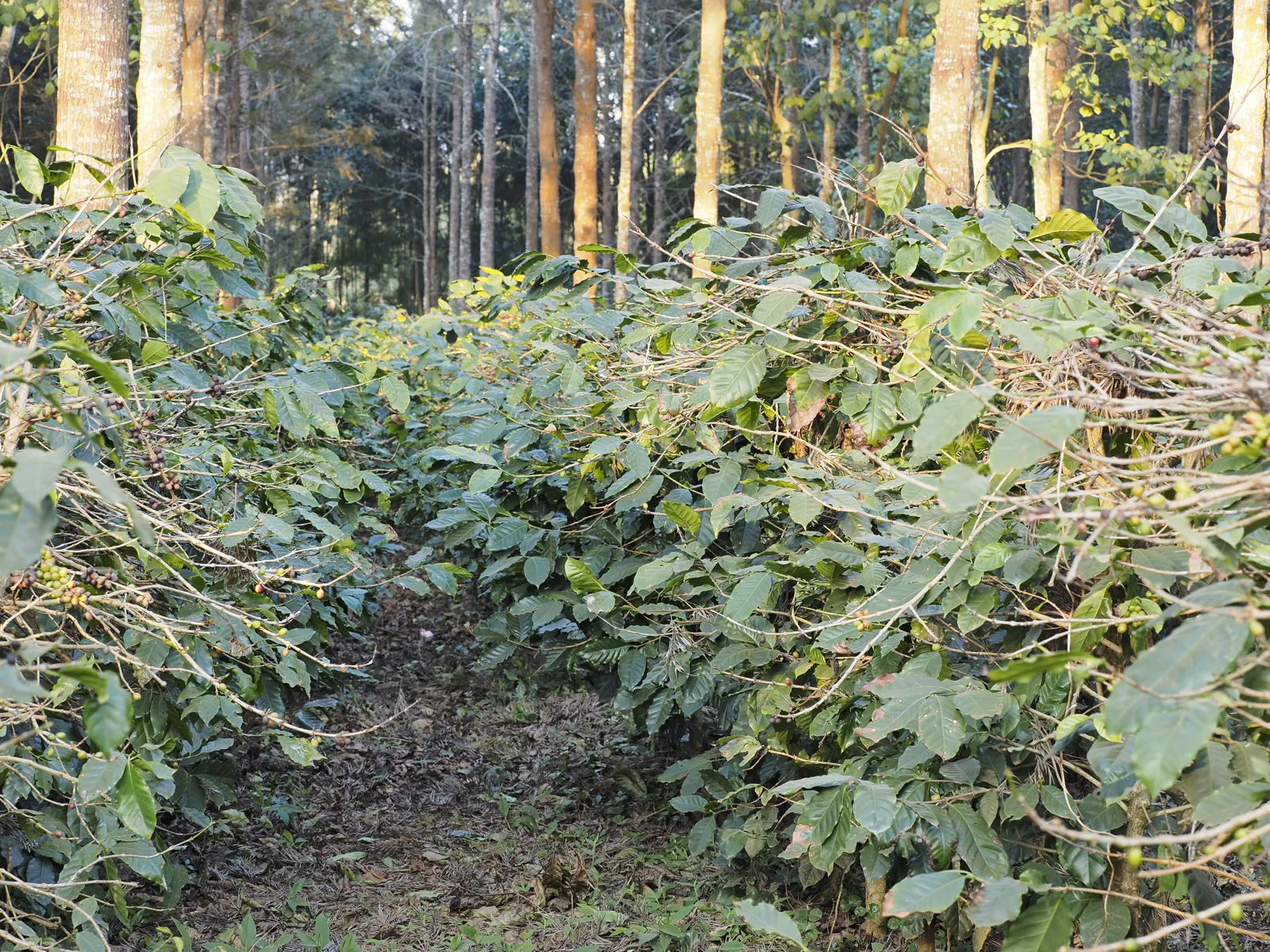
According to the president of the coffee association, in 2016, arabica grows in the uplands of the northern and southern Shan States, the Chin, Kachin and Kayah States, the Sagaing and Mandalay regions, and canephora in the lowlands of Bago, Ayeyarwady and Kayin (Karen) State. The ministry figures for 2012-13 that he presents give the measure of each zone: 60,795 acres planted, about 24,600 hectares, of which 26,980 in harvest, for 7,441 tonnes. Northern Shan State supplies 2,678 tonnes, the south 1,598, the Mandalay region, around Pyin Oo Lwin, 758 tonnes on 16,982 acres planted of which only 3,350 in harvest, and Karen State 1,243 tonnes. The Ayeyarwady delta counts only 75 acres and 38 tonnes: Burmese canephora is above all a Karen affair, in a State that also has its arabica hills around Thandaung. A 2023 market report estimates plantations at nearly 50,000 acres (20,243 hectares) in 2020, of which 75 to 80% arabica and 20 to 25% canephora [8][10]
The FAO manual of 2005 describes the longest-established variety, S 795, a selection from the Indian station of Balehonnur resulting from the cross of S 288 and Kent, S 288 itself descended from a natural hybrid between Coffea arabica and Coffea liberica. Caturra arrived in the 1950s, Catimor and Catuai in 1986, Kenyan selections such as SL 28 and SL 34 in 2004, and the manual recommends S 795 and Catimor above 1,000 meters, warning that many of the Catimors planted are not true Catimors. At Ywangan, in southern Shan State, the profiles of the 21 producer groups published by Winrock in 2017 show another reality: villages, mostly Danu, located between 1,005 and 1,601 meters, where Catuai accounts for 80 to 100% of the trees, supplemented by a little Catimor or Caturra [5][7]
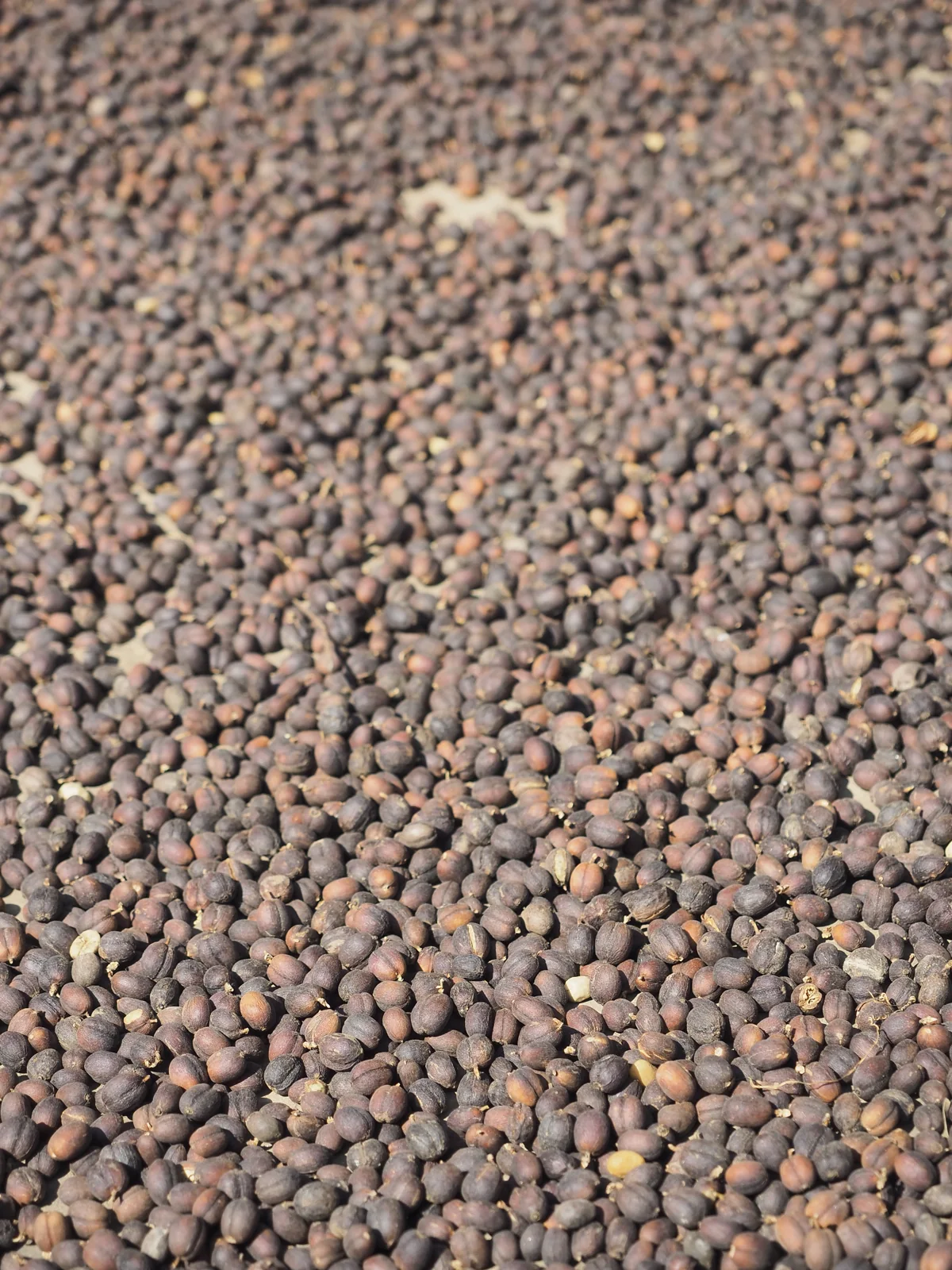
Specialty coffee, that is, coffee scored at least 80 points out of 100 in cupping under the Specialty Coffee Association protocol, was born of an American program. At the end of 2013, a former Green Mountain Coffee executive who came as a USAID volunteer tasted the local coffees and pushed the producers to organize. In September 2014, plantation owners of the Mandalay Coffee Group founded the Myanmar Coffee Association, and at the end of 2014 Winrock International signed with USAID the agreement for the Value Chains for Rural Development project, with the Coffee Quality Institute as partner. The first national competition, in May 2015, ranked 21 samples out of 58 above 80 points. A consultant who had worked in Yemen proposed sun-dried naturals, whole cherries dried for 25 to 35 days on raised tables, a method within reach of smallholders. The first lot exported, 36 tonnes in May 2016, combined 26 tonnes from the plantations of the Mandalay group and 10 tonnes from smallholder villages. The group opened in Pyin Oo Lwin in 2017 the first quality hulling mill, where the dry coffee is stripped of its husks, sorted and graded, and eighteen villages of Ywangan formed in 2018 their own association, Shwe Taung Thu. The project ended at the end of 2019. The announced gains, cherries paid 1.00 to 1.20 dollars a pound in 2018, 54 to 85% above the local price of 2015, are those that Winrock itself publishes [6][7]
The association, whose headquarters are in Pyin Oo Lwin, had in 2016 six local groups and more than 300 members, ten groups in 2019, and has held an annual competition since 2015. Public research is located near the same town, at the research and extension center of Myanmar Farm Enterprises, modernized with FAO help between 2003 and 2005; the state press still cites in 2022 a coffee research center at Pyin Oo Lwin. The Swiss Federal Institute of Intellectual Property had the collective mark “Ywangan Coffee” registered and prepared a geographical indication file, but it stopped all work with the Burmese administrations after February 2021 [5][6][8][13][14]
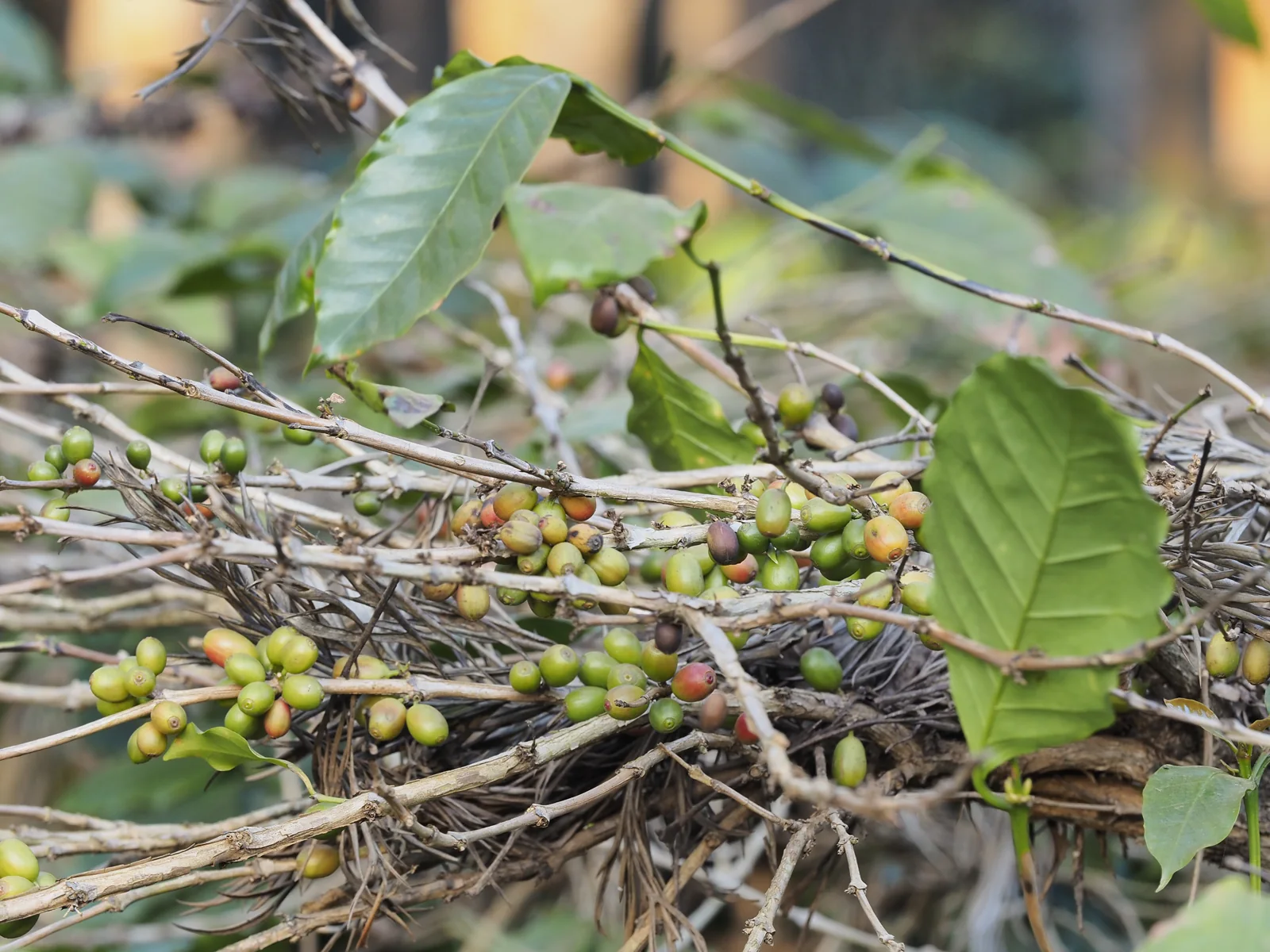
The harvest runs from late December or early January to late March, according to an importer who buys from the country; the 1940 report placed it from November to the end of February. Classic wet processing is practiced there, honey, where the bean dries for ten to fifteen days covered with part of its pulp, and naturals. The large plantations are in the Mandalay region, and Shan State producers most often own less than a hectare [2][6][8][12]
Green coffee exports declared by Myanmar to the United Nations Comtrade database go from 1,531 tonnes in 2014, of which 1,131 to China, to 812 tonnes in 2019 and 301 tonnes in 2020, then rise again to 537 tonnes in 2021, 1,401 tonnes in 2022 and 1,894 tonnes in 2024, of which 1,099 to Thailand and 404 to China. The average declared value goes from about 2.2 dollars a kilo in 2019 to 8.2 dollars in 2022, then 5.7 dollars in 2024 (calculations made here). The researchers of the International Growth Centre noted that between 2011 and 2017 border trade went 92.6% to China, at 0.85 dollar a pound against 1.06 for shipments by sea; a 2023 report reserves specialty coffees for the United States, Europe, Japan and Korea, ordinary coffee for China and Thailand, and attributes the domestic market's peak in the 2022 season to Thai demand. The coup of February 1, 2021 fell in the middle of the harvest: banks closed by civil disobedience, parcel carrier closed in Yangon until April 20, internet cuts, and producers who sold their cherries on the spot to have cash. In the country, coffee is drunk mostly as a “three-in-one” instant mix, of which a 2011 survey counted 39 brands [9][10][11][12][15]
- Cultivated species
- Coffea arabica in the uplands, Coffea canephora in the lowlands, mostly in Karen State [8]
- Altitude of the Ywangan producer groups
- 1,005 to 1,601 m [7]
- Dominant variety at Ywangan
- Catuai, 80 to 100% of the trees depending on the group [7]
- Harvest
- late December to late March [12]
- Last official production (FAOSTAT)
- 8,557 t in 2022; 2023 and 2024 imputed [1]
- Planted area
- 20,243 ha in 2020, of which 75 to 80% arabica [10]
- Declared green coffee exports
- 1,894 t in 2024, of which 1,099 t to Thailand [11]
- First documented plantation
- around 1886, forest service trial gardens at Mergui and Tavoy [2]
Gray areas
The date of 1885 and its missionaries, repeated everywhere, do not hold up against the source given for them. The FAO manual of 2005 writes that missionaries launched coffee in 1885, “according to the Burma Bureau of Agriculture in 1940,” and the coffee association then a 2023 report take it up. Yet the 1940 report says “around 1886,” attributes the first gardens to the forest service and mentions no missionary. The manual adds that Catholic missionaries brought arabica in 1930 to the Shan States and Pyin Oo Lwin, whereas the 1940 survey has cultivation come from the Karen hills toward the Myelat; an importer writes in 2021 that coffee arrived in the 1880s around Pyin Oo Lwin. The manual also states that the Karens developed canephora, whereas the 1940 report says that Burmese coffee is mostly arabica and does not give the species of Karen coffee; the 1893 pamphlet on Liberian coffee at Tavoy shows that a third species was tried. No source read dates the arrival of canephora. Even the quantified past diverges: 268 tonnes in 1935-36 according to the manual, about 6,600 hundredweights, some 335 tonnes, in the 1940 table [2][3][5][8][10][12]
No source consulted measures the harvest. FAOSTAT gives 8,769 tonnes for 2019, the figure from the ministry's statistical yearbook; the importer Atlas, who buys from the country, estimated production that same year at between 3,500 and 4,000 tonnes. For 2003-04, the FAO manual announces 3,380 tonnes on 15,351 acres where the ministry figures presented in 2016 give 3,012 tonnes. A large part of the planted area does not produce, 20,243 hectares planted in 2020 against 12,935 harvested according to FAOSTAT, and the series itself mixes converted round acres, a value repeated in 2021 and imputed years. The International Trade Centre's 2021 coffee guide does not mention the country: there is no second independent series. The share of canephora varies too, from “almost exclusively arabica” according to the researchers of the International Growth Centre, who cite the press, to 20 or 25% of plantations according to the 2023 report [1][5][8][9][10][12][17]
Exports do not agree any better. For 2019, Comtrade records 812 tonnes declared by Myanmar, the importer Atlas 400 to 500 tonnes. For 2021, the state press announced about 100 tonnes, Comtrade records 537. Above all, Thailand, the leading declared customer since 2022 with 738, 691 then 1,099 tonnes, itself declares less than 41 tonnes from Myanmar in 2022, less than 24 in 2023 and 168 in 2024. China records nothing in 2014 and almost nothing in 2015, when Myanmar declares 1,131 then 936 tonnes to it. Border trade therefore escapes one of the two statistics, and it is not known which. Finally, the results of the specialty program, prices, shares of the price going to producers, number of villages, come from the reports of Winrock, the organization that ran it; no independent evaluation was found, and nothing says what these chains became after the project's departure and the coup [6][11][12][13]
Not covered: No production figure measured independently of the ministry: FAOSTAT copies its estimates, the ICO does not publish the country in the documents consulted and the USDA was not queried for lack of quota. No area or production by species, hence no figure of its own for canephora. No harvest calendar for canephora or description of its preparation. No independent evaluation of the USAID project, whose final report was not found; the budget cited by the press (27 million dollars) was not verified and is not repeated. Nothing established on the state of the Shan industries since 2022, on the fighting in northern Shan State or on the Myanmar Coffee Association after the coup. The case of the United Nations Office on Drugs and Crime (UNODC) projects in coffee is known only from a mention in the 2023 report. No free archive image found for the colonial period.
- Production: Crops and livestock products, Coffee, green (656), Myanmar: production, harvested area, yield, with their flags, FAO, FAOSTAT, 2025, https://bulks-faostat.fao.org/production/Production_Crops_Livestock_E_ solid level
Series 1961-2024 and flag of each year: X for the 1961 production, A from 1962 to 2022, I for 2023 and 2024 (area I, yield E). Maximum 8,908 t in 2020 repeated in 2021; areas from 1991 to 2015 equal to converted round thousands of acres. File of the 12/23/2025 release, read locally. - Report on the Marketing of Coffee in India and Burma (Agricultural Marketing in India, No. 21), India, Office of the Agricultural Marketing Adviser, Government of India Press, Delhi, 1940, https://archive.org/details/in.ernet.dli.2015.33539 solid level
First plantation around 1886, forest service gardens at Mergui and Tavoy, Nancho and the coffee leaf rust of 1897-1898, Karen coffee of Toungoo, zones of 1931-1939, average production of 5,097 cwt, structure of holdings, cherry preparation, village merchants, Thamadi mark of 1939, consumption and trade (pages 16-17, 57-59, 137, 166-167, 172-173 approximately, read in the archive.org OCR). - All About Coffee, William H. Ukers, The Tea and Coffee Trade Journal Company, 1922, https://www.gutenberg.org/ebooks/28500 solid level
Coffee grown “on a restricted scale” in Burma (chapter on India); reference table of chapter XXIV: Burma, Rangoon market, Tavoy district, large and spongy bean, grassy cup, no commercial importance; bibliography: J. D. Watson, Liberian coffee cultivation in Tavoy, Tavoy, 1893. - Coffee: Its History, Classification and Description, Joseph M. Walsh, 1894, https://www.biodiversitylibrary.org/bibliography/33348 medium level
“Burmah coffee” described as new on the market, rare, large greenish bean, grassy cup (p. 121); colonial judgment of the population, not repeated. PDF copy from the library. - Arabica coffee manual for Myanmar, Edward Winston, Jacques Op de Laak, Tony Marsh, Herbert Lempke, Okkar Aung, Thaung Nyunt, Keith Chapman, FAO Regional Office for Asia and the Pacific, 2005, https://www.fao.org/3/ae938e/AE938E.pdf solid level
History of coffee in Myanmar (1885 attributed to the 1940 report, Chaungwe, state farms 1968-1994, anti-poppy campaigns 1975-1991, seeds of 1986, MFE in 1994, plan of 2004), figures for 1971, 1977-1985 and 2003-04, list and origin of varieties, Pyin Oo Lwin research center. - Myanmar's Specialty Coffee Makes It to the Top Shelf, Lorene Flaming and the VC-RD team, Winrock International for USAID, 2019, https://winrock.org/document/myanmars-specialty-coffee-makes-it-to-the medium level
Program chronology 2013-2019: volunteer in late 2013, founding of the MCA in September 2014, USAID-Winrock agreement at the end of 2014, 2015 competition, naturals, first export of 36 t in May 2016, Pyin Oo Lwin mill in 2017, Shwe Taung Thu in 2018, announced prices. Assessment written by the organization that ran the project. - Specialty Coffee Producer Group Profiles, Ywangan Township, Southern Shan, Winrock International, Value Chains for Rural Development, 2017, https://winrock.org/document/coffee-communities-in-shan-state-myanmar- medium level
Profiles of 21 producer groups: altitude 1,005 to 1,601 m, Catuai at 80-100%, Catimor and Caturra as supplements, Danu population. - Myanmar Coffee Industry in Brief (presentation), U Ye Myint, president of the Myanmar Coffee Association, Myanmar Centre for Responsible Business, 2016, https://www.myanmar-responsiblebusiness.org/pdf/2016-11-08-Food-Safety medium level
Arabica and canephora zones, 22 arabica varieties grown, ministry series 2003-04 to 2012-13 (planted and harvested areas, production), table by State and region for 2012-13, association profile (2014, Pyin Oo Lwin, six groups, more than 300 members), wet and dry processes. - Myanmar's emerging coffee sector: Opportunities and constraints (policy brief), Siddhartha Basu, Tim Dobermann, Rocco Macchiavello, International Growth Centre, 2019, https://www.theigc.org/sites/default/files/2019/09/Basu-et-al-2019-pol medium level
Coffee “almost exclusively arabica” (according to the press), areas by State according to the Myanmar Times, border trade 2011-2017 at 92.6% to China, average prices of 0.85 and 1.06 dollars a pound according to the Department of Commerce. - Brief From Market System Analysis Of Coffee In Chin State, myanSEED Agribusiness Consultancy, distributed by the Myanmar Information Management Unit (MIMU), 2023, https://www.themimu.info/sites/themimu.info/files/assessment_file_atta medium level
Nearly 50,000 acres (20,243 ha) in 2020, 75 to 80% arabica, 8,769 t in 2019-20 according to the Myanmar Agricultural Statistics Book 2021; 2020 destinations; role of Thai demand in 2022. Repeats the 1885 date and the missionaries. Year deduced from the text (2022 season cited in the past tense), not printed. - UN Comtrade, HS 090111 (coffee, not roasted, not decaffeinated), Myanmar reporter and partner, 2012-2024, United Nations Statistics Division, 2026, https://comtradeapi.un.org/public/v1/preview/C/A/HS solid level
Exports declared by Myanmar and imports declared by its partners, in net weight and in value, queried on 10/21/2026 through the public API (one year per request). - Isolation and Fear Among Myanmar Coffee Producers as Military Coup Wears On, Susan Heller Evenson (Atlas Coffee Importers), Daily Coffee News, 2021, https://dailycoffeenews.com/2021/04/08/isolation-and-fear-among-myanma medium level
Harvest calendar, 2019 production estimated at 3,500-4,000 t and exports at 400-500 t, effects of the coup (banks, sample transport, internet), Shan farms of less than a hectare. Author an employee of an importer who buys from the country. - Myanmar to Export 450-500 Tonnes of Coffee: New Light, Asia Financial, based on The Global New Light of Myanmar, 2022, https://www.asiafinancial.com/myanmar-to-export-450-500-tonnes-of-coff low level
According to the state press and the Pyin Oo Lwin coffee research center, about 100 t exported in 2021 and 450 to 500 t expected for the season. Cited only as an official claim, set against Comtrade. - The Myanmar-Swiss Intellectual Property Project, MYSIPP (project sheet), Swiss Federal Institute of Intellectual Property (IPI), SECO funding, 2025, https://www.ige.ch/fileadmin/user_upload/recht/entwicklungszusammenarb solid level
Project 2020-2024, halt of activities with the State after February 2021, collective mark “Ywangan Coffee” registered, geographical indication file prepared. - Consumer Behavior towards Coffee Mix in Yangon, Tin Tin Aye, Yangon University of Economics Research Journal, 2011, https://meral.edu.mm/records/1347 medium level
Survey of 300 Yangon consumers: daily drink as a “3 in 1” instant mix, about 39 brands on the market. Read in the repository record, not in the full text. - Les caféiers et les cafés dans le monde, vol. I, René Coste, 1955, https://horizon.documentation.ird.fr/exl-doc/pleins_textes/divers20-12 solid level
Coffea bengalensis cited for India and Burma among the coffee trees of Asia (p. 20). - The Coffee Guide, 4th edition, International Trade Centre (ITC), 2021, https://www.intracen.org/resources/publications/the-coffee-guide-fourt solid level
No mention of Myanmar or Burma in the full text (search in the library copy): the country is absent from the production tables drawn from the ICO.