ATLASMozambique
about 800 tonnes (FAOSTAT 2024, imputed value)In-depth dossier, atlas 2026In-depth dossier: the FAOSTAT series compared with the other figures, the history, today's sector and its gray areas, numbered sources. Region: Africa.
Mozambique had only a statistical reference point. This dossier completes it: the history of the industry, what it is today, and what remains uncertain, with each paragraph pointing to its sources, numbered at the foot of the page.
The FAOSTAT series remains displayed as is. The dossier says what it is worth, year by year when possible, and compares it with the other figures available.
- Geographic status
- country
- Name in FAOSTAT
- Mozambique
- Latest value
- about 800 tonnes in 2024
- Nature of the value
- value imputed by the receiving organization
- Start of the positive series
- 1961
- Series maximum
- about 1,000 tonnes in 1961, estimated value
Confirmed coverage: FAOSTAT series, and a dossier of 29 sources that draws together the history, today's industry and what remains uncertain.
History
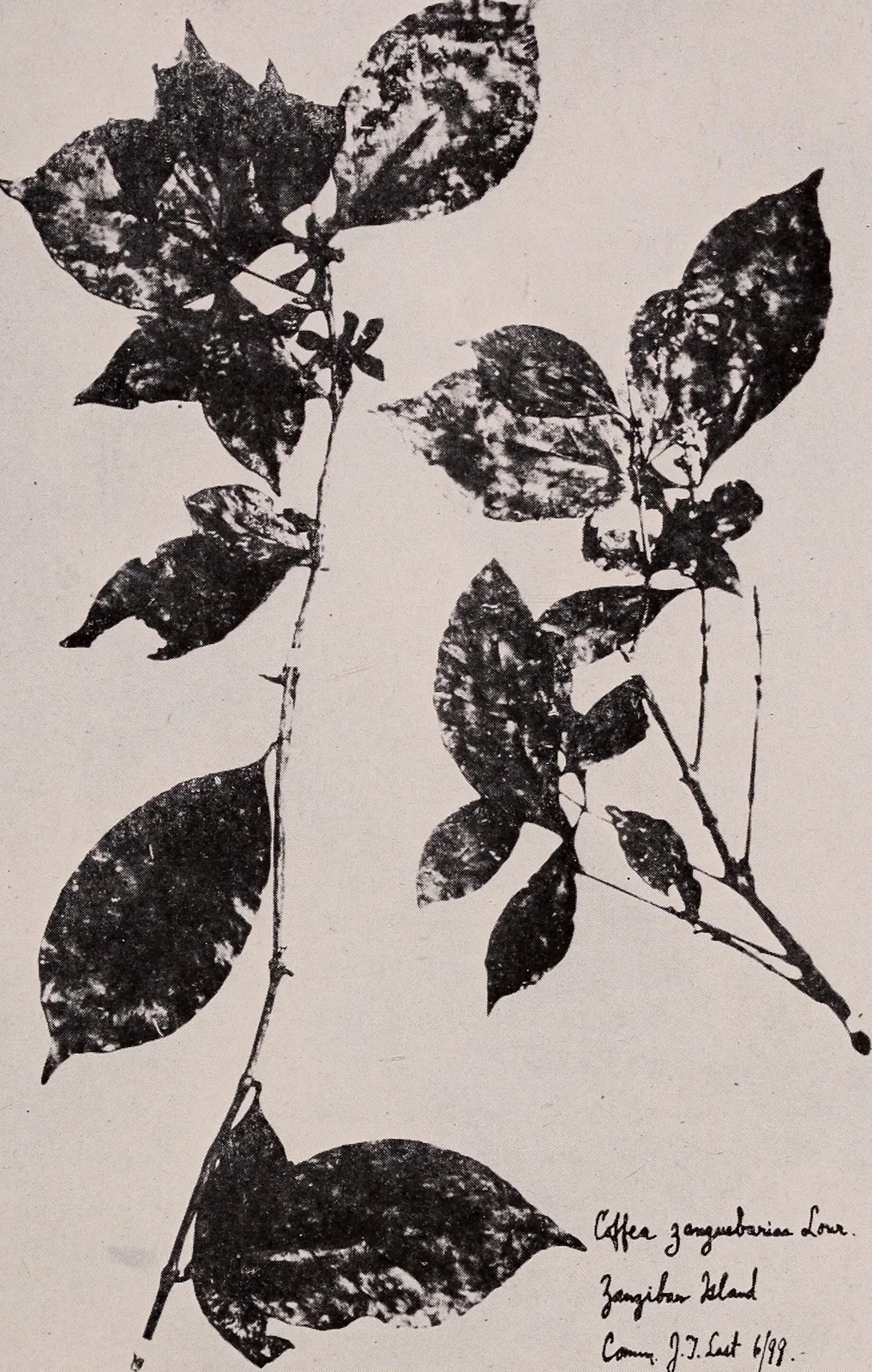
In Mozambique, wild coffee trees preceded cultivated ones. Two species are indigenous there, that is, they grow there naturally: Coffea racemosa, in the center and south of the country, in coastal forest, riverine forest and thickets, from sea level to 500 meters, and Coffea zanguebariae, in the north, between 10 and 350 meters, which is also found in southern Tanzania and northern Zimbabwe. Loureiro described both in a flora printed in Lisbon in 1790: the first from a herbarium specimen collected in Mozambique, now lost and replaced by a neotype, that is, a reference specimen chosen after the fact, from the district of Massingir, in Gaza province; the second from material from Zanzibar, where, according to him, the Portuguese had brought it. Coste, in 1955, places these coffee trees in the section that Chevalier had named Mozambicoffea: small shrubs with often deciduous leaves, that is, leaves that fall in the dry season, with very small fruits and seeds, together with a third coffee tree that he attributes to Mozambique, C. salvatrix. The Crop Trust adds to them in 2017 a subspecies of C. mufindiensis present in the west of the country [5][8][9].
These two species were cultivated, on a small scale, well before any modern project. Inhambane coffee is C. racemosa: Hiern noted in 1876 that a drink is made from it, and herbarium specimens of 1937 show it planted on several farms less than 80 kilometers from Inhambane, one specifying that the trees were 35 years old, which takes the cultivation back to at least the early 20th century. Ibo coffee, named for an island of the Quirimbas archipelago, off Cabo Delgado, is C. zanguebariae. Its seeds appear, according to Cheney, on the German East Africa market in 1893; Froehner described it in 1897, in Berlin, as a distinct species, C. ibo, and Cheney wrote in 1925 that it is grown in its places of origin to replace arabica. It received in 1906, in Lisbon, a gold medal diploma. For a century, authors confused the two coffees, which resemble each other from leaves to seeds; it took DNA, in Davis and his coauthors in 2021 then in Navarini and his coauthors in 2024, to establish that the Ibo and Quirimba plants are all zanguebariae, and those of Inhambane province racemosa. Neither is a canephora: they are two diploid species, with 22 chromosomes, close to each other and genetically distant from the two commercial species [5][6][7].
In the trade manuals, Mozambique gets a line. Thurber, in 1881, counts it among the East African coasts that produce small quantities of coffee, of no weight for Europe and the United States. Walsh, in 1894, describes a rather good coffee, comparable to the average of mild coffees, medium-sized, greenish, full-bodied and mellow in the cup; Ukers took up this description almost word for word in 1922 and adds that production is small. He does better: in his general consumption table, he lists Mozambique among the countries that do not produce enough for themselves, with 111,614 pounds imported in 1919, about 50.6 tonnes, 78,973 pounds re-exported and 32,641 pounds consumed, less than 15 tonnes. His table of commercial coffees sheds light on these re-exports: Nyasaland coffee, the present Malawi, leaves through Chinde, and that of Rhodesia through Beira, two ports of Portuguese East Africa. Ukers also notes that Africans prepare coffee there in their way and Europeans in theirs. None of these authors says what species the “Mozambique coffee” he describes is made of [4][3][2].
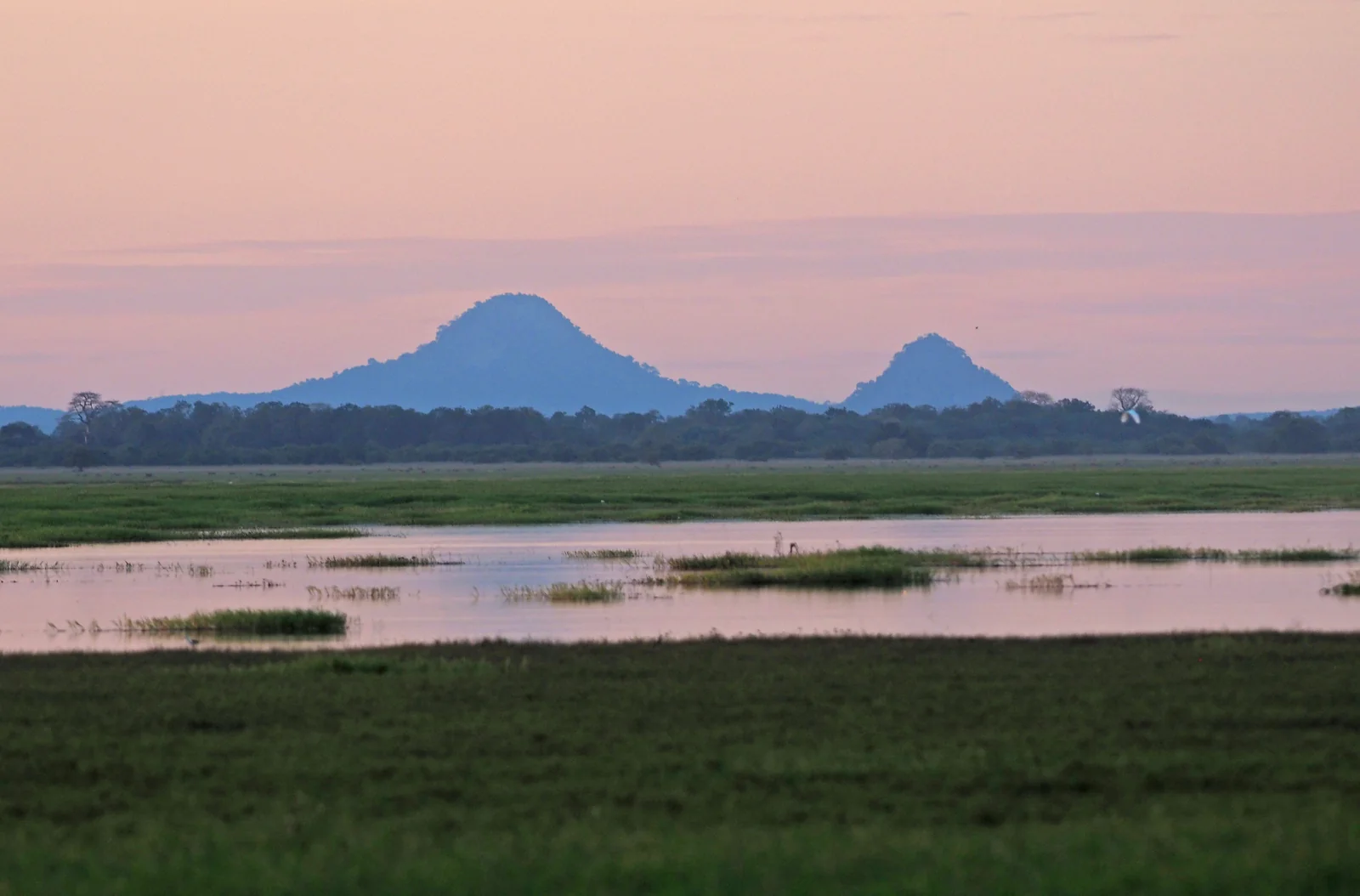
Coffee never became a leading colonial crop. Coste wrote in 1955 that documentation on Mozambique is virtually nonexistent, to the point that a recent catalog of harmful insects cites only a single coffee pest for it. In the mid-1960s, Portugal bogged down in its colonial wars in Angola and Mozambique; excluded from certain international organizations, it had to route through the FAO, in Rome, the exchanges of its coffee leaf rust research center, until the overthrow of the Estado Novo in 1974, and Mozambique became independent in 1975. Gorongosa National Park, created in 1960 in the colonial era, was devastated by the civil war that pitted the ruling Frelimo against Renamo, the Mozambican National Resistance, from 1977 to 1992; the war caused up to a million deaths according to the Associated Press, and Renamo kept bases on Mount Gorongosa long after the peace. The park's scientists estimate that the mountain has lost about 40% of its original forest since 1970 [8][10][13][12].
The FAOSTAT series shows nothing of this history, because it measures nothing. Of its 64 values, from 1961 to 2024, none is an official figure: 49 are FAO estimates (E) and 15 are imputed values (I), that is, calculated by a model for lack of a declaration from the country. From 1961 to 1989, it enters 1,000 tonnes every year, on 1,400 hectares, with a yield of 714.3 kilos per hectare: twenty-nine identical years, which pass through independence and most of the civil war without moving by a tonne. The series maximum, 1,000 tonnes in 1961, is therefore not a peak but the first copy of a conventional figure. From 1990 to 1999, the values oscillate between 700 and 1,000 tonnes, then fall to 600 in 2000; since 2014, they have stayed between 790 and 841 tonnes, and all those after 2016 are imputed. The current value, 803.7 tonnes in 2024 on an estimated 819 hectares, is one of them: it extends a trend, it accounts for no harvest [1].
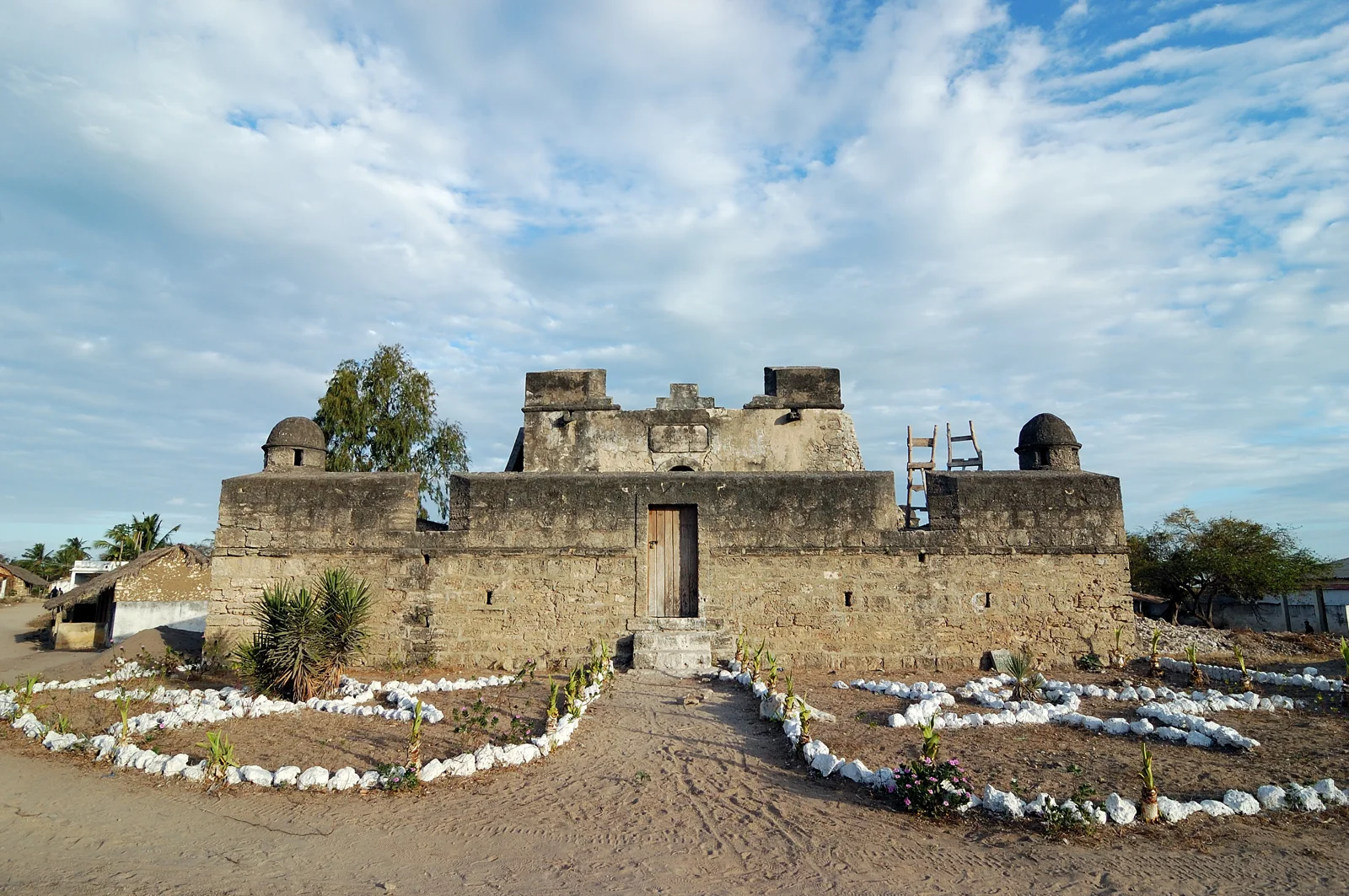
Today
Almost all of today's Mozambican coffee comes from a conservation project. On Mount Gorongosa, which peaks at 1,863 meters in Sofala province, the national park has Coffea arabica planted under indigenous trees, to give the mountain's families an income and make them give up the slash-and-burn farming that is eating into the forest. The idea came from the park's conservator, Pedro Muagura; the project began in 2013 according to the factory's quality manager, in 2014-2015 according to its deputy director, and the first harvest, in 2018, filled only a few bags. The system is established mostly above 700 meters, in the park's protected zone. The study by Cassamo and coauthors concerns the cultivar Costa Rica 95, of the Catimor group, planted at 1.5 meters along the row and 3 meters between rows, or about 2,222 plants per hectare, in the shade of Khaya anthotheca, Erythrina lysistemon, Albizia adianthifolia and Bridelia micrantha. The Associated Press counted in 2018 about 90 trees planted per hectare of coffee, with banana trees, pineapples and beans between the rows [12][13][14][15].
The project grew at the pace of peace. In 2018, the Associated Press described Renamo bases on the mountain, a road sometimes blocked by logs, officials who could no longer climb up, and only 40 hectares planted, for a target of 1,000 hectares in ten years. The disarmament and reintegration of 5,221 former Renamo combatants, opened in 2018, ended in June 2023 with the closing of the Vunduzi base, the last one, in the Gorongosa district, and the factory manager links the expansion of cultivation to these closings. The area exceeded 240 hectares in 2022 and reached 309 hectares in 2023, farmed that year by 915 producers. In 2025, the project says it works with more than 1,000 farmers, nearly half of them women, in eight communities spread over three zones, Tambarara, Canda and Sandundjira, and the park speaks of 1,500 families [12][13][14][17].
Each zone has its wet-process station, where the fruit's pulp is removed and the bean washed; the coffee then dries at Mapombwe, near Vila Gorongosa, on raised beds, then is hulled and sorted in a factory equipped with a sizer and a gravity table, which separates beans by density. The project prepares mostly washed coffees, also naturals, dried in their cherry, and is trying anaerobic fermentation and the honey process; in 2025, its deputy director announced about 346,000 kilos of cherries processed in the year, 90% of it washed, and more than 40 tonnes of green coffee a year. On the trial plots, altitude matters more than shade: between 650 and 935 meters, ripening lengthens by four weeks, the beans gain in size, density and trigonelline, an aroma precursor, while the shade level changes almost nothing, apart from a lower bean mass in full sun. The same team predicts that in an agroforestry system the mountain's suitable area will shrink by about 30% by 2041-2060, and that in full sun there would already be none in 2021-2040. The coffee is sold under the brand Nossa Gorongosa; its buyers are Portugal, England and the United States, but the leading consumer remains Mozambique, according to the park [14][15][16][17].
Other hubs have opened since 2019, all in highland arabica. In Manica province, the company Café de Manica distributed that year 500 plants to about a dozen farmers around Chimanimani National Park, then seeds of seven varieties from Malawi, Brazil and Zimbabwe; it works in 2023 with more than 2,300 farmers and exported a first lot to the Netherlands in 2022. A team of researchers followed in June 2024, at Mount Tsetsera, in the same park, the spontaneous fermentation of a washed arabica for 72 hours. The ICO's 2023 press release cites six brands: Nossa Gorongosa, Café Chimanimani, Café Niassa, Café Vumba, Café de Manica, grown in the Mussapa mountains, and Café de Ibo. In 2025, the government counts more than 4,000 smallholders, on plots of 0.5 to 1 hectare, and names as main zones Manica, Sofala and Cabo Delgado; the coffee growers' association, AMOCAFÉ, cites for its part Nampula, Zambezia, Niassa and Manica, with the Gurúè and Lichinga plateaus, which it says are traditionally linked to arabica. A model published in 2023 designates Manica, Sofala, Zambezia and Nampula as the regions suitable for arabica [22][23][24][18][21][11].
The indigenous coffees survive in gardens. On Ibo and Quirimba, C. zanguebariae grows in family gardens and small plantations mixed with other crops, without irrigation, regular manuring or pruning, so that it has the look of a spontaneous plant. Davis and his coauthors record there a spacing of 2.5 to 3 meters, a flowering from December to January, triggered by the first heavy rains, and a harvest in March and April, about four months later; an adult tree yields 3 to 4 kilos of cherries, or 300 to 800 grams of green coffee depending on the yield retained. The island receives about 950 millimeters of rain a year, with seven months under 50 millimeters, for an average of 26 °C, and maxima of 39 to 45 °C in the shade were recorded there in January and February 2019. Four tasting panels found in zanguebariae notes of grass, licorice, jasmine, eucalyptus and dark chocolate, on poorly harvested and poorly kept samples. The C. racemosa of Inhambane, for its part, could not be seen again in cultivation by Davis, who reports only accounts of local cultivation. The Ibo producers have an association, and a UNIDO project financed by Italian cooperation described the morphology of Ibo coffee in 2021 [7][5].
The institutional framework is new. AMOCAFÉ, the Mozambican Association of Coffee Growers, was created in 2021 and brings together eleven companies in 2023. Mozambique, a mere observer when the International Coffee Agreement of 2007 was adopted, became a member of the International Coffee Organization on June 13, 2023, by signing the 2022 agreement in London. The national strategy aims at about 5,000 hectares in ten years, with 4 million euros from Italian cooperation for the MAIS VALOR II program, and Italy also finances an agri-food center in Manica, priced at 35 million euros. Declared trade remains minuscule: according to UN Comtrade, the country exported 7 tonnes of green coffee in 2021, mostly to the United States, then 8 in 2022, 9 in 2023 and 6 in 2024, mostly to South Africa, while it imports 6 to 70 tonnes each year since 2010, coming mostly from South Africa, Malawi and Portugal [24][25][19][21][26].
- Species
- Cultivated Coffea arabica (Gorongosa, Chimanimani); C. zanguebariae (Ibo, Quirimba) and C. racemosa (Inhambane), indigenous [7]
- 2024 production (FAOSTAT)
- 803.7 tonnes, imputed value (I) [1]
- FAOSTAT series 1961-2024
- no official value: 49 estimated, 15 imputed; 1,000 t entered every year from 1961 to 1989 [1]
- Production announced by the government
- 40 tonnes in 2024, nearly 100 tonnes expected in 2025 [17]
- Gorongosa
- Costa Rica 95 (Catimor group) under indigenous trees, trials between 650 and 935 m [15]
- Gorongosa project area
- 309 hectares and 915 producers in 2023 [13]
- Ibo coffee harvest
- March and April, after a flowering from December to January [5]
- International Coffee Organization
- member since June 13, 2023 [24]
Gray areas
Nobody knows how much coffee Mozambique produces. For 2024, FAOSTAT enters 803.7 tonnes, imputed value, on an estimated 819 hectares; the government, quoted by the Lusa agency, speaks of 40 tonnes harvested and about 300 hectares in the whole country, and expects nearly 100 tonnes for 2025; industry players, quoted by Zitamar, give 50 tonnes for the 2023-2024 season, reduced by a stem borer and the Antestia bug; the president of AMOCAFÉ announces in August 2025 500 to 600 tonnes a year. The Gorongosa project alone describes itself in turn by 370 tonnes “harvested” since 2013, 120 tonnes in a few months of 2023, more than 30 tonnes of dry coffee per season, more than 40 tonnes of green coffee a year and 5 tonnes every three months, without always saying whether it counts cherries or green bean, whereas it takes 5 to 10 kilos of cherries for one kilo of green. The declared exports, 6 to 9 tonnes a year, agree with none of these figures. The specialist press repeats “827 tonnes in 2019” according to the United Nations, while the current version of FAOSTAT gives 789.95 tonnes for that year: the imputed value was recalculated between two deliveries. The ICO and the US agricultural service publish no figure for the country. For the same year 2024, the FAOSTAT figure is twenty times the government's, and nothing allows it to be taken as a measurement [1][17][20][21][13][14][5][26][22][27].
Several accounts about Ibo coffee do not hold up before botanists. The joint press release of the ICO and the government, in 2023, states that this coffee was introduced by Arab merchants in the 11th century and that it is naturally low in caffeine. Yet C. zanguebariae is indigenous to northern Mozambique, and analysis of Ibo samples in 2022 gives about 1% caffeine, give or take 0.3 point, like the 1.06% measured in C. racemosa in 1993, levels that Navarini and his coauthors judge in line with those of other coffee trees. The reputation for a low-caffeine coffee comes from descriptions of the 1950s and from Brazilian trials that used racemosa to lower the caffeine of arabica. The site repeats it: the avenir-09 plate gives a “low” caffeine to both species and the atlas's C. racemosa profile a “very low caffeine content”; these two mentions deserve to be qualified. Other claims circulate without proof. The park's conservator maintains in 2024 that the Portuguese colonists forbade Africans to plant coffee in order to protect Brazil, then presented as their coffee colony, which no source read attests and which the chronology makes doubtful, Brazil having been independent since 1822; in the same interview, the mountain's coffee forest would cover 600,000 hectares, whereas the project cultivates 309. Perfect Daily Grind writes that Portugal reserved coffee for Angola and tea for Mozambique, without citing a source. Walsh, in 1894, has coffee passing from Mozambique to Madagascar around 1717, without proof; Cheney, in 1925, attributes to zanguebariae 9,300 kilos harvested at Nosy Be in 1880, a faulty reading that Davis corrects: the figure concerned an arabica Bourbon [24][7][5][29][28][27][3][6].
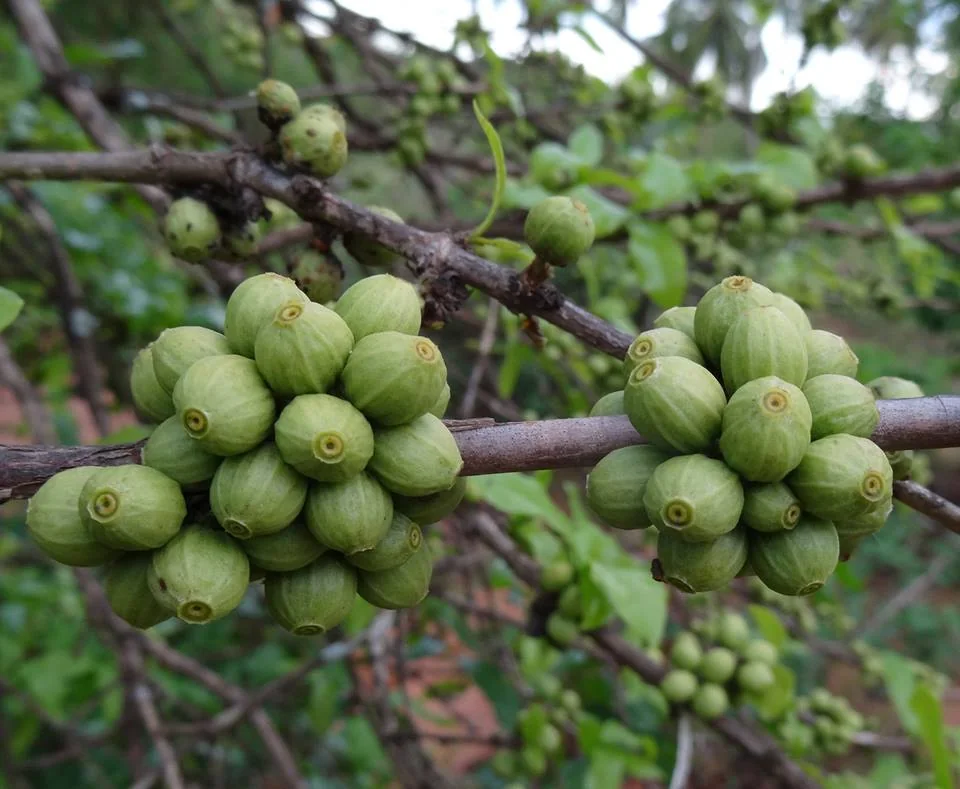
Mozambique's canephora remains to be documented. No source read gives an area, a province or a tonnage of canephora: the Secretary of State cites in 2025 “arabica and robusta” among the country's varieties, the specialist press mentions the species without figures, and the 2024 genetic study writes that the country has no tradition of growing arabica or canephora. Ibo coffee, which is sometimes grouped with it, is a zanguebariae. The identity of the northern coffee trees also poses a problem of imagery: two photographs by Ton Rulkens of December 6, 2013, captioned “Coffea racemosa, small plantation at the village of Chiure, northern Mozambique,” were taken at Chiure, a district of Cabo Delgado, a province where botanists report only zanguebariae; the photograph of cherries that the site uses in the avenir-16 plate, by the same author on the same day, might show the same species wrongly named, which only verifying its place of capture would settle. Finally, the colonial history of coffee remains to be quantified: outside herbaria and trade manuals, no production statistic between 1920 and 1975 was found, and Coste already judged the documentation almost nonexistent [18][14][7][5][29][8].
Not covered: Colonial production and export statistics between 1920 and 1975: no series found, neither in the library nor online, and I did not have access to the colony's statistical yearbooks. The full text of Cassamo et al. 2023: the University of Lisbon repository stopped responding during the session, only the abstract was used. Canephora: no source quantifies or locates it, the brief that placed it in Zambezia and at Ibo was not confirmed. The articles by Halle and Faria (1973) and Lopes (1974) on Mozambican racemosa, cited by Davis, not accessible. The harvest calendar for arabica at Gorongosa and Manica: only a June 2024 harvest at Chimanimani is dated. Prices paid to producers: two annual incomes per family were cited by officials (150,000 and 250,000 meticais), with no basis of calculation. The IUCN status of racemosa and zanguebariae: 2017 factsheets cited, not opened. The park's site (gorongosa.org/coffee) redirects to an unrelated shop and was not used. Mirror import declarations by partners in UN Comtrade, not queried.
- FAOSTAT, Production: Crops and livestock products, Coffee, green (code 656), Mozambique: production, harvested area, yield and status of each value, Food and Agriculture Organization of the United Nations (FAO), 2025, https://bulks-faostat.fao.org/production/Production_Crops_Livestock_E_ solid level
Series read in the bulk archive already extracted on disk, identical to pays_producteurs_complement.json (delivery of December 23, 2025). Production: 1,000 t every year from 1961 to 1989 (E), 937 t in 1990, 700 t in 1992, 600 t in 2000, 900 t in 2012-2013, 840.46 t in 2016 (E), 789.95 t in 2019 (I), 803.7 t in 2024 (I). Production statuses: 49 E and 15 I (1998, 1999, 2001 to 2003, 2014, 2015, 2017 to 2024), no A. Area: 1,400 ha (E) from 1961 to 1989, 819 ha (E) in 2024. Yield: 714.3 kg/ha (E) from 1961 to 1989, 980.8 kg/ha in 2024. - All About Coffee, ch. XXII (general consumption table), XXIV (characteristics of coffees and reference table of commercial coffees) and XXXV (uses), William H. Ukers, 1922, https://www.gutenberg.org/ebooks/28500 solid level
Mozambique in 1919: 111,614 pounds imported, 78,973 exported, 32,641 consumed, in the list of countries that do not produce enough for themselves; greenish coffee, medium-sized, mellow, small production; medium bean, greenish, full-bodied, sweet and mellow in the cup; Nyasaland coffee exported through Chinde and Rhodesian through Beira, ports of Portuguese East Africa; Africans preparing coffee the African way, Europeans the European way. - Coffee: Its History, Classification and Description, pp. 24-25, 104 and 107-108, Joseph M. Walsh, 1894, https://www.biodiversitylibrary.org/bibliography/33348 medium level
PDF copy from the local library. Mozambique coffee fairly good, in the rank of average mild coffees, medium bean, greenish, full-bodied and mellow; classed among the coffees of the east coast; coffee carried from Mozambique to Madagascar by Africans around 1717, no proof given. Trade work. - Coffee: From Plantation to Cup, Francis B. Thurber, 1881, https://archive.org/details/coffeefromplanta00thur medium level
PDF copy from the local library. Small quantities of coffee on the east coast of Africa, Mozambique included, with no influence on the supply of Europe and the United States. Trade work. - Hot Coffee: The Identity, Climate Profiles, Agronomy, and Beverage Characteristics of Coffea racemosa and C. zanguebariae, Frontiers in Sustainable Food Systems 5, 740137, doi:10.3389/fsufs.2021.740137, Aaron P. Davis, Roberta Gargiulo, Iolanda N. das M. Almeida, Marcelino Inácio Caravela, Charles Denison, Justin Moat, 2021, https://doi.org/10.3389/fsufs.2021.740137 solid level
Full text read. Ranges of C. racemosa (central and southern Mozambique, eastern Zimbabwe, KwaZulu-Natal, 0 to 500 m) and of C. zanguebariae (southern Tanzania, northern Zimbabwe and Mozambique, 10 to 350 m); descriptions by Loureiro (1790), Massingir neotype; Hiern 1876; 1937 herbarium specimens around Inhambane, trees 35 years old; agronomy of zanguebariae at Ibo (spacing, flowering December-January, harvest March-April, 3 to 4 kg of cherries per tree, yields 5:1 or 10:1); Ibo climate (950 mm, seven months under 50 mm, 26 °C, 39 to 45 °C recorded in 2019); tasting notes from four panels; cultivation of racemosa at Inhambane not verified; low-caffeine reputation according to authors of 1954 and 1956; Cheney's error on Nosy Be corrected by reading Lanessan 1886. - Coffee: a monograph of the economic species of the genus Coffea L., pp. 27-29 and 68-70, plate 25, Ralph Holt Cheney, New York University Press, 1925, https://archive.org/details/coffeemonographo00chen solid level
Full text read (Internet Archive). C. ibo Froehner, “Ibo coffee”: seeds on the German East Africa market in 1893, Portuguese island of Ibo at about 12° south latitude, specimens sent to the Berlin botanical museum, description of 1897, recent cultivation as a substitute for arabica; C. racemosa known since 1790, local use; C. zanguebariae “Zanzibar coffee,” 9,300 kg harvested at Nosy Be in 1880 (a claim that Davis 2021 corrects). - Mozambican Coffea accessions from Ibo and Quirimba Islands: identification and geographical distribution, AoB PLANTS 16(2), plae004, doi:10.1093/aobpla/plae004, Luciano Navarini, Davide Scaglione, Lorenzo Del Terra, Simone Scalabrin, Lopes Mavuque, Luca Turello, Rafael Nguenha, Gianluca Luongo, 2024, https://pmc.ncbi.nlm.nih.gov/articles/PMC10880890/ solid level
Full text read. No tradition of growing arabica or canephora in Mozambique; Ibo coffee cultivated for nearly two centuries, gold medal diploma in Lisbon in 1906; historical confusion between Ibo coffee and Inhambane coffee; sequencing of 40 accessions: C. zanguebariae alone present at Ibo and Quirimba, C. racemosa specific to Inhambane province; diploid species with 22 chromosomes; family gardens and small plantations, without irrigation, manuring or pruning; caffeine of about 1% (± 0.3) at Ibo (Abdurabe 2022 thesis), 1.06% in racemosa (Anthony 1993); Ibo coffee producers' association; UNIDO project and Italian cooperation (Mavuque 2021). - Les caféiers et les cafés dans le monde, vol. I, Les caféiers, René Coste, 1955, https://horizon.documentation.ird.fr/exl-doc/pleins_textes/divers20-12 solid level
PDF copy from the local library. Section Mozambicoffea Chev.: often small shrubs, with deciduous leaves, very small fruits and seeds; C. zanguebariae (Zanzibar, Tanganyika, Mozambique), C. racemosa, C. salvatrix (Mozambique); documentation on coffee pests in Mozambique “virtually nonexistent,” a single insect cited by a recent catalog. - Global Conservation Strategy for Coffee Genetic Resources, table of Coffea species, Crop Trust and World Coffee Research (Bramel, Krishnan, Horna, Lainoff, Montagnon), 2017, https://www.croptrust.org/saving-coffee/ solid level
Library copy. Ranges according to the Kew list: C. racemosa (Mozambique, Zimbabwe, KwaZulu-Natal, islands of the Mozambique Channel), C. zanguebariae (southern Tanzania, northern Mozambique), C. salvatrix (southwestern Tanzania, Malawi, Mozambique, Zimbabwe), C. mufindiensis subsp. australis (southern Malawi, western Mozambique, eastern Zimbabwe). - Coffee Is Not Forever: A Global History of the Coffee Leaf Rust, Stuart McCook, Ohio University Press, 2019, https://ohioopen.library.ohio.edu/oupress/96/ solid level
PDF copy from the local library. Portugal's colonial wars in Angola and Mozambique in the mid-1960s, exclusion from certain multilateral organizations, CIFC exchanges passing through the FAO until the fall of the Estado Novo in 1974; independence of Mozambique the following year. - Genomic Evaluation of Coffea arabica and Its Wild Relative Coffea racemosa in Mozambique: Settling Resilience Keys for the Coffee Crop in the Context of Climate Change, Plants 12(10), 2044, doi:10.3390/plants12102044, Inocência da Piedade Ernesto Tapaça et al., Universidade de Lisboa, IIAM, UniLúrio, Gorongosa National Park, 2023, https://pmc.ncbi.nlm.nih.gov/articles/PMC10220690/ solid level
Full text read. Mozambique absent from the lists of producing countries; Gorongosa agroforestry system cited as an exemplary case; cultivation of racemosa at Inhambane reported as early as 1876 (Hiern); modeling by Cassamo et al. 2023: Manica, Sofala, Zambezia and Nampula suitable for arabica; arabica sampled at Gorongosa and Niassa, wild racemosa in the provinces of Inhambane, Sofala and Maputo. - Coffee and Conservation: Mozambique Tries Both on a Mountain, Associated Press, republished by Voice of America, 2018, https://www.voanews.com/amp/coffee-and-conservation-mozambique-tries-b medium level
Article of July 11, 2018: Renamo bases on Mount Gorongosa, road blocked, access impossible at times; 90 trees planted per hectare of coffee, intercropping; civil war that caused up to a million deaths, ended in 1992, violence until 2016; summit at 1,863 m; about 40% of the forest lost since 1970 according to scientists; 40 ha planted, 100 ha planned within the year, 1,000 ha targeted in ten years; first harvest four years after planting; coffee on sale at the Chitengo lodge. - Moçambique aumenta produção e exportação de Café da Gorongosa, Forbes Portugal, Lusa dispatch, 2023, https://www.forbespt.com/mocambique-aumenta-producao-e-exportacao-de-c medium level
Article of November 19, 2023, statements by Edna Catondo, the factory's quality control manager: project begun in 2013, 370 t harvested and exported to the United Kingdom and South Africa since, 120 t since January 2023 on 309 ha against 105 the previous year, 915 producers; increase of 150 t from 2019 to 2022 after the closing of the first Renamo bases; DDR of 5,221 combatants opened in 2018, completed in June 2023 with the Vunduzi base; more than 240 ha in 2022, more than 30 t of dry coffee per season; park created in 1960, civil war from 1977 to 1992, management agreement with Greg Carr's foundation in 2008. - In Mozambique, The Gorongosa Coffee Project Is Changing Lives (And Saving Forests), Sprudge, interview with Camille de Boissel, deputy director of the project, 2025, https://specialprojects.sprudge.com/?p=719 medium level
Article of April 30, 2025, the project's own account: start in 2014-2015 on the initiative of Pedro Muagura; Quentin Haarhoff from 2014 to 2021; first harvest in 2018, a few bags; civil war from 1977 to 1992; instability in 2015-2016; more than 1,000 farmers, nearly 50% women; from 5 to more than 200 ha, eight communities, zones of Tambarara, Canda and Sandundjira; more than 40 t of green per year; three wet-process stations, drying at Mapombwe; washed, naturals, anaerobic and honey trials; about 346,000 kg of cherries processed in the year, 90% washed; mention of canephora among the country's species, without figures; claim of ICO membership. - Shade and Altitude Implications on the Physical and Chemical Attributes of Green Coffee Beans from Gorongosa Mountain, Mozambique, Agronomy 12(10), 2540, doi:10.3390/agronomy12102540, Crimildo T. Cassamo, Adilson V. J. Mangueze, António E. Leitão et al., Universidade de Lisboa and Universidade Eduardo Mondlane, 2022, https://repositorio.ulisboa.pt/handle/10400.5/25894 solid level
Full text read (University of Lisbon repository). C. arabica cv. Costa Rica 95 (Catimor group), four-year-old plants, 1.5 m × 3 m, about 2,222 plants/ha; trials at 650, 825 and 935 m, dense shade, moderate shade and full sun; indigenous shade trees (Khaya anthotheca, Erythrina lysistemon, Albizia adianthifolia, Bridelia micrantha); plantations above 700 m; ripening lengthened by two to four weeks with altitude; size, uniformity, mass, density and trigonelline higher at 935 m; weak effect of light, lower mass in full sun; wet process with 24 h of fermentation in water, sun drying. - Impact of climate changes in the suitable areas for Coffea arabica L. production in Mozambique: Agroforestry as an alternative management system to strengthen crop sustainability, Agriculture, Ecosystems & Environment 346, 108341, doi:10.1016/j.agee.2022.108341, Crimildo T. Cassamo et al., 2023, https://doi.org/10.1016/j.agee.2022.108341 solid level
Abstract only read (OpenAlex), full text not opened: under agroforestry, the favorable area of Mount Gorongosa reduced by about 30% in 2041-2060 and by 50% in 2081-2100; in full sun, no suitable area at all from 2021-2040; nationally, loss of half to two thirds of the area under agroforestry by 2041-2060. - Mozambique: Coffee production employs 1,500 families in Gorongosa, Lusa, republished by the Alliance of Mediterranean News Agencies (AMAN), 2025, https://aman-alliance.org/Home/ContentDetail/95719 medium level
Dispatch of October 8, 2025, statements by Pedro Muagura: at least 1,500 families; about 5 t of coffee every three months; buyers Portugal, England, United States, Mozambique the leading consumer; production systematized for nearly five years, concentrated at Gorongosa; about 300 ha of coffee in the country; nearly 100 t expected in 2025 after 40 t in 2024; 4 million euros from Italian cooperation, 2,200 families; 5,000 ha targeted in ten years. - Mozambique forecasts production of about 90 tonnes of coffee, Agência de Informação de Moçambique (AIM), 2025, https://aimnews.org/2025/06/13/mozambique-forecasts-production-of-abou medium level
Dispatch of June 13, 2025, statements by Secretary of State Momade Juízo at Expo Café Moçambique: about 90 t expected, more than 4,000 smallholders on 0.5 to 1 ha, main zones Manica, Sofala and Cabo Delgado; “arabica and robusta” and racemosa cited among the country's varieties. - Mozambique: Government expects almost 100 tonnes of coffee production this year, Lusa, republished by AMAN, 2025, https://www.aman-alliance.org/Home/ContentDetail/91144 medium level
Dispatch of June 12, 2025: about 90 t expected, 2,200 families; strategy financed by 4 million euros from the Italian Cooperation Agency (MAIS VALOR II program); target of 5,000 ha in ten years. - Mozambican coffee moves from fashion trend to large-scale production, Zitamar News, 2025, https://www.zitamar.com/mozambican-coffee-moves-from-fashion-trend-to- medium level
Article of July 14, 2025, only the beginning is freely accessible: 90 t of dry coffee expected, a record; only 50 t in 2023-2024, harvest hit by a stem borer and the Antestia bug, mostly in the Gorongosa district, where most Mozambican coffee comes from. - Governo aposta no relançamento da cadeia de café em Moçambique, Agência de Informação de Moçambique (AIM), 2025, https://aimnews.org/2025/08/26/governo-aposta-no-relancamento-da-cadei medium level
Dispatch of August 26, 2025, FACIM: Manica agri-food center of 35 million euros financed by Italy; statements by Genaro Lopez, president of AMOCAFÉ: provinces of Nampula, Zambezia, Niassa and Manica, Gurúè and Lichinga plateaus traditionally linked to arabica, production of 500 to 600 t per year. - Café de Manica Envisions a New Era for Coffee in Mozambique, Daily Coffee News (Roast Magazine), 2023, https://dailycoffeenews.com/2023/02/10/cafe-de-manica-envisions-a-new- medium level
Article of February 10, 2023: 500 arabica plants distributed in 2019 to about a dozen farmers around Chimanimani park, seven varieties from Malawi, Brazil and Zimbabwe, more than 2,300 farmers, first export to the Netherlands in 2022; repeats the figure of 827 t in 2019 “according to a United Nations estimate”; the ICO and the US agricultural service do not include Mozambique in their reports. - Integrated microbial-metabolomic analysis reveals how fermentation contributes to the unique flavor of African Arabica coffee, Food Chemistry: Molecular Sciences, doi:10.1016/j.fochms.2025.100344, Gilberto V. de Melo Pereira et al., with the Higher Polytechnic Institute of Manica and the University of Lisbon, 2026, https://pmc.ncbi.nlm.nih.gov/articles/PMC12859811/ solid level
Full text partly read. Spontaneous 72 h fermentation trial on a washed arabica from Mount Tsetsera, Chimanimani National Park (Manica), in June 2024, during the harvest; new plantations under way in the park. - PR 343/23, Planet-protecting coffee: Mozambique joins the International Coffee Organization, International Coffee Organization (ICO) and the Government of Mozambique, joint press release, 2023, https://ico.org/documents/cy2022-23/pr-343e-joint-pr-mozambique-signat solid level
Press release of June 13, 2023: Mozambique's accession to the ICO and signing of the International Coffee Agreement of 2022 in London by Minister Celso Correia; six brands (Nossa Gorongosa, Café Chimanimani, Café Niassa, Café Vumba, Café de Manica, Café de Ibo); AMOCAFÉ created in 2021, eleven companies. The promotional claims of the same text (Ibo coffee introduced by Arab merchants in the 11th century, naturally low in caffeine) are not established: see the gray areas. - Membership of the International Coffee Agreement 2007, as at 2 February 2022, International Coffee Organization (ICO), 2022, https://www.icocoffee.org/wp-content/uploads/2022/11/membershipica2007 solid level
Text copy already extracted by the missing-countries session. Mozambique appears among the countries invited as observers at the 98th session of the Council, which adopted the 2007 agreement, and not among the members. - UN Comtrade, annual data HS 090111 (green coffee, not decaffeinated), declarations of Mozambique, 2010-2024, United Nations Statistics Division, 2026, https://comtradeplus.un.org/ solid level
Queried through the public interface: declared exports of 7.05 t in 2021 (6.8 t to the United States), 8.31 t in 2022, 9.07 t in 2023 and 6.14 t in 2024 (mostly to South Africa), none or almost none before; imports of 5.9 t (2010) to 69.9 t (2018), mostly from South Africa, Malawi and Portugal. Partners' mirror declarations were not queried. - O café em Moçambique: conheça mais sobre essa região produtora, Perfect Daily Grind (Portuguese edition), 2021, https://perfectdailygrind.com/pt/2021/10/28/o-cafe-em-mocambique-conhe medium level
Article of October 28, 2021: unsourced account of a Portugal reserving coffee for Angola and tea for Mozambique; repeats 827 t in 2019 according to the FAO; about 200 ha at Gorongosa, coffees scored 82 or 83 according to the park's coffee manager; Nespresso support announced in 2020. - The forest is us, and we are it too, Rewilding Magazine, interview with Pedro Muagura, 2024, https://rewildingmag.com/the-forest-is-us-and-we-are-it-too low level
Article of August 14, 2024, voice of a project actor: colonial ban on coffee growing by Africans to protect Brazil, unsourced; about 800 t produced in Mozambique in 2022; reforestation plan launched in 2014, 270,000 coffee trees in 2017, 16 t of green harvested afterwards with 800 farmers; “600,000 hectares” of coffee forest. - Site plates: what lies ahead, sections 09 (wild species, table) and 16 (photograph of cherries), C. racemosa profile in the atlas, provenance page, PXL Roasters, based on Coste 1955, Davis et al. 2021 and Wikimedia Commons, 2026 solid level
Source inherited from the site, reread in this pass: C. racemosa and C. zanguebariae, hot, dry climate (Mozambique, Tanzania), “low” caffeine, assessed by tasting panel in 2021 (avenir-09); atlas profile of racemosa, “very low caffeine content,” parent of Aramosa and Siriema; photograph “Cherries of Coffea racemosa,” Ton Rulkens, December 6, 2013, CC BY-SA 2.0, Commons file Coffea_racemosa_berries.jpg (avenir-16 and provenance).