ATLASNepal
501 tonnes (FAOSTAT 2024)In-depth dossier, atlas 2026In-depth dossier: the FAOSTAT series set against other figures, the history, today's industry and its gray areas, with numbered sources. Region: Asia.
Nepal had only a statistical reference point. This dossier completes it: the history of the industry, what it is today, and what remains uncertain, with each paragraph pointing to its sources, numbered at the foot of the page.
The FAOSTAT series remains displayed as is. The dossier says what it is worth, year by year when possible, and compares it with the other figures available.
- Geographic status
- country
- Name in FAOSTAT
- Nepal
- Latest value
- 501 tonnes in 2024
- Nature of the value
- official figure
- Start of the positive series
- 1995
- Series maximum
- 532 tonnes in 2016
Confirmed coverage: FAOSTAT series, and a dossier of 22 sources that crosses the history, today's sector and what remains uncertain.
History
Nepalese coffee has no written early history. Ukers, who reviews in 1922 the coffees of all producing countries, does not mention Nepal. The founding account comes from the National Tea and Coffee Development Board, the public body in charge of the industry: around the year 1995 of the Nepali calendar, the Vikram Samvat, which runs about 56 years and 8 months ahead of the Gregorian calendar, that is, in 1938 or 1939, a certain Hira Giri, a resident of Aapchaur, in Gulmi district, is said to have brought seeds back from Burma and sown them around his village. Coffee then remained for some forty years, the Board writes, a plant of curiosity, passed from one peasant to another without being grown for sale [3][6][7]
The State got involved from the 1960s. According to the Board, the government distributed around 2020 in the Nepali calendar, that is, in 1963 or 1964, seeds imported from India; a 2019 report on the national coffee brand places this import in 1968. In 1978, King Birendra declared Gulmi a coffee region, which this same report takes as the start of commercial production. Sale only really became possible with the Nepal Coffee Company, founded in 1983-84 at Manigram, in Rupandehi district, at the foot of the hills: it bought dried cherry coffee from the farmers, that is, the whole fruit dried with its pulp, and processed it for the domestic market. A coffee development center of the Department of Agriculture opened the following year at Aapchaur, and the idea of organic coffee was born in the early 1990s around Madanpokhara, in Palpa district [3][6]
The producers then organize. The committee of a producers’ association forms at Palpa in 1988 according to the 2019 report, while the Board dates the association to 2048 in the Nepali calendar, that is 1991-92. The law creating the National Tea and Coffee Development Board bears the year 2049, 1992-93, and the Board is established in 1993. A national coffee policy follows in 2003: it provides for a national logo for exported coffee, financed by the Trade and Export Promotion Centre. The logo is registered as a trademark in eight countries, including Canada, Japan, Norway, Singapore and Hong Kong, but it never enters common use, and its registrations lapse in Canada, Norway and Japan for lack of use, as the authors of the report note in 2019; the report was commissioned by a producer-support project financed by the European Union. Foreign trade long remains symbolic: exports amounted to 3.6 tonnes until 2000, writes the Kathmandu Post in 2019, and it is after 2002 that rising sales abroad and in the country convince farmers to make coffee a cash crop [3][6][13]
The FAOSTAT series for green coffee begins only in 1995, at 25 tonnes, an estimate (flag E); the years 1991 to 1994 are marked missing (M), and all values since 1996 are official figures (flag A). It climbs to 500 tonnes in 2008, falls back to 268 tonnes in 2009 with no source read explaining the drop, then fluctuates between 366 and 532 tonnes from 2011 to 2019. For the years that can be checked, these figures are the Board’s, shifted by calendar, and not always its first announcements: for 2012, the Board gave 482 tonnes as a provisional figure, and FAOSTAT keeps 425. FAOSTAT’s year 2014 corresponds to the Board’s 2070/71 fiscal year, which runs from mid-July 2013 to mid-July 2014, and the two series then give the same 1,911 hectares and 430 tonnes to the rounding, then the same 463.6, 466, 513 and 530 tonnes in the following years. One year is the exception: for 2016, FAOSTAT takes over the Board’s area, 2,618 hectares, but records 532 tonnes where the Board announces 434. The maximum of the series therefore rests on a figure that the national source does not confirm [1][2][14][15][17]
The 2020 drop is real. The Board’s spokesperson announced in June 2020 a fall of 40 to 50% in the harvest, due in his view to the weather of the previous season far more than to the lockdown, and the Board records 273 tonnes for the 2019/20 fiscal year, almost half the previous year’s figure. FAOSTAT records 297 tonnes for 2020, and 2,355 hectares for 2020 as for 2021, where the Board gives 1,891 and then 3,052 hectares. The two series then converge, to within a few hectares: 355 tonnes in 2022, 394.4 in 2023, then 501.3 tonnes in 2024 on about 4,300 hectares, the last FAOSTAT value. The Board has already published the following fiscal year, 2024/25, with 641.9 tonnes on 5,501.1 hectares, the highest level in its table [1][2][16]
Today
Nepali coffee grows in the middle hills, those that rise in tiers between the Terai plain and the high mountains. The Board says it is present in about forty districts and grown for sale in 20 to 22 hill districts of the West and the Center. The producing districts named by the 2019 report and by the press are Gulmi, Palpa, Arghakhanchi, Syangja, Tanahu, Lamjung, Kaski, Gorkha, Parbat and Baglung in the west, Lalitpur, Kavre (Kavrepalanchok) and Sindhupalchok around the Kathmandu Valley, and Ilam in the east. The farms are tiny: in a rural municipality of Gulmi, the 60 households surveyed in 2023 grew on average 0.13 hectare of coffee trees. The reported number of producers ranges from 27,000 households in 42 districts in 2019 to more than 30,000 growers in 43 districts in 2026 [3][6][11][14][17][22]
All the country’s coffee is arabica, of the Typica and Bourbon type according to the Board, grown between 1,000 and 1,600 meters; a 2020 review article lowers the bottom of the range to 800 meters. The 2019 report stresses a cultivation higher and farther north than the tropical belt where the rest of the world’s coffee is concentrated. No source consulted mentions Coffea canephora. In 2023, a genetic study conducted by the Board and by the coffee research program of the Nepal Agricultural Research Council (NARC), with technical support from a European Union program, analyzed 104 samples of 26 named varieties, taken from 13 public and private nurseries: about 70% carry the genetic fingerprint of Bourbon, and the proportion rises to 98% for seedlings from private nurseries sold under a local name. The authors see a risk in this, since Bourbon is susceptible to leaf rust, and recommend broadening the genetic base [4][6][9][12]
Two pests sum up the health of the orchards. The coffee berry borer, Hypothenemus hampei, a small beetle that lays its eggs in the bean, is present in every producing country except Nepal, according to the World Coffee Research variety catalog. The white stem borer, Xylotrechus quadripes, a longhorn beetle whose larva tunnels into the trunk, has on the other hand settled in: first signs around 1998, an epidemic in Gulmi in 2016, where 72% of the 68 producers surveyed considered it a major problem and where some reported up to 60% annual losses in the affected plots, according to a 2018 press investigation that does not say who conducted the survey [19][20]
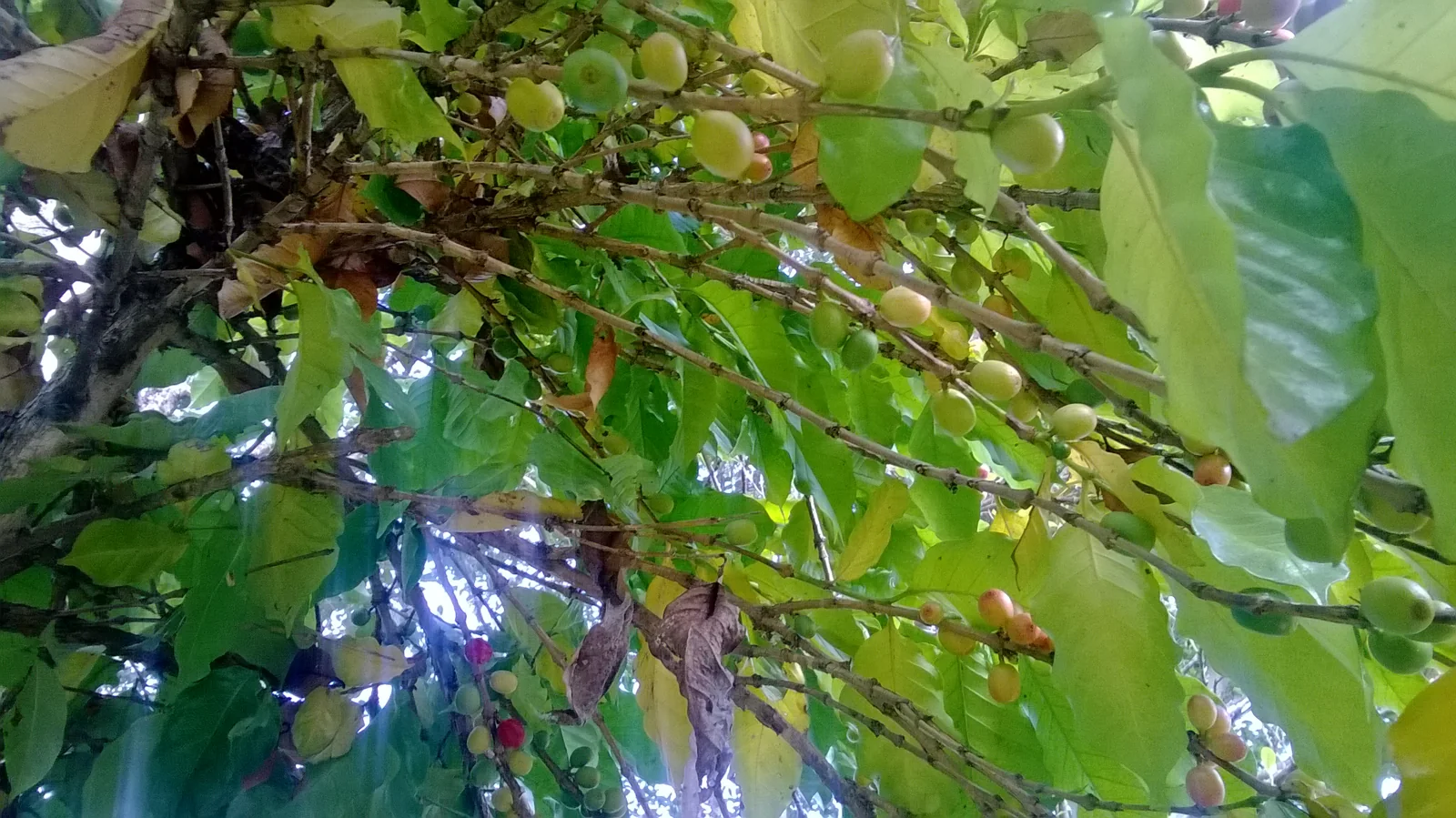
The harvest begins in November, when the cherries turn bright red. The ripe fruits are picked by hand, selectively, then pulped immediately in small hand pulpers, that is, machines that tear off the skin and pulp to leave only the bean in its parchment, the envelope around it; this is the wet process. For family consumption, the cherries are simply dried in the sun on the farm. In a survey of 100 producers in Gulmi published in 2020, not all could move to the wet process, and the lack of pulpers came first among the obstacles, ahead of the lack of water and the lack of roads. Each year, before the National Coffee Day in November, the Board sets an agreed minimum price for three forms of sale: grade A fresh cherry goes from 80 rupees a kilo in 2072 of the Nepali calendar (2015-16) to 105 rupees in 2081 and 2082, parchment from 400 to 535 rupees, dried cherry from 140 to 280 rupees [4][5][6][10][13][15]
Nepali coffee is sold mostly in the country, and the country drinks mostly imported coffee. According to the Board’s table, exports fluctuate between 47 and 111 tonnes a year since the 2013/14 fiscal year, to Japan, the United States and Europe; over the first nine months of the 2025/26 fiscal year, Germany, Switzerland, Italy and Japan each bought from 4 to 8.3 tonnes. Imports rise from 64 tonnes in 2013/14 to more than 440 tonnes in 2022/23 and in 2023/24. Over the nine months of 2025/26, the country imported 979 tonnes of coffee and coffee products, including 527 tonnes of instant coffee and 173 tonnes of green coffee, for 34 tonnes exported. Nepali green coffee was then selling at 1,600 to 1,700 rupees a kilo, green coffee imported from India at 1,200 to 1,300 rupees. Consumption has grown with the cafés: the Himalayan Java chain, founded in 1999, now has outlets in all seven provinces, and the Himalayan News Service agency put the number of cafés in the country at about 6,000 in 2019. For planting, the Board subsidizes half the cost, and it takes at least three years to wait for the first harvest [2][4][14][18]
- Species grown
- Coffea arabica only, of the Typica and Bourbon type [4]
- Growing altitude
- 1,000 to 1,600 m [4]
- Production, 2024/25 fiscal year
- 641.9 t of green coffee on 5,501.1 ha planted [2]
- Latest FAOSTAT value
- 501.3 t in 2024, official figure (flag A), equal to the Board’s 2023/24 fiscal year [1]
- Exports, 2024/25 fiscal year
- 64 t [2]
- Start of the harvest
- November [13]
- Introduction according to tradition
- around 1938, at Aapchaur (Gulmi district), seeds from Burma [3]
- Share of Bourbon in the nurseries
- about 70% of 104 samples analyzed in 2023 [12]
Gray areas
Hira Giri’s story has no contemporary source. The Board reports it as a tradition, and its versions diverge: a resident of Aapchaur for the Board, a Nepali national for the 2019 report, a Burmese hermit for the Kathmandu Post. The Board has the seeds come from a “Sindhu province” in Burma, a name that none of the sources consulted makes it possible to locate. The date itself is a conversion of “around 1995” in the Nepali calendar, and the 2019 report prints “1995” in its chronology as if it were a Gregorian year. Other accounts, reported by traders, attribute the arrival of arabica to Gurkha soldiers and to Nepali workers on the plantations of southern India. Even the state’s involvement is hazy: Indian seeds distributed in 1963-64 according to the Board, in 1968 according to the 2019 report, in the late 1970s according to the Kathmandu Post and according to another passage of the same report. No archival document, no published genetic analysis says where the country’s first coffee tree came from [3][6][13]
The production figures do not cross-check. The FAOSTAT maximum, 532 tonnes in 2016, appears in no national source read, all of which give 434 tonnes for that fiscal year, and the 2009 drop remains unexplained. The International Coffee Organization, cited by the International Trade Centre’s 2021 guide, counts for the 2014 to 2019 crop years one or two thousand 60-kilo bags a year, or about 60 to 120 tonnes: four to eight times less than the Board, and roughly the level of the exports the Board reports. Areas swell faster than harvests, from 2,761 hectares in 2018/19 to 5,501 hectares in 2024/25, so that the apparent yield falls from about 190 to 117 kilos of green coffee per hectare (calculation made here); the table does not separate young plantings, which produce only after three years, from bearing trees. The numbers of producers and districts change from one article to another, and a survey by the central statistics bureau cited in 2020 found coffee in only 32 districts [1][2][8][14][15][16][18]
Where Nepali coffee goes is the sharpest contradiction. A 2010 journal article estimated that 65% of the harvest left the country, a 2018 press investigation and the Kathmandu Post in 2019 speak of more than 70%, and the Himalayan News Service wrote the same year that 60% was consumed in the country. Yet the Board’s table gives exports that represent between 10 and 26% of production each year, 84 tonnes out of 513 in 2017/18, 64 tonnes out of 641.9 in 2024/25 (calculations made here), without specifying whether these weights are green coffee, parchment or roasted coffee. The same table records for 2018/19 1,262 tonnes imported for 98 million rupees, about 78 rupees a kilo when the other years lie between 400 and 950 rupees: a data-entry error or another product counted, nothing makes it possible to decide. The domestic demand of more than 2,800 tonnes put forward in the press in 2026 refers to no published survey. Finally, the organic label that the Board applies to almost all Nepali coffee comes from a state of affairs, farmers with poor access to fertilizers and pesticides, rather than from certification: no source read measures the share of the coffee that is actually certified [2][4][9][13][14][18][19][21]
Not covered: No production figure independent of the Board: FAOSTAT copies it, and the International Coffee Organization, the only other series, counts four to eight times less without saying why. No breakdown of production by district or province verified against a Board document. No harvest end date established by a solid source. The text of the 2003 national coffee policy and the report of the 2023 genetic study were not read, only their summaries. The NARC variety recommendations (Gulmi Local, Selection-10, yellow Caturra) are known only through a personal communication and are not taken up. The mirror data of the importing countries (Comtrade) could not be queried, the API having refused the request. Nothing established on the cause of the 2009 drop or on the area actually bearing. The two images were not seen; their subject is deduced from their description and their categories.
- Production: Crops and livestock products, Coffee, green (656), Nepal: production, area harvested, yield, with their flags, FAO, FAOSTAT, 2025, https://bulks-faostat.fao.org/production/Production_Crops_Livestock_E_ solid level
Series 1995-2024 and the flag of each year: M (missing) from 1991 to 1994, E for 1995 (25 t, 200 ha), A from 1996 to 2024. 500 t in 2008, 268 t in 2009, maximum 532 t in 2016, 297 t in 2020, 501.3 t in 2024; area of 2,355 ha repeated in 2020 and 2021. File of the 12/23/2025 release, read locally. - Coffee Statistics (Coffee in Statistics), National Tea and Coffee Development Board, Nepal, 2025, https://www.teacoffee.gov.np/pages/coffee-statistics-17/ solid level
Table of the 2070/71 to 2081/82 fiscal years (2013/14 to 2024/25): area planted, green coffee production, quantities and values exported and imported. 434 t in 2072/73, 273 t and 1,891 ha in 2076/77, 641.9 t and 5,501.1 ha in 2081/82; imports of 1,262,409 kg for 98,014 thousand rupees in 2075/76. Page accessed on 10/21/2026. - History of Nepali Coffee, National Tea and Coffee Development Board, Nepal, accessed in 2026, https://www.teacoffee.gov.np/pages/history-of-nepali-coffee-14/ solid level
Official version of the introduction: Hira Giri, a resident of Aapchaur (Gulmi), seeds from the “Sindhu province” in Burma around 1995 in the Nepali calendar; a curiosity plant for four decades; seeds from India distributed around 2020 BS; Nepal Coffee Company at Manigram in 2040/41; producers’ association in 2048; coffee in 40 districts, commercial in 20 to 22 hill districts. Text in Nepali, read in translation. - About Nepali Coffee, National Tea and Coffee Development Board, Nepal, accessed in 2026, https://www.teacoffee.gov.np/pages/about-nepali-coffee-13/ solid level
All Nepali coffee is arabica, Typica and Bourbon, grown between 1,000 and 1,600 m; hand picking, manual pulping or with a small pulper; almost entirely organic production; exports to Japan, the United States and Europe. - Minimum agreed price of coffee (agreed minimum price of coffee by year), National Tea and Coffee Development Board, Nepal, accessed in 2026, https://www.teacoffee.gov.np/pages/minimum-agreed-price-of-coffee-16/ solid level
Minimum prices from 2072 to 2082 of the Nepali calendar for fresh cherry, parchment and dried cherry, grades A and B: fresh cherry A from 80 to 105, parchment A from 400 to 535, dried cherry A from 140 to 280. The page does not give the unit; the kilo is established by source 15. - The Nepal Coffee Mark: A Roadmap from Obscurity to Opportunity, Prakat Khati and Prabisha Basnet, Hamro Coffee project (ICCO, Nepal Coffee Producers' Association, European Union funding), 2019, https://coffeenepal.org.np/wp-content/uploads/2024/01/The-Nepal-Coffee medium level
Hira Giri in 1938, seeds from India in 1968, Gulmi as a coffee region in 1978, Nepal Coffee Company in 1983, Aapchaur development center in 1984, organic coffee at Madanpokhara in the early 1990s, producers’ committee at Palpa in 1988, Board in 1993, coffee policy in 2003, logo registered in eight countries then registrations canceled in Canada, Norway and Japan; arabica Bourbon and Typica between 1,000 and 1,600 m, wet process with the hand pulper, dry process for family consumption; list of producing districts. A commissioned report, which partly copies the Board’s pages; its chronology writes “1995” for the date of Hira Giri. - All About Coffee, William H. Ukers, The Tea and Coffee Trade Journal Company, 1922, https://www.gutenberg.org/ebooks/28500 solid level
No occurrence of Nepal, Nepaul or Katmandu in the full text (search made on the library copy): the country does not exist for the world coffee trade in 1922. - The Coffee Guide, 4th edition, table 5 (Exporting countries: Total production, crop years 2014-2019), International Trade Centre, from the International Coffee Organization, 2021, https://www.intracen.org/resources/publications/the-coffee-guide-fourt solid level
Nepal (A) line, October-September crop year: 2, 2, 1, 2, 1, 2 thousand 60-kg bags for 2014 to 2019 (printed page 87, PDF page 114, read by word coordinates). - Coffee production in Nepal, a brief review (Acta Horticulturae 1274, p. 161-166), A. Tuladhar and D. R. Khanal, 2020, https://doi.org/10.17660/ActaHortic.2020.1274.21 solid level
Arabica grown between 800 and 1,600 m on 2,646 ha in 42 of the 75 districts; “organic by default” coffee for lack of access to chemical fertilizers and pesticides (abstract). - Constraints and Determinants of Coffee Processing Methods in Gulmi District, Nepal (International Journal of Applied Sciences and Biotechnology 8(3), p. 368-373), Paudel and Parajuli, 2020, https://doi.org/10.3126/ijasbt.v8i3.31565 solid level
Dry and wet processes the most common, the wet process better paid; survey of 100 producers in Gulmi; lack of hand pulpers first among the obstacles (index 0.867), then water and transport (abstract read through Crossref). - Economic analysis of coffee production in Gulmi District, Nepal (Food & Agribusiness Management 5(2), p. 103-112), Sharma, Shrestha and Chaulagain, 2024, https://doi.org/10.26480/fabm.02.2024.103.112 medium level
60 households of the Satyawati rural municipality (Gulmi) surveyed in 2023; average area in coffee of 0.13 ha. Rated medium: a journal from a publisher whose peer review was not verified. - Nepal is a Bourbon coffee country, report says, The Kathmandu Post, 2023, https://kathmandupost.com/money/2023/01/23/nepal-is-a-bourbon-coffee-c medium level
Genetic study by the Board and the NARC coffee program, EU-NTIP support: 104 samples, 26 varieties, 13 nurseries; 70% (elsewhere 71%) Bourbon fingerprint, 98% for the local names in private nurseries; rust risk. The report itself was not read. - Nepalis wake up and smell (Nepali) coffee, Prahlad Rijal, The Kathmandu Post, 2019, https://kathmandupost.com/money/2019/07/22/nepalis-wake-up-and-smell-n medium level
Hira Giri presented as a Burmese hermit, the version with Gurkha soldiers and workers from the plantations of southern India, seeds imported in the late 1970s, Nepal Coffee Company in 1983-84; cherry ripeness monitored in November; 70% exported; exports of 3.6 t until 2000 against 84.2 t. - Coffee production rises, full potential untapped, Himalayan News Service, The Himalayan Times, 2019, https://thehimalayantimes.com/business/coffee-production-rises-full-po medium level
Production for the 2013/14 to 2017/18 fiscal years: 429, 463, 434, 466, 513 t, of which 84 t exported in 2017/18; more than 27,000 households in 42 districts; list of districts; 60% consumed in the country; about 6,000 cafés. - Govt fixes support price of coffee targeting farmers, The Himalayan Times, 2017, https://thehimalayantimes.com/business/government-fixes-support-price- medium level
Prices set by the Board on the eve of National Coffee Day, in rupees per kilo (fresh cherry A 83, parchment A 415, dried cherry A 140); 466 t against 434 t the previous year; 2,646 ha in 2017-18. - Tea production likely to drop by 25pc this year, The Himalayan Times, 2020, https://thehimalayantimes.com/business/tea-production-likely-to-drop-b medium level
The Board’s spokesperson, Deepak Khanal, forecasts a fall of 40 to 50% in the coffee harvest, due to the weather before the lockdown; coffee grown in 32 districts according to a survey by the central statistics bureau (June 18, 2020). - Coffee output grew 20 percent to 482 tonnes last fiscal year, The Kathmandu Post, taken up by ShareSansar, 2012, https://www.sharesansar.com/newsdetail/coffee-output-grew-20-percentto medium level
Provisional figures from the Board and the producers’ association: 482 t against 401 t in 2010-11, 2,100 ha against 1,752; 27,000 producers; main districts Syangja, Palpa, Lalitpur, Ramechhap, Ilam and Gulmi. - Nepal exports premium coffee to the world, yet relies on imports for domestic needs, Ritu Kafle, Onlinekhabar English, 2026, https://english.onlinekhabar.com/nepal-exports-premium-coffee-world.ht medium level
Board table 2020/21 to 2024/25; trade over the first nine months of 2025/26 (979,130 kg imported, of which 527,169 kg instant and 172,996 kg green, 33,772 kg exported, customers); prices of Nepali and Indian green coffee; Himalayan Java since 1999; demand of more than 2,800 t; 50% subsidy; three years before the first harvest. - Can Nepali coffee survive impacts of climate change?, The Third Pole, taken up by Onlinekhabar English, 2018, https://english.onlinekhabar.com/can-nepali-coffee-survive-impacts-of- medium level
White stem borer (Xylotrechus quadripes): first signs around 1998, epidemic in Gulmi in 2016, 72% of 68 producers, losses up to 60%; more than 70% of production exported; about 32,000 producers in 40 districts. - Coffee Varieties Catalog, World Coffee Research, 2025, https://varieties.worldcoffeeresearch.org/ solid level
The coffee berry borer (Hypothenemus hampei) is present in every producing country except Nepal and Papua New Guinea (PDF page 97 of the library copy). - Agricultural Policy Review for Coffee Promotion in Nepal (Journal of Agriculture and Environment 11, p. 138-147), K. P. Tiwari, 2010, https://doi.org/10.3126/aej.v11i0.3661 solid level
Cultivation in the middle hills, mostly by the wet process; about 65% of the harvest exported; gap between policies and practice (abstract). - Demand exceeds coffee production, leading to high export prices, Deepak Pariyar, Kantipur, 2026, https://ekantipur.com/business/2026/07/03/en/demand-exceeds-coffee-pro medium level
More than 30,000 growers in 43 districts (July 2026).