Leogap
Production drums, Curitiba, Paraná, Brazil.
History
The company was born in Curitiba in 1963. Léo Gappmayer, a Brazilian industrialist, founded it and left it his name, contracted into Leogap. It was then called Metalúrgica Leogap S.A. The location is explained by coffee. The north of Paraná lived off it, it was its main wealth, until the black frost of July 18, 1975 that burned the coffee trees of Maringá and Londrina. A workshop of roasting and grinding machines thus had its market close at hand. This workshop did not stick to coffee. It also made wood dryers, sugarcane bagasse furnaces, then protective doors for robotized automotive lines. ISO 9001 certification, a quality management standard, arrived on June 5, 1998. It was issued by TECPAR in Brazil and by TÜV internationally. The company then called itself the first in the Americas, in its trade, to obtain it. The turning point was announced on July 3, 2001. Probat-Werke, of Emmerich, took a stake that the company describes as majority. Leogap was exporting at that time to more than ten countries. Rolf Kepper, its head almost since the beginning, remained a shareholder and chairman. The agreement had a precise industrial purpose: Leogap began making components of Probat machines locally, which lowered their import price in Brazil. In 2019, the capital became entirely German, and the company went from partner to subsidiary. It is today the group's only South American address.
What it makes
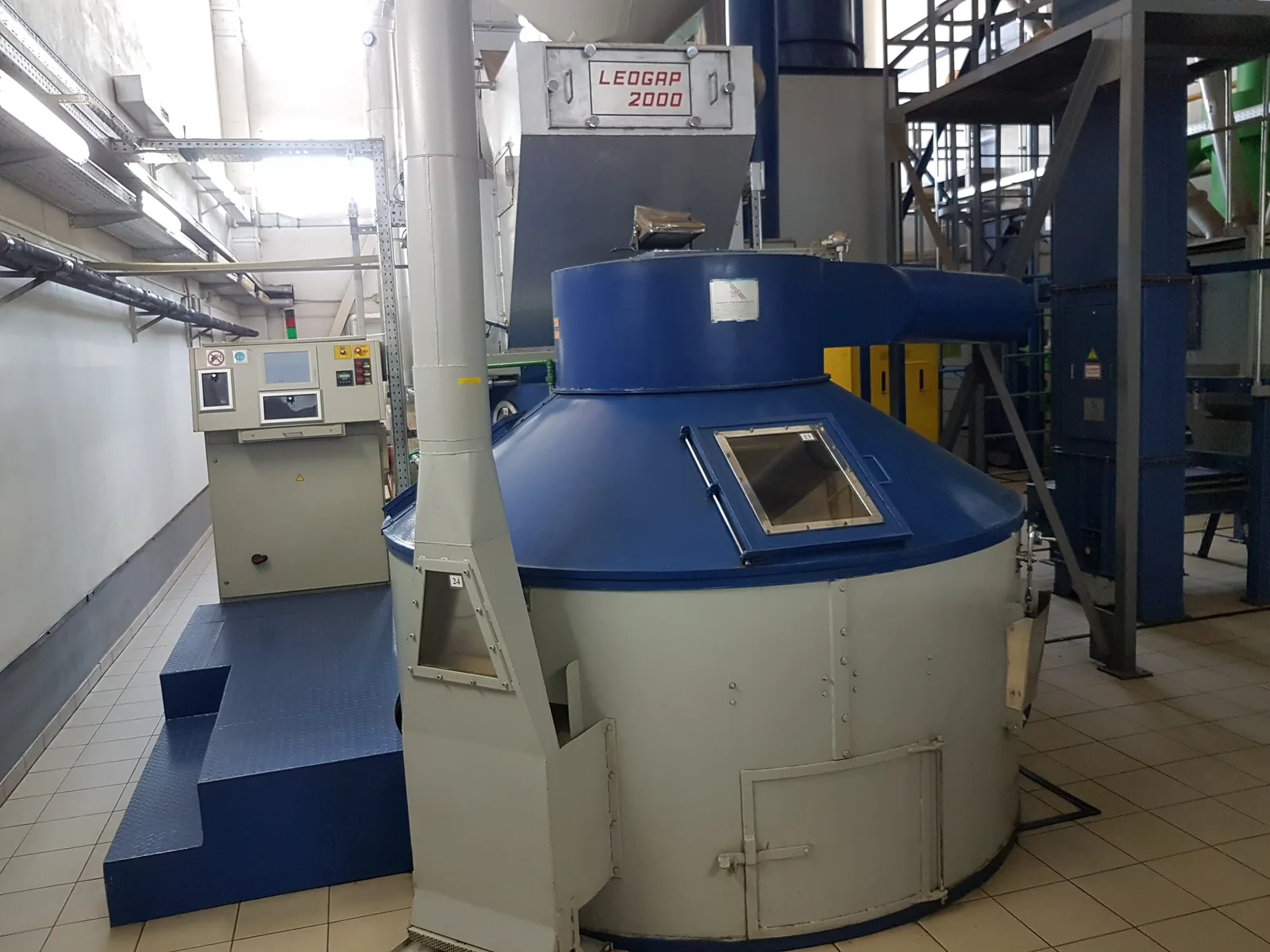
Leogap builds production roasters and roller mills. The roasters fall into two families, according to how the fire reaches the bean.
The first is the drum, that is, a rotating cylinder. The Probatone 60 runs it with indirect heating: the burner heats air, and this hot air alone enters a solid, double-wall cylinder, never perforated. The flame touches neither the bean nor the sheet metal that carries it. Two transfers then share the work, conduction by contact with the wall and convection by the airflow. The Basic 1000 is built differently. Its hearth is internal, fueled by gas or diesel, and followed by an afterburner, that is, a second fire that burns the fumes before release. The ProMundo is modular: a pre-dryer can be added to it, and its gas recirculation is set to partial or total.
The second family is the tangential roasting of the Turbo 4000. There is no rotating drum. The coffee passes through two fixed chambers where paddles stir it, one drying while the other roasts. This alternation removes dead times, and it is what carries the throughput.
The mills are water-cooled roller grinders. The MRA-L 2500 works with four pairs of rollers distributed over two stages. The first two pairs distribute, break and make the coarse grind. The next two refine and flatten. An extraction screw then packs the ground coffee to increase its density, which allows smaller packaging at equal weight. The MRM also exists in a single-stage version, four rollers, reserved for coarse grinds and the granulation of instant coffee.
The models
Four roasters in the Brazilian catalog, all given with their load, throughput and roasting time. Basic 1000: 150 to 210 kg per batch, 900 kg per hour, 8 to 20 minutes. Probatone 60: 50 to 60 kg per batch, 240 kg per hour, 10 to 18 minutes. ProMundo 2000: 300 to 480 kg per batch, 2,000 kg per hour, 10 to 20 minutes. ProMundo 2750: same load, 2,750 kg per hour, 8 to 20 minutes. Turbo 4000: 180 to 300 kg per batch, 4,000 kg per hour, 4 to 8 minutes. On the grinding side, the MRA-L 2500 gives 2,000 kg per hour for fine grind, 2,500 for medium, 3,000 for coarse. The MRM 2000 gives 1,000, 1,500 and 2,000 kg per hour at these same three fineness levels. The MRM 500 gives 300, 400 and 500. The two MRM reach 4,000 and 1,000 kg per hour in granulator mode, where only two pairs of rollers work, for instant coffee. The site menu adds a fifth roaster, the Probat Shop Roaster. The link points to probat.com: it is a group machine distributed in Brazil, not a Curitiba product.
What you gain
Indirect heating puts two screens between the flame and the bean, the air first, the double wall next. No point of the sheet is heated directly. Nothing therefore scorches the surface of the bean, even on a reduced load, which allows roasting small lots without marking them.
Roasting and cooling run at the same time, and the figures show it. The Probatone 60 announces 60 kg per batch and 240 kg per hour. That makes four batches, hence a cycle of fifteen minutes. Yet roasting alone lasts ten to eighteen minutes. The cooler therefore works during the next batch, otherwise the count does not add up.
Gas recirculation sends already hot air back to the burner. It is partial on the Basic 1000, partial or total on the ProMundo. It lowers fuel consumption per kilo. It also reduces the volume of fumes that the afterburner must burn, hence the cost of treatment.
The two fixed chambers of the Turbo remove the wait. While one chamber roasts, the other is already drying the next load. It is this alternation that allows 4,000 kg per hour with batches of only 180 to 300 kg.
The mill rollers are water-cooled. Grinding heats the coffee and makes it lose its volatile compounds, those that carry the aroma. Cooling the rollers limits this loss.
What you lose
The price of this gentleness is slowness. Between the gas valve and the bean there is a mass of air, then a steel double wall. A correction takes tens of seconds to show. A direct flame, for its part, recovers in a few seconds.
The solid cylinder does not send air through the bed of beans. The mechanical stirring of the paddles therefore does a large part of the work. An underload mixes poorly, and the roast loses its evenness there.
The announced throughputs hold only at the low end of the roasting range. The Basic 1000 gives 900 kg per hour with batches of 150 to 210 kg. This imposes a cycle of ten to fourteen minutes, when its roast can go up to twenty. Roasting long therefore costs throughput, and the catalog figure does not hold on a slow profile.
The Turbo 4000 announces 4 to 8 minutes. Delivering the same energy in half the time takes hotter air. The gap then widens between the surface of the bean and its core. The chambers are moreover fixed: the bean has no rotating wall to even out what it receives.