Lambert Machine Co.
Production drums, Battle Creek then Marshall, Calhoun County, Michigan, United States.
History
Joseph Lambert was a former mechanic based in Battle Creek, Michigan. He had worked at John Harvey Kellogg's sanatorium, where the aim was to feed patients without meat. In the mid-1890s he developed a mill that grinds peanuts into butter. The company was thus born of a food machine, not of coffee. In 1897 he made and sold in Battle Creek a so-called self-contained roaster, that is, one delivered with its own hearth and frame. Until then, installing a roasting machine meant building a brick oven around it on site. This masonry nailed the machine to the premises and forbade moving it. A. P. Grohens joined Lambert in 1900. The Lambert Food and Machinery Co. was incorporated in 1901, then reorganized in 1904. It is Grohens who then drove the improvements, and the four patents read all bear his signature alone. In 1901 one of the first gas machines called indirectly heated came out, in which the flame is not supposed to touch the bean. Manufacturing moved to Marshall, east of Battle Creek. In 1913, at a foreclosure sale, Grohens bought the machines and patents of the Reuter-Jones Manufacturing Co. of St. Louis. That company came from the Burns model and had brought out in 1910 a self-contained gas roaster, the St. Louis Jr. The purchase therefore brought in at once a competing patent portfolio. In January 1917, the Lambert Machine Co. presented itself in the trade press as designer and builder of its machines. The same advertisement announces coffee roasters and peanut butter installations.
What it makes
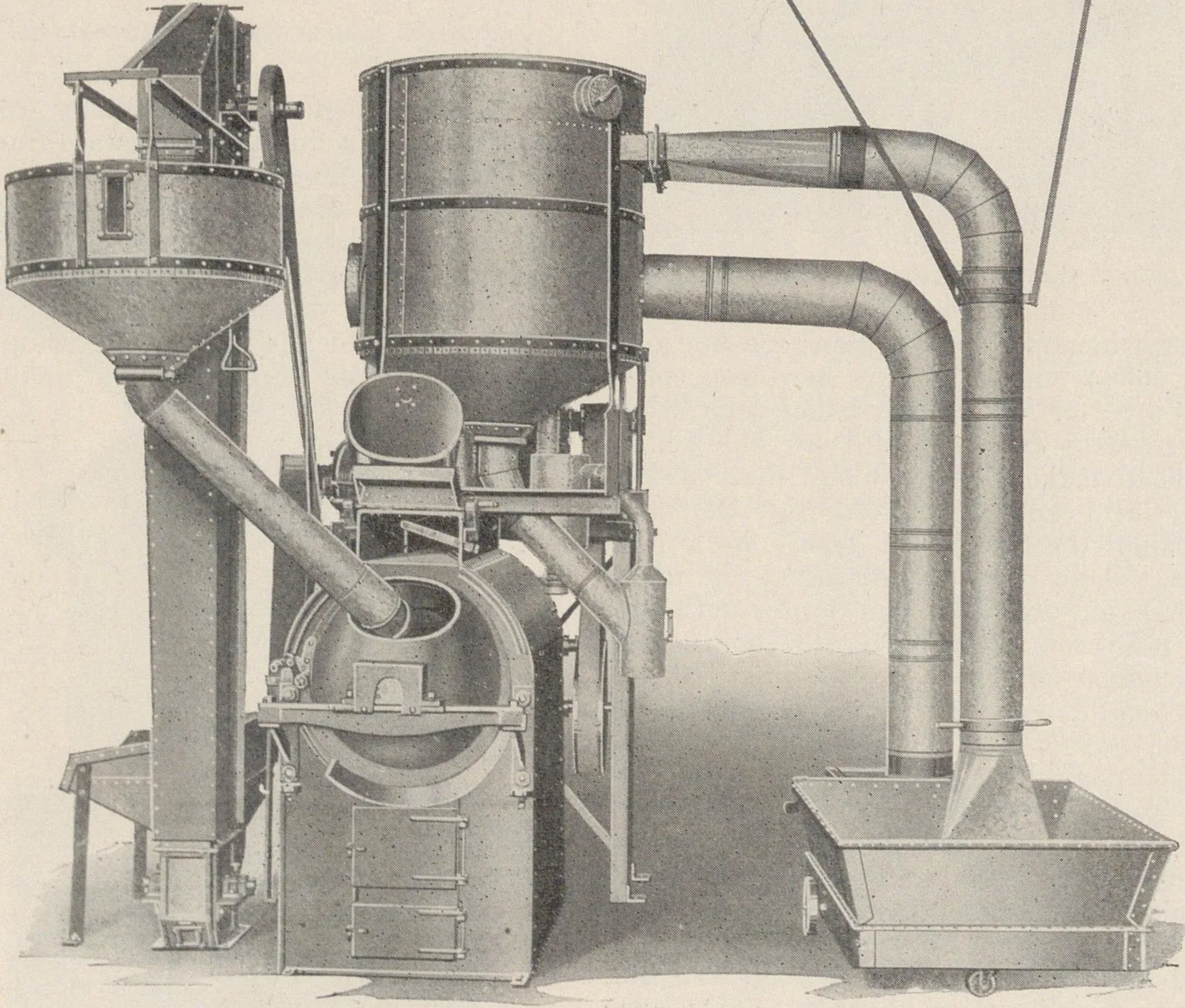
Drum roasters, heated from the inside. Grohens's patents describe the principle in detail. A sheet metal drum turns in a cylindrical casing. Its wall is pierced with holes of one eighth of an inch, or 3.2 mm, spaced three sixteenths of an inch apart and arranged in a staggered pattern. In the axis of the drum, a second perforated cylinder, called the guard tube, turns with it. The burner sits inside this guard tube. It is a pipe whose lower half is slotted and upper half closed, which sends the flame downward. It receives a mixture of air and gas prepared by a mixing valve. The air comes from a compressor belt-driven from the drive shaft, the very one that turns the drum by gearing. The guard tube has a precise function: to break the first violence of the flame so that it does not burn the bean. The hot gases then pass through the load via the perforations. Heat therefore goes from the center to the wall, and not from the wall to the center as in a classic drum. The burner stays fixed in the 1922 patent, while the guard tube turns. The 1923 patent reverses this point: the burner turns in its turn, on a gas supply pipe that stays fixed. The company also builds its coolers. A cart with a perforated bottom receives the batch, and a suction box placed below draws air through the layer of coffee. The cooler patent says why: the coffee leaves the drum at around 400 degrees Fahrenheit, or about 205 degrees Celsius, and keeps roasting as long as it is not cooled. Coal or coke models remain offered alongside gas.
The models
Range known from Ukers's 1922 edition, text and plate captions. Economic: self-contained coal or coke set, which can be fitted for gas. It combines the roaster, a rotary cooler, a lifting feed hopper and an electric motor. Added to it are a destoner, which removes the stones, and a chaff remover, which sucks away the chaff detached from the bean. The plate caption gives it for one or two bags, without specifying the weight of the bag. Victory: 600 pounds per batch, or about 272 kg, gas heating and electric drive, presented as a recent release in 1922. Lambert Junior: 50 pounds, or about 22.7 kg, gas set combining roasting, cooling and destoning, intended for the retail store. No range later than 1929 could be established.
What you gain
Heating through the axis moves the heat source. The drum wall ceases to be the only hot point. The bean that touches it thus no longer takes the whole thermal shock. The gases pass through the mass via 3.2 mm holes spaced 4.8 mm apart. Convection thus works in the thickness of the load, not only at the surface. A mechanical valve doses air and gas in a fixed proportion, so the flame setting is found again from one batch to the next. The front of the guard tube and the bottom of the drum are perforated. The patent says why: these holes let you see the flame and judge its state during roasting. Without masonry, the machine installs in a shop, which the 50-pound Junior model exploits directly.
What you lose
The burner is housed in the drum, so the bean falls back onto it. Grohens spends five years correcting the brutality of this flame, in two patents. The 1923 one bends the ports to throw the flame along the axis instead of radially, so that the heat is already diffuse when it reaches the perforations. The 1928 one caps the burner with an air chamber and a refractory lining, and says expressly why: the product falls on top of the burner and scorches there. A defect that takes two patents in five years is a defect of principle. The drum is perforated, so the combustion fumes pass into the coffee, despite the word indirect used by the company. The air compressor is driven by the shaft that turns the drum, so airflow and rotation speed cannot be adjusted separately. None of the four patents read provides for measuring the bean temperature.