James W. Carter (“pull-out” roaster)
Production drums, Boston, Massachusetts, United States.
History
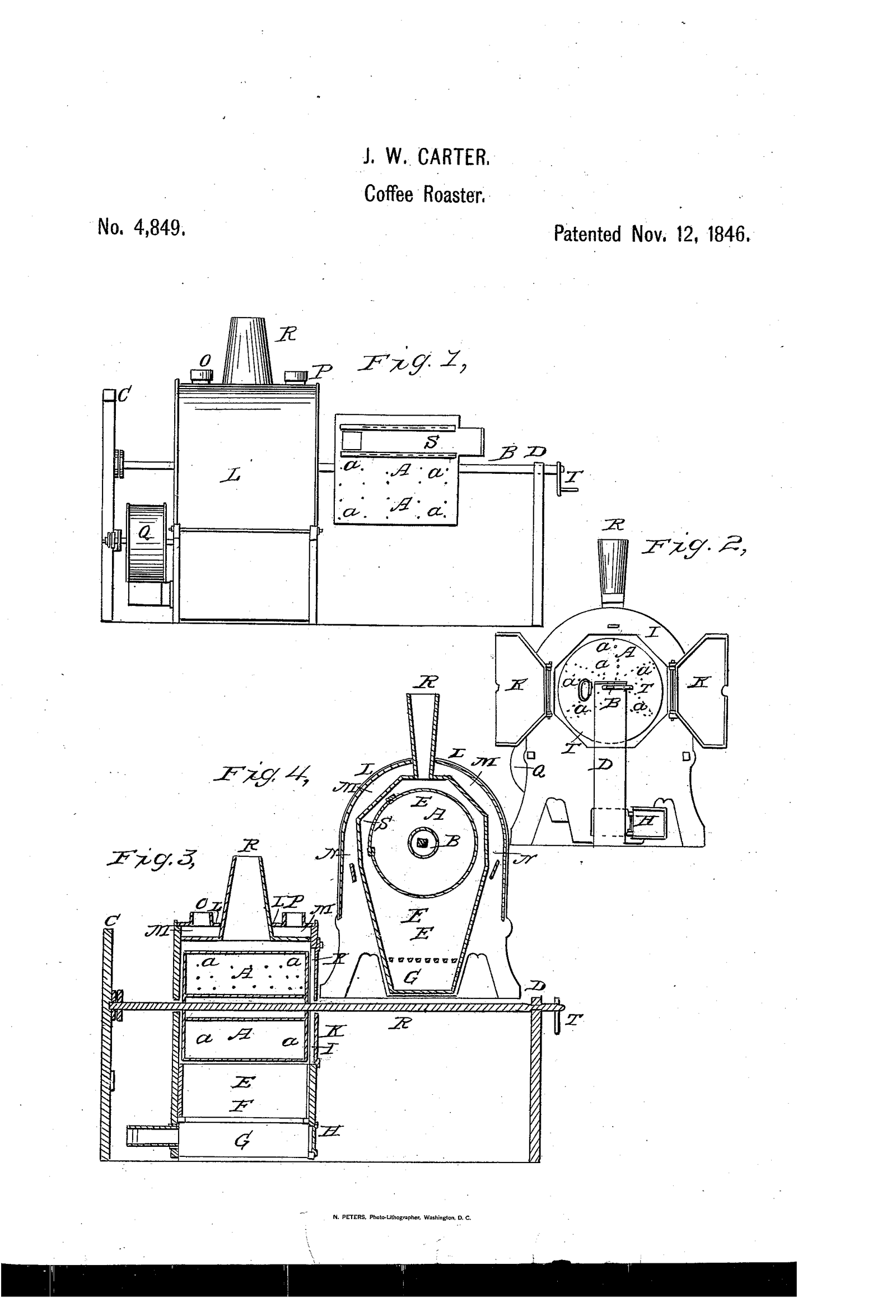
There is no Carter firm, and that is the first fact to set down. There is a patent: number 4,849 of the United States, signed on June 26, 1846 and issued on November 12 of the same year. It is in the name of James W. Carter, of Boston, Suffolk County. The text covers the roasting of coffee, but also that of “various kinds of grain.” Until then, the wholesale roasters of America bought their equipment in England, for lack of finding any at home. The patent changes that. For the twenty years that follow, Carter's machine is the one most often met in American shops. It is called “pull-out,” literally “pulled out,” because the drum comes out of the firebox to be emptied and recharged. It runs in Boston at Dwinell and Company, the firm that will become Dwinell-Wright, at James H. Forbes and William Schotten in St. Louis, at D. Y. Harrison in Cincinnati. No Carter construction shop is nonetheless documented. In St. Louis, some of the machines were built on site “after the Carter pattern,” according to A. E. Forbes. In 1864, Jabez Burns patented a drum that is charged and emptied without taking it out of the fire. The pull-out then becomes a survival, because reopening the firebox at each batch costs time and heat. Thomas Page, a millwright in New York, still builds new ones from 1868, however.
What it makes
A horizontal drum of sheet iron, crossed by a square shaft. This shaft rests on two vertical posts, and the drum slides along it. The charcoal firebox is placed below and surrounds the drum. Heat therefore passes through the sheet, then from the sheet to the bean by contact. This is conduction, not convection, that is, the hot air does not pass through the mass of coffee. The fire does not lick the wall: at Forbes's, the grate lay forty to forty-five centimeters below the drum. The drum comes entirely out of the firebox through a passage that two doors close again while running. The patent describes only an opening fitted with a sliding hatch, which serves for charging as for emptying. The witnesses, for their part, describe it as running the whole length of one side and twenty-three centimeters wide. The patent has the shaft turned by a crank. In shops it was driven otherwise: by hand, then by horse-driven gear at Harrison's, by steam at Forbes's. The belt was then shifted onto a loose pulley, free on its axle, which stopped the drum before it was pulled. The patent adds a double casing around the firebox, with intake flaps and discharge pipes. This is the only thing Carter claims: he acknowledges himself that the drum-and-firebox pairing was already known and used. He likewise disclaims the blower drawn on his plate. The specification finally asks for small holes in the drum to let the vapors escape. The machine described by A. E. Forbes had none.
The models
There is no range, because there is no single manufacturer. Each shop had its machine built or adapted, and the sizes varied from place to place. The only orders of magnitude documented are indirect, and all come from recollections gathered by Ukers. A. E. Forbes remembers that the worker charged an entire Rio bag. A bag then weighed one hundred sixty to one hundred seventy-five pounds, or seventy-two to seventy-nine kilos. He places the front post about eight feet from the wall of the firebox, two meters forty: this is the travel available to the drum to come out. The first two Burns machines, sold in 1864 to the Globe Mills of New York, are called “one-bag” and four feet long. They sit there beside four pull-outs of the old type, which gives the measure of the fleet still in service. No catalog, no price list, no capacity announced by a manufacturer has been found.
What you gain
The drum comes out of the fire, so roasting stops as soon as it is pulled. A bed of charcoal cannot be cut off in a few seconds: pulling the drum is the only action that works as fast. Charging and emptying are done outside the firebox, through the sliding hatch, and not above the flames. With the drum out, the hatch is opened and the bean is looked at. Witnesses did this several times per batch, for lack of any other way to judge the roast. The double casing, flaps closed, keeps heat in the walls of the firebox. The patent aims at the moment when the fire is low: the masonry stays hot and the next batch starts faster. With the flaps open, the pipes conduct this heat outside, or to a room one wants to heat.
What you lose
Each batch requires opening the firebox to take out the drum, and heat leaves through this opening. The cycle becomes long. Conduction through a solid wall heats strongly the bean that touches the sheet, little the one in the center. Rotation alone evens it out: small charge or lively fire, the surface burns. Without perforations, the water vapor and the volatile compounds stay enclosed. The bean cooks in its own moisture, which the trade will eventually judge bad. There is no sampler: to see the bean, the drum must be stopped and pulled out of the fire. The only continuous marker is the color of the smoke coming out of the edge of the hatch. The patent provides nothing for cooling. The coffee falls into a wooden bin or onto the floor itself, where two men stir it with a hoe. As long as it is not spread out, it keeps cooking in the pile. It was therefore sprinkled with a watering can, at the cost of a fog of steam in the shop.