Levels: species, varieties, caffeine-free coffee plants
| Species, variety | Caffeine, % of dry weight | Source |
|---|---|---|
| Arabica | 0.85-1.15 (Yang 2026); 0.8-1.7 (ITC 2021); 1.5 (Ukers 1922) | review, institute |
| Canephora (robusta) | 1.5-2.5 and more (ITC); 2.7 (UCDA 2019); 1.97 (Ukers) | institute |
| Liberica | 1,2-1,5 | commercial pages, weak |
| Laurina (Bourbon Pointu) | 0,4-0,75 | specialist press, weak |
| C. mauritiana | 0,07 | Ukers 1922 |
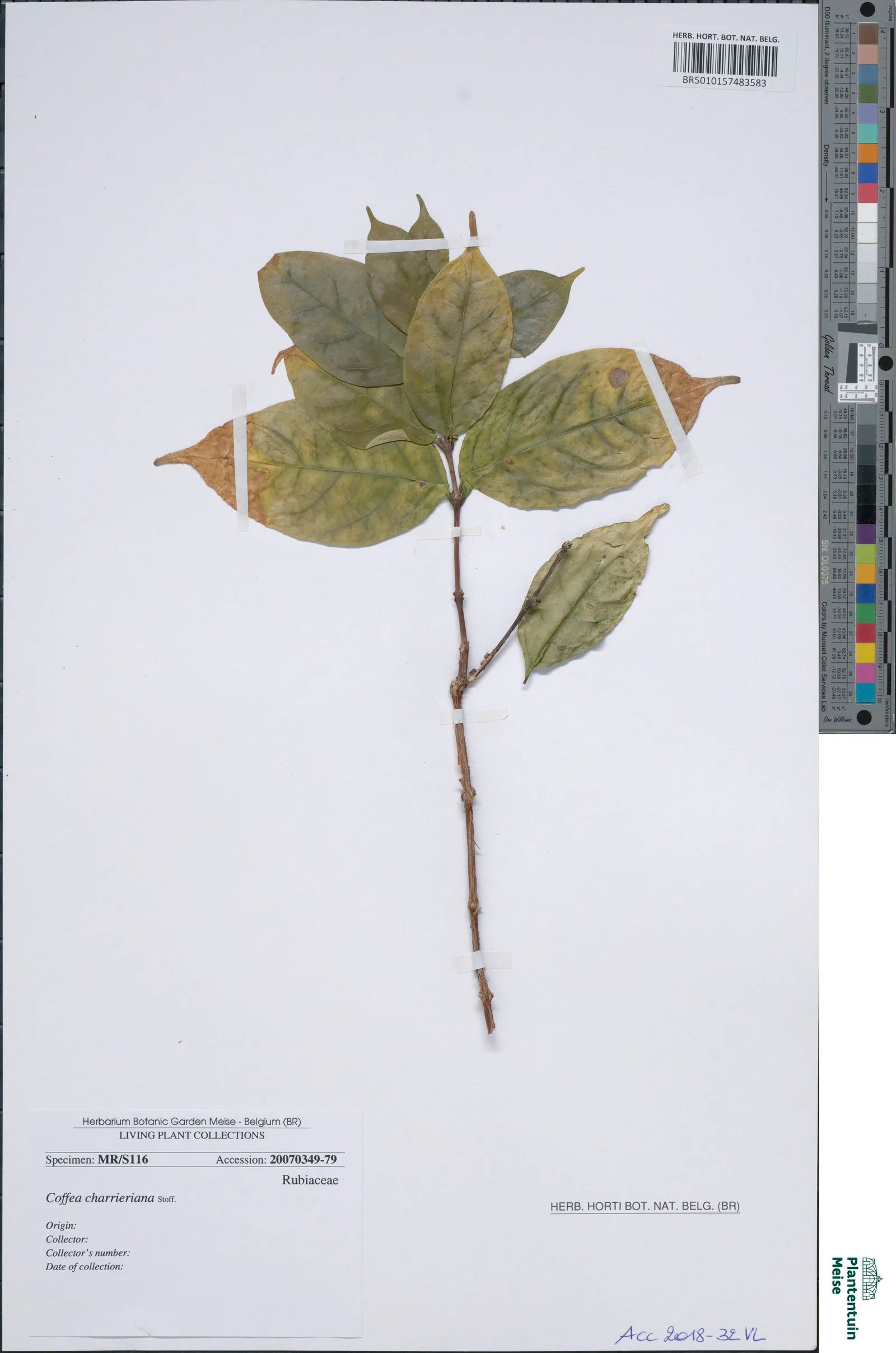
| Mascarocoffea (18 spp.), C. charrieriana, C. pseudozanguebariae | 0 | Coste 1955; Stoffelen 2008 |
The orders of magnitude have been stable for a century. Ukers gives in 1922 an average of 1.5% of dry weight for arabica and 1.97% for C. canephora; the ITC's Coffee Guide (2021) gives 0.8-1.7% for arabica and 1.5-2.5% and more for canephora; the Ugandan canephora handbook (2019) compares 2.7% with 1.5%; Yang (2026) narrows arabica to 0.85-1.15%. Liberica stands, according to commercial pages, around 1.2-1.5%, a figure of weak evidence for lack of a peer-reviewed source. Coste wrote in 1955 that the seeds of the section Eucoffea contain 0.5 to 2% caffeine and that the content varies with soil and climate; Yang confirms this instability: caffeine falls with altitude in Ethiopia and rises in Costa Rica, a contradiction that the authors attribute to cultivar, local climate and even slope orientation. A washed coffee contains slightly more caffeine than a natural, according to the same review.
Ukers 1922, ch. XVIII, table II; ITC, The Coffee Guide, 4th ed. (2021), pp. 9-10, via digest; UCDA, Robusta Coffee Handbook (2019), p. 4; Coste 1955, pp. 20-22; Yang et al. 2026, pp. 3-4, 8-9, via digestSome coffee plants do not make any. Coste places in the section Mascarocoffea eighteen Malagasy and Mascarene species devoid of caffeine; Ukers already cites in 1922 C. mauritiana at 0.07% and C. humboldtiana at zero, but with a bitter principle, cafamarine, which makes the brew undrinkable, and reports that Willcox, analyzing wild coffees of Madagascar, found none free of caffeine. In continental Africa, C. pseudozanguebariae (Kenya) is caffeine-free, and Coffea charrieriana, collected in 1983-1985 in the Bakossi forest reserve in Cameroon and described in 2008 by Stoffelen and Anthony in the Botanical Journal of the Linnean Society, is the first caffeine-free species known from central Africa; it is classed as critically endangered, known from a single locality.
Ukers wondered in 1922 why the trade had not taken advantage of these species or selected lines low in caffeine; a century later the question is still open, because these species cross poorly with arabica and their cup has never convinced.
Coste 1955, pp. 20-22, via digest; Ukers 1922, ch. XV (pp. 131-148) and ch. XVIII; Stoffelen et al., A new caffeine-free coffee from Cameroon, Bot. J. Linn. Soc. 158 (2008), pp. 67-72; Wikipedia, Coffea charrieriana, accessed on 09/07/2026Only one cultivated variety is naturally low in caffeine: Laurina, or Bourbon Pointu. It escapes the problem just described. It is not another species but a mutation of Bourbon: an ordinary arabica, one copying accident away.
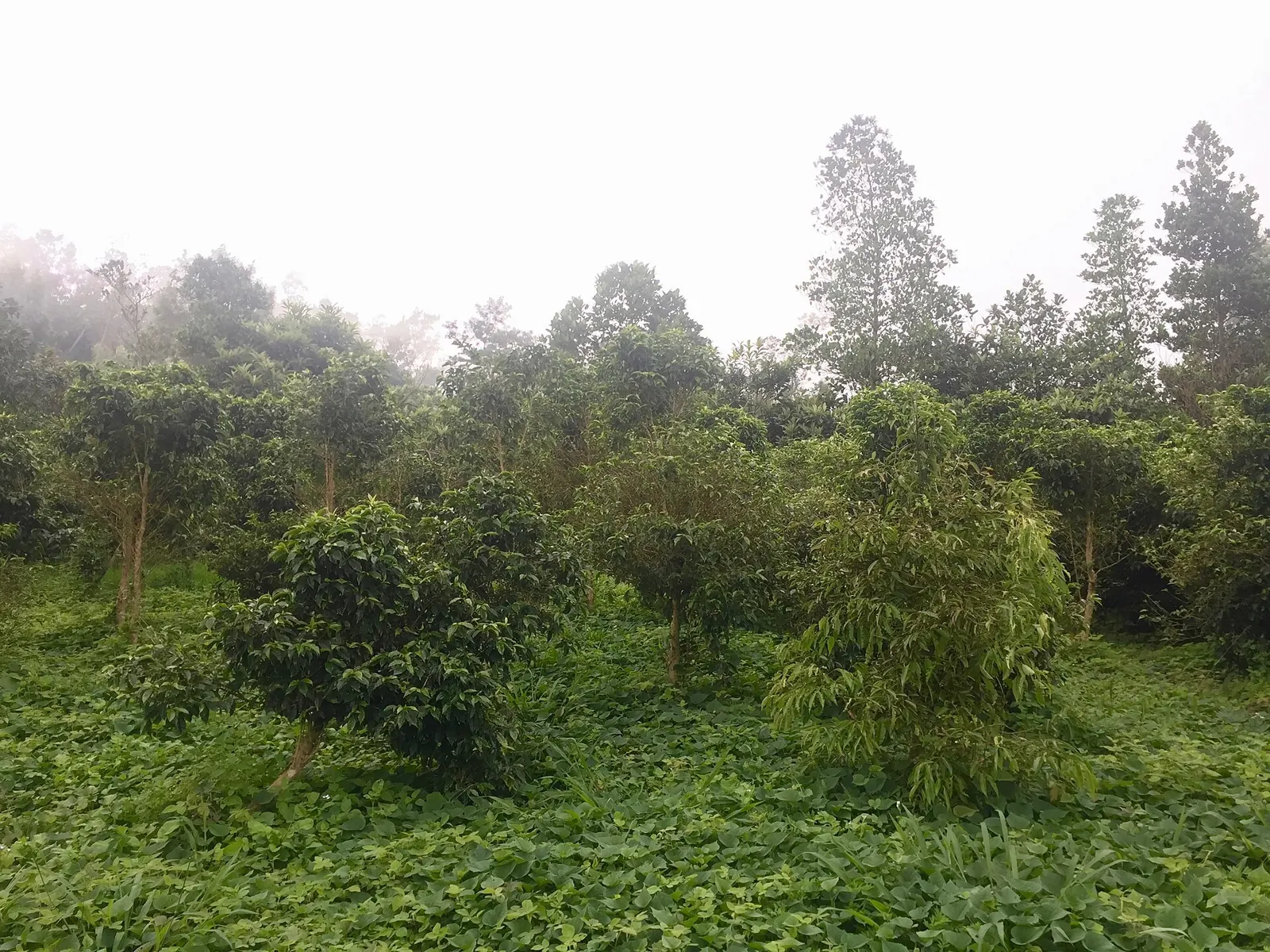
The mutation was spotted around 1810 in Réunion, and was first known by the name of the planter who isolated it, “Le Roy”. The tree is smaller than Bourbon. The foliage resembles laurel, the cherries and beans are elongated to a point: these are the two traits that earned it its two names. Caffeine stands, according to analyses, between 0.4 and 0.75% of dry weight, about half that of an ordinary arabica.
Laurina nearly disappeared in the 20th century. It was found again on the island in 1999 by Yoshiaki Kawashima, head of agronomic research at UCC in Japan, who financed its revival. It is sold today among the most expensive coffees in the world, and is also grown in Brazil, El Salvador and Colombia.
This low caffeine is paid for in vigor: the tree is fragile, low-yielding, susceptible to rust. The sources cited here do not establish the causal link between the two, but the fact itself is constant. It is enough to explain the price, and to explain why the variety has remained a curiosity. A fragile, low-yielding coffee plant will not replace industrial decaf. See the variety sheet for the genealogy.
Musées de la Réunion, Une histoire du café Bourbon pointu; Perfect Daily Grind, What is Laurina coffee?, 04/2022; Royal Coffee, Bourbon's botanical origins and the evolution of Laurina; levels: commercial pages, weak evidenceIn this plateThe 14 sections
- 01The molecule
- 02What it does for the plant
- 03Levels: species, varieties, caffeine-free coffee plants
- 04What it does to the body: pharmacology
- 05The genetics of the response
- 06How to read a coffee study
- 07Established, associated, unknown: organ by organ
- 08Sleep, pregnancy, thresholds
- 09How much is in the cup
- 10Three beliefs from 1685, and a fourth
- 11Decaf
- 12Instant coffee: from Kato to Nescafé
- 13Making instant coffee
- 14Today (2024-2026)
The table of contents, with the first sentence of each section