The molecule
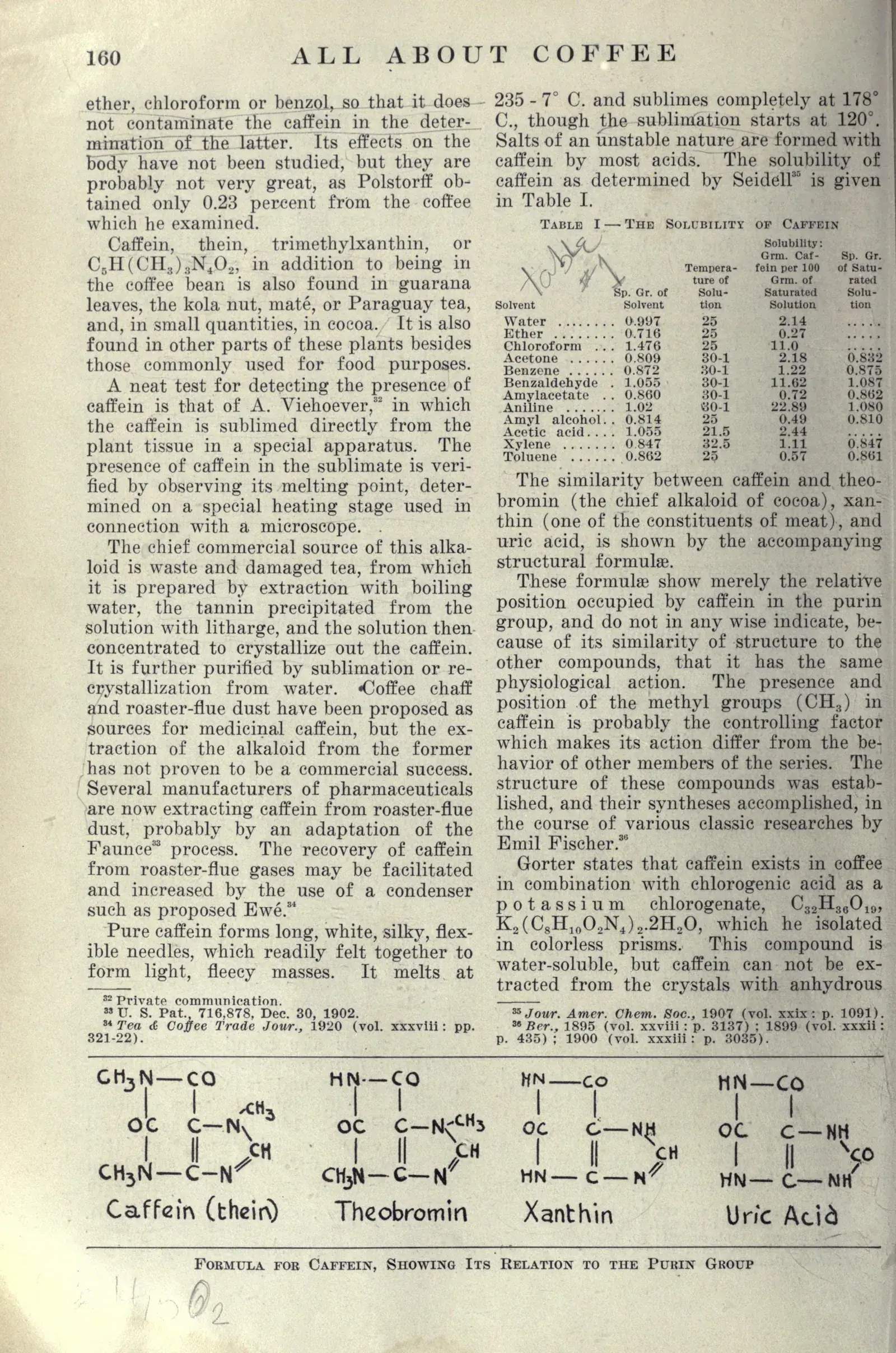
Caffeine is 1,3,7-trimethylxanthine, formula C₈H₁₀N₄O₂, an alkaloid of the purine group, related to the theobromine of cocoa (dimethylxanthine) and the theophylline of tea. It was isolated from coffee in 1819-1820 by the German chemist Friedlieb Ferdinand Runge; the training documents give 1820, the year of publication. During the 19th century it was found in tea (where it was first called theine), guarana, kola nut and maté: it is the same molecule everywhere.
Pure, it forms long, silky white needles, melts at about 235 °C, sublimes from 140 °C, and dissolves well in hot water, little in alcohol, very little in ether. Ukers reports in 1922 that, according to Gorter, the caffeine of the green bean is not free but bound to chlorogenic acid in a water-soluble complex, hence the difficulty of extracting it with organic solvents as long as this complex has not been dissociated: the whole history of decaffeination comes down to this chemical detail.
Ukers 1922, ch. XVIII (pp. 174-188); professional training document, Caffeine and decaffeination processes, p. 2; LC ch. 19Ukers also describes the first measuring tools: the Viehoever test, which sublimes caffeine directly out of the plant tissue in a small apparatus and identifies its crystals under the microscope, and the gravimetric assays by chloroform extraction that feed his tables II and III. He notes that in 1922 manufacturers were already recovering caffeine from the dust in roaster chimneys. Today the content is measured by high-performance liquid chromatography (HPLC) with ultraviolet detection at 272-280 nm; the ISO 20481 (2008) standard sets the method for green, roasted, instant and decaffeinated coffee, with hot-water extraction and an internal standard. It is this method that the technical sheets of decaffeination companies cite when they announce 99.9% of the caffeine removed.
Ukers 1922, ch. XVIII, tables II and III; ISO 20481:2008, Coffee and coffee products, determination of caffeine content by HPLCIn this plateThe 14 sections
- 01The molecule
- 02What it does for the plant
- 03Levels: species, varieties, caffeine-free coffee plants
- 04What it does to the body: pharmacology
- 05The genetics of the response
- 06How to read a coffee study
- 07Established, associated, unknown: organ by organ
- 08Sleep, pregnancy, thresholds
- 09How much is in the cup
- 10Three beliefs from 1685, and a fourth
- 11Decaf
- 12Instant coffee: from Kato to Nescafé
- 13Making instant coffee
- 14Today (2024-2026)
The table of contents, with the first sentence of each section