ATLASYemen
about 27,000 tonnes (FAOSTAT 2024, imputed value)In-depth dossier, atlas 2026In-depth dossier: the FAOSTAT series set against other figures, the history, today's industry and its gray areas, with numbered sources. Region: Asia.
Yemen had only a statistical reference point. This dossier completes it: the history of the sector, what it is today, and what remains uncertain, each paragraph referring to its sources, numbered at the bottom of the page.
The FAOSTAT series remains displayed as is. The dossier says what it is worth, year by year when possible, and compares it with the other figures available.
- Geographic status
- country
- Name in FAOSTAT
- Yemen
- Latest value
- about 27,000 tonnes in 2024
- Nature of the value
- value imputed by the receiving organization
- Start of the positive series
- 1961
- Series maximum
- 41,933 tonnes in 2021, figure from an external organization
Confirmed coverage: FAOSTAT series, and a dossier of 15 sources that draws together the history, today's industry and what remains uncertain.
History
Yemen is not the coffee tree's country of origin. Coffea arabica grows wild in the forests of southwestern Ethiopia and on the Boma Plateau in South Sudan; Yemen is its main center of domestication, that is, the place where the wild plant became a crop. The date of this transition remains vague. Ukers cites authors who trace it back to 575, without following them, and sees intensive cultivation only in the 15th and 16th centuries. McCook also places the beginning of cultivation in the 15th or 16th century and reports, from the anthropologist Daniel Varisco, that the coffee tree supposedly arrived from Ethiopia at the same time as qat, the country's other stimulant plant. The Arabic texts reported by Ukers link the use of the drink to the Sufi brotherhoods of Aden around 1454 [10][12][14]
For nearly two centuries, Yemen is the only country that grows coffee for trade. The Ottomans, who conquer the country in the late 1530s, make it a source of state revenue; the Qasimite imams, who drive them out in 1635, continue to sell to the Ottoman cities and levy, according to the historian Nancy Um cited by McCook, a quarter of the sale price. Ukers reports that the beans left the country only scalded or roasted, so that they could no longer germinate. In the 18th century, Yemen exports, according to McCook, between 12,000 and 15,000 tonnes a year. The port of Mocha, on the Red Sea, gives its name to the coffee without ever having produced any: in 1922, Ukers calls it commercially unimportant, Aden and Hodeidah having taken over [12][14]
The market that La Roque describes at close range is that of Bayt al-Faqih, La Roque's “Betelfaguy,” three leagues from the mountains from which the coffee comes down, where the merchants of Saint-Malo, arriving by sea in the early 18th century, set up a trading house. The account published in 1716 describes a bazaar held every day except Friday, where customs officers note the weight and price of each sale in order to levy the king's tax, paid by the seller alone. The peasants, La Roque notes, do not bring their coffee when the price does not suit them. Merchants from Egypt and Turkey load two bales of 270 pounds per camel toward a small Red Sea port. This monopoly was only a de facto one: it crumbles as soon as the Dutch, then the French, have the plant grown in Java, in Bourbon and then in the Antilles, between the end of the 17th century and the 1720s [11][13][14]
What the world took from Yemen amounts to few seeds. The 2025 World Coffee Research catalog describes two departures. The first leads to India at the end of the 17th century; the catalog attributes it to Baba Budan and dates it to 1670, whereas Ukers gave 1600, or 1695 according to an authority he judged better. The second leads to Bourbon Island, where the French attempt three introductions, in 1708, 1715 and 1718. From there come the Typica and Bourbon lineages, that is, the base of most arabicas grown outside Ethiopia. McCook notes one consequence: coffee leaf rust, Hemileia vastatrix, did not take hold in this dry country without humid forest, and the botanist Pierre Sylvain found no trace of it in the 1950s. The plants that left Yemen were healthy, but without any resistance [11][12][14]
In 1922, Ukers finds no production statistics. He cites the estimate of the oldest merchant of Aden, 45,000 bags of 176 pounds per year, or about 3,600 tonnes (calculation made here). The same work shows that more than half the coffee shipped from Aden comes from elsewhere: in 1917-1918, the port receives the equivalent of 2,800 tonnes from Ethiopia through Djibouti against 3,000 tonnes from Mocha and Jizan. The name Mocha then designates a transit port as much as a terroir. The trade sells the coffee under district names, Yafei, Anezi, Mattari, Sanani, Sharki or Haimi-Harazi for the best. The 2005 USAID report claims that before the end of the 1940s the country exported 12,000 tonnes or more per year, without saying where this figure comes from [6][12]
The FAOSTAT series begins in 1961 at 6,300 tonnes, oscillates between 3,800 and 7,500 tonnes until 1990, then exceeds 10,000 tonnes from 1996. It jumps from 11,331 tonnes in 2005 to 17,292 in 2006, a rise of 53% in one year that comes mainly from the yield, which went from 393 to 536 kg per hectare; USAID noted at the end of 2005 that a 2004 census had just corrected the estimates for several provinces. The last official figure, flagged A, is that of 2019: 20,812 tonnes on 34,981 hectares. From 2020 to 2023, FAO publishes only unofficial figures taken from another organization (flag X), then an imputed value for 2024 (flag I), 26,544 tonnes. The maximum of the series, 41,933 tonnes in 2021, is not a harvest: it is an unofficial value computed with a yield of 1,125 kg per hectare, double that of the previous year, fallen back to 23,945 tonnes the following year [1][6]
Today
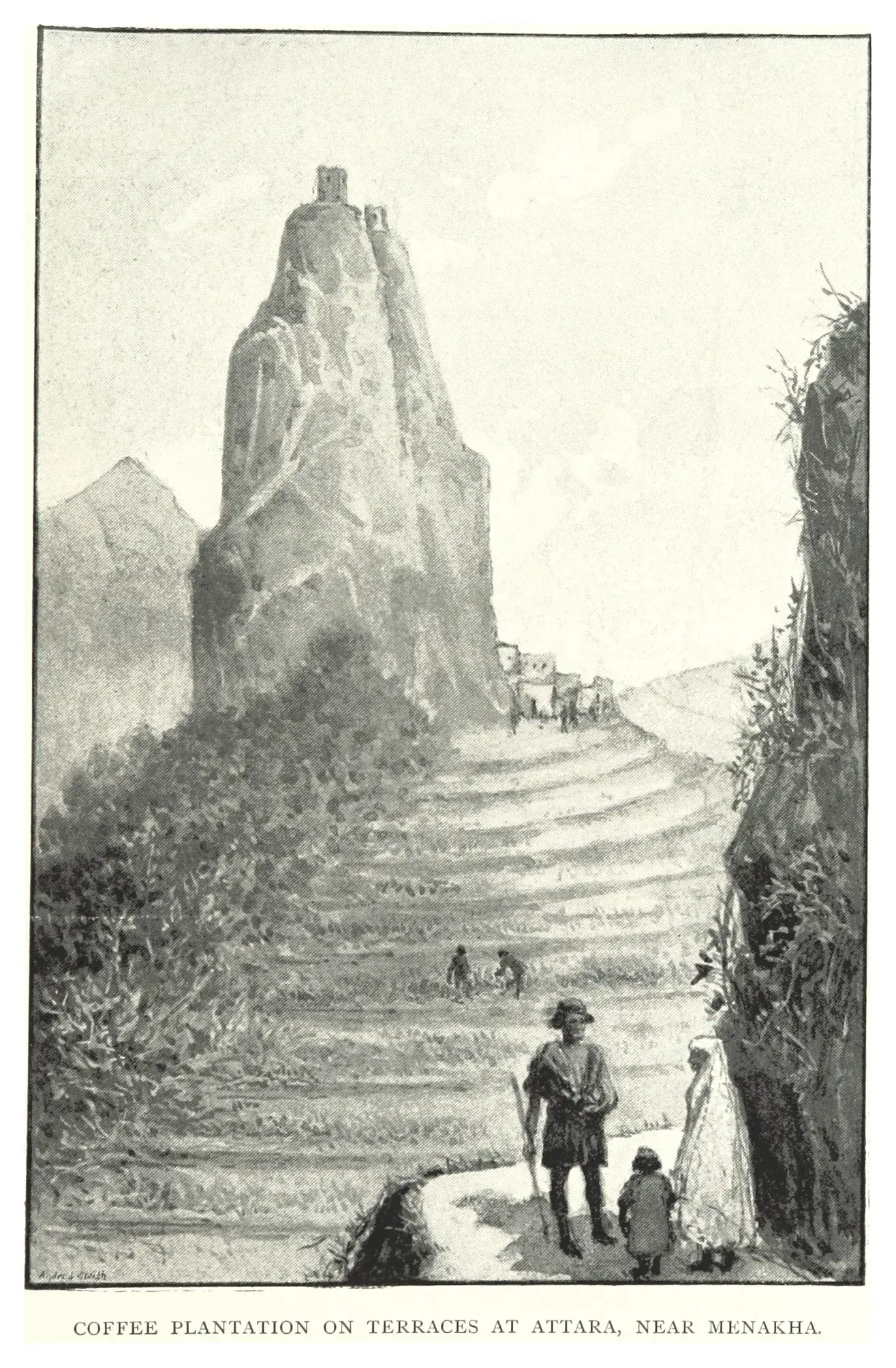
Coffee grows on the western slopes of the highlands, on terraces held up by stone walls or at the bottom of narrow valleys. In 2005 USAID placed more than 95% of production in ten western provinces; FAO and the International Finance Corporation (IFC) count fifteen producing ones in 2023. The survey by Montagnon and his coauthors, conducted in 2020 among 148 farms, covers five governorates: Ibb, Raymah and Dhamar in the south, Al Mahwit and Sanaa in the north. Ukers already named the same axes in 1922, between Taiz, Ibb, Yarim and Sanaa, and on the road from Hodeidah to Sanaa via Manakha. The altitudes cited range from about 1,000 meters, a floor noted by Sylvain in the 1950s, to 2,500 meters for the Bura'i type [6][7][10][12][14]
Growers name their trees Udaini, Tufahi, Dawairi, Bura'i, Jaadi or Buna, and USAID assigns them different altitude bands, Dawairi up to 1,700 meters, Udaini and Tufahi up to 2,000. Montagnon and his coauthors compared these names in 2022 with the genetics of 88 trees, typed by microsatellites, that is, by short repeated DNA sequences that serve as a fingerprint. The names follow geography, not genetics: among the trees called Udaini, 67% belong to the New-Yemen group, 19% to the Typica-Bourbon group and 14% to the SL34 group. These three groups had been described in 2021 by the same team, from 45 Yemeni trees compared with 72 Ethiopian accessions and 20 varieties cultivated elsewhere; the New-Yemen group has been found only in Yemen. The 2025 World Coffee Research catalog contains no Yemeni variety profile [6][9][10][11]
Yemeni coffee is almost entirely processed by the dry process: the whole cherry dries in the sun, most often on the flat roofs of houses, then the dried fruit is hulled to separate the bean. USAID noted in 2005 that space is lacking, that cherries are piled in several layers and rarely turned, which lengthens drying and favors mold and fermentations. Picking is by hand, in three to five passes per tree. The United Nations Development Programme (UNDP) places flowering in February and March and the harvest from October to December, sometimes until January, with a peak in sales from November to January [6][8]
Farms are tiny: 0.291 hectare and 394 coffee trees on average, for 114 kg of coffee per family, according to the UNDP figures taken up by FAO and the IFC. The 2000 census counted 99,056 producing households. The direct competitor is qat (Catha edulis), a shrub whose leaves are chewed for their stimulant effect. In 2005 USAID attributed to it more than 120,000 hectares against fewer than 30,000 for coffee; in 2022 the UNDP cites the official figures of 166,745 hectares of qat against 32,984 of coffee, or about 15% of agricultural land and nearly 40% of irrigation water for qat. FAO and the IFC add that any coffee land can carry qat, the reverse not being true [6][7][8]
The war that opened in 2015 cut the coffee administration in two. In the north, two bodies manage the sector, the General Coffee Authority of the Ministry of Agriculture and a coffee unit attached to the High Agricultural Commission of Ansar Allah, which requires two certificates to export; in the south, the Ministry of Agriculture has no equivalent body. The country has two central banks and two exchange rates. Trucks pass through checkpoints, driving at night is dangerous, and the embargo imposed by neighboring countries weighs on inputs as on exports; Aden has kept its port and airport open. Yemen signed the International Coffee Agreement of 2007 and joined the ICO in 2008, but according to FAO and the IFC it is not active there and does not pay its dues. Saudi Arabia remains the leading customer, with 63% of exports by value in 2019, out of a total of about 20.2 million dollars [5][7]
Ukers wrote in 1922 that Yemenis do not drink the bean but kisher, a decoction of the dried husks of the cherry, so that the whole harvest went for export. That is no longer the case: FAO and the IFC estimate that about 40% of the coffee stays on the domestic market. Qishr, the other name for kisher, has itself become an export commodity, about 1,200 tonnes in 2019 for 2.5 million dollars, of which 2.2 million went to Saudi Arabia [7][12]
- Species grown
- Coffea arabica, local populations [6]
- Growing altitude
- about 1,000 to 2,500 m [6]
- Harvest
- October to December, sometimes January [8]
- Processing
- dry process, whole cherry dried on roofs [6]
- Last official production (FAOSTAT)
- 20,812 t in 2019, on 34,981 ha [1]
- Production according to the ICO
- 91,000 bags of 60 kg in 2019/20 [2]
- Average farm
- 0.291 ha and 394 coffee trees [7]
- Leading customer
- Saudi Arabia, 63% of exports by value in 2019 [7]
Gray areas
No one knows how much Yemen produces. For the 2019/20 crop year, the ICO counts 91,000 bags of 60 kg, or 5,460 tonnes, whereas FAOSTAT gives 20,812 tonnes for 2019: nearly four times more. The ICO series has its own breaks: from 57,000 to 69,000 bags a year from 1998/99 to 2002/03, or 3,400 to 4,100 tonnes, an order of magnitude close to the official exports of the time, then 193,000 bags in 2003/04, the FAO figure, which the ICO then took over for this non-member country. The two series then part ways at the jump of 2006, which FAO kept and the ICO did not follow: around 200,000 bags, about 12,000 tonnes, from 2004/05 to 2007/08. The ICO still estimated average production at 250,000 bags in 2008, and the 2021 ITC guide gave 106,000 and 100,000 bags for 2018 and 2019, which the ICO tables bring down in 2024 to 86,000 and 91,000. Since 2020, FAOSTAT no longer publishes an official figure; the 2021 peak and the imputed value of 2024 are not to be read as harvests. The UNDP acknowledges it: no independent source allows a reliable estimate of coffee and qat areas [1][2][3][4][5][6][8][15]
The 2023 FAO and IFC report, the most recent source on the sector, contradicts itself on the essentials. It writes that about 60% of green coffee is exported, then that less than a quarter is, 3,600 tonnes out of 21,000 in 2019. It reports exports going from 44,000 to 75,000 tonnes between 2000 and 2005, more than the production given by any source, puts the country's share of world production at 0.0000021% and gives 21,639 tonnes for 2021 when FAOSTAT publishes 41,933. Its area and production for 2019 are those of the ministry, which FAOSTAT also takes up: the agreement between the two is therefore circular. For the past, the orders of magnitude do not agree either: USAID puts forward 12,000 tonnes exported per year until the 1940s, whereas the estimate cited by Ukers in 1922 places production around 3,600 tonnes [1][6][7][12]
The genetics of Yemeni coffee rests on two studies by the same team, funded by Qima Coffee, a company that sells Yemeni coffee and with which two of the authors of the first are affiliated, then by the Qima and Lavazza foundations. The authors declare no conflict of interest and share their data only on request. The result does not thereby become suspect, but no independent study reproducing it was found in the sources consulted, and 45 trees from a selection population do not sum up a country. The climate is no better fixed: less than 400 mm of rain per year according to Montagnon, 455 to 1,500 mm according to USAID, 800 to 2,000 mm during the rainy season according to McCook. Finally, the dates of the coffee tree's arrival, from the 6th to the 16th century, and that of the departure of seeds to India, 1600, 1670 or 1695, depend on the authors who write them rather than on dated documents [6][9][10][11][12][14]
Not covered: No reliable production or export figure after 2020: FAOSTAT publishes only unofficial or imputed values, the ICO tables consulted stop at the 2020/21 crop year, more recent files not having been found on the organization's new site, and the FAO-IFC report of 2023 contradicts itself. No export volume series drawn from a trade database (Comtrade, ITC Trade Map), for lack of a search quota and because the flows pass through Saudi Arabia and the Emirates without being declared as Yemeni. No primary source on the technical parameters of drying (duration, thickness, final moisture). The thesis by Greeney (Harvard, 2022), which compares the FAO and ICO estimates, could not be read (repeated 429 error) and is not cited. The role of the specialty traders established since 2015 is not covered, for lack of a source other than their own communication.
- Production: Crops and livestock products, Coffee, green (656), Yemen: production, harvested area, yield, with their flags, FAO, FAOSTAT, 2025, https://bulks-faostat.fao.org/production/Production_Crops_Livestock_E_ solid level
The 1961-2024 series and the flag of each year: X (unofficial figure from another organization) for 1961-1969, 1982-1983 and 2020-2023, A (official) for the other years through 2019, I (imputed) for 2024; area and yield, including the yield of 1,125 kg/ha that produces the 2021 peak. File of the 12/23/2025 release, read locally. - Total production by all exporting countries, crop years 1990/91 to 2019/20 (table 1a), International Coffee Organization (ICO), 2024, http://web.archive.org/web/20240415232356/https://ico.org/historical/1 solid level
Production of Yemen in thousands of 60 kg bags: 0 from 1990/91 to 1997/98, 57 to 69 from 1998/99 to 2002/03, 193 in 2003/04, 198 to 207 from 2004/05 to 2007/08, 220 in 2008/09, 178 in 2014/15, 86 in 2018/19, 91 in 2019/20. Read in the archive capture of 04/15/2024, the original address returning a 404 on 10/21/2026. - Crop year production by country (Table 1), International Coffee Organization (ICO), 2024, http://web.archive.org/web/20240724002100/https://www.ico.org/prices/p solid level
Yemen: 132, 86, 91 and 100 thousand bags for the crop years starting in 2017, 2018, 2019 and 2020. Archive capture of 07/24/2024. - Coffee production in countries which are not Members of the International Coffee Organization (EB 3869/04), ICO, Executive Board, 2004, https://ico.org/documents/eb3869e.pdf solid level
In 2004, Yemen is not a member; the ICO attributes to it 191,650 bags in 2003/04 and 123,516 in 1990/91, on 33,545 ha, figures taken from FAO (identical to FAOSTAT 1990 and 2002). - Signature of the International Coffee Agreement 2007 (PR 271), ICO, 2008, https://ico.org/documents/pr271e.pdf solid level
Yemen signs the International Coffee Agreement of 2007 before 08/31/2008; the ICO estimates its average annual production at about 250,000 bags of 60 kg. - Moving Yemen Coffee Forward: Assessment of the Coffee Industry in Yemen to Sustainably Improve Incomes and Expand Trade, USAID, report written by ARD Inc. (D. Giovannucci et al.), 2005, http://web.archive.org/web/20111023212240/http://pdf.usaid.gov/pdf_doc solid level
99,056 producing households (2000 census); more than 95% of production in ten western provinces; qat on more than 120,000 ha against fewer than 30,000 for coffee; drying on roofs, three to five picking passes; altitudes by local type; official exports of about 3,000 t; country not a member of the ICO in 2005. Read in an archive capture, pdf.usaid.gov no longer responding on 10/21/2026. - Coffee value chain in Yemen: export potential and investment opportunities, FAO and IFC (H. Fathallah, A. Al-Najjar, J. Santos Rocha), 2023, https://yemen.un.org/sites/default/files/2025-03/FAO%20Yemen%20-%20Cof solid level
Organization of the sector after 2015 (divided administration, certificates, transport, embargo, port of Aden), ICO membership in 2008 without activity, farm structure, 2019 exports and Saudi share, qishr exports. Several figures in the same report contradict each other (see gray areas): it is cited for the facts of organization, not for volumes. - Qat and Coffee Value Chain Analysis in Yemen, UNDP Yemen (K. Khan, A. G. Al-Kirshi), 2022, https://www.undp.org/sites/g/files/zskgke326/files/2022-08/VC%20Analys solid level
Flowering and harvest calendar; official areas of 166,745 ha of qat and 32,984 ha of coffee; share of qat in agricultural land and in irrigation water; admission that no independent source allows these areas to be estimated. - Unveiling a unique genetic diversity of cultivated Coffea arabica L. in its main domestication center: Yemen, C. Montagnon, A. Mahyoub, W. Solano, F. Sheibani, Genetic Resources and Crop Evolution 68 (2021), pp. 2411-2422, 2021, https://doi.org/10.1007/s10722-021-01139-y solid level
137 samples, including 45 Yemeni trees from the Qima selection population, 72 Ethiopian accessions and 20 cultivated varieties; five genetic groups, including a New-Yemen group specific to Yemen. Funding: Qima Coffee. - Vernacular Names and Genetics of Cultivated Coffee (Coffea arabica) in Yemen, C. Montagnon, V. Rossi, C. Guercio, F. Sheibani, Agronomy 12 (2022), 1970, 2022, https://doi.org/10.3390/agronomy12081970 solid level
2020 survey of 148 farms in five governorates, 88 trees genotyped; no significant association between local name and genetic group; Yemen the main domestication center; rainfall below 400 mm per year. Funding: Qima and Lavazza foundations. - Coffee Varieties Catalog, revision of September 4, 2025, World Coffee Research, 2025, https://worldcoffeeresearch.org/resources/coffee-varieties-catalog solid level
History of the Typica and Bourbon lineages (pp. 9-10): departure for India attributed to Baba Budan in 1670, three introductions to Bourbon in 1708, 1715 and 1718; no Yemeni variety profile in the catalog. - All About Coffee, William H. Ukers, The Tea and Coffee Trade Journal Company, 1922, https://www.gutenberg.org/ebooks/28500 solid level
Early cultivation and departures of seeds (p. 5 from the index), areas and altitudes, terraces, kisher (ch. XX, pp. 230-231), estimate of 45,000 bags of 176 pounds and origin of the coffee re-exported through Aden in 1916-1919 (ch. XXII, p. 282 from the index), trade names and grades (ch. XXIV, p. 351), Baba Budan 1600 or 1695. - A Voyage to Arabia Felix through the Eastern Ocean and the Straits of the Red-Sea (English translation of the Voyage de l'Arabie heureuse, 1716), Jean de La Roque, 1732, https://archive.org/details/voyagetoarabiafe00laro solid level
The market of Betelfaguy (Bayt al-Faqih) around 1712: daily bazaar except Friday, king's tax paid by the seller, peasants who hold back their coffee when the price does not suit them, two bales of 270 pounds per camel (pp. 103-106 of the 1732 edition). - Coffee Is Not Forever: A Global History of the Coffee Leaf Rust, Stuart McCook, Ohio University Press, 2019, https://ohioopen.library.ohio.edu/oupress/96/ solid level
Cultivation in Yemen from the 15th-16th centuries, simultaneous arrival of qat according to Varisco, Ottoman conquest, Qasimite imamate and its share of the price, exports of 12,000 to 15,000 t in the 18th century, absence of rust noted by Sylvain, cultivation from 1,000 m (pp. 23-25). - The Coffee Guide, 4th edition, table 5, International Trade Centre (ITC), 2021, https://www.intracen.org/resources/publications/the-coffee-guide-fourt solid level
Production of Yemen according to the ICO, in thousands of bags: 178, 156, 143, 132, 106 and 100 for 2014 to 2019 (p. 87), an earlier version than the revision published by the ICO in 2024.