ATLASLaos
174,900 tonnes (FAOSTAT 2024)In-depth dossier, atlas 2026In-depth dossier: the FAOSTAT series set against other figures, the history, today's industry and its gray areas, with numbered sources. Region: Asia.
Laos had only a statistical reference point. This dossier completes it: the history of the industry, what it is today, and what remains uncertain, with each paragraph pointing to its sources, numbered at the foot of the page.
The FAOSTAT series remains displayed as is. The dossier says what it is worth, year by year when possible, and compares it with the other figures available.
- Geographic status
- country
- Name in FAOSTAT
- Lao People's Democratic Republic
- Latest value
- 174,900 tonnes in 2024
- Nature of the value
- official figure
- Start of the positive series
- 1961
- Series maximum
- 183,895 tonnes in 2023
Confirmed coverage: FAOSTAT series, and a dossier of 15 sources that draws together the history, today's industry and what remains uncertain.
History
Laos does not appear in the library's old sources. Ukers, in 1922, nonetheless describes French Indochina in detail: first trials in 1887 near Hanoi with arabica seeds from Réunion, a 1916 census counting about a million bearing coffee trees in Tonkin, Annam and Cochinchina, with cultivation also cited in Cambodia. Laos is not named there even once. Thirty-three years later, Coste lists Laos among the highland zones where Coffea arabica is grown and cites a “Boloven agricultural station” devoted to that species. In between, cultivation was born on the Bolovens Plateau, a plateau of about 500 km² in the south of the country, between 600 and 1,300 meters of altitude [2][3][5].
The date of this birth varies with who tells it. The FAO manual of 2005 speaks of the “early 1900s,” the French Development Agency of the 1920s, a University of Bern compilation of 1920. The source closest to the facts is an article in L'Écho annamite of September 15, 1939: coffee growing on the plateau, “begun around 1925,” covered 2 hectares in 1931, 66 in 1936, 160 in 1937 and 400 in 1938, and production reportedly rose in eight years from one tonne to about 300 tonnes. Ukers's silence in 1922 fits better with an introduction in the 1920s than with one at the start of the century [2][4][5][10][11].
The impetus came from the colonial administration. The former agricultural service created an experimental station at the Bolovens, taken over by the Institute of Agronomic Research, which tried coffee, tea and cinchona there, then turned it into a colonization farm, that is, an estate responsible for training and settling colonists. The agricultural engineer Jean Forgemol, who entered the agriculture service in 1931, spent most of his career there and also headed the Bolovens coffee cooperative, equipped with a factory that received, dried, hulled and sorted the coffee from November to February. To hull, here, is to remove the parchment, the envelope that surrounds the bean. The cooperative bought the coffee of the “Kha,” the name the administration gave to the peoples of the highlands, and that of the small colonists, then sold it in Saigon under a registered trademark of “pure arabica.” The 1939 text notes that the cultivation of canephora, which had at first tempted local planters with its yield, had been “definitively abandoned” on the administration's advice, and that the “borer,” a boring insect, and hemileia, the fungus of orange coffee leaf rust, had been reported on the plateau [4].
Vietnam was present from the very beginning. The station develops its estate with “Annamite labor,” that is, Vietnamese in colonial parlance; the report of La Dépêche d'Indochine of December 1937 describes the ten-hectare plantation of an Annamite planter settled in Laos for more than thirty years, and the colonization plan of February 1939 reserves land for “Annamite immigration.” The coffee, for its part, goes down to Saigon. The war stopped this momentum: in 1945, French prisoners of the Japanese were housed in the coffee cooperative, near Paksong, before building their camp, and in 1947 the cooperative of French planters of the Bolovens, meeting in Saigon, put war damages on the agenda of its assembly. The sources consulted do not say what the following decades, the Indochina War then the American bombings from 1964 to 1973, did to the plantations [4][11].
The shift from arabica to canephora is dated by no source read. The FAO attributes it to arabica coffee leaf rust and the low prices of liberica, two species that were part of the first trials with canephora, and records the result in 2001: 34,000 hectares of coffee trees, 88% of them canephora and 12% arabica, grown by 23,000 families. The revival of arabica followed the New Economic Mechanism of 1986, the opening of the regime to the market economy. The French Development Agency financed from 1998 to 2002 a project on the plateau that promoted arabica and the wet process, and a new arabica variety, which the FAO manual identifies as Catimor, resistant to coffee leaf rust, was released on the Bolovens in the late 1990s [5][10][11].
The FAOSTAT series starts at 1,000 tonnes in 1961, rises to 3,500 tonnes in the mid-1960s, falls back to 1,800 tonnes in 1973 and in 1975, then climbs slowly: 10,020 tonnes in 1996, 23,500 in 2000, 46,290 in 2010. It then makes a jump that no source read explains, from 52,010 tonnes in 2011 to 87,330 in 2012, or 68% in a year, and peaks at 183,895 tonnes in 2023. The 2024 value, 174,900 tonnes, carries status A, official figure: it is the number the Lao State transmits. The trade portal of the Ministry of Industry and Commerce publishes the same values, to the tonne for 2014 and 2018, and the Bern compilation cites the Lao statistics bureau for 2010 and 2017. The series therefore says what the State declares, not what a third-party body measured, and that is where the country's main gray area lies [1][9][11].
Today
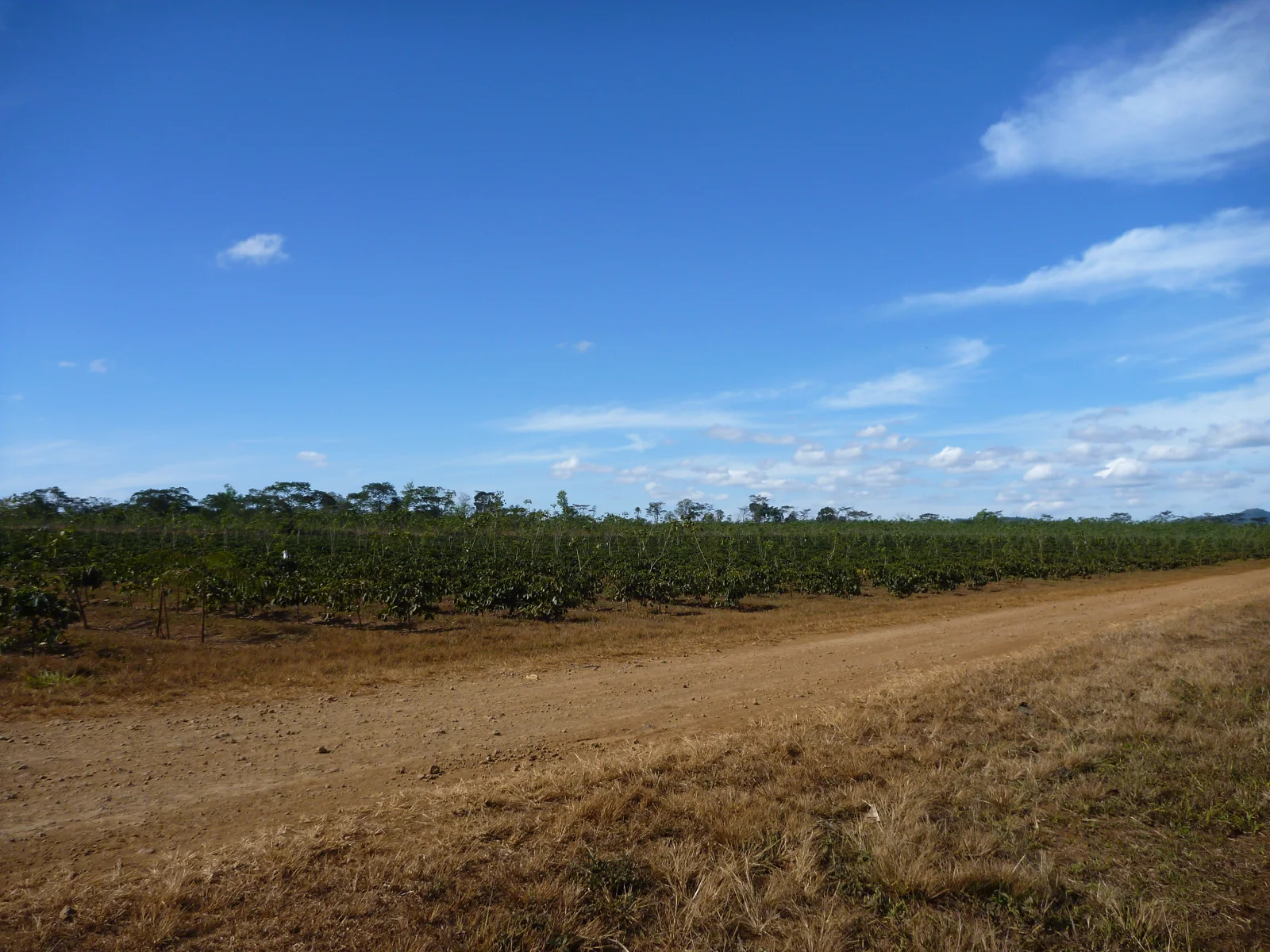
The Bolovens Plateau still supplies most of Lao coffee, about 95% according to the FAO in 2005. It extends over the provinces of Champassak, Salavan and Xekong, which had respectively 51,200, 24,000 and 13,370 hectares of coffee in 2018 according to the Ministry of Industry and Commerce, or 91% of the 97,400 hectares planted in the country. Paksong, the plateau's town, is at 1,200 meters. The ministry counts eleven coffee provinces and names several in the north, Phongsaly, Oudomxay, Houaphan, Luang Prabang and Xayaburi; the FAO reports arabica there without saying where. A cooperative supported by the United Nations Office on Drugs and Crime, Vanmai, helps villages move from opium to coffee [5][9][13].
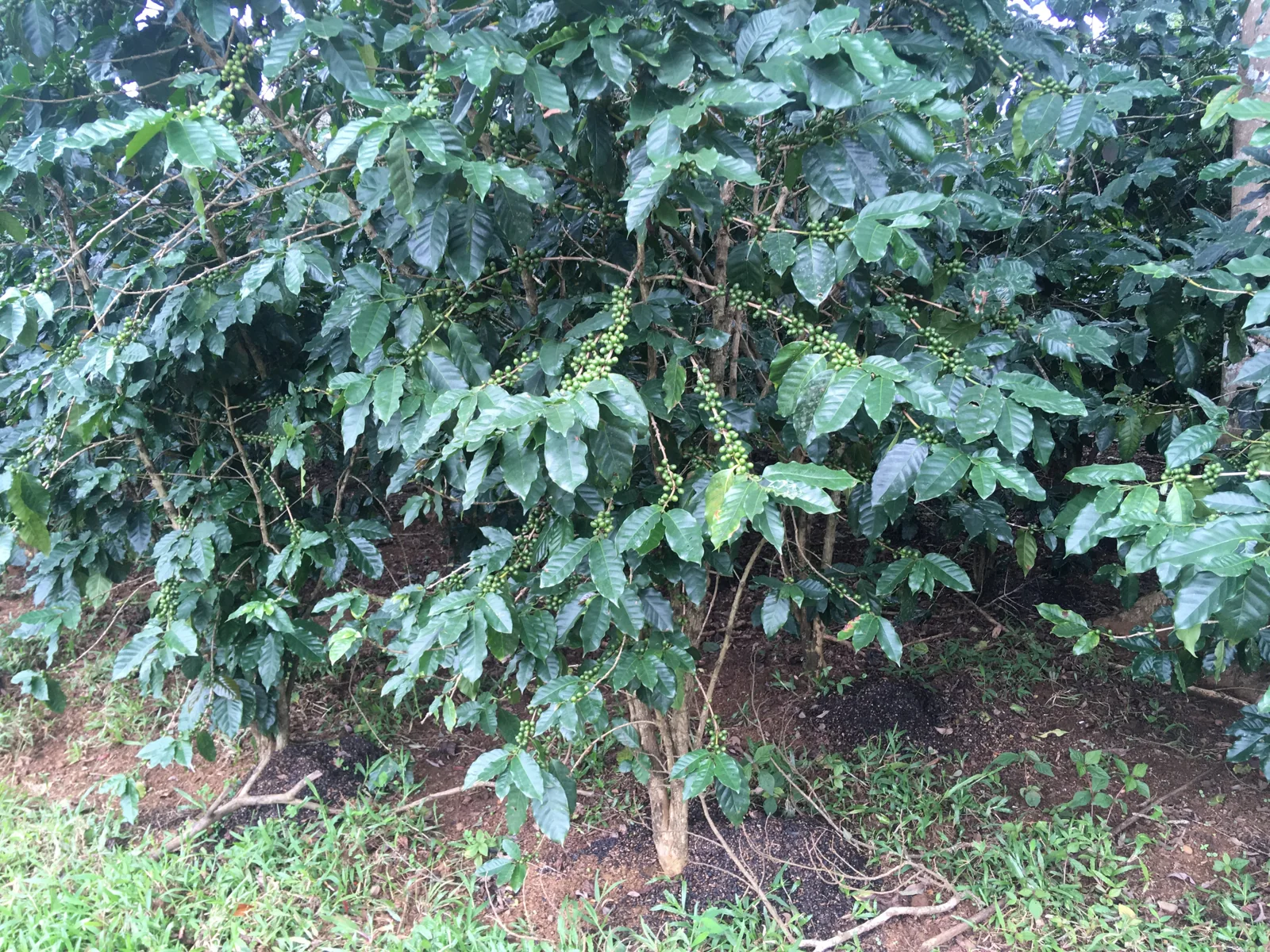
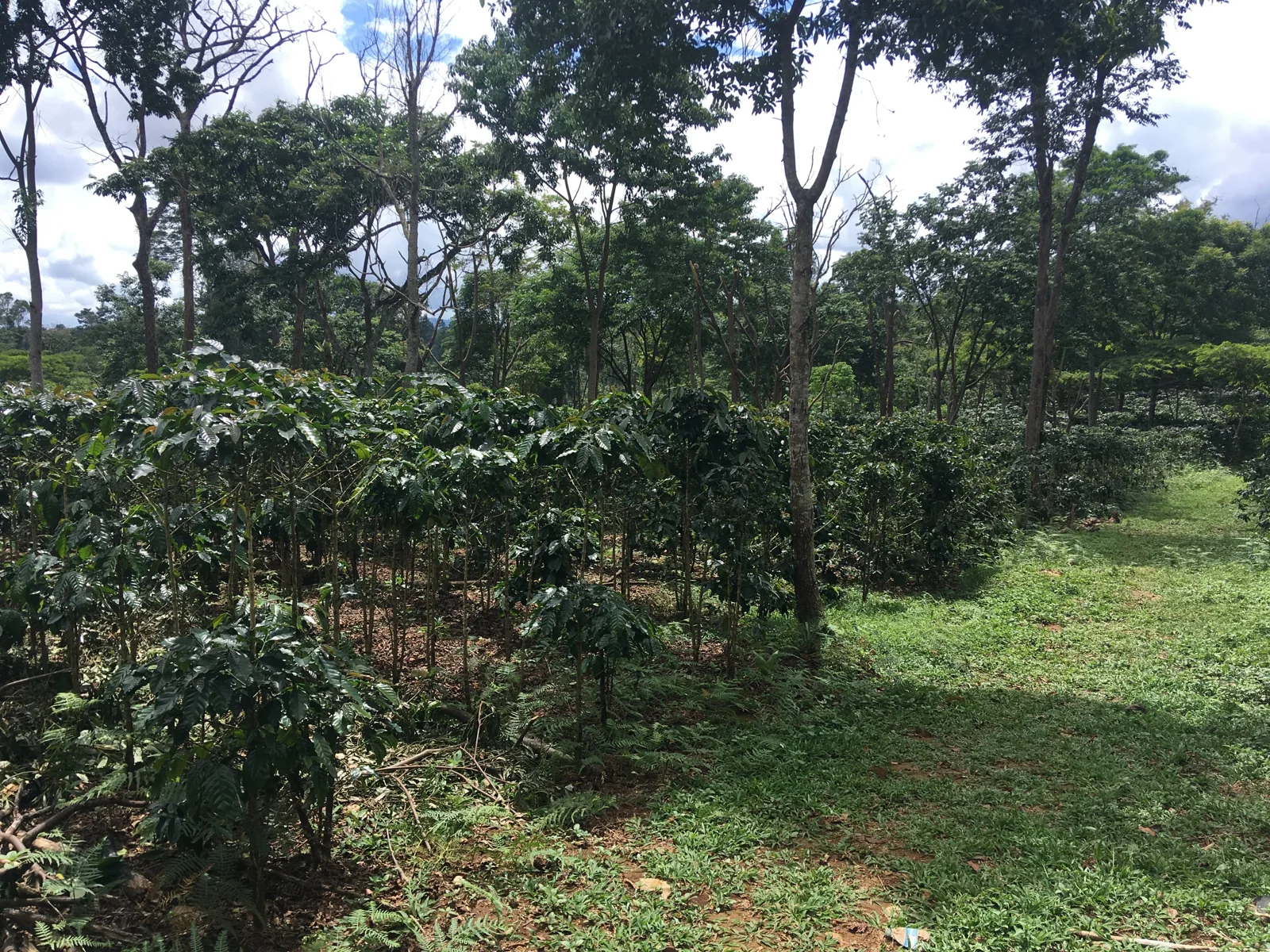
The country produces canephora first of all. The table of the International Coffee Organization taken up by the International Trade Centre classes it among producers of canephora only, and the same guide places it seventh in the world for that species in 2018-2019, with 503,000 bags of 60 kilos, behind Vietnam, Brazil, Indonesia, India, Uganda and Côte d’Ivoire. The World Coffee Research catalog of 2025 also cites it right after these six countries. Arabica, which according to the FAO needs more than 1,000 meters, occupies the upper parts of the plateau, but no recent source read quantifies its share: the last measurement found is that of 2001, 12% of the area [5][6][15].
Harvest runs from October to December for arabica and from December to February for canephora, according to the FAO manual, and the colonial factory of 1937 already ran from November to February. Most of the canephora is processed by the dry process, as whole cherries sun-dried for 18 to 20 days, a method the manual judges inexpensive but of low quality. Arabica goes through the wet process: pulping, fermentation, washing, then drying of the parchment in 9 to 10 days. The FAO recommended for Laos pulper-demucilagers, machines that remove the pulp then the mucilage, the sugary layer stuck to the parchment, with half a liter of water per kilo of cherry instead of 2 to 10 liters for a full wash [4][5].
The organization of producers takes up a colonial idea. A program of the French Development Agency gave rise in 2007 to the Association of Coffee Producer Groups of the Bolovens Plateau, which brought together 53 groups, then another project, run from 2010 to 2015, turned it in 2014 into a cooperative, the CPC, Coffee Producers Cooperative. The Bern compilation lists it among the southern cooperatives certified organic, which guarantee their members a purchase price. The RECoSeL program launched from 2017 to 2021 twenty-one sub-projects in eight provinces with the Ministry of Agriculture, and the State has given itself a coffee development strategy to 2025, completed in 2021 by an export roadmap prepared with the International Trade Centre. In October 2026, the French ambassador announced that Laos would become a member of the International Coffee Organization in 2027 [10][11][13][14].
Lao customs declare 35,887 tonnes of green coffee exported in 2023, for 89.5 million dollars, of which 22,525 tonnes to Vietnam, or 63%, and 6,986 tonnes to Thailand. Vietnam's share rose from 32% in 2015 to 72% in 2020; Japan, Belgium and Germany follow depending on the year with a few thousand tonnes at most. The Vientiane Times gave 56% for Vietnam in a 2022 article. The leading customer for Lao coffee is therefore the world's top producer of canephora, a neighbor of a landlocked country. The site keeps a trace of this in the China dossier, which imports canephora from Laos and Vietnam [8][12].
- Dominant species
- Coffea canephora, 88% of the area in 2001; no recent measurement of the share of arabica [5]
- Main area
- Bolovens Plateau, 600 to 1,300 m, about 95% of Lao coffee [5]
- Start of cultivation on the Bolovens
- Around 1925 according to the 1939 press; competing dates from 1900 to 1920 [4]
- Harvest
- Arabica from October to December, canephora from December to February [5]
- Official production 2024
- 174,900 t, status A (official figure) [1]
- Production estimated by the ICO
- 500,000 bags of 60 kg in 2019-2020, or 30,000 t [6]
- Green coffee exports 2023
- 35,887 t, of which 63% to Vietnam [8]
- Producer organization
- CPC, cooperative formed in 2014 from an association of 53 groups founded in 2007 [10]
Gray areas
The volume of Lao coffee is not known to better than a factor of five. For 2019, FAOSTAT gives 171,380 tonnes, official figure; the International Coffee Organization, for the crop year beginning in 2019, 500,000 bags of 60 kilos, or 30,000 tonnes; the US Department of Agriculture, 440,000 bags, or 26,400 tonnes. The gap grows over time: FAOSTAT was 3.4 times the ICO estimate in 2014 and 5.7 times in 2019. Exports lean toward the low estimates: 26,155 tonnes declared by Lao customs in 2019, when the US department estimates domestic consumption at only 100,000 bags, 6,000 tonnes. If the official figure were right, more than 130,000 tonnes of green coffee would remain in the country each year, neither drunk nor sold. Yields say the same: 150,800 tonnes on 93,300 hectares harvested in 2017 is 1.6 tonnes per hectare, against about 0.3 tonne with the ICO figure [1][6][7][8][11].
No source read explains this gap. The ministry's portal specifies that its 154,435 tonnes for 2018 are “green coffee.” One hypothesis comes to mind, which nothing consulted confirms: that the national figure adds up weights of coffee in cherry or in parchment, heavier than green bean, or that it extrapolates from planted areas. Articles repeat these figures without checking them and sometimes muddle them: the Vientiane Times of 2022 gives 77,540 “tonnes” for 2015, which is in fact the harvested area in hectares published by the ministry. Laos not yet being a member of the ICO, nothing indicates that the organization's figures are anything other than estimates. The species is also poorly tracked: the US department classes all Lao production as canephora, not a single bag of arabica, whereas the FAO counted 12% arabica in 2001 and French aid has financed arabica since 1998 [5][7][9][10][12][14].
The flow to Vietnam is itself poorly measured. In 2023, Laos declares 22,525 tonnes exported to Vietnam, and Vietnam declares only 11,190 imported from Laos; in 2015, it was the reverse, 5,407 tonnes on one side, 10,355 on the other. Part of the coffee declared toward Vietnam may only be passing through on its way to a port, or be blended there and resold under another origin: no source read measures it. As for history, the date of introduction oscillates between the beginning of the century and 1925 depending on the authors, and the shift from arabica to canephora, which the colonial administration claimed in 1939 to have ruled out, is dated by no one [4][5][8][10][11].
Not covered: Local uses of coffee (no source read describes them); the FAOSTAT status of each year, only that of 2024 being known, for lack of having downloaded the full archive; recent ICO figures, its site not having responded; the number of CPC members, which importer profiles give contradictorily without my having been able to open a primary source; Vietnamese or foreign investments in the plantations; varieties other than Catimor; prices paid to producers; the cause of the 2012 jump in the FAOSTAT series; the effect of the wars of 1946 to 1975 on the plantations.
- FAOSTAT, Production: Crops and livestock products, Coffee, green (656), FAO, 2025, https://www.fao.org/faostat/en/#data/QCL solid level
Series 1961 to 2024 read in pays_producteurs_complement.json (version of December 23, 2025): 174,900 t in 2024, status A; maximum of 183,895 t in 2023; jump from 52,010 t to 87,330 t between 2011 and 2012. The status is known only for the current year. - All About Coffee, William H. Ukers, The Tea and Coffee Trade Journal Company, 1922, https://www.gutenberg.org/ebooks/28500 solid level
French Indochina p. 237: trials of 1887 in Tonkin with arabica from Réunion, 1916 census (about a million trees in Tonkin, Annam and Cochinchina), Cambodia cited in another chapter. Laos appears nowhere in the full text (search in the library copy). - Les caféiers et les cafés dans le monde, vol. I, Les caféiers, René Coste, Larose, 1955 solid level
Library copy (Pepites_historiques_et_scientifiques). P. 61: C. arabica grown in the highland zones of “Viet-Nam (Laos).” Around pp. 329 and 348: “Boloven Agricultural Station,” research on C. arabica. - Société coopérative agricole des Bolovens (Laos), dossier de presse et d'archives, Entreprises coloniales françaises, compilation of L'Écho annamite (September 15, 1939), La Dépêche d'Indochine (December 20, 1937), Rapport du Gouvernement général sur le Laos 1937-1938, Bulletin administratif de l'Annam (1940), Journal de Saïgon (1947), testimony published in 1994, 2019, updated in 2026, https://www.entreprises-coloniales.fr/inde-indochine/Cooperative_agric medium level
Cultivation “begun around 1925”; 2 ha in 1931, 66 in 1936, 160 in 1937, 400 in 1938; production from one tonne to about 300 t in eight years; experimental station and colonization farm; cooperative and factory (November to February); sale in Saigon under a pure arabica brand; abandonment of canephora on the administration's advice; borer and hemileia reported; Annamite labor and immigration; prisoners housed in the cooperative in 1945; war damages in 1947. Period documents transcribed by a history site, hence the medium level. - Arabica coffee manual for Lao PDR, Edward Winston, Jacques Op de Laak, Tony Marsh, Herbert Lempke, Keith Chapman, FAO Regional Office for Asia and the Pacific (project TCP/LAO/2903), 2005, https://www.fao.org/4/ae939e/ae939e03.htm solid level
Chapter 1: first French plantations “in the early 1900s”; canephora having become dominant because of arabica coffee leaf rust and low liberica prices; Catimor introduced; Bolovens of about 500 km², 600 to 1,300 m, 95% of Lao coffee; 34,000 ha in 2001, 88% canephora and 12% arabica, 23,000 families; arabica above 1,000 m; Paksong at 1,200 m. Chapter 8 (ae939e08.htm): harvest calendar, dry process for most of the canephora, drying times, pulper-demucilagers. - The Coffee Guide, 4th edition, International Trade Centre (ITC), with data from the International Coffee Organization, 2021 solid level
Library copy. Table 2, p. 80: Laos seventh producer of canephora in 2018-2019, 503,000 bags. Table 5, p. 87 (ITC and ICO source): Laos classed (R), October-September season, 552, 535, 510, 533, 503 and 500 thousand bags for 2014 to 2019. - Production, Supply and Distribution Online, coffee file (psd_coffee_csv), USDA Foreign Agricultural Service, 2026, https://apps.fas.usda.gov/psdonline/downloads/psd_coffee_csv.zip solid level
File downloaded on October 21, 2026. Laos: production of 440,000 bags in 2019, 410,000 in 2023, 450,000 in 2024; arabica production nil, everything under the “Robusta Production” heading; exports of 340,000 bags in 2019; domestic consumption of 100,000 bags in 2019. - UN Comtrade, HS 090111 (coffee, not roasted, not decaffeinated), United Nations Statistics Division, 2026, https://comtradeapi.un.org/public/v1/preview/C/A/HS?reporterCode=418&a solid level
Queried on October 21, 2026. Exports declared by Laos: 17,098 t (2015) to 42,488 t (2020), 35,887 t and 89.5 million dollars in 2023; Vietnam's share from 32% (2015) to 72% (2020), 63% in 2023; Thailand 6,986 t in 2023. Imports declared by Vietnam from Laos: 10,355 t (2015), 11,190 t (2023). - The production and export of Lao coffee in 2018 and the global coffee production situation, Lao Trade Portal, Department of Foreign Trade, Ministry of Industry and Commerce, based on the Ministry of Agriculture and Forestry, around 2019, https://laotradeportal.gov.la/en-gb/site/display/1702 solid level
Production from 113,580 t (2014) to 154,435 t (2018), called “green coffee” for 2018; 97,400 ha planted and 82,980 ha harvested; Champassak 51,200 ha, Salavan 24,000 ha, Xekong 13,370 ha; eleven coffee provinces; exports of 31,495 t in 2018. Internal figures sometimes contradictory (areas for 2017 and 2018 identical, two values for 2018). - Laos: Increasingly Sustainable Coffee Production, French Development Agency, 2021, https://cambodia-kh.afd.fr/en/actualites/laos-increasingly-sustainable solid level
Coffee introduced in the 1920s; projects PDRPB (1998-2002, arabica and wet process), PCADR-PAB (AGPC association of 53 groups in 2007), PRCC 2 (2010-2015, transformation into the CPC cooperative in 2014), RECoSeL (2017-2021, 21 sub-projects in eight provinces). - The Coffee Sector in Lao PDR, Background Information, Maliphone Douangphachanh, Alina Ferrara, Jesse Hanich, Eva Ming, Manivanh Sengphachanh, Yarin Shmerling, University of Bern, 2022, https://www.coffeegame.unibe.ch/unibe/portal/fak_naturwis/micro_coffee medium level
French introduction around 1920; New Economic Mechanism of 1986; new arabica variety released on the Bolovens in the late 1990s; harvested area from 50,600 ha (2010) to 93,300 ha (2017) and production from 46,300 t to 150,800 t according to the Lao statistics bureau; southern cooperatives certified organic; American bombings from 1964 to 1973. - Lao coffee brand wins Asian award, Vientiane Times, 2022, https://www.vientianetimes.org.la/freeContent/FreeConten193_Laocoffee. medium level
Vietnam's share of Lao green coffee exports, 56% the previous year; exports of 28,320 t (2017) and 31,495 t (2018); gives 77,540 “tonnes” for 2015, a value that matches the harvested area published by the ministry. - New roadmap adopted to export more Lao coffee to the EU, United Nations in the Lao People's Democratic Republic, 2021, https://laopdr.un.org/en/135084-new-roadmap-adopted-export-more-lao-co solid level
Export roadmap launched on July 8, 2021 with the ITC and ARISE Plus, aligned with the coffee development strategy to 2025; coffee the third agricultural product exported; Vanmai cooperative supported by UNODC to replace opium. - Lao PDR Marks International Coffee & Tea Day 2026: Two Brews, One Journey, Delegation of the European Union to Lao PDR (European External Action Service), 2026, https://www.eeas.europa.eu/delegations/lao-pdr/lao-pdr-marks-internati solid level
Statement by the French ambassador, October 2, 2026: Laos will become a member of the International Coffee Organization in 2027; French support for a new coffee development strategy; ministry now named Ministry of Agriculture and Environment. - Coffee Varieties Catalog, World Coffee Research, 2025, https://varieties.worldcoffeeresearch.org/ solid level
Library copy, p. 90: Laos follows the top six canephora producers (Vietnam, Brazil, Indonesia, Uganda, India, Côte d’Ivoire) in the world top ten, according to Abacusbio 2023.