38Australia
In-depth country profile: production, varieties, classification, history, current situation and points still uncertain. Region: Oceania.
Australia is a little-known producer, which nonetheless planted its first coffee trees as early as 1788. After a long decline, the industry emerged again from the 1980s. Curiously, arabica grows there at low altitude, between 100 and 900 meters, which sometimes requires additional irrigation.
The volume remains low and most of it is consumed locally. What distinguishes Australia is its model: highly modernized, in monoculture, with mechanized harvesting and efficient processing plants. Here, optimizing the cost of production is the first concern, a logic almost the opposite of that of the other origins.
- Botanical species
- Arabica
- Altitude
- 100 to 900 m
- Soil type
- Metamorphic (granitic, paleo-volcanic)
- Shade
- Present on some plantations
- Harvest
- Mechanical only (high labor cost)
- Processing
- Dry process and wet process
- Preparation
- Mechanical screen grading and sorting
- Harvest period
- June to September
- Packaging
- 20 kg bag
There is no official classification, but there are two usual benchmarks.
Cup assessment
Fancy = mild; Fine Cup = mild.
Quality of preparation (screen grading + sorting)
| Grade | Screen | Max defects (300 g) |
| Grade 1 | > 18 | 8 |
| Grade 2 | > 16 | 15 |
| Grade 3 | > 15 | 23 |
| Grade 4 | > 14 | 86 |
History
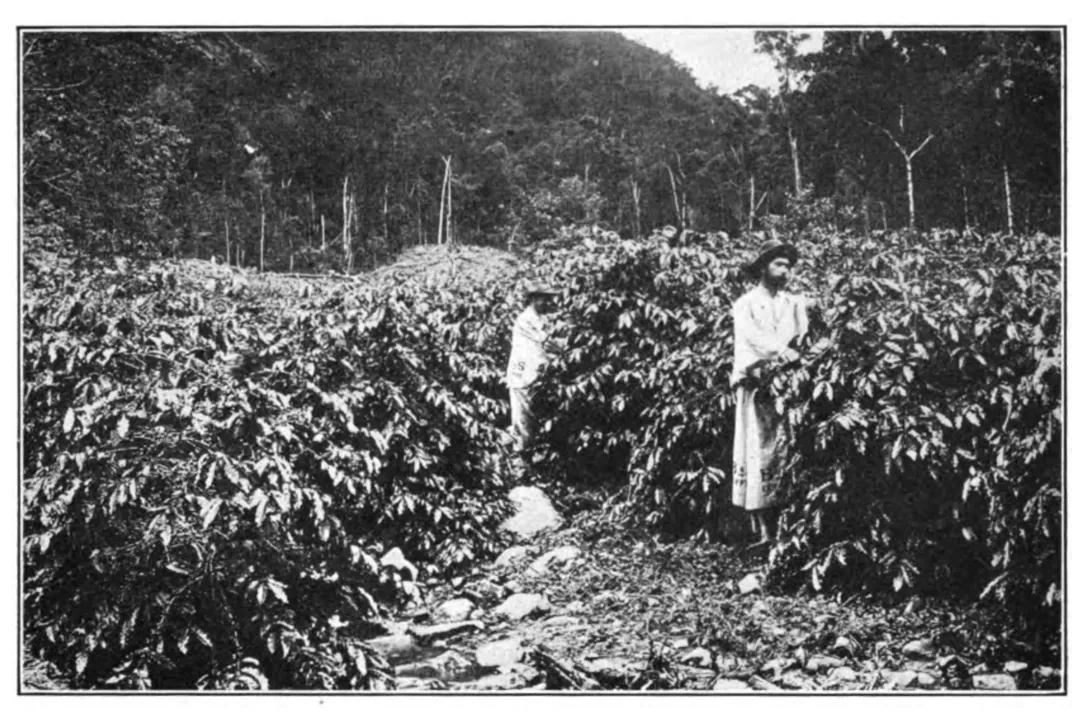
Ukers dates the introduction of coffee growing in Queensland to 1896, and judges it successful on a small scale. The profile traces the first coffee trees back to 1788, with the First Fleet. No source consulted reconciles the two dates: between a plant landed and an established crop, there is more than a century.
Ukers, All About Coffee (1922), ch. II, p. 5-10; Country Profiles, Marco De Sousa Rosa, 2026After a long decline, the industry re-emerges from the 1980s, on a model found nowhere else: fully mechanized monoculture, efficient processing plants, and optimization of the cost of production as the first concern. It is the opposite logic of the other origins, where labor is abundant and capital scarce.
Country Profiles, Marco De Sousa Rosa, 2026Today
The profile gives no production volume. Arabica grows there at low altitude, between 100 and 900 meters, which sometimes requires additional irrigation, in Bourbon, Caturra and Catuai. Harvesting is exclusively mechanical, because of the cost of labor, and processing is by the dry process as well as the wet process. The volume remains low and most of it is consumed locally.
Country Profiles, Marco De Sousa Rosa, 2026Gray areas
- The dates of 1788 (profile) and 1896 (Ukers) are not reconciled.
- No Australian production volume is given by the profile or sourced elsewhere here.
- The reasons for the long decline between the nineteenth century and the 1980s are documented by no source in the corpus.
- The Australian cost of production, presented as the central variable of the model, is quantified by no source consulted.