The San Franciscan Roaster Company (Coffee PER Inc.)
Production drums, Carson City, Nevada, United States.
WhereCarson City, Nevada, United States
Since1992
FamilyProduction drums
History
The company comes from a repairer's trade, not from a design office. Sherman Dodd left school at sixteen for the oil fields. A coffee agent then hired him to install industrial roasting machines, and Probat recruited him right after. From this stint with others came Coffee PER, a company that began by installing and refurbishing before building its own machines. The trade press dates the company to 1992. The workshop ended up settling in Nevada. It was still in Fallon at the end of 2013, and it is in Carson City by August 2015 at the latest. In 2008, Bill Kennedy bought Coffee PER Inc. from Dodd. Kennedy was not a mechanic by training: he had been a teacher and then a middle school principal for about twenty years, after studying industrial management. He widened the range beyond the SF-1 and SF-6, and made a name as a trainer for small roasters. His death was announced on December 11, 2025. The company changed hands in June 2026. Dave Marson, founder of Nature's Bakery then of Marson Foods, is the owner, and Matthew Sewell, engineer at the workshop since at least 2015, is the general manager. Eight people work there.
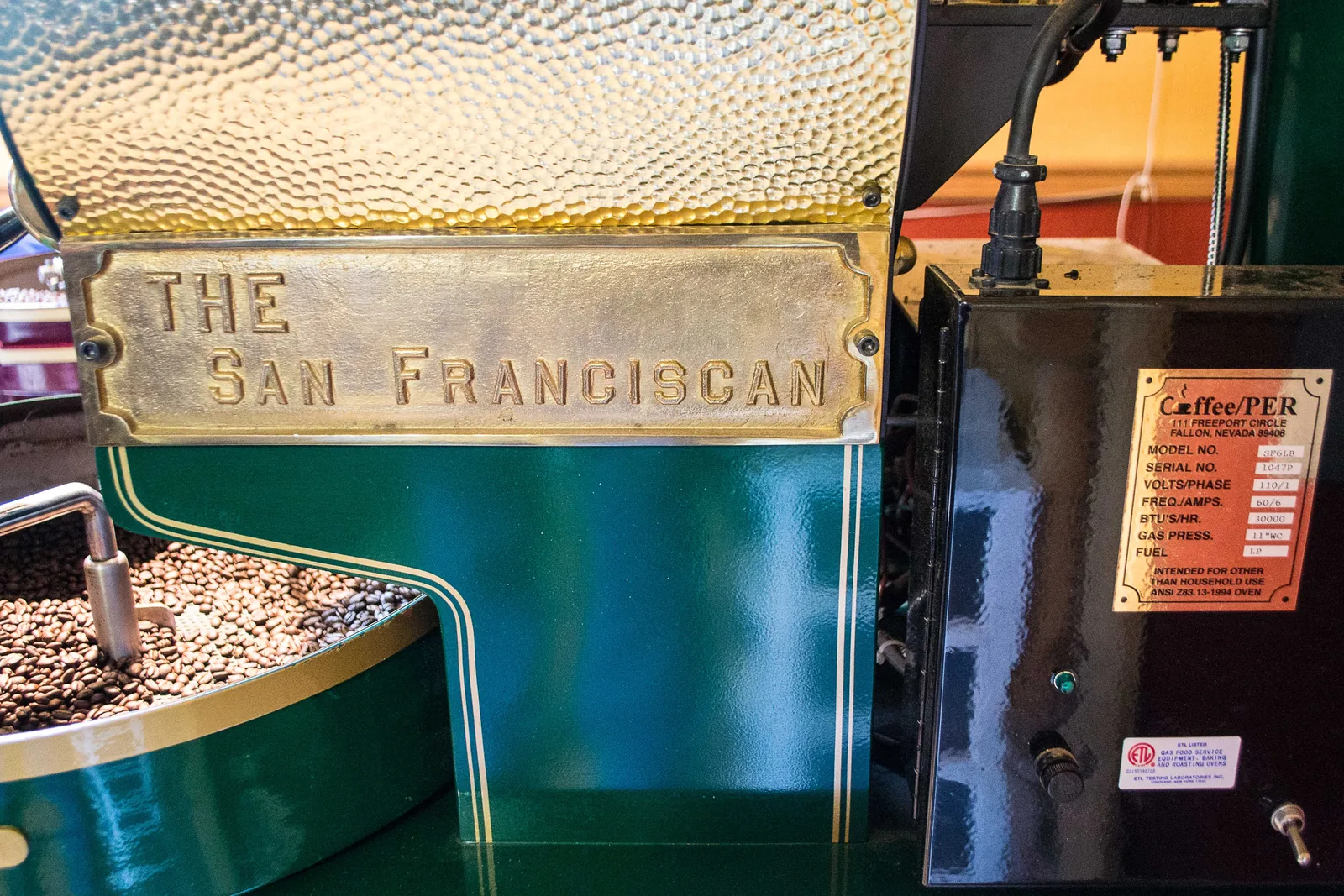
Brass plate “The San Franciscan” on a roasterVisitor7 · CC BY-SA 3.0
What it makes
A single type of machine: the horizontal-drum roaster, heated with natural gas or propane. The drum is single-wall, in mild steel rolled in the United States, of a grade the company calls schedule 40. Schedule 40 designates a standardized series of steel tube thicknesses, that of common industrial piping, and not a particular alloy. No cast parts. The choice of the single wall is embraced and argued: a second sheet would screen the bean from the flame, and is of interest only if the metal conducts poorly. Heating is from below, with brass burners mounted on a manifold. The orifices are drilled with a number 60 bit for natural gas and a number 69 for propane, smaller because propane carries more energy by volume. The bean therefore receives heat from the wall by conduction. Added to this is a convective share, which the operator doses with the draft lever. On the large models, a variable-speed turbine also gets involved. The faceplates are a quarter inch, or 6.4 mm, on the small machines, and five eighths of an inch, or 15.9 mm, on the SF-10 and SF-25. All the machines roast and cool at the same time. Measurement relies on two resistance probes, bean and ambient, a Watlow EZ Zone display and an isolated USB converter, readable by Artisan or Cropster. The integrated afterburners of the SF-25 and SF-75 are Weishaupt WG30 and WG40 burners, modulating and low-NOx, made in Germany. Assembly is done by hand in Carson City.
The models
Six models in the catalog. The SF-1 roasts 200 to 450 g per batch, three to four times an hour, or 1.4 kg in the hour. The manufacturer itself presents it as a sample and profiling roaster, not as a production tool. The SF-6 roasts 3 kg, minimum 1 kg, in ten to fifteen minutes, for 8.2 kg in the hour. The SF-Super 6 takes the same 3 kg batch, but climbs to four or five passes. It thus puts out 10.9 kg of green coffee in the hour, under 30,000 BTU per hour, on 120 V and 6 A. The SF-10 roasts 5 kg and puts out 22 kg in the hour; it was presented at the SCA show in Seattle in May 2018, announced then at a little under 30,000 dollars and delivered in 90 to 100 days. The SF-25 roasts 2.7 to 12 kg per batch, in eight to fifteen minutes. It requires 100,000 BTU per hour, plus 250,000 for its afterburner, on 220 V and 30 A. The SF-75 roasts 34 kg in thirteen to fifteen minutes, under 300,000 BTU per hour, plus one million BTU per hour of afterburner; it weighs 839 kg and fits in 60 inches by 96.
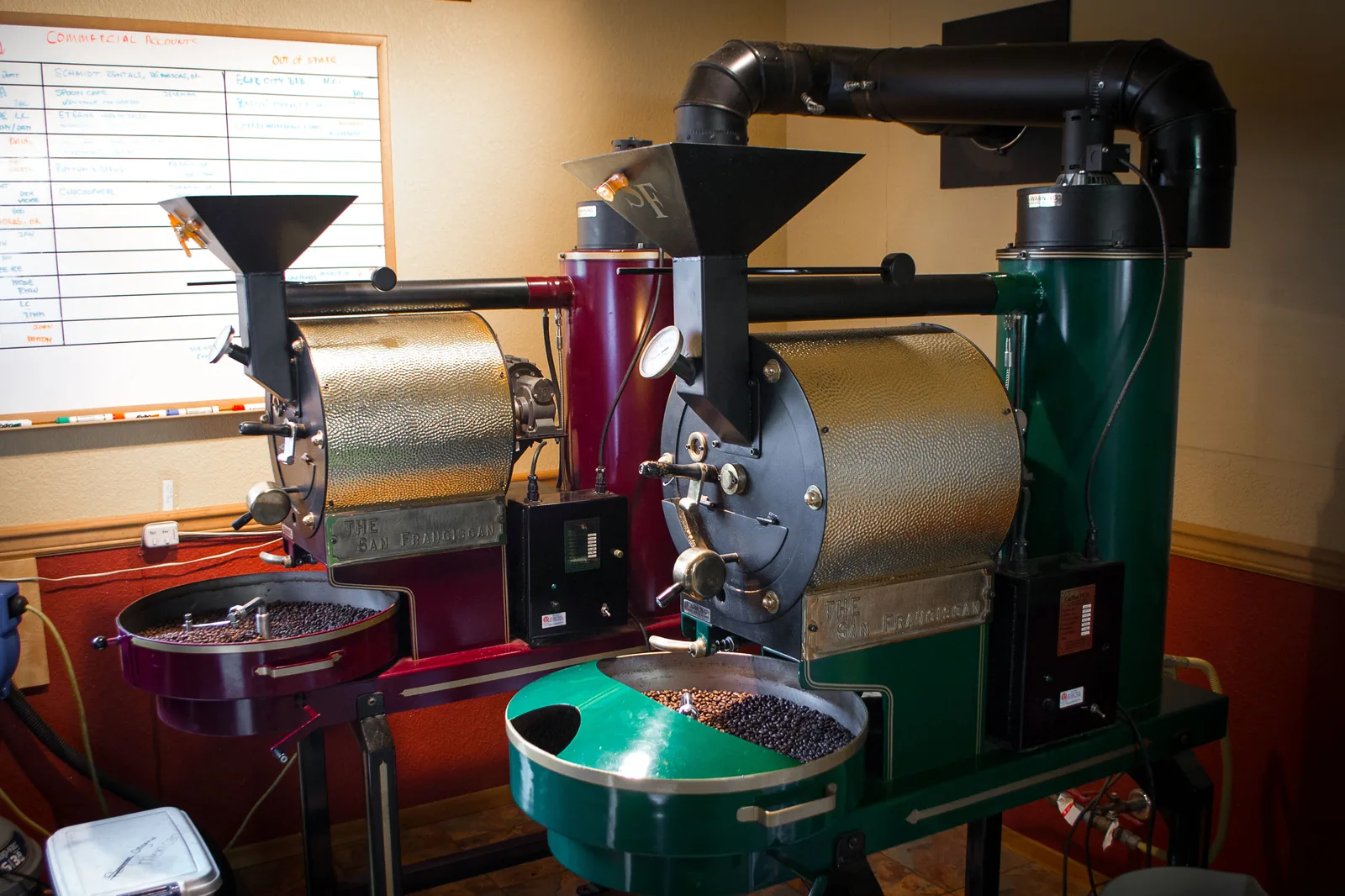
Two “The San Franciscan” roasters installed side by sideVisitor7 · CC BY-SA 3.0
What you gain
The SF-75 weighs 839 kg for 34 kg of coffee, or 24 kg of metal per roasted kilo. This inertia holds the charge temperature from one batch to the next. It makes the announced four to five passes per hour credible. Power follows the law of surfaces: 10,000 BTU per hour per kilo on the Super 6, 8,300 on the SF-25, 8,800 on the SF-75. A large machine therefore demands less per kilo than a small one. The single wall removes a screen between the flame and the bean. The gas gesture therefore shows up faster on the probe.
What you lose
These 24 kg of metal per kilo store heat as much as they stabilize it: a drop in gas takes a while to show. The single wall, for its part, loses its heat faster between batches, and the manufacturer admits it. A morning with an irregular rhythm therefore costs gas. The measurement chain is read-only. Artisan and Cropster record the profile, they do not replay it, unless the automation option is fitted. On the SF-1, SF-6 and Super 6, the only live levers remain gas and draft. Finally, the SF-25's afterburner consumes 250,000 BTU per hour, or two and a half times the roaster it cleans.
Gray areaThe year 1992 rests on a single trade press article of June 2026. The manufacturer publishes no founding date, and no registration document could be consulted. The place of founding is not established. All we know is that the workshop was in Fallon, Nevada, at the end of 2013, and in Carson City by August 2015 at the latest. Neither the date of the installation in Fallon nor that of the move to Carson City is verified. The exact meaning of the acronym PER is confirmed by none of the sources consulted: the article the company devotes to Sherman Dodd does not spell it out and stops on a “to be continued,” with no year. The Nevada Appeal article of July 6, 2026 could not be read, the server refusing access. The heating geometry remains imprecise. The manufacturer does not say whether a sheet separates the flame from the drum, does not give the wall thickness, which it describes only as calculated, nor the rotation speed, nor the airflow. Power ratings are published only for the Super 6, the SF-25 and the SF-75; those of the SF-1, SF-6 and SF-10 remain unknown. Weight and footprint are published only for the SF-75, and its floor dimensions are given twice in the same document with incompatible values. Hourly throughputs also contradict each other: the SF-25 is announced at 56 kg and then 48 kg per hour, the SF-75 at 170 kg and then 136 kg. The formula “100 percent American parts” coexists with Weishaupt afterburner burners made in Germany, which restricts it to the roaster and not the complete installation. The real difference between the SF-6 and the Super 6, beyond continuous cooling, is not detailed, and both remain in the catalog. The origin of the name San Franciscan is explained nowhere. Finally, the number of machines produced per year, the historical workforce, revenue, export markets and the price of the 2026 sale are not public.
Manufacturer's website, sanfranroaster.com, About Us page (address 4048 Technology Way Suite F, Carson City, Nevada, range of six models, lifetime warranty on materials and workmanship, one year on third-party components), accessed September 2026; sanfranroaster.com, FAQ page (capacities and hourly rates of the SF-1, SF-6, SF-10, SF-25 and SF-75, simultaneous roasting and cooling, afterburner integrated into the SF-25); sanfranroaster.com, SF-1 sheet (200 to 450 g per batch, three to four batches per hour, 1.4 kg per hour, ten to fifteen minutes, quarter-inch faceplates, machine described as sample roaster and profile roaster); sanfranroaster.com, SF-6 sheet (3 kg per batch, minimum 1 kg, 8.2 kg per hour, schedule 40 steel, quarter-inch plates, self-igniting burners, chaff cyclone at the rear); sanfranroaster.com, SF-Super 6 sheet (four to five batches per hour, 10.9 kg of green and 9.07 kg of roasted per hour, 30,000 BTU per hour, 120 V 6 A 60 Hz single-phase, ETL listing United States and Canada); sanfranroaster.com, SF-10 sheet (5 kg per batch, 22 kg per hour, five-eighths-inch plates, drum speed control, mechanical damper and variable-speed turbine); sanfranroaster.com, SF-25 sheet (6 to 25 pounds per batch, 100,000 BTU per hour at the roaster and 250,000 at the afterburner, 7 inches of water column on natural gas and 11 on propane, 220 V 30 A NEMA L14-30P plug, five-eighths-inch plates, four one-third horsepower motors, powder paint baked at 400 degrees Fahrenheit, 18 inches of clearance on all sides); sanfranroaster.com, SF-75 sheet (34 kg per batch, 300,000 BTU per hour plus one million at the afterburner, 220 V single-phase 30 A, 1,850 pounds or 839 kg, 6 to 10 inch flue, half-inch water quench); sanfranroaster.com, knowledge base, page Why does the flame look orange (brass burners on manifold, orifices drilled with number 60 bit on natural gas and number 69 on propane); sanfranroaster.com, knowledge base, page What are my data logging options (RTD probes, Watlow EZ Zone display, isolated USB converter, communication driver, Cropster and Artisan as third-party software); sanfranroaster.com, page Afterburners (Weishaupt WG30 and WG40 burners made in Germany, modulating, low-NOx, integrated into the SF-25 and SF-75); sanfranroaster.com, blog, article The coffee roaster drum wall debate, single wall vs double wall (single-wall drum, American mild steel schedule 40, faster heat loss than a double wall); sanfranroaster.com, blog, article The rhythm of the roaster drum (single wall of calculated thickness, conduction and convection dosing by air lever, without recourse to radiation); sanfranroaster.com, blog, article Why conductive heating is important (steel rolled in the United States, evenness, hot spots blamed on remelted steels); sanfranroaster.com, blog, article Coffee Processing Equipment and Repair, Coffee PER (Sherman Dodd, left school at sixteen, oil fields, installing equipment for a coffee agent, hired at Probat); sanfranroaster.com, blog, article Coffee Roaster, Welcome to our Factory, dated December 27, 2013 (workshop then in Fallon, Nevada); sanfranroaster.com, blog, article From the old world to the new, dated November 29, 2018 (lineage from European drums, rejection of cast iron, single wall); site archive of August 21, 2015, About Us page (Carson City address already in place, range limited to the SF-1, SF-6, SF-25 and SF-75, Matt Sewell director of operations and chief engineer, Good Food Award 2015 with Magpie Coffee Roasters); Daily Coffee News, May 17, 2018, San Franciscan Roaster Company Covers the Middle Ground With the SF10 (launch at the SCA show in Seattle, price just under 30,000 dollars, lead time of 90 to 100 days, side plates made in the San Francisco Bay area, hoppers hand-spun in Jackson, California); Daily Coffee News, December 11, 2025, Bill Kennedy, San Franciscan Roaster Owner and Educator, Dies (purchase of Coffee PER Inc. from Sherman Dodd in 2008, two decades in public education, industrial management at LeTourneau University in 1985, addition of the SF-10, SF-25 and SF-75, Coffee Roasting Legends podcast in 2025, death announced); Daily Coffee News, June 29, 2026, The San Franciscan Roaster Company Is Under New Ownership (founding dated 1992, Dave Marson owner, Matthew Sewell general manager, eight employees, amount undisclosed)