Primo Roasting Equipment
Production drums, Huntington Beach, California, United States.
History
Dion Humphreys leaves Diedrich Roasters in 1993 to found Primo. The oldest known state of its site, dated December 3, 1998, places the workshop at 17875 Sky Park North, in Irvine, California. The toll-free number is already there, and it is the one the company still gives today: thirty years of continuity that nothing else documents. Next comes the PRI series, known from archived data sheets of the 2010s. It runs from the PRI-TT-EC, charged with 2.7 kg of green, to the PRI-265, charged with 140 kg, or two bags. In 2018, Brandon Miller sets up Dynamize Coffee with Christian Longnecker and buys a 5 kg from them. A year later he returns to order a 30 kg. It will be the last machine assembled by Humphreys himself. The founder was leaving the state and had only a few weeks to find a successor. Miller, a twenty-seven-year-old engineer, takes over Primo without an investor, reinvesting only his profits. He has the company's plans digitized for the first time, until then kept on paper. He redesigns parts so they are simpler to machine, which shortens lead times. At the end of 2021, the Xr series begins to replace the PRI. The workshop then occupied 6,000 square feet in Santa Ana, about 560 square meters. It has since moved to Huntington Beach, an address the site has given since early 2026.
What it makes
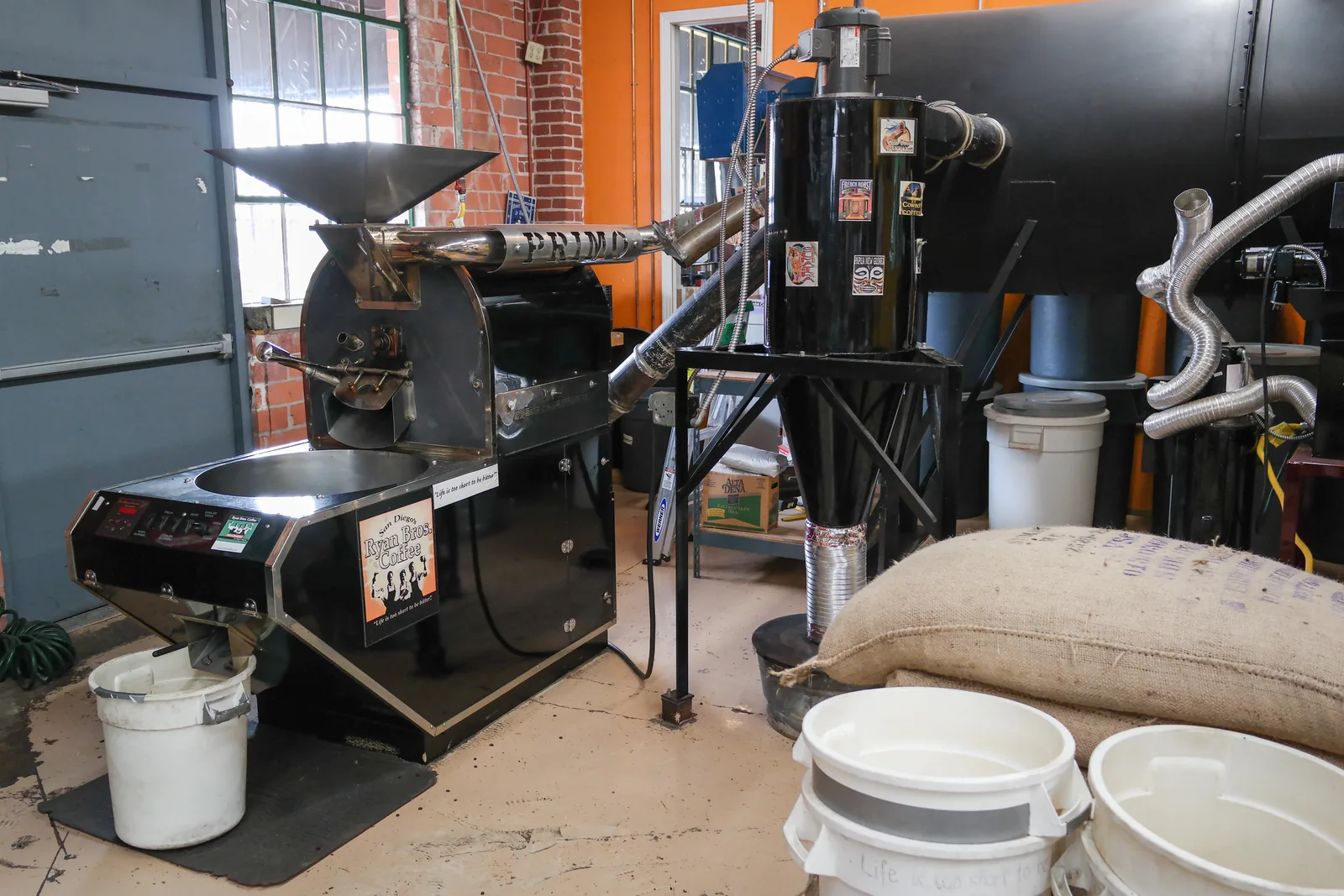
Gas-heated horizontal drum, natural gas or propane at choice, with an infrared burner. In this type of burner, the gas burns at the surface of an element that glows red. Heat then travels toward the drum sheet metal as radiation, and not as a flame licking the metal. The bean therefore receives its heat by conduction from the sheet metal, and by convection from the air drawn through. The manufacturer announces 300 cubic feet per minute of roasting air on the XR-15, or about 510 cubic meters per hour, and 360 on the XR-20 and XR-30. An independent cyclone, that tower which separates the chaff from the air by centrifugal force, collects the fines. The cooling tray has its own fan and its own motor, which allows batches to overlap. Cutting, welding and assembly take place in the Huntington Beach workshop. Only the motors and control modules come from Grainger, a general industrial distributor. The machine speaks Modbus ASCII over a USB port, an open and documented industrial protocol.
The models
Xr series in the catalog in September 2026. The XR-5 takes 2.5 to 5 kg of green per batch and puts out 19 kg of roasted per hour. The XR-15 goes from 7 to 15 kg, for 43 kg per hour. The XR-20 goes from 9 to 20.4 kg, for 65 kg per hour. The XR-30 goes from 15.9 to 31.75 kg, for 104 kg per hour. The manufacturer announces two infrared burners on the XR-15, XR-20 and XR-30, a single one on the XR-5. The XR-70 and custom builds are announced from 70 to 200 kg. The XR-3 has left the catalog, but its parts are still sold. Prices are published, from 28,000 dollars for the XR-5 to 195,000 for the XR-70. The PRI series is discontinued. It counted the PRI-TT-EC, charged with 6 pounds of green, or 2.7 kg, and the PRI-T, charged with 12 pounds, or 5.4 kg. Next came the PRI-20 (35 pounds, 15.9 kg), the PRI-35 (45 pounds, 20.4 kg) and the PRI-50 (70 pounds, 31.8 kg). The two largest, PRI-135 and PRI-265, charged 155 and 310 pounds, or 70 and 140 kg.
What you gain
The infrared burner has no tongue of flame touching a point of the sheet metal. Heat arrives by radiation along the whole length of the drum. There is therefore no overheated band where the bean in contact would burn. The cooling tray has its own fan, rated at 1125 cubic feet per minute. The next batch can therefore leave while the previous one cools, hence the 104 kg per hour announced on the XR-30. Since the Modbus protocol is open, Artisan and Cropster read the machine without going through the manufacturer's software. Any sheet metalwork can be redone at the workshop, since it was cut and welded there. Only the motors and control modules depend on a third party.
What you lose
A radiant surface has inertia. When the gas is cut, the element keeps glowing for a few seconds. The correction therefore arrives late, where a direct flame responds immediately. Air per kilo also falls as machines get bigger. At full load, the XR-15 has 20 cubic feet per minute per kilo, the XR-30 only 11.3. The big machine therefore gives the air less grip. Same slope in cooling: the XR-15, XR-20 and XR-30 get the same fan motor and the same announced flow of 1125 cubic feet per minute. The kilo to be cooled has half as much air on the XR-30 as on the XR-15. Roast Master automates gas and air, but leaves the drum speed to the operator's hand.