Joper
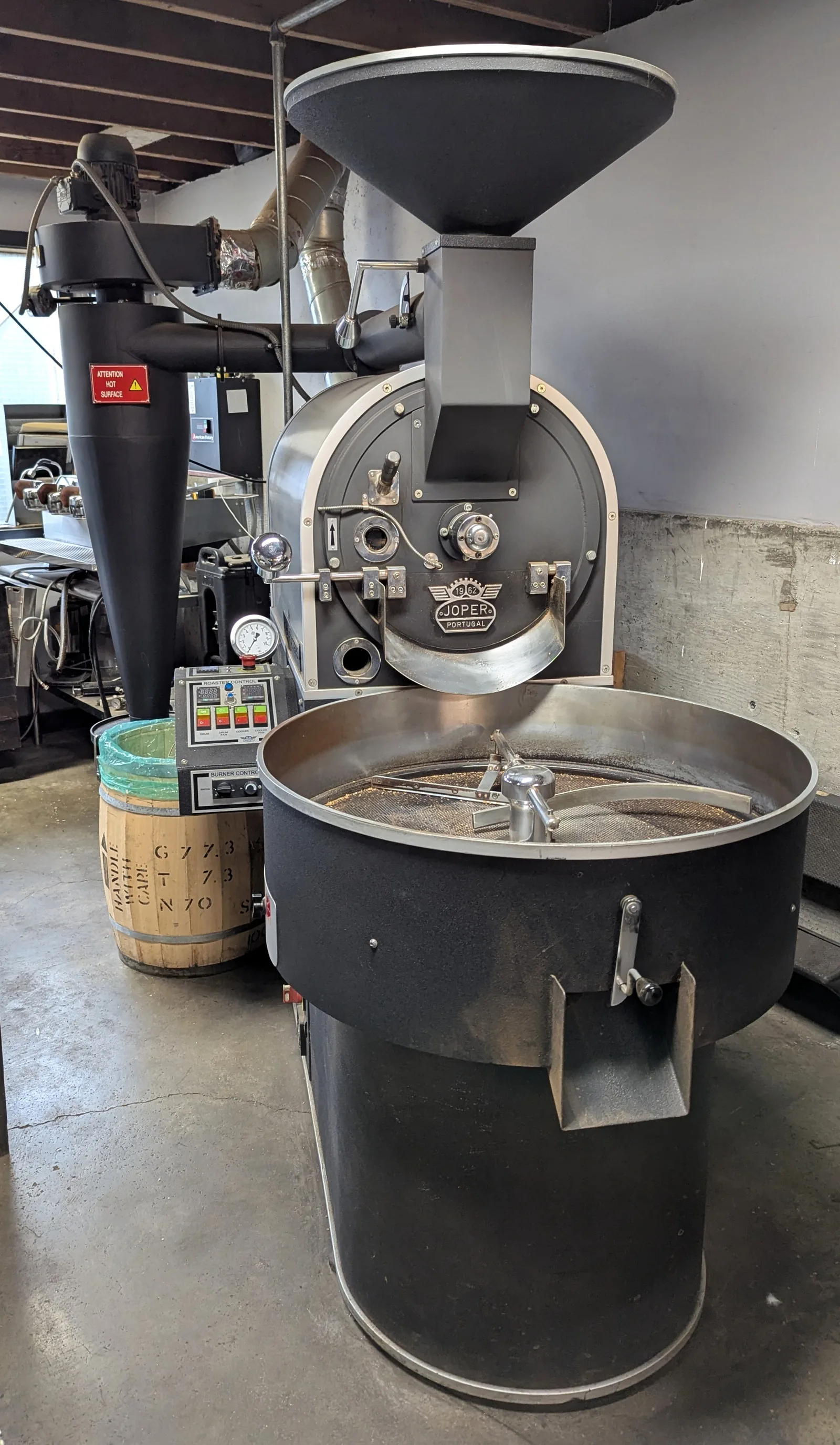
Production drums, Canelas (Porto), Portugal.
History
Neither Lisbon nor Sintra: Canelas, in the Porto region, more than three hundred kilometers away. João Rodrigues Pereira founded Joper in 1962; his grandson João Paulo Pinheiro joined in 1990 and now runs a third-generation company, which claims sixty-four years of experience and publishes no chronology between 1962 and 2019.
The brand's hallmark is cast iron, and it is argued: “cast iron has exceptional thermal inertia and radiating capacity, it holds heat.” Joper says it is the only one to also make the drum bearing supports in cast iron, with a two-year mechanical warranty. And it writes what that costs: “this equipment becomes much more expensive, but Joper is firmly committed to building cast iron roasters.”
What it makes
Double-wall drums and cast iron frame, indirectly heated by a gas-burner oven whose hot air circulates in the drum; premix burner, two thermocouples, negative pressure measurement in pascals, set up for Cropster and Artisan on the shop range; Brigus system for the automatic industrial range.
The models
Shop BR version II: BR 1 (0.5 to 1 kg), BR 3, BR 5 (2.5 to 5 kg, 450 kg), BR 15, BR 25 (12.5 to 25 kg, 100 kg/h), in Standard, Advanced or Auto. Industrial CRM (manual) and CRS (automatic, Brigus): 30, 60, 120, 240 kg. Cocoa BR-F and CRS-F; sample CRG 100 with one, two, four or six drums.
What you gain
Cast iron, double wall and indirect heating give a very high inertia: the machine takes the green load without a collapse in temperature and runs “on several shifts, seven days a week.” Two rare and verified things: the measurement of draft in pascals on machines of 1 to 25 kg, which says whether a roast changed because the coffee changed or because the chimney got fouled; and the publication of a minimum load for each model, at half of the maximum load.
What you lose
The same inertia responds slowly: reducing the flame at the end of the roast is not seen right away, the cast iron keeps radiating. A Joper rewards anticipation and forgives improvisation poorly. And a BR 5 weighs 450 kg for five kilos of batch: the floor must follow.