ATLASSri Lanka
5,117 tonnes (FAOSTAT 2024)In-depth dossier, atlas 2026In-depth dossier: the FAOSTAT series set against other figures, the history, today's industry and its gray areas, with numbered sources. Region: Asia.
Sri Lanka had only one statistical landmark. This dossier completes it: the history of the sector, what it is today, and what remains uncertain, each paragraph referring to its sources, numbered at the foot of the page.
The FAOSTAT series remains displayed as is. The dossier says what it is worth, year by year when possible, and compares it with the other figures available.
- Geographic status
- country
- Name in FAOSTAT
- Sri Lanka
- Latest value
- 5,117 tonnes in 2024
- Nature of the value
- official figure
- Start of the positive series
- 1961
- Series maximum
- 16,600 tonnes in 1983
Confirmed coverage: FAOSTAT series, and a dossier of 18 sources that draws together the history, today's industry and what remains uncertain.
History
Ceylon coffee begins with a date that nobody can verify. Ukers reports, giving it as a legend, that Arabs supposedly introduced the coffee tree to the island before the arrival of the Portuguese in 1505; the site’s chronicle explains why nothing confirms it. The dated facts are Dutch. The Dutch drive out the Portuguese in 1658 and begin to plant, but Ukers places a “more systematic” cultivation only in 1690, and Thurber, in 1881, is content with the end of the seventeenth century. The outlet remains narrow: in 1721, about sixteen pounds of Ceylon coffee sell in Amsterdam for more than Java and Mocha; in 1741, Dutch sales reach 370,192 pounds, about 168 tonnes, then low prices and the abundance of Java coffee discourage the planters. The British take the island in 1795 or in 1796, Ukers gives both dates, and cultivation does not really progress until 1824 [2][3]
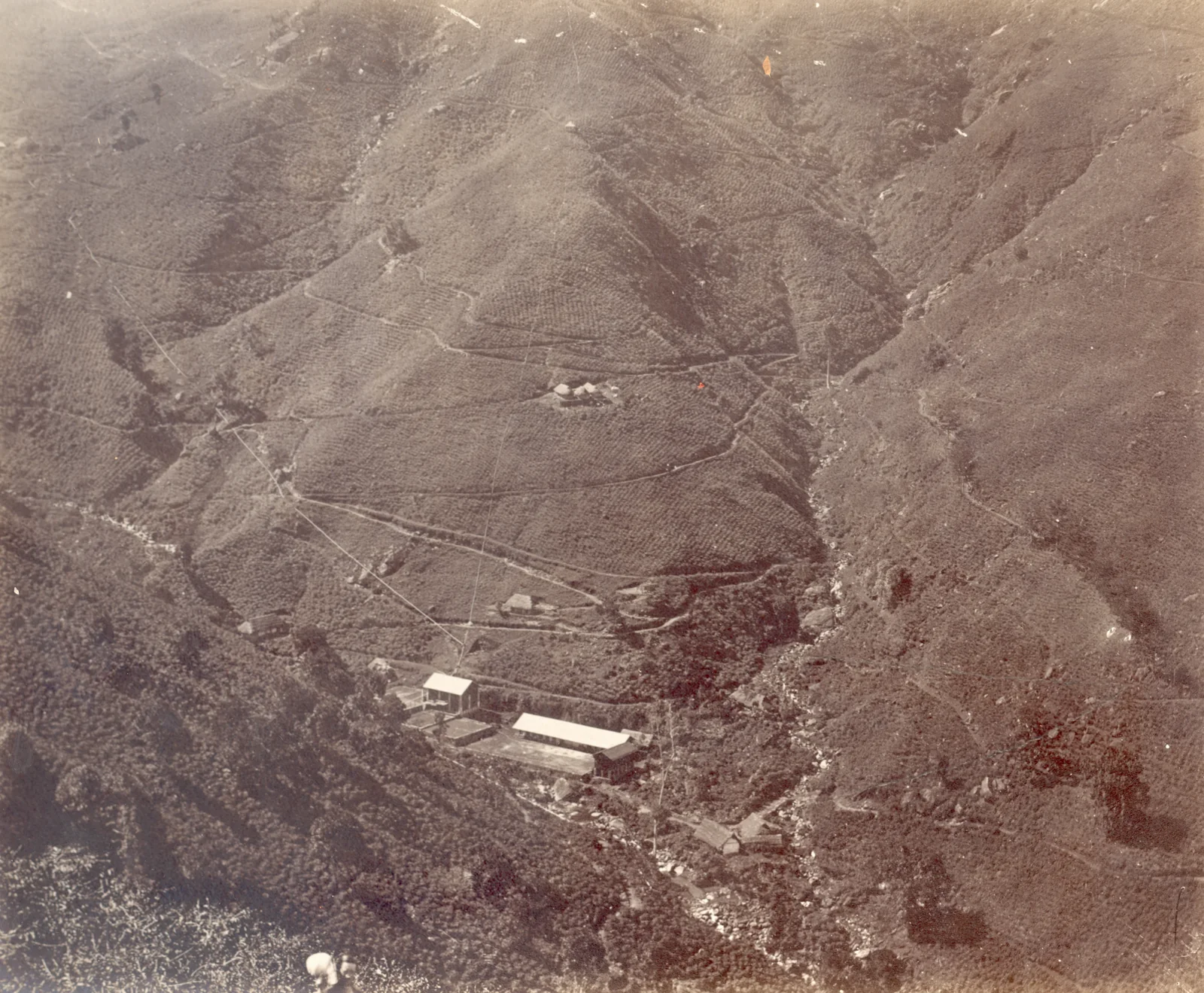
British plantation coffee is born in the highlands of the former kingdom of Kandy. Sir Edward Barnes opens in 1825 the first highland plantation run by a Briton, the great boom dates from 1832 to 1836, and a speculation in which 5 million pounds sterling are said to have been committed ends in 1845 with the bursting of a bubble that ruins hundreds of planters. Growth then resumes: in 1877, Thurber counts 1,357 European plantations on 272,243 acres, about 110,000 hectares, to which are added 50,000 to 70,000 acres, or 20,000 to 28,000 hectares, cultivated by the island’s inhabitants in their gardens. Exports peak around 1870: Ukers gives 118,160,000 pounds for that year, about 53,600 tonnes, and Coste 50,000 tonnes exported in 1867. Coffee leaf rust, Hemileia vastatrix, observed in 1869 in the Madulsima district, undoes this economy in some twenty years. The site’s plate on diseases, in its section on Ceylon, tells how it unfolded, the mission of Harry Marshall Ward and the switch to tea; this dossier does not repeat it and sticks to what surrounds it [2][3][4]
Three elements complete this account. The first is the villagers’ coffee, which the trade called “native.” Its exports fall from 218,000 English hundredweight in 1868, about 11,000 tonnes, to 49,284 hundredweight in 1879, about 2,500 tonnes, whereas plantation coffee varies from one year to the next without yet collapsing; Thurber concludes that the gardens suffered from the disease more than well-kept plantations. The second is an insect: Coste attributes to the green scale, Coccus viridis, a predominant role in the gradual abandonment of the coffee tree from 1886, to the point that, in the most infested districts, it is replaced by the tea plant. The third is another species: the planters try Coffea liberica from the 1870s, a booklet published in Colombo traces its history up to April 1878, but its cup does not satisfy buyers. What remains is a commercial class “Liberian,” which Ukers still ranks in 1922 alongside the “native,” “plantation” and “mountain” coffees [2][3][4][5]
Coffee does not disappear for all that; it changes scale. Ukers records 4,875 acres in 1903, 2,433 in 1907, 1,389 in 1912 and 941.5 in 1919, about 380 hectares, and a crop of 2,200 pounds, barely a tonne, in 1917. The island has become an importer: in 1920 it receives 1,853,537 pounds of coffee, about 840 tonnes, and exports only 2,240 pounds, and the statistics of British India count 1,423,072 pounds shipped to Ceylon in the 1920 fiscal year. Each inhabitant then consumes 0.43 pound of coffee a year, against 0.36 in 1913. To revive cultivation, the experimental stations of Peradeniya and Anuradhapura try several forms of Coffea canephora, under the commercial names of the time, as well as a hybrid, and the Tea and Coffee Trade Journal was already announcing a “new hybrid” of Ceylon coffee in 1916; in 1955, Coste still lists the Peradeniya station among the research centers on canephora. Ukers also notes that “mountain” coffee, a small steel-blue bean, used to go to Aden to be blended with Mocha, a practice described in the site's plate on adulteration [2][4]
Coffee becomes an export crop again in the 1970s, by way of the so-called minor crops, that is, the export crops other than tea, which falls under a separate administration. The national agricultural policies of 1971 lead to the creation in 1972, by a Cabinet memorandum, of a Department of Minor Crops attached to the Ministry of Plantations, then placed under the Ministry of Agriculture in 1975. According to the People's Bank economic review in 1985, the country has exported green coffee only since 1973: 132,100 kilograms that year, a record of 3,124,400 kilograms in 1983. Sri Lanka then takes part in the International Coffee Agreement, whose quotas frame producers' sales: 45,000 bags of 60 kilograms for the 1980-81 crop year, or 2,700 tonnes, 72,000 bags with the supplementary quota of 1982-83, 54,053 bags in 1983-84. The same review warns that the country struggles to fill these quotas, because most of the coffee comes from smallholdings and home gardens whose harvest nobody can predict [6][9][10]
The FAOSTAT series begins in 1961 at 4,002 tonnes. All its annual production figures carry flag A, official figure, except that of 2015, 5,866.3 tonnes, an imputed value (flag I); only the areas for 1961 and 1962 are estimates. It climbs to its maximum of 16,600 tonnes in 1983, the year of the export record, then drops to 5,622 tonnes as early as 1986, a fall of two thirds, while the harvested area goes from 8,720 hectares in 1983 to 14,240 in 1989: the implied yield falls from 1,904 kilograms per hectare in 1983 to 411 in 1988, and no source consulted explains this drop. USDA also records a trough in 1986, 25,000 bags, but a return to 70,000 bags as early as 1987. FAOSTAT production rises again to between 10,000 and 11,760 tonnes in the 1990s, falls back almost every year from 2001 to 2010, then oscillates between 4,750 and 6,725 tonnes. The current value, 5,117 tonnes in 2024 on 4,900 hectares, is an official figure. USDA, which had been reporting the country's crop since 1960, stops tracking it after the 2008 crop year [1][7]
Today
The research director of the Department of Export Agriculture (DEA), the administration that oversees coffee today, recommends in 2023 arabica above 400 meters in the districts of Nuwara Eliya, Kandy, Matale and Badulla, and canephora below 600 meters in those of Kegalle, Kurunegala, Kandy and Matale. In 2017 the DEA gave Japanese surveyors an optimum of 1,000 to 2,000 meters for arabica, from which the surveyors derive, around Kotmale, Hanguranketha, Walapane, Nuwara Eliya, Welimada, Haputale and Bandarawela, about 2,514 square kilometers of favorable land. In 1983 the Ministry of Agriculture counted 11,055 hectares of coffee trees, of which 2,520 in Nuwara Eliya, 2,054 in Kegalle, 1,640 in Kandy, 1,115 in Kurunegala, 890 in Matale and 750 in Badulla, the estates holding only a small share of them. Canephora dominates in volume: USDA credited it with 60 to 90% of the crop depending on the year between 1960 and 2008, 25,000 bags out of 35,000 in the last year, and the ICO table reproduced by the International Trade Centre ranks the country among the canephora producers that also harvest arabica, on an October to September crop year [6][7][8][9][11]
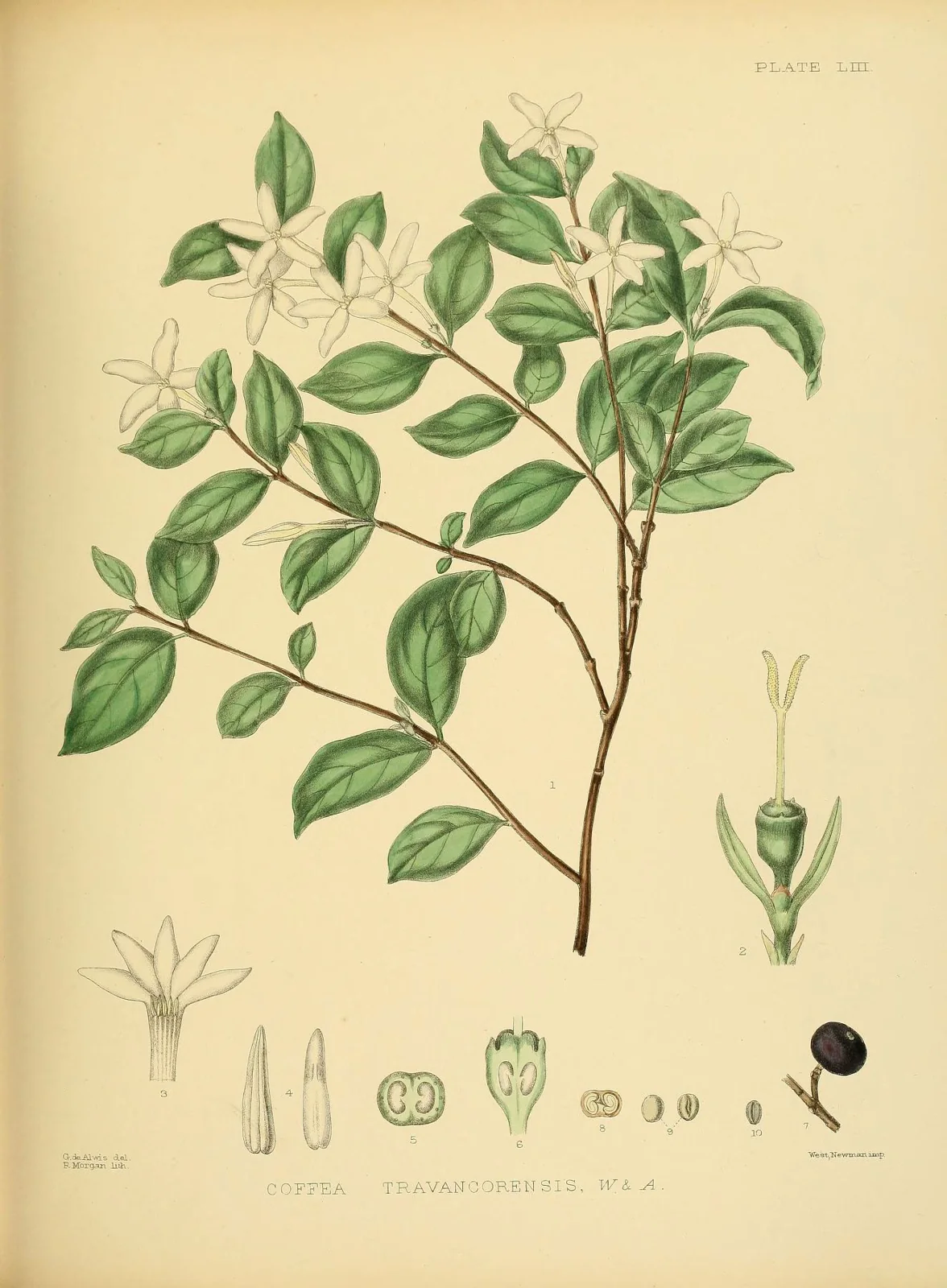
On the arabica side, the 2017 survey finds mostly Catimor, a lineage derived from the Timor Hybrid, that natural cross between arabica and canephora which brings resistance to rust, and it reports the commercial cultivation of another species, Coffea congensis. The DEA promotes Lak Parakum, developed over some fifteen years at its research center in Matale: a presumed mutation of the Bourbon lineage, according to those who selected it, whose cherries stay ripe on the tree for a long time, so that one or two pickings per season are enough, and of which 5 kilograms of cherries give about 1 kilogram of green coffee. In 2023 the department's researchers test propagation by cuttings of Lak Parakum and of the S9 selection, and the grafting of these two arabicas onto canephora rootstocks. The public export promotion body lists in 2021 other selections, Lak Saviru and Lak Komali for arabica, Lanka Chandra, Lanka Bimsara and Lanka Isuru for canephora, without describing them. Finally, the island is home to two wild coffee trees, Coffea travancorensis and Coffea wightiana, also found in southern India [9][10][17][18]
Coffee remains a matter of gardens. As early as 1985, most of it came from smallholdings and home gardens; estate coffee, sold at the Colombo auctions, made up only a small share, and the rest passed through four to six intermediaries, collector, village fair, town trader, wholesaler, before reaching the exporter. The 2017 survey describes a coffee almost always grown in shade, mixed with other crops, on the farms of mountain peasants who grow several products at once. The DEA estimates productivity in 2023 at 450 to 500 kilograms per hectare, and one of its officials judges that only 20 to 30% of local coffee meets export criteria, because of the picking of green fruit and poorly managed preparations. This is the point addressed by the 2020 pilot project of the Market Development Facility, a program funded by Australia: a processing center where producers deliver ripe cherries instead of preparing their coffee at home [6][9][11][16]
The DEA has borne its current name since Act No. 46 of 1992 on the promotion of export crops, which gives it authority over spices and the other crops of this group. Coffee comes only third in its priorities, with cocoa, behind cinnamon and pepper, then nutmeg, cardamom and clove, according to the 2017 survey; in the Nuwara Eliya district alone, the department distributed 314,800 arabica plants from 2010 to 2016, enough to plant about 105 hectares. In 2023 it plants 180.04 hectares of new arabica, gives 38,195 coffee plants to home gardens and 17,871 canephora plants to villages grouped in producer clusters, and organizes a coffee day in Ella on October 20. Its targets for 2025, cited in 2023, were 5,800 hectares and 200 tonnes exported. Sri Lanka is not a member of the International Coffee Organization: it appears among the countries invited as observers to the sessions where the agreements of 2007 and 2022 were adopted [9][10][11][13]
Sri Lankan coffee is drunk on the spot. According to the DEA figures passed on in 2017, estimated production from 2005 to 2015 ranges from 2,580 to 3,250 tonnes, and exports never represent more than 4.8% of it, from 9.6 to 157.4 tonnes depending on the year. The country's reports to the United Nations Comtrade database are weaker still for green coffee: 41.8 tonnes in 2014, of which 36 to Italy, then at most 8 tonnes a year from 2015 to 2024, the year 2018 being missing, and 2.1 tonnes in 2024, sold mainly to the United Arab Emirates, Japan and Australia; the small imports come mainly from India and Vietnam. The revival targets specialty coffee, that is, coffee sold on its cup quality, scored at tasting. The Market Development Facility takes an interest in the sector around 2017 and announces more than 2,400 producers reached, including more than 1,200 women; Sri Lankan coffee appears for the first time in 2022 at the international exhibition in Melbourne. The regional plantation companies, which manage the large tea estates, count about 100 hectares of coffee in 2024 and aim for 10% of their land, and officials announce in October 2025, before a parliamentary committee, more than 5,000 hectares and a target of 10,000 hectares within two years [9][12][14][15][16]
- Cultivated species
- Mostly Coffea canephora, 60 to 90% of the crop according to USDA from 1960 to 2008; Coffea arabica at altitude [7]
- Areas recommended by the DEA
- arabica above 400 m (Nuwara Eliya, Kandy, Matale, Badulla), canephora below 600 m (Kegalle, Kurunegala, Kandy, Matale) [11]
- Area and production according to the DEA
- 4,787 ha; 2,537 t in 2022 [11]
- FAOSTAT production
- 5,117 t in 2024, official figure; maximum 16,600 t in 1983; only imputed year, 2015 [1]
- Declared green coffee exports
- 2.1 t in 2024 [12]
- DEA arabica variety
- Lak Parakum, selected at the Matale research center [9]
- Institution
- Department of Export Agriculture, created in 1972 as the Department of Minor Crops, current name since 1992 [10]
- Peak of colonial exports
- 118,160,000 pounds, about 53,600 t, in 1870 [2]
Gray areas
The country has two production series that probably do not measure the same thing, and no source says which one is in green coffee. FAOSTAT gives each year from 2005 to 2015 between 1.6 and 2.4 times the figure that the DEA handed to the Japanese surveyors: 7,240 against 3,086 tonnes in 2005, 6,089 against 2,674 in 2014. The gap persists in 2021 and 2022, 5,306.2 and 4,828 tonnes against 2,439 and 2,537. The ICO, through the International Trade Centre guide, stays close to the DEA: 36,000 to 40,000 bags from 2014 to 2019, or 2,160 to 2,400 tonnes. The areas, for their part, are similar, 5,607 hectares in FAOSTAT in 2022 and 4,787 hectares according to the DEA in 2023, so that the implied FAOSTAT yield, from 861 to 1,153 kilograms per hectare since 2020, is about double the 450 to 500 kilograms announced by the DEA. A factor of two resembles the weight ratio between coffee dried in the cherry and green coffee, but that is a hypothesis: no source consulted says in what unit the statistic passed on to FAO is kept. In 1985, the People's Bank review cited official sources according to which production could not exceed 2,500 tonnes and stood rather between 1,500 and 2,000, whereas FAOSTAT records 16,600 tonnes for 1983, USDA 58,000 bags, about 3,480 tonnes, and exports exceed 3,100 tonnes. The series has moreover been revised: the export promotion body still cites in 2021 a maximum of 25,575 tonnes in 1967 and a minimum of 4,109 tonnes in 1988, values absent from the 2025 FAOSTAT release, where 1967 stands at 11,488 tonnes and 1988 at 5,600 [1][6][7][8][9][11][17]
The figures for old Ceylon coffee do not agree, even within a single book. Ukers places the export peak in 1870, 118,160,000 pounds, in one chapter, and in 1873, 111,495,216 pounds, in another, this second figure also appearing in Thurber's table; he also gives 1795 and 1796 for the arrival of the British, 1658 and 1690 for the start of Dutch cultivation. The areas diverge more. The site's plate on diseases retains, after Waller and his coauthors, a fall from 68,787 to 14,170 hectares, whereas Thurber counts 272,243 acres of European plantations in 1877, about 110,000 hectares without the village gardens, and Ukers gives a maximum of 340,000 acres, about 137,600 hectares; the export promotion body even writes 275,000 hectares for 1870, probably a confusion between acres and hectares. The rank of third exporter in the world, repeated in 2024 by the Colombo business press and in 2025 by the Australian program, is backed in these texts by no statistic [2][3][14][16][17]
Several quantities have never been measured. The DEA statistics do not distinguish arabica from canephora, the 2017 survey observed, and since USDA stopped tracking the country after 2008, no source consulted gives the share of each species. Domestic consumption, which nonetheless absorbs almost the whole crop, was “never known” according to the 1985 review, and nothing more recent puts a figure on it. Exports depend on who is counting: the DEA announces 30.47 tonnes in 2021 and 50.56 in 2022, Comtrade records 8.0 and 6.0 tonnes of green coffee, and all the coffee positions together, green, decaffeinated, roasted, husks and skins, 76.8 and 27.3 tonnes, with no total matching the other. The areas, finally, range from 4,787 hectares according to the DEA in 2023 to more than 5,000 according to the officials heard in 2025, and up to 60,580 hectares for 2021 according to the export promotion body, a figure more than twelve times higher than the others. No source consulted gives a harvest calendar; the 1985 review noted only that exports rise from October and peak in December [6][9][11][12][15][17]
Not covered: No established harvest calendar for either species, nor any sourced description of the treatments practiced beyond the pilot center of 2020; the University of Moratuwa study on the wet process and the dry process was seen only as a search result. No complete official DEA series beyond 2005-2015, 2021 and 2022: its site did not respond, and the unit of its statistic (green coffee or dried cherry) remains unknown, as does that of the series passed on to FAO. No figure for the share of each species after 2008. No explanation of the drop of 1984-1988, nor of the country's departure from the International Coffee Organization, the date of which was not found. Domestic consumption is quantified by no recent source. The selections Lak Saviru, Lak Komali, Lanka Chandra, Lanka Bimsara, Lanka Isuru and S9 are described nowhere in what I have read. The Hatton Plantations project (harvest announced for 2026) is known only from a search summary and is not included. The history of rust and of the switch to tea is deliberately left to the diseases plate.
- Production: Crops and livestock products, Coffee, green (656), Sri Lanka : production, harvested area, yield, with their flags, FAO, FAOSTAT, 2025, https://bulks-faostat.fao.org/production/Production_Crops_Livestock_E_ solid level
Series 1961-2024 and flag of each year: production A throughout except 2015 (5,866.3 t, flag I, area I, yield E); areas for 1961 and 1962 estimated (E). Maximum 16,600 t in 1983 on 8,720 ha; 5,117 t on 4,900 ha in 2024. Read in the local copy already extracted from the full file (temporary folder faostat-production-extract). - All About Coffee, William H. Ukers, The Tea and Coffee Trade Journal Company, 1922, https://www.gutenberg.org/ebooks/28500 solid level
Arab legend from before 1505, Dutch in 1658 and 1690, sales of 1721 and 1741, British in 1795 and 1796, Barnes in 1825, bubble of 1845, peak of 1873 (111,495,216 lb) and areas from 1903 to 1919 (pp. 236-237); exports from 1741 to 1900, peak of 1870 (118,160,000 lb), 340,000 acres at the maximum, 810 acres in 1917 (pp. 282-283); imports of 1920 (p. 288) and per capita consumption; commercial classes native, plantation, mountain and Liberian (pp. 351-352, 370); canephora trials at Peradeniya and Anuradhapura. - Coffee: From Plantation to Cup, Francis B. Thurber, American Grocer Publishing Association, 1881, https://www.biodiversitylibrary.org/item/115824 medium level
Chapter XI on Ceylon (pp. 90-98): Dutch introduction at the end of the 17th century, sales of 1721 and 1741, 1,357 European plantations and 272,243 acres in 1877 plus 50,000 to 70,000 acres of village gardens, fall of “native” coffee from 218,000 cwt (1868) to 49,284 cwt (1879). Author a trader, figures taken from the Ceylon Directory. - Les caféiers et les cafés dans le monde, tome I : Les caféiers, René Coste, Larose, 1955, https://horizon.documentation.ird.fr/exl-doc/pleins_textes/divers20-12 solid level
50,000 t exported in 1867 (p. 3); Coffea wightiana and Coffea travancorensis in India and Ceylon (p. 20); role of Coccus viridis in the abandonment of coffee from 1886 (chapter on animal parasites); Peradeniya station among the research centers on canephora (p. 330). - High extinction risk for wild coffee species and implications for coffee sector sustainability, Aaron P. Davis, Helen Chadburn, Justin Moat, Robert O'Sullivan, Serene Hargreaves, Eimear Nic Lughadha, Science Advances 5 (1), 2019, https://doi.org/10.1126/sciadv.aav3473 solid level
Cultivation of liberica documented in the early 1870s, hopes disappointed by its cup, in particular in Sri Lanka, after G. A. Cruwell, Liberian Coffee in Ceylon, Colombo, 1878. - Coffee plantation and market: a Sri Lankan and international perspective (Special Report), T. B. Karunaratne, Economic Review, People's Bank, Colombo, February-March 1985, digitized by the National Science Foundation, 1985, https://dl.nsf.gov.lk/bitstreams/de2f0dd0-d4dc-4f10-9ab4-708d4b2c94a8/ medium level
Exporting country since 1973 (132,100 kg) up to the record of 3,124,400 kg in 1983; quotas of the International Agreement from 1980-81 to 1983-84; areas by district in 1983 (11,055 ha, according to the Ministry of Agriculture); crop coming mostly from smallholdings and gardens; official estimate of 1,500 to 2,000 t, at most 2,500 t; domestic consumption unknown; four to six intermediaries; maximum exports in December. Text read in the OCR of the scan, tables partly garbled. - Production, Supply and Distribution Online, Coffee, Green, Sri Lanka (code CE), USDA, Foreign Agricultural Service, 2026, https://apps.fas.usda.gov/psdonline/app/index.html#/app/downloads solid level
Production by species from 1960 to 2008 in thousands of 60-kg bags (canephora share of 60 to 90%, 25,000 bags out of 35,000 in 2008; 58,000 bags in 1983; 25,000 in 1986, 70,000 in 1987), exports and consumption; zero values from 2009. File psd_coffee.csv downloaded by another agent of the same series and reread here. - The Coffee Guide, 4th edition (table 5, production of exporting countries 2014-2019), International Trade Centre (ITC), from the International Coffee Organization, 2021, https://www.intracen.org/resources/publications/the-coffee-guide-fourt solid level
Sri Lanka, class R/A, October to September crop year: 36, 36, 37, 37, 36 and 40 thousand bags from 2014 to 2019 (p. 88). Row reread by word coordinates, pdftotext -layout having assigned the Thailand row to the country. - スリランカ国 農村生産者コミュニティのコーヒー分散型生産・集約管理システムの導入基礎調査 業務完了報告書 (baseline survey for introducing a decentralized production and centralized management system for coffee in rural producer communities), Japan International Cooperation Agency (JICA), study entrusted to the company Natural Coffee, 2017, https://openjicareport.jica.go.jp/pdf/12289377.pdf medium level
Estimated production and exports from 2005 to 2015 according to the DEA (table 4); statistics without distinction of species; Catimor dominant, commercial cultivation of Coffea congensis; Lak Parakum (Matale center, characteristics, table 7); areas favorable to arabica according to the DEA; plants distributed in Nuwara Eliya from 2010 to 2016; rank of coffee among the DEA's priorities; coffee grown in shade in association. Feasibility study written by a Japanese importer. - Annual Performance Report 2023, Department of Export Agriculture, Ministry of Agriculture and Plantation Industries, tabled in the Parliament of Sri Lanka, 2024, https://www.parliament.lk/uploads/documents/paperspresented/1749208010 solid level
History of the department (policies of 1971, Department of Minor Crops in 1972, Ministry of Agriculture in 1975, Act No. 46 of 1992); trials of propagation by cuttings and grafting of Lak Parakum and S9 on canephora; 180.04 ha of arabica planted, 38,195 and 17,871 plants distributed, Ella coffee day of October 20, 2023. Year of tabling inferred, not printed. - Brewing a special cup with Sri Lankan coffee, Randima Attygalle, Daily FT, 2023, https://www.ft.lk/Agriculture/Brewing-a-special-cup-with-Sri-Lankan-co medium level
According to the DEA: 4,787 ha, 2,439 t in 2021 and 2,537 t in 2022, exports of 30.47 t and 50.56 t, 2025 targets of 5,800 ha and 200 t; recommended areas and altitudes from the research director; productivity of 450 to 500 kg/ha; 20 to 30% of the coffee meeting export criteria. Article of May 18, 2023. - UN Comtrade, HS 0901 (coffee) and 090111 (not roasted, not decaffeinated), Sri Lanka reporter, 2012-2024, United Nations Statistics Division, 2026, https://comtradeapi.un.org/public/v1/preview/C/A/HS solid level
Exports and imports reported in net weight and in value, by partner, queried on 2026-10-21 through the public API; no data for 2018; detail by position for 2021 and 2022. - Membership of the International Coffee Agreement 2007 (as of February 2, 2022) and document ED 2409/22 Rev. 3 (July 16, 2025), International Coffee Organization (ICO), 2025, https://www.ico.org/documents/cy2024-25/ed-2409-r3e-membership-ica-202 solid level
Sri Lanka absent from the members, cited among the countries invited as observers at the 98th session (adoption of the 2007 agreement) and at the 133rd session (2022 agreement). 2022 list: https://www.icocoffee.org/wp-content/uploads/2022/11/membershipica2007-e.pdf, read in the local copies of the agent in charge of the missing countries. - Sri Lanka's RPCs set sights on 10% coffee cultivation expansion, Nishel Fernando, Daily Mirror, 2024, https://www.dailymirror.lk/business-news/Sri-Lankas-RPCs-set-sights-on medium level
About 100 ha of coffee at the regional plantation companies and a target of 10% of their land (Roshan Rajadurai, Planters' Association of Ceylon); presence at the Melbourne exhibition in 2022; rank of third exporter in the 1850s, without a source. Article of April 30, 2024. - Ministerial Consultative Committee on Agriculture, Livestock, Land and Irrigation (minutes of the meeting of October 24, 2025), Parliament of Sri Lanka, parliamentary news, 2025, https://www.parliament.lk/en/home/parliament-news/view/4883 solid level
More than 5,000 ha of coffee and a plan to reach 10,000 ha in two years, according to unnamed officials. Official claim, not verified elsewhere. - Sri Lanka's Bean-to-Cup Specialty Coffee Journey, Vishan Rajakaruna and Tharindri Rupesinghe, Market Development Facility, Palladium, 2025, https://thepalladiumgroup.com/news/Sri-Lankas-Bean-to-Cup-Specialty-Co medium level
Interest of the Australian program around 2017, pilot processing center of 2020 supplied with ripe cherries, more than 2,400 producers reached including more than 1,200 women; repeats the rank of third exporter. Review written by the program's operator. - Coffee from Sri Lanka, Sri Lanka Export Development Board (EDB), blog of the srilankabusiness.com portal, 2021, https://www.srilankabusiness.com/blog/coffee-from-sri-lanka.html medium level
List of arabica and canephora selections; 60,580 ha of coffee; 25,575 t in 1967 and 4,109 t in 1988; 275,000 ha around 1870. Unsigned page of August 11, 2021, cited for its figures and for its contradictions, not as a reference. - Global Conservation Strategy for Coffee Genetic Resources, Paula Bramel, Sarada Krishnan, Daniela Horna, Brian Lainoff, Christophe Montagnon, Crop Trust and World Coffee Research, 2017, https://www.croptrust.org/fileadmin/uploads/croptrust/Documents/Ex_Sit solid level
Coffea travancorensis and Coffea wightiana distributed in southern India and Sri Lanka, according to the Kew World Checklist of Selected Plant Families (WCSP).