ATLASEl Salvador
about 28,000 tonnes (FAOSTAT 2024, imputed value)In-depth dossier, atlas 2026In-depth dossier: the FAOSTAT series set against the other figures, the history, today’s sector and its gray areas, numbered sources. Region: Central America.
El Salvador had only one statistical landmark. This dossier completes it: the history of the sector, what it is today, and what remains uncertain, each paragraph referring to its sources, numbered at the foot of the page.
The FAOSTAT series remains displayed as is. The dossier says what it is worth, year by year when possible, and compares it with the other figures available.
- Geographic status
- country
- Name in FAOSTAT
- El Salvador
- Latest value
- about 28,000 tonnes in 2024
- Nature of the value
- value imputed by the receiving organization
- Start of the positive series
- 1961
- Series maximum
- 185,625 tonnes in 1979
Confirmed coverage: FAOSTAT series, and a dossier of 15 sources that draws together the history, today's industry and what remains uncertain.
History
The sources do not agree on the arrival of the coffee tree, and the question is treated as a gray area. Ukers, in 1922, retains 1852 and plants from Cuba, by way of Havana, with slow beginnings: exports exceed 100,000 dollars in 1865, reach 8.5 million pounds in 1874-1875, and the first large plantation opens in 1876 in the department of La Paz, which becomes the country’s leading coffee zone. According to the site’s chronicle, the country converts to coffee after the fall of indigo, the dye plant it exported before [2][15].
In the early 1920s, coffee accounts for more than half the value of exports. Ukers counts 166,000 acres planted, or about 67,000 hectares, almost all the country’s land suited to it, between 1,500 and 4,000 feet, that is, between about 460 and 1,220 meters. He notes two traits that set the country apart from its neighbors: the farms belong mostly to Salvadorans and not to foreigners, and the harvest is mostly prepared by the dry process, as naturals, that is, dried in its cherry. The New York trade judges this coffee inferior to Guatemalan at equal grade, useful for blends. In 1920, exports reach 82.9 million pounds, about 37,600 tonnes [2].
That the owners are nationals says nothing of their number. The site’s chronicle recalls, after Anderson and Paige, that Indian communal lands were privatized in 1881-1882 for the benefit of the planters, and that an oligarchy called “the fourteen families” held the land and the coffee. When prices collapse in 1929-1931, the pickers’ wages follow. The peasant uprising of January 1932, in the coffee-growing west, is crushed in a few weeks: the Matanza, that is, the massacre, leaves according to estimates ten to thirty thousand dead [15].
The postwar period is the time of selection. In 1949, a dwarf Bourbon appears on a farm of the Pacas family, in the Santa Ana region: it is a natural mutation, the Salvadoran equivalent of the Brazilian Caturra. The Salvadoran Coffee Research Institute (ISIC), created by decree on December 16, 1955, has led pedigree selection since 1960, which consists in following individual plants over successive generations. The same institute crosses Pacas with Maragogipe to obtain Pacamara, and releases in 1977 Tekisic, a mass selection of Bourbon. Around 1975, according to the Salvadoran Coffee Council, Pacas is planted on a large scale. The FAOSTAT series follows this movement: from 122,500 tonnes in 1961, production rises to 185,625 tonnes in 1979, its maximum. The Pacas, Pacamara, Tekisic and Bourbon profiles in the atlas carry the genealogy of these coffees [11][5][8][1].
The break takes just a few months. A coup d’état, in October 1979, opens a civil war of more than a decade; two months later, coffee leaf rust appears in the department of Usulután, at once over more than 10,000 hectares, and instability prevents it from being contained. On January 2, 1980, Decree 75 creates the Instituto Nacional del Café (INCAFE) and nationalizes the foreign trade of a bean that made up, in 1979, 63.7% of exports. In 1987, the journal of the Central American University (UCA) describes a producer paid 180 colones per quintal, a unit of 100 pounds, when that quintal was worth 325.59 at the official exchange rate and 564 on the parallel market; the planters denounce massive abandonment. The ISIC itself is dissolved in December 1981, then recreated a year later. From 1979 to 1988, production falls by 35% [3][4][5][1].
The end of the quotas of the International Coffee Agreement, in 1989, opens a series of price rises and collapses. That same year, on October 19, a law creates the Consejo Salvadoreño del Café (CSC), in charge of coffee policy. Production climbs back to 175,720 tonnes in 1992, then the price crisis of 1999 to 2004 brings it down to 81,157 tonnes in 2003. A local flare-up of rust accompanies these low prices in 2002-2003, and a trust fund, the FICAFE, is created in 2001 to defer the planters’ debts, which they are still repaying. The Big Rust completes the movement: according to the CSC, the harvest goes from 1,239,585 60-kilo bags in 2012-2013 to 506,310 in 2013-2014, a drop of 59%. The last two values of the series, 32,571 and 28,488 tonnes, are lower than the exports of 1920 [3][7][1][8][10][2].
Today
Coffee is grown on six mountain ranges. According to the CSC, in 2015-2016, Apaneca-Ilamatepec holds half the area, El Bálsamo-Quezaltepec a little over a quarter and Tecapa-Chinameca nearly an eighth; Chichontepec, Cacahuatique and Alotepec-Metapán share the rest. The plantations range from 500 to 2,365 meters, and the trade grades coffee by altitude: Strictly High Grown (SHG), that is, “strictly grown at altitude,” comes from above 1,200 meters. All production is Coffea arabica. The CSC declares all plantations managed under shade, and the PROCAFE foundation presents the coffee area as the country’s main forest [8][10][14].
Bourbon dominates: 62% in the breakdown published by the CSC, against 31% for Pacas and 2% for Pacamara. All three are susceptible to rust, Pacas and Pacamara very strongly according to World Coffee Research, and Pacamara is not a stable variety in the strict sense, its descendants not all resembling their parents. The plants distributed by the state in 2025-2026, mainly to smallholders, are Cuscatleco, a Sarchimor selected by PROCAFE, Marsellesa, Anacafé 14 and other Sarchimors, alongside Pacas and Pacamara. Pacamara and Geisha still dominate the country’s Cup of Excellence, a competition whose best lots are sold at online auctions. The Pacas, Pacamara, Bourbon, Cuscatleco and Bernardina profiles in the atlas detail these lineages [8][11][10].
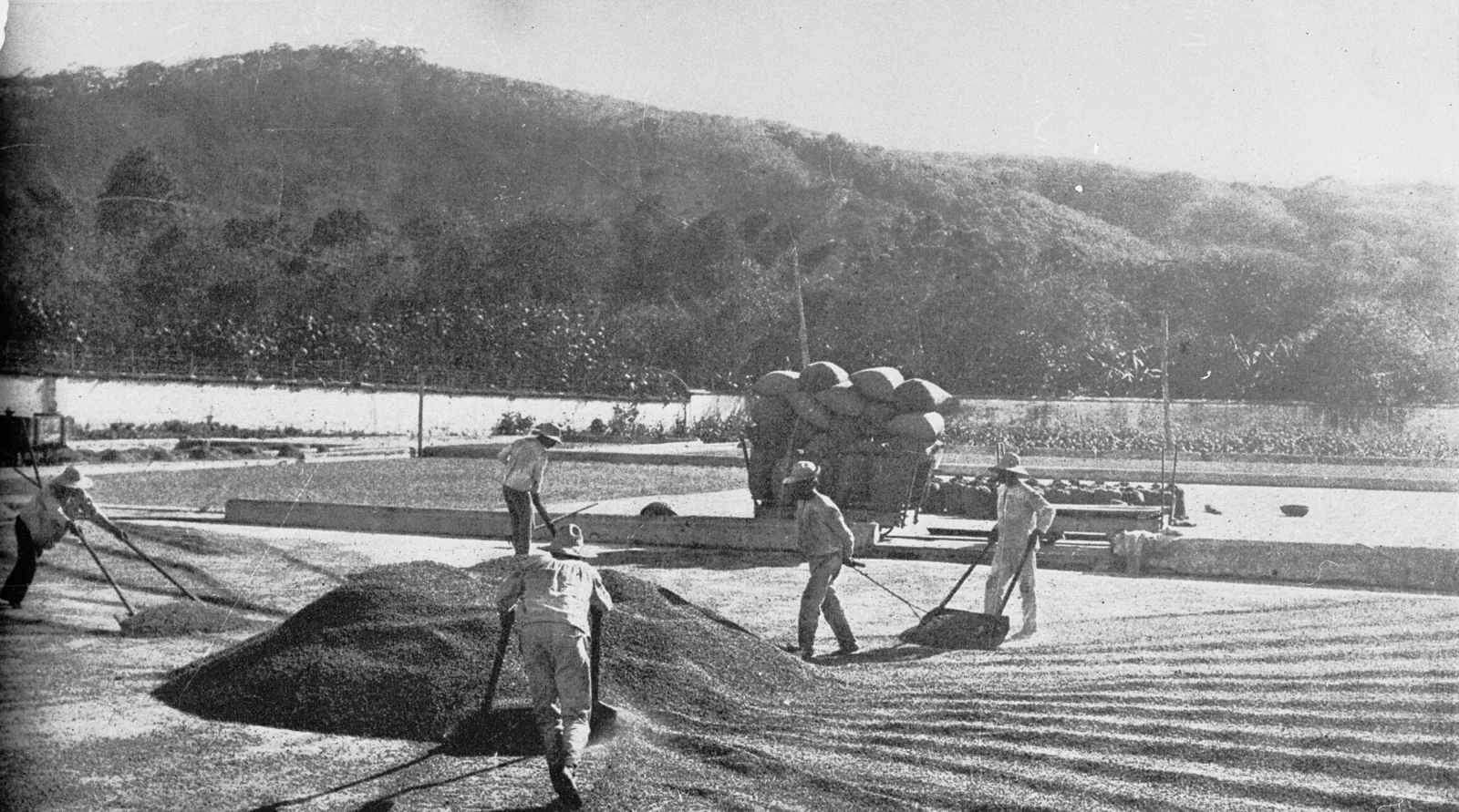
Processing has changed sides in a century. Ukers described a harvest mostly dried in the cherry; the CSC today counts 96% washed coffee in beneficios, the mills that pulp, ferment, wash then dry the parchment, that is, the envelope around the bean. The remaining 4% groups the semi-washed, honeys and naturals; the site’s plate on honeys makes El Salvador the second home of this process and describes the black honey of its farms. The harvest runs from October to March, later as one climbs, and the commercial year runs from October to September [2][8][10].
The institutions have changed shape several times. The ISIC of 1955, dissolved in 1981 and recreated in 1982, had lost all functioning when a law of November 9, 2021 creates an Instituto Salvadoreño del Café devoted to research. On August 29, 2023, Decree 835 merges this institute and the CSC of 1989 into a new Instituto Salvadoreño del Café (ISC), based in Santa Tecla, which directs both coffee policy and research, and repeals the Council’s law. Outside the state, PROCAFE, the Fundación Salvadoreña para Investigaciones del Café, is a research foundation that selected Cuscatleco and supplies Pacas seed. The public agricultural technology center, CENTA, for its part carried in 2016 a coffee program opened in 2014 [5][6][7][11][8].
The sector remains in crisis. The U.S. agricultural service estimates the 2025-2026 harvest at 586,000 bags, about 35,000 tonnes, and forecasts 542,000 for 2026-2027 because of El Niño. The average yield does not reach five bags per hectare on some 118,000 hectares harvested. Many trees are more than 25 years old, labor leaves for construction sites in the cities, private banks no longer lend, and the same report estimates at 35% the share of producers who abandon their farm. Land remains very unevenly distributed: in 2023, 77% of producers had fewer than five manzanas, about 3.5 hectares, and held 13% of the area, whereas 2% held 40%. The United States buys half of the 535,100 bags exported in 2025-2026, Belgium about 11% [10][13].
The country mostly drinks a coffee it does not produce. Of the 332,000 bags consumed in 2025-2026, 292,000 are instant, imported mostly from Mexico and Brazil, and only 40,000 roasted ground. The CSC estimated in 2016 that 40% of the coffee drunk in the country was produced there. The return of tourism, driven by improved security, and the rise of cafés in town raise the demand for local coffees, Bourbon, Pacas, Pacamara and Geisha, without reversing the preference for instant, which is cheaper [10][8].
- Species grown
- Coffea arabica, the whole of production [10]
- 2024 production (FAOSTAT)
- 28,488 tonnes, imputed value (I) [1]
- FAOSTAT series maximum
- 185,625 tonnes in 1979 [1]
- Estimated 2025-2026 harvest
- 586,000 60-kg bags [10]
- Area harvested
- about 118,000 hectares (2025-2026) [10]
- Growing altitude
- 500 to 2,365 meters depending on the ranges [8]
- Harvest
- October to March [8]
- Main varieties
- Bourbon 62%, Pacas 31%, Pacamara 2% (CSC, 2016) [8]
Gray areas
Five dates for one introduction. Ukers gives 1852 and plants from Cuba; the World Coffee Research catalog writes, on the same page, that El Salvador received seeds from Cuba in 1840 and that it grew Typica as early as 1740; the CSC retains 1740, with a first export in 1855; PROCAFE, in 2005, placed the introduction between 1779 and 1815; the 2023 press evokes encouragement in 1770. None of these sources cites a document of the period. The dates of the varieties are hardly better: WCR has the ISIC begin the selection of Tekisic in 1949, whereas the institute was born in 1955, and the year 1958 for the Pacamara cross, taken up by the atlas, was found only at roasters, who place its release sometimes in the late 1980s, sometimes in the early 1990s [2][11][8][14][13][5].
The current value of the series is imputed. FAOSTAT flags A, official figure, every year from 1961 to 2022, but I, value imputed by the agency that receives it, for 2023 and 2024, whose yields are also estimates. The U.S. agricultural service counts more: 604,000 bags for 2023-2024, about 36,200 tonnes against 32,571 at FAOSTAT, and for 2024-2025 first 561,000 bags in May 2025, then 581,000 in April 2026, whereas the official USDA figure stays at 500,000 and FAOSTAT at 28,488 tonnes. The areas pose another problem: FAOSTAT records 140,000 hectares every year from 2014 to 2021, then 116,011 in 2022, at the moment when the CSC cleans up its register and goes from 200,025 to 170,569 manzanas, or from about 139,800 to 119,200 hectares. The drop is therefore in large part a bookkeeping correction, and the yields of the preceding years are probably underestimated. The same doubt applies to 1984: the ministry said 43% of the coffee farms of 1980 were abandoned, whereas FAOSTAT keeps 170,616 hectares harvested [1][9][10][13][4].
The rust figure depends on the years compared. McCook, citing the International Coffee Organization, gives a drop of 57%, the one retained by the site’s plates on diseases; the CSC figures give 59% from 2012-2013 to 2013-2014, but 73% if one starts from the 2010-2011 harvest, and FAOSTAT 63% from 2012 to 2013. None is wrong, they do not measure the same interval. Likewise, Pacas weighs 31% at the CSC and about 25% of production at WCR, without the CSC saying whether it counts areas or volumes, and the grade boundaries differ: the CSC places High Grown between 800 and 1,200 meters, the ITC guide between 900 and 1,200 [3][8][1][11][12].
Not covered: The date and founding act of PROCAFE, which neither open sources nor two searches established; the fate of INCAFE and the date of the end of the state monopoly, absent from the documents read; the specific effects of the 1980 land reform on coffee farms, no source read quantifies them; the ICO series by coffee year before 2010, the historical statistics page no longer answering at the known addresses; the release dates of Pacamara, for lack of an ISIC document; the geographical indications of the six regions, cited by the USDA with neither date nor registration text.
- FAOSTAT, Production: Crops and livestock products, Coffee, green (code 656), El Salvador: production, area harvested, yield and status of each value, Food and Agriculture Organization of the United Nations (FAO), 2025, https://bulks-faostat.fao.org/production/Production_Crops_Livestock_E_ solid level
Series 1961-2024 read in the bulk archive (release of December 23, 2025): maximum of 185,625 t in 1979, 120,290 t in 1988, 175,720 t in 1992, 81,157 t in 2003, 89,489 t in 2012, 32,864 t in 2013, 32,570.72 t in 2023 and 28,487.64 t in 2024; status A from 1961 to 2022, I in 2023 and 2024; area harvested of 140,000 ha every year from 2014 to 2021, 116,011 ha in 2022, 170,616 ha in 1984; yields for 2023 and 2024 flagged E. - All About Coffee, ch. II, XIX, XX (p. 217-219), XXI (p. 263), XXII (p. 279-280) and XXIV (p. 347), William H. Ukers, 1922, https://www.gutenberg.org/ebooks/28500 solid level
Introduction in 1852 from Cuba; exports of more than 100,000 dollars in 1865 and of 8.5 million pounds in 1874-1875; first large plantation in 1876 at La Paz; 166,000 acres; altitudes of 1,500 to 4,000 feet; farms mostly Salvadoran; harvest from November to March, climbing with altitude; preparation mostly by the dry process; the trade’s judgment; exports of 82,864,668 pounds in 1920. - Coffee Is Not Forever: A Global History of the Coffee Leaf Rust, p. 151-158, 171-178 and 196, Stuart McCook, Ohio University Press, 2019 solid level
PDF copy from the local library. Rust appeared in December 1979 in Usulután over more than 10,000 ha, two months after the October 1979 coup; end of the quotas of the International Agreement in 1989; price crisis 1999-2004; rust flare-up in El Salvador in 2002-2003; 57% drop in production during the Big Rust, according to ICO statistics; production still 10 to 30% below the pre-rust level in 2016-2017. - El problema del INCAFE, ECA Estudios Centroamericanos, vol. 42, n° 461, p. 242-245, doi:10.51378/eca.v42i461.6728, E. M., Universidad Centroamericana José Simeón Cañas, 1987, https://revistas.uca.edu.sv/index.php/eca/article/view/6728 medium level
Decree 75 of January 2, 1980 creating INCAFE and nationalizing the coffee trade; coffee at 63.7% of exports and 36% of foreign exchange in 1979; producer paid 180 colones per quintal when the world price of 141 dollars was worth 325.59 colones at the official exchange rate and 564 on the parallel market; Ministry of Agriculture estimate of 1984: 125,600 of the 294,500 manzanas of 1980 abandoned. Analysis article signed with initials, in a university journal. - Decreto n° 124, Ley de creación del Instituto Salvadoreño de Investigaciones del Café, Asamblea Constituyente de la República de El Salvador, 1982, https://www.jurisprudencia.gob.sv/DocumentosBoveda/D/2/1980-1989/1982/ solid level
Creation of the ISIC by legislative decree No. 2013 of December 16, 1955; repeal by decree No. 903 of the Junta Revolucionaria de Gobierno of December 22, 1981; recreation of the ISIC by this decree of December 1982; coffee is there called the main product of foreign trade. - Decreto n° 206, Ley de creación del Instituto Salvadoreño del Café, Asamblea Legislativa de la República de El Salvador, text reproduced by FAOLEX, 2021, https://faolex.fao.org/docs/pdf/els219699.pdf solid level
Law of November 9, 2021; the ISIC of 1982 has lost its functioning; creation of an autonomous research and technology transfer institute based in Santa Tecla. - Decreto n° 835, Ley del Instituto Salvadoreño del Café, Asamblea Legislativa de la República de El Salvador, 2023, https://www.jurisprudencia.gob.sv/DocumentosBoveda/D/2/2020-2029/2023/ solid level
Creation of the CSC by decree No. 353 of October 19, 1989; law passed on August 29, 2023 and promulgated on September 4, 2023; new ISC, attached to the Ministry of Agriculture, in charge of coffee policy and research; repeal of the laws of the CSC (1989) and of the ISC (2021), transfer of their assets and staff. - El Salvador, coffee profile (presentation 7.2 to the International Coffee Council, coffee year 2015-2016), Consejo Salvadoreño del Café (CSC), 2016, https://www.ico.org/documents/cy2015-16/Presentations/7.2%20EL%20SALVA solid level
Six cordilleras, their areas (66,550 ha for Apaneca-Ilamatepec, 50.1%) and their altitudes (500 to 2,365 m); grades CS 600-800 m, HG 800-1,200 m, SHG above 1,200 m; varieties Bourbon 62%, Pacas 31%, Pacamara 2%, others 5%; all plantations under shade; harvest from October to March; 96% washed coffee; production of 1,872,960 bags in 2010-2011, 1,239,585 in 2012-2013 and 506,310 in 2013-2014; 40% of the coffee consumed produced in the country; CENTA Café since 2014; chronology (1740, 1855, 1975, 1980). - El Salvador: Coffee Annual, GAIN report ES2025-0003, May 13, 2025, USDA Foreign Agricultural Service, San Salvador post, 2025, https://apps.fas.usda.gov/newgainapi/api/Report/DownloadReportByFileNa solid level
Production estimated at 604,000 bags in 2023-2024 and 561,000 in 2024-2025 (post estimate), against 500,000 as the official USDA figure for 2023-2024. - El Salvador: Coffee Annual, GAIN report ES2026-0004, April 20, 2026, USDA Foreign Agricultural Service, San Salvador post, 2026, https://apps.fas.usda.gov/newgainapi/api/Report/DownloadReportByFileNa solid level
Production of 581,000 bags in 2024-2025 and 586,000 in 2025-2026, forecast of 542,000 for 2026-2027; all arabica; about 118,000 ha harvested; yield of 4.97 bags per hectare; plants distributed (Cuscatleco, Marsellesa, Pacas, Pacamara, Sarchimor, Anacafé 14); consumption of 332,000 bags of which 292,000 instant; exports of 535,100 bags, 50% to the United States; FICAFE created in 2001; 35% of producers abandoning; trees older than 25 years; Pacamara and Geisha at the top of the Cup of Excellence. - Coffee Varieties Catalog (revision of September 4, 2025) and online profiles Pacas, Pacamara, Tekisic and Bourbon, accessed on October 21, 2026, World Coffee Research, 2025, https://varieties.worldcoffeeresearch.org/varieties/pacas solid level
Pacas discovered in 1949 on a farm of the Pacas family (Santa Ana), pedigree selection by the ISIC from 1960, about 25% of production, seeds at PROCAFE; Pacamara derived from Pacas × Maragogipe by the ISIC, not stable; Tekisic selected by the ISIC from 1949 and released in 1977; Cuscatleco selected by PROCAFE; susceptibility of Pacas and Pacamara to rust; arrival of Typica in 1840 and cultivation as early as 1740 according to the same history page. - The Coffee Guide, fourth edition, International Trade Centre (ITC), 2021 solid level
PDF copy from the local library, page 198 of the file. Salvadoran grades: SHG above 1,200 m, HG from 900 to 1,200 m, CS from 500 to 900 m. - El parque cafetalero es más pequeño de lo registrado, en 29,400 manzanas, Uveli Alemán, Diario El Mundo, from CSC reports, 2023, https://diario.elmundo.sv/economia/el-parque-cafetalero-es-mas-pequeno medium level
Article of June 5, 2023: register cleaned up, 170,569 manzanas in 2022-2023 against 200,025 in 2021-2022; Apaneca-Ilamatepec 53% of production; 77% of producers under five manzanas hold 13% of the area, 2% hold 40%; encouragement of cultivation dated 1770. - Destacan importancia de cultivo café en la economía salvadoreña, ACAN-EFE, published by La Nación (Costa Rica), from a PROCAFE press release, 2005, https://www.nacion.com/economia/destacan-importancia-de-cultivo-cafe-e medium level
Dispatch of October 22, 2005: according to PROCAFE, coffee introduced between 1779 and 1815; the coffee area presented as the country’s main forest. - Matanza: El Salvador's Communist Revolt of 1932 (Anderson, 1971) and Coffee and Power (Paige, 1997), cited by the site’s chronicle, Thomas P. Anderson ; Jeffery M. Paige, 1971 ; 1997 solid level
Source inherited from the site’s chronicle, not reopened in this pass: abandonment of indigo, privatization of communal lands in 1881-1882, fourteen families, price collapse of 1929-1931, uprising and Matanza of January 1932, ten to thirty thousand dead.